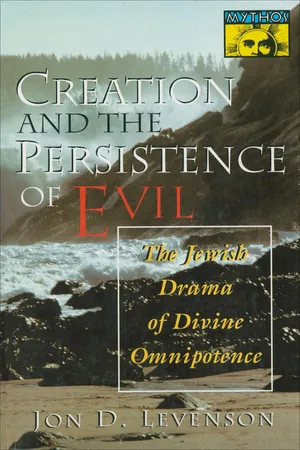
This paperback edition of Creation and the Persistence of Evil brings to a wide audience one of the most innovative and meaningful models of God for this post-Auschwitz era. In a thought-provoking return to the original Hebrew conception of God, which questions accepted conceptions of divine omnipotence, Jon Levenson defines God's authorship of the world as a consequence of his victory in his struggle with evil. Classic doctrines of God's creation of the universe from the void do not do justice to the complexity of that hard-fought battle, which is uncertain in its outcome. Levenson traces this more flexible conception of God to the earliest Hebrew sources. He argues that Genesis 1 does not describe the banishment of evil but the attempt to contain the menace of evil in the world, a struggle that continues today.
eBook - ePub
Creation and the Persistence of Evil
The Jewish Drama of Divine Omnipotence
- 208 pages
- English
- ePUB (mobile friendly)
- Available on iOS & Android
eBook - ePub
About this book
Information
Topic
Theology & ReligionSubtopic
Biblical StudiesI. THE MASTERY OF GOD AND THE VULNERABILITY OF ORDER
He puts no trust in His holy ones. . . .
1. The Basic Idea of Israelite Religion?
We can capture the essence of the idea of creation in the Hebrew Bible with the word “mastery.” The creation narratives, whatever their length, form, or context, are best seen as dramatic visualizations of the uncompromised mastery of YHWH, God of Israel, over all else. He alone is “the Lord of all the earth,”1 and when the cosmogonic events are complete, his lordship stands beyond all doubt. He reigns in regal repose, “majestic on high,”2 all else subordinate to him.
Yehezkel Kaufmann (1889–1963), one of the great Jewish biblical scholars of modern times, went a step further. He considered the concept that I am calling mastery to be more than merely the essence of creation: he deemed it “the basic idea of Israelite religion”3 and the factor that differentiates absolutely between that religion and “paganism,” that is, all religions that are not derived from it. Whereas the “pagan” believes “that there exists a realm of being prior to the gods and above them, upon which the gods depend, and whose decrees they must obey,”4 for Israel “there is no realm above or beside YHWH to limit his absolute sovereignty.”5 But even for Kaufmann it is in the stories of creation that one sees so markedly the differences wrought by this most fundamental of Israelite beliefs. Whereas “pagan” creation stories display “the idea of a primeval realm out of which the gods have emerged and within which they operate,”6 “the idea of a supreme deity who is above any natural connection with his creation found expression in the image of Genesis l: a deity who creates by fiat.”7
The Babylonian creation story, Enuma elish, is an instructive and often cited contrast to Genesis 1.8 In the Enuma elish, “creation,” if we may call it that, begins with the mingling of the subterranean fresh waters, Apsu, and the saline waters of the oceans, Tiamat. From these emerge new gods, whose clamor is so disruptive that Apsu resolves to annihilate them. But Ea, one of the intended victims, succeeds in anaesthetizing Apsu with a spell, despoiling him of his kingship, and then killing him. This so enrages Apsu’s wife, Tiamat, that she is easily persuaded to declare war on the other gods, appointing Kingu her field marshal. In the pantheon there is only great disconsolation, as god after god proves inadequate to the challenge. Finally Marduk, Ea’s son, undertakes to do combat with the sea goddess’s formidable hosts. But Marduk exacts his price—that he be proclaimed supreme among the gods and the command of his lips unalterable. The other gods submit, they acclaim him king, and in a horrific battle he overwhelms his foes. Marduk then proceeds to create the familiar world out of the body of Tiamat, which he has split in half. He fixes a crossbar and posts guards over the half from which the heavens were made, so that their waters might not escape and threaten his victory. Out of Kingu he creates humanity, to relieve the gods of some of their drudgery. In gratitude, a delegation of gods asks whether they might repay their debt to Marduk by building him a palace, or temple, and when he assents, they construct Esagila, the terraced Marduk temple in Babylon. The Enuma elish closes with the gods’ hymnic recitation of the glorious fifty names of Marduk, their hero, savior, lord, and king.
Like other scholars, Kaufmann cited the Enuma elisn as a parade example of “paganism,”9 and it is not hard to see why. Marduk is not primordial; like the other younger gods, he emerges at a certain point in time. The two who are primordial, Apsu and Tiamat, fail to transcend nature. One never forgets their physical basis, water, and each of them dies, so that the primordial gods are no more, and Tiamat is now at best only the matter out of which Marduk has shaped the world.10 Marduk’s own mastery is not inherent, but something others—the members of the pantheon—have conveyed to him. The collegial basis of his authority has not been eradicated from memory. And although his commands are efficacious, he does not create ex nihilo, but exerts his creative word upon a powerful preexistent material substratum. All of this suggests a different and more qualified concept of mastery than one finds in Genesis 1.
On the other hand, we must be careful about overdrawing the contrast. Nowhere in the seven-day creation scheme of Genesis l does God create the waters; they are most likely primordial. The traditional Jewish and Christian doctrine of creatio ex nihilo can be found in this chapter only if one translates its first verse as “In the beginning God created the heaven and the earth” and understands it to refer to some comprehensive creative act on the first day. But that translation, subject to doubt since the Middle Ages,11 has fallen into disfavor among scholars,12 and the rest of the chapter indicates that the heaven was created on the second day to restrain the celestial water (vv. 7–5), and the earth on the third day (vv. 9–10). It is true—and quite significant—that the God of Israel has no myth of origin. Not a trace of a theogony can be found in the Hebrew Bible.13 God has no nativity. But there do seem to be other divine beings in Genesis l, to whom God proposes the creation of humanity, male and female together: “Let us make man in our image, after our likeness” (v. 26).14 When were these other divine beings created? They too seem to have been primordial. Whether their existence should be interpreted as a qualification upon God’s mastery in Genesis is impossible to determine. Because they do not dissent from his proposal to create humanity in his and their image, we cannot say whether God’s authority, like Marduk’s, involved some element of collegiality. From other biblical accounts of the divine assembly in session,15 it would appear that these “sons of God/gods” played an active role and made fresh proposals to God, who nonetheless retained the final say. In short, like the other gods at the close of the Enuma elish, they are thought to be real and important, but also subordinate and not very individualized.
The placement of Genesis 1 first in the Bible makes a theological statement that must not be evaded.16 Nonetheless, it is possible to overstress that chapter, as occurs when scholars present it as the only Israelite creation story or, worse, as the quintessence of ancient Hebrew theology. On the basis of Genesis 1, one must say, as does Kaufmann, that the God of Israel has no origin and his mastery has no origin: he has always reigned supreme. It is likely that it was just such a theology that the compilers of the Torah sought to make by beginning with this passage. But it is characteristic of the Hebrew Bible that some of the alternatives that the Torah tries to suppress have been preserved and can yet be examined.
Psalm 82 is a case in point. It begins when
1God takes his stand in the assembly of El;
among the gods He pronounces judgment.17
The judgment is a reaction to their injustice, their failure to favor the unfortunate of society.
6I had said, “You are gods,
sons of Elyon all of you,
7But you shall die like a man,
fall like a prince.” (Ps. 82:6–7)
The psalm closes with a plea that God rule, that he take possession of all nations.
One can interpret Psalm 82 according to the traditional theology represented in our discussion by Kaufmann’s critical restatement of it. In that case, “God” (′ĕlōhîm), El, and Elyon will all be seen to refer to the same deity. The “gods” (also ′ĕlōhîm) will be interpreted as only angels or, less plausibly but more traditionally, as human judges.18 On this reading, Psalm 82 represents nothing more than God’s death sentence upon corrupt and insensitive underlings. If, however, “God” and El are not to be identified here, and if ′ĕlōhîm is taken at face value, then Psalm 82 commemorates the moment that God assumed the commanding position in the pantheon (perhaps replacing El or Elyon, probably two names for one deity19) and eliminated his colleagues. If this interpretation is correct, then the theology of the poem bears a striking resemblance to that of the Enuma elish: both celebrate the assumption of mastery by the supreme deity of the society. In neither case is the deity’s mastery primordial. Although on either interpretation there is still no theogony in Psalm 82, on the second one, we should have to doubt Kaufmann’s unnuanced claim of an absolute distinctiveness to Israel. Just as the Enuma elish proclaims and celebrates Marduk’s mastery, so does Psalm 82 proclaim and celebrate YHWH’s. In neither case is the mastery that of the unchallenged sovereign ruling from all eternity in splendid solitude. Rather, it is the mastery of the deity whose special excellence comes to entitle him to supremacy. The recitation of the Enuma elish during the Babylonian New Year’s festival20 suggests that Marduk’s celebrated mastery was not a simple given, but something that had to be renewed and reactualized periodically. The closing plea of Psalm 82—“Arise, God, and rule the world/Take possession of all peoples” (v. 8)21—likewise implies that God’s assumption of mastery is not complete and that the demise of the dark forces in opposition to him lies in the uncertain future. Kaufmann’s “basic idea of Israelite religion” is an accurate description of the hope of Psalm 82 but not of the current reality that the psalmist experiences. Kaufmann has mistaken the volitive for the indicative, the visionary world of liturgy for a description of quotidian reality.
Whatever mythological ideas may underlie Psalm 82, the drama of YHWH’s ascent to cosmic mastery that predominates in the Hebrew Bible is one that nicely parallels the story of combat with the sea found in the Enuma elish and its analogues:
12O God, my king from of old,
who brings deliverance throughout the land;
13it was You who drove back the sea with Your might,
who smashed the heads of the monsters in the waters;
14it was You who crushed the heads of Leviathan,
who left him as food for the denizens of the desert;
15it was You who released springs and torrents,
who made mighty rivers run dry;
16the day is Yours, the night also;
it was You who set in place the moon22 and the sun;
17You fixed all the boundaries of the earth;
summer and winter—You made them. (Ps. 74:12–17)
The immediate background of this passage is a Canaanite myth, well attested in the literary remains of the city of Ugarit from the Late Bronze Age (ca. 14th century B.C.E.), in which the god Baal defeated the ocean, there conceived as masculine and known variously as Prince Yamm (“Sea”), Judge River, Lotan (the biblical “Leviathan”), the twisting seven-headed dragon, and “Tannin,” some other sort of monster.23 Each of these words occurs in some form in the passage just quoted. Without the Ugaritic literature, these allusions would remain tantalizing obscurities, for the Bible offers no connected narrative of primordial divine combat, only poetic snippets, usually within a hymnic or plaintive context. Having the Ugaritic and similar materials, we are able to get a sense of the full dimensions of the old myth and its continuing vitality in Israel—as well as the failed efforts of some circles to suppress it.
Awa...
Table of contents
- Dedication
- Epigraph
- Contents
- Abbreviations
- Acknowledgments
- Note on the Text (1994)
- Preface (1994)
- Preface
- Part I: The Mastery of God and the Vulnerability of Order
- Part II: The Alternation of Chaos and Order—Genesis 1:1–2:3
- Part III: Creation and Covenant: The Dynamics of Lordship and Submission
- Notes
- Scripture Index
- Author Index
- About the Author
- Copyright
- About the Publisher
Trusted by 375,005 students
Access to over 1.5 million titles for a fair monthly price.
Study more efficiently using our study tools.
Frequently asked questions
Yes, you can cancel anytime from the Subscription tab in your account settings on the Perlego website. Your subscription will stay active until the end of your current billing period. Learn how to cancel your subscription
No, books cannot be downloaded as external files, such as PDFs, for use outside of Perlego. However, you can download books within the Perlego app for offline reading on mobile or tablet. Learn how to download books offline
Perlego offers two plans: Essential and Complete
- Essential is ideal for learners and professionals who enjoy exploring a wide range of subjects. Access the Essential Library with 800,000+ trusted titles and best-sellers across business, personal growth, and the humanities. Includes unlimited reading time and Standard Read Aloud voice.
- Complete: Perfect for advanced learners and researchers needing full, unrestricted access. Unlock 1.5M+ books across hundreds of subjects, including academic and specialized titles. The Complete Plan also includes advanced features like Premium Read Aloud and Research Assistant.
We are an online textbook subscription service, where you can get access to an entire online library for less than the price of a single book per month. With over 1.5 million books across 990+ topics, we’ve got you covered! Learn about our mission
Look out for the read-aloud symbol on your next book to see if you can listen to it. The read-aloud tool reads text aloud for you, highlighting the text as it is being read. You can pause it, speed it up and slow it down. Learn more about Read Aloud
Yes! You can use the Perlego app on both iOS and Android devices to read anytime, anywhere — even offline. Perfect for commutes or when you’re on the go.
Please note we cannot support devices running on iOS 13 and Android 7 or earlier. Learn more about using the app
Please note we cannot support devices running on iOS 13 and Android 7 or earlier. Learn more about using the app
Yes, you can access Creation and the Persistence of Evil by Jon D. Levenson in PDF and/or ePUB format, as well as other popular books in Theology & Religion & Biblical Studies. We have over 1.5 million books available in our catalogue for you to explore.