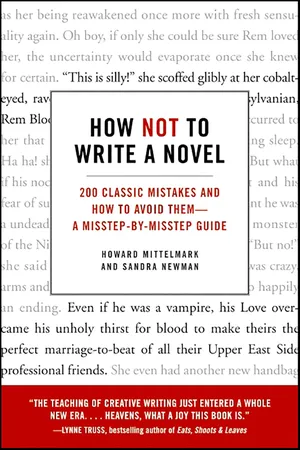
"The teaching of creative writing just entered a whole new era . . . Heavens, what a joy this book is." —Lynne Truss,
New York Times–bestselling author of
Eats, Shoots & Leaves
"What do you think of my fiction book writing?" the aspiring novelist extorted.
"Darn," the editor hectored, in turn. "I can not publish your novel! It is full of what we in the business call 'really awful writing.'"
"But how shall I absolve this dilemma? I have already read every tome available on how to write well and get published!" The writer tossed his head about, wildly.
"It might help," opined the blonde editor, helpfully, "to ponder how NOT to write a novel, so you might avoid the very thing!"
Many writing books offer sound advice on how to write well. This is not one of those books. On the contrary, this is a collection of terrible, awkward, and laughably unreadable excerpts that will teach you what to avoid—at all costs—if you ever want your novel published.
The authors of
How Not to Write a Novel distill their decades of combined experience in teaching, editing, writing, and reviewing fiction to bring you real advice from the other side of the query letter. Rather than telling you how or what to write, they identify 200 common mistakes unconsciously made by writers and teach you to recognize, avoid, and amend them. With hilarious examples to demonstrate each manuscript-mangling error, they help you troubleshoot your beginnings and endings, bad guys, love interests, style, jokes, perspective, voice, and more. As funny as it is useful, this essential how-NOT-to guide will help you get your manuscript out of the slush pile and into the bookstore.
"A great resource, this tongue-in-cheek guide is a fun read with a lot of solid advice." —
Publishers Weekly
"This writing how-to should carry a warning: it's the kind of book one reads at the expense of other responsibilities. . . . a surprisingly distinctive approach." —
Library Journal
"Hilarious, wickedly observed and deeply useful." —
The Observer
"An invaluable guide." —
The Independent
eBook - ePub
How Not to Write a Novel
200 Classic Mistakes and How to Avoid Them—A Misstep-by-Misstep Guide
- 272 pages
- English
- ePUB (mobile friendly)
- Available on iOS & Android
eBook - ePub
How Not to Write a Novel
200 Classic Mistakes and How to Avoid Them—A Misstep-by-Misstep Guide
About this book
Information
Print ISBN
9780061357954
Subtopic
AuthorshipPART I
PLOT
Not just a bunch of stuff that happens
As a writer you have only one job: to make the reader turn the page. Of all the tools a writer uses to make a reader turn the page, the most essential is the plot. It doesn’t matter if the plot is emotional (“Will Jack’s fear of commitment prevent him from finding true love with Synthya?”), intellectual (“But Jack, Synthya’s corpse was found in a locked room, with nothing but a puddle on the floor next to her and a recently thawed leg of mutton on the end table!”), or physical (“Will Jack’s unconstitutional torture of Synthya Abu Dhabi, the international terrorist, lead to the location of the ticking bomb?”) as long as it compels the reader to find out what happens next. If your reader doesn’t care what happens next—it doesn’t.
Typically, the plot of a good novel begins by introducing a sympathetic character who wrestles with a thorny problem. As the plot thickens, the character strains every resource to solve the problem, while shocking developments and startling new information help or hinder her on the way. Painful inner conflicts drive her onward but sometimes also paralyze her at a moment of truth. She finally overcomes the problem in a way that takes the reader totally by surprise, but in retrospect seems both elegant and inevitable.
The plot of a typical unpublished novel introduces a protagonist, then introduces her mother, father, three brothers, and her cat, giving each a long scene in which they exhibit their typical behaviors one after another. This is followed by scenes in which they interact with each other in different combinations, meanwhile driving restlessly to restaurants, bars, and each other’s homes, all of which is described in detail.
A typical plot event in an unpublished novel is when the protagonist gets a disastrous haircut, at a moment when her self-esteem is hanging by threads. This sets the character up for the ensuing “Mother thinks protagonist spends too much on haircuts, but is made to see that self-esteem is crucial to mental health” scene, the “boyfriend doesn’t understand character’s needs, but finally acknowledges the gendered basis of his priorities,” scene, and the “taking a bubble bath to relax after stress-filled scenes” scene, in which the protagonist mentally recapitulates the previous three scenes. Cue waking up the next morning on chapter 9, with anything resembling a story yet to appear on the horizon.
Sometimes a contemplative prologue will depict the protagonist looking out the window and thinking of all the philosophical conundrums the author will not have time to present in the ensuing narrative. Sometimes the prologue simply presents those philosophical conundrums in a voice that issues from nowhere. Sometimes the prologue dispenses with philosophy completely and presents a protagonist looking out the window thinking about hair products.
A great many plot problems that show up in unpublished manuscripts can be resolved with a single strategy. Know what the chase is, and cut to it. Do not write hundreds of pages without knowing what story you really want to tell. Do not write hundreds of pages explaining why you want to tell the story you are about to tell, why the characters are living the way they are when the story begins, or what past events made the characters into people who would have that story. Write hundreds of pages of the story, or else you’ll find that what you write will not be shelved in the libraries of the future but will instead form the landfill upon which those libraries are built. In fact, employing any of the plot mistakes that follow will guarantee that your novel will be only a brief detour in a ream of paper’s journey to mulch.
1
BEGINNINGS AND SETUPS
A manuscript comes screaming across the sky…
Many writers kill their plots in their infancy with an ill-conceived premise or an unreadable opening. Try any of the strategies we’ve collected in our extensive field work, and you too can cut off narrative momentum at the ankles.
The Lost Sock

“Fools,” Thomas Abrams thought, shaking his head as he completed his inspection of the drainage assembly under the worried eyes of Len Stewart. “Foolish, foolish, fools,” he muttered. Squirming out from under the catchment basin, he stood up and brushed off the grit that clung to his gray overalls. Then he picked up his clipboard and made a few notes on the form, while Len waited anxiously for the verdict. Thomas didn’t mind making him wait.
“Well,” he said, as he finished and put the pen away. “Well, well, well.”
“What is it?” Len asked, unable to keep a tremor out of his voice.
“When will you people learn that you can’t use a B-142 joint-enclosure with a 1811-D nipple cinch?”
“B-but—” Len stammered.
“Or maybe, let me take a wild guess here, just maybe, you confused an 1811-D with an 1811-E?” He paused to let it sink in before delivering the death-blow. “…Again.”
He left Len speechless and walked away without a look back, chuckling ruefully as he imagined the look on Len’s face when he fully realized the implications of his mistake.
Here the main conflict is barely adequate to sustain a Partridge Family episode. Remember that this drama has to carry the reader through 300-odd pages. The central dilemma of a novel should be important enough to change someone’s life forever.
Furthermore, it should be something of broad interest. One of the first stumbling blocks a novelist must overcome is the misapprehension that what is of interest to him will necessarily be of interest to anybody else. A novel is never an opportunity to vent about the things that your roommates, friends, or mother cannot bear to listen to one more time. No matter how passionate and just your desire to see the masculine charms of the short man appreciated by the fair sex, or to excoriate landlords who refuse to make plumbing repairs, even when in violation of the specific wording of the lease, which wording he might pretend to be unaware of, but you know better because you have made highlighted copies for him as well as for your roommates, friends, and mother—these are not plots but gripes.
This is not to say that a short man, unlucky in love and living in a house with substandard plumbing, cannot be your hero, but his height and plumbing should be background and texture, sketched in briefly as he heads to the scene of the crime, wondering how the hell anyone could get injuries like that from a leg of mutton.
The Waiting Room
Reggie boarded the train at Montauk and found a seat near the dining car. As he sat there, smelling the appalling cheeseburgers from the adjoining carriage, he started thinking about how he had decided to become a doctor. Even as a boy, he had been interested in grotesque diseases. But did that mean he had a vocation? The train jolted, keeping him from falling asleep, and the smell of those cheeseburgers was making him nauseous. It was the same way the sight of blood still made him feel, he realized. Why had he made that decision, so many years ago?
Montauk rushed backward in the windows…
(10 pages later:)
The last houses of Montauk were tiny among the sandy grass. They seemed to shine against the backdrop of Reggie’s continuing gloom as he considered further the reasons for his current predicament. If only he had done the biology PhD he’d originally wanted, instead of taking the advice of Uncle Frank. Uncle Frank had said to him on that occasion, scratching his hairy neck as was his habit, “Now, Reggie, don’t make the mistakes I made when I took that biology PhD in ’56 and gave up my chances at…”
(10 pages later:)
…and to make a long story short, that’s how I met your Aunt Katharine. And that’s how you got here,” Uncle Frank concluded. Reggie would have been nonplussed, he had reflected at the time, had he not learned of his mother’s illicit affair with Uncle Frank from Cousin Stu months earlier, when Stu had called to tell him about his golf scholarship to Penn, a scholarship which had only rekindled Reggie’s bitterness about his mistaken decision to take premed…
Here the writer churns out endless scenes establishing background information with no main story in sight. On chapter 3, the reader still has no idea why it’s important to know about Reggie’s true parentage, his medical career, or the geography of Montauk. By chapter 7, the reader would be having strong suspicions that it isn’t important, were a reader ever to make it as far as chapter 7.
The writer has also created an entire frame scene in which nothing actually happens. Don’t forget that from the reader’s perspective, the main story line is what is happening to the protagonist now. So whatever Reggie thinks about on the train, the main action is a man sitting and staring out of a window, feeling a little queasy, page after page after page.
Avoid creating scenes merely as places where a character remembers or mulls over background information. The character will have plenty of time to do that in scenes where something actually happens. It would be much more effective, for instance, if Reggie had reservations about his profession in the course of a scene in which he is performing a life-saving operation on his kid brother.
If you find yourself unable to escape a Waiting Room, look honestly at your novel and consider what the first important event is. Everything before that event can probably be cut. If there is important information in that material, how briefly can it be explained? Surprisingly often, twenty pages of text can be replaced by a single paragraph of exposition or interior monologue. If you feel even more drastic measures are called for, see “Radical Surgery for Your Novel,” chapter 1.
The Long Runway
- 1 -
Reynaldo’s first memory was of his mother, the Contessa, dressing for ...
Table of contents
- Cover
- Title Page
- Contents
- Introduction
- Part I
- Part II
- Part III
- Part IV
- Part V
- Part VI
- Part VII
- Afterword
- Searchable Terms
- About the Authors
- Copyright
- About the Publisher
Trusted by 375,005 students
Access to over 1.5 million titles for a fair monthly price.
Study more efficiently using our study tools.
Frequently asked questions
Yes, you can cancel anytime from the Subscription tab in your account settings on the Perlego website. Your subscription will stay active until the end of your current billing period. Learn how to cancel your subscription
No, books cannot be downloaded as external files, such as PDFs, for use outside of Perlego. However, you can download books within the Perlego app for offline reading on mobile or tablet. Learn how to download books offline
Perlego offers two plans: Essential and Complete
- Essential is ideal for learners and professionals who enjoy exploring a wide range of subjects. Access the Essential Library with 800,000+ trusted titles and best-sellers across business, personal growth, and the humanities. Includes unlimited reading time and Standard Read Aloud voice.
- Complete: Perfect for advanced learners and researchers needing full, unrestricted access. Unlock 1.5M+ books across hundreds of subjects, including academic and specialized titles. The Complete Plan also includes advanced features like Premium Read Aloud and Research Assistant.
We are an online textbook subscription service, where you can get access to an entire online library for less than the price of a single book per month. With over 1.5 million books across 990+ topics, we’ve got you covered! Learn about our mission
Look out for the read-aloud symbol on your next book to see if you can listen to it. The read-aloud tool reads text aloud for you, highlighting the text as it is being read. You can pause it, speed it up and slow it down. Learn more about Read Aloud
Yes! You can use the Perlego app on both iOS and Android devices to read anytime, anywhere — even offline. Perfect for commutes or when you’re on the go.
Please note we cannot support devices running on iOS 13 and Android 7 or earlier. Learn more about using the app
Please note we cannot support devices running on iOS 13 and Android 7 or earlier. Learn more about using the app
Yes, you can access How Not to Write a Novel by Howard Mittelmark,Sandra Newman in PDF and/or ePUB format. We have over 1.5 million books available in our catalogue for you to explore.