eBook - ePub
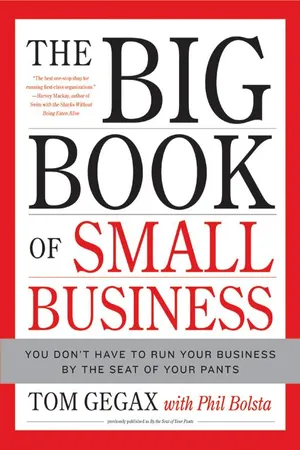
The Big Book of Small Business
You Don't Have to Run Your Business by the Seat of Your Pants
- 448 pages
- English
- ePUB (mobile friendly)
- Available on iOS & Android
eBook - ePub
The Big Book of Small Business
You Don't Have to Run Your Business by the Seat of Your Pants
Information
I
SETTING UP SHOP
What Every Budding Entrepreneur Needs to Know
It was my job as a Shell Oil Company sales manager to organize 1975âs gala trade show for our Minnesota service station dealers. Instead of a run-of the-mill hall, I booked a high-end Minneapolis hotel. What do you know, the upgrade worked: We doubled our sales goal. But my district manager, âJohn,â chewed me out for modestly exceeding the eventâs bud get. I protested that I had still netted a huge profit for Shell. âIt doesnât matter,â John spit. âYou were still over your expense bud get!â Hello? On what planet do profits not matter? As John stormed away and left me fuming, I thought, I canât take this garbage, Iâve gotta think about starting my own company.
Shell had planted the seed earlier in the year when execs poured cold water on my entrepreneurial impulse. I had seen a new era dawning for the oil industry when the Minnesota State Legislature legalized self-service gas stations. After researching the market possibilities, I designed a plan that seems obvious today for Shell station owners to convert one of their full-service pump islands over to self-service. Increased volume, I calculated, would more than offset Shellâs share of conversion costs. Management yawned and said the self-service concept was probably a flash-in-the-pan trend. It was laughable, they added, to think that self-serve would catch on in the Minnesota tundra. End of discussion. Turns out it wasnât such of a leap to think that Minnesotans, who sit for hours on a frozen lake staring into a fishing hole in the ice, would happily don a parka for cheaper gas.
Two months after the trade show fiasco, my entrepreneurial engine was back in high gear. My boss, John, had scored football tickets to the big December clash between the Minnesota Vikings and the Green Bay Packers. A Packers fan, he asked me to book his hotel roomâa presidential suite complete with fresh flowers and champagneâand put it on my expense account. With thousands of rabid Packers fans streaming into the Twin Cities, rooms were scarce. But I had a good relationship with a hotel near the stadium and managed to book precisely what John requested. A few weeks after the game (the Vikes ruled, 24â3), John held a sales meeting and announced a new corporate austerity program. It included a crackdown on expense accounts. After the meeting, I walked up and joked to John that it was a good thing the new policy didnât apply to the football weekend. John looked me in the eye and said, âGod, Iâm sorry, but it does,â and walked away. Nothing more. I was stunnedâand wound up paying $750 for Johnâs weekend getaway (thatâs more than $2,800 in 2007 dollars, a big hit for a young family of four). Strike three; Iâm outta there.
A few months later, I resigned to start Tires Plus. To be sure, my eight-year apprenticeship at Shell Oil was invaluable. Met a lot of good people, learned a lot of skills. But the plodding bureaucracy, risk phobia, and office politics were warping my idealism and enthusiasm. I was working in a Dilbert cartoon.
If youâre running your own show, you can relate to the urge to ditch the out-of-touch boss, the tone-deaf bureaucracy, corporate Americaâs myopic obsession on quarterly numbers. You and I, we wonder: How do so many people endure soul-draining offices? Weâre not cut out to work for somebody else. We want more control of our destiny. Weâre not afraid of hard work. We get excited about valuing entrepreneurship, ingenuity, and fairnessâunder a shingle that we hang ourselves. Most important, deep down, we possess a certaintyâpart confidence, part arrogance, part naĂŻvetĂ©âthat weâve got what it takes to make it on our own.
Nodding your head? The next seven chapters describe what the early days need to look like if you want to succeed. Thereâs a swarm of things to anticipate. Iâll take you from wannabe entrepreneur to confident, informed start-up chief. Even if youâre well underway, think of these chapters like a computerized scope hooked up to your car engine, detecting problems that you can fix now in order to avoid costly breakdowns later.
CHAPTER 1
MAKE UP YOUR MIND
Uncommon Factors to Consider Before Quitting Your Day Job
Call me naĂŻve. It never occurred to me that my new business might fail.
Hey, this was me weâre talking about. Tom Gegax. Four-sport high-school hotshot. Rising star at Shell Oilâearning promotions like compliments at the prom, tooling around town in a company car, illuminating for service-station managers the finer points of running their businesses. I knew it all.
In reality, I had no idea what I was about to do to myselfâand to my family. Oh sure, my wife, Jan, and I had talked it through: Should I stay or should I go? Jan was supportive, telling me that I knew best whether I was up to the challenge. Of course I was. So I took the leapâand landed chest-deep in the proverbial creek, with the rapids rising fast.
Donât get me wrong: Iâm glad I went out on my own. I just wish I had better anticipated the toll it would take. If I had been as prepared as youâll be after reading these pages, I wouldâve dealt better with the inevitable crises that flew my wayâand dodged many of them altogether.
Entrepreneurial types are apt to jump the starting gun. That pedal-to the-metal mind-set is one of our greatest strengths. But it can also be our Achillesâ heel. In our zeal to conquer the business world, we may disregard or overlook these critical start-up issues.
Consider the impact on your family. In my acceptance speech for Inc. magazineâs 1995 Midwest Entrepreneur of the Year Award, I wondered aloud whether the price Iâd paid was too steep. In the early years, I was a slave to the business, working miserably long hours. While I did attend most of my kidsâ activities, and even coached their baseball and basketball teams, it felt as if I was always multitasking, wondering how to replace a key employee who had just resigned or whether I would make the next payroll. My kids, who quickly learned to recognize when I was zoning out, would jar me back into real time by tapping on my shoulder: âEarth to Dad.â As the business grew, I had more flexibility for family time, although it took a lot of focus to keep my mind off business when I was off the clock.
Was it all worth it? Would I do it all over again? Yesâunder two conditions. First, Iâd need to know everything in The Big Book so I could escape the straightjacket stress and strain of running a business. That calmer state of mind would fulfill the second condition: a better balance of work and family.
Face the fear. I was twenty-nine years old, my first day off Shellâs payroll, and my wife and two sons were at a Dairy Queen in suburban Minneapolis. We ordered Peanut Buster Parfaits and Dilly Bars. As I handed over a five-dollar bill and took the ice cream, ten words ambushed my mind: Where will the money come from to pay for these? That thought was more chilling than an Arctic Rush brain freeze. No more checks on the first and fifteenth. No profit sharing, no company car, no expense account. Really, I had no idea if my new business could generate enough revenue to support the four of us. That undercurrent of quiet terror was my constant companion for a long, long time.
When in doubt, gut it out. Tell me I canât do something that I want to do, and Iâll work my butt off to prove I can. My junior year of high school, there were fifteen seconds left in the last basketball game of the season. We were trailing by one point against a much larger school that my small town hadnât beaten in twenty years. I had the ball. Dribbling down court, I saw an open teammate streak down the sideline. Misjudging how far to lead him with the ball, I passed it behind him and out of boundsâand threw away our chance to take the final, potentially game-winning shot. I was so embarrassed and guilt-ridden that I didnât show my face in school for two days. The only thing my coach ever said about it was, âDonât bother going out next year; you wonât make the team.â I loved basketball, so his words lit a bonfire in my belly. I practiced five hours a day, every day, all summer longâwith ankle weights. Not only did I make the team, I was leading scorer and all-state honorable mention in Indiana, where basketball is right there next to Mom, God, and country.
That unshakableâand, in hindsight, borderline delusionalâbelief in myself saved my business bacon countless times. At Shell, my manager said I wasnât tough enough to transfer from HR to the field. After a year, he relented and assigned me to the toughest part of Chicago, the near South Side, Bad Bad Leroy Brownâs neighborhood. I helped take South Side dealers from worst to first in tire sales. As soon as I started my own business, before the paint had even dried on my store signs, a competitor told me straight to my face, âYouâre not going to make it, Tom.â Even my equipment supplier had no faith. âI wish you the best,â he said, âbut itâs just not going to happen.â Oh, and Michelin initially to supply tires to us because we werenât big enough. Perversely, all that only inspired me to build a team that captured 1.5 percent of the U.S. tire market, selling over a million tires annually.
My post-Shell cluelessness did have a few advantages. Had I known how hard it was to launch a business, price and market products, hire and train people, make payroll, and pay off loans, I might have stayed in my corporate cocoon. But leave I did. Head down and plowing through crisis after crisis, I earned a Ph.D. in business management from the school of hard knocks. I can appreciate Winston Churchillâs sentiment when he said, âIf youâre going through hell, keep going.â
Think about partnering up. Remember the buddy system; it works in business, too. Even a motivated overachiever canât always go it alone. The right partner is a godsend if heâs rational, caring, and willing to compromiseâon issues, not values. Itâs hard to come by a partner with integrity, multiple specialties, and the flexibility to deal with change. I did. Don Gullett and I complemented each other like McCartney and Lennon. I was the internal face of Tires Plus (conducting meetings, addressing the troops) and outer face (for business partners, investors, community leaders). Don was in the trenches getting things doneâdirecting operations and making the trains run on time.
Know your would-be partner inside and out (see the interview checklist in chapter 13) before signing anything. If heâs a social acquaintance, drill down. How would he handle a financial crisis or a delicate employee matter? Don was a good fit because he had spent eighteen months under me as a sales rep at Shell. Still, from the outset I made it clearâspelled out on paperâthat I would be in charge. Fifty-fifty splits are dangerous, in my book. Sure, weâd go with Donâs ideas when they were better. But if there was a difference of opinion, the buck stopped with me.
One more reason to team up: Itâs lonely at the top. Your partner is the only one who can relate to whatever youâre going through. It may sound like a negligible benefit, but having a trustworthy peer to commiserate and brainstorm with is like having a close family to endure personal crises with.
Live lean. New businesses gobble up cash, so I looked for every opportunity to save a buck here and make a buck there. Our first real headquarters was a second-rate office park in a third-rate neighborhood and cost $250 for rent. Noticing it lacked vending machines, I asked the buildingâs owner if I could install one myself. That netted $250 a month. Now rent was free.
Labor will likely be your biggest cost. Keep base salaries low by hiring top-notch talent whoâll work their tails off for incentive-based payoffs like commissions, bonuses, and stock options. The more hats you wear yourself, the fewer people youâll have to hire. In our first year, Don was a one-man wholesale companyâhe ordered the products, unloaded them, stocked them, sold them, delivered them, and collected for them.
Initially, anyway, youâll have to pinch pennies more than youâd like. Our family car was a used, eight-year-old Plymouth station wagon with a hatchet hole in the rear, bought at an auction (we imagined that it had been used in some kind of grisly crime). But it got us where we needed to go. I paid myself enough to cover monthly expenses and plowed the rest back into the company.
Why do young companies hoover up so much cash? Other than labor costs, the four main sources of suction are:
- taxes
- start-up loans (with after-tax money)
- inventory (as stock levels increase)
- accounts receivable (even if every customer pays on time, youâre still thirty to ninety days behind, depending on the terms you offer)
These greenback gluttons can drain morale along with cash. Letâs say you net an annual profit of $400,000. Taxes take $150,000 off the top. Boosted inventory shaves off $75,000. Another $75,000 gets tied up in increased receivables. Oh, and donât forget those loan obligations that take $100,000. For you? That leaves exactly zilch. Now that Iâm consulting, I hear it all the time: âIâm working 24/7, sales and profits are increasing, but thereâs nothing left for me!â Thatâs why entrepreneurs need to keep costs low (chapter 54), ride herd on receivables (chapter 54), and get creative when theyâre under a cash crunch (chapter 57).
CHAPTER 2
RESEARCH THE MARKET
Analyzing the Data to Determine Your Niche
Before starting Tires Plus, I cased the stores I would compete against. I picked the brain of a tire-distributor friend. I lured five buddies over for beers and a focus group. That was it, that was the extent of my market research. I was somewhat familiar with the industry after working for Shell, but I got lucky. If I tried that nonchalance in todayâs hyper-competitive marketplace, youâd find me scampering back to Corporate America faster than you could say âgoing-out-of-business sale.â Whether youâre starting a retail store, a whol...
Table of contents
- Cover
- Title Page
- Dedication
- Contents
- Foreword
- Introduction
- Part I
- Part II
- Part III
- Part IV
- Part V
- Part VI
- Part VII
- Part VIII
- Part IX
- Part X
- Part XI
- Conclusion
- Acknowledgments
- Searchable Terms
- About the Authors
- Credits
- Copyright
- About the Publisher
Trusted by 375,005 students
Access to over 1.5 million titles for a fair monthly price.
Study more efficiently using our study tools.
Frequently asked questions
Yes, you can cancel anytime from the Subscription tab in your account settings on the Perlego website. Your subscription will stay active until the end of your current billing period. Learn how to cancel your subscription
No, books cannot be downloaded as external files, such as PDFs, for use outside of Perlego. However, you can download books within the Perlego app for offline reading on mobile or tablet. Learn how to download books offline
Perlego offers two plans: Essential and Complete
- Essential is ideal for learners and professionals who enjoy exploring a wide range of subjects. Access the Essential Library with 800,000+ trusted titles and best-sellers across business, personal growth, and the humanities. Includes unlimited reading time and Standard Read Aloud voice.
- Complete: Perfect for advanced learners and researchers needing full, unrestricted access. Unlock 1.5M+ books across hundreds of subjects, including academic and specialized titles. The Complete Plan also includes advanced features like Premium Read Aloud and Research Assistant.
We are an online textbook subscription service, where you can get access to an entire online library for less than the price of a single book per month. With over 1.5 million books across 990+ topics, weâve got you covered! Learn about our mission
Look out for the read-aloud symbol on your next book to see if you can listen to it. The read-aloud tool reads text aloud for you, highlighting the text as it is being read. You can pause it, speed it up and slow it down. Learn more about Read Aloud
Yes! You can use the Perlego app on both iOS and Android devices to read anytime, anywhere â even offline. Perfect for commutes or when youâre on the go.
Please note we cannot support devices running on iOS 13 and Android 7 or earlier. Learn more about using the app
Yes, you can access The Big Book of Small Business by Tom Gegax,Phil Bolsta in PDF and/or ePUB format, as well as other popular books in Business & Business Skills. We have over 1.5 million books available in our catalogue for you to explore.