"Persuasive . . . interesting and unusual." —
Kirkus Reviews
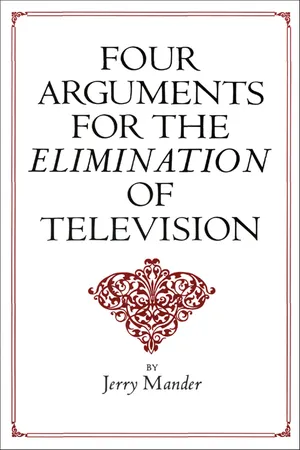
A total departure from previous writing about television, this book is the first ever to advocate that the medium is not reformable. Its problems are inherent in the technology itself and are so dangerous—to personal health and sanity, to the environment, and to democratic processes—that TV ought to be eliminated forever.
Weaving personal experiences with meticulous research, the author ranges widely over aspects of television that have rarely been examined and never before joined together, allowing an entirely new, frightening image to emerge. The idea that all technologies are neutral, benign instruments that can be used well or badly is thrown open to profound doubt. Speaking of TV reform is, in the words of the author, "as absurd as speaking of the reform of a technology such as guns."
Praise for the work of Jerry Mander
"Lively, provocative." —
Publishers Weekly
"A skilled writer." —
Kirkus Reviews (starred review)
- 384 pages
- English
- ePUB (mobile friendly)
- Available on iOS & Android
eBook - ePub
Four Arguments for the Elimination of Television
About this book
Information
ARGUMENT THREE
EFFECTS OF TELEVISION ON THE HUMAN BEING
Television technology produces neuro-physiological responses in the people who watch it. It may create illness, it certainly produces confusion and submission to external imagery. Taken together, the effects amount to conditioning for autocratic control.
VIII
ANECDOTAL REPORTS: SICK, CRAZY, MESMERIZED
ANECDOTAL REPORTS: SICK, CRAZY, MESMERIZED
DURING the years I was preparing this book, occasional pieces of publicity appeared about it. With each exposure mail would arrive in my home. From one article alone I received more than two hundred fifty letters. Most were passionate and troubled. It became clear that watching TV was an experience that an amazing number of people were eager to describe.
I also kept an informal record of the terms people used in ordinary conversation to describe how they felt about television. In all, I recorded about two thousand conversational and written descriptions.
While I make no claims about this amounting to any kind of bona fide scientific sampling, the phrases people chose had a definite consistency. To give you an idea, I’m going to list the fifteen phrases most frequently used.
If you could somehow drop all preconception of television and read this list as though people were describing some instrument you’d never seen yourself, I think the picture you would obtain is of a machine that invades, controls and deadens the people who view it. It is not unlike the alien-operated “influencing machine” of the psychopathic fantasy.
1) “I feel hypnotized when I watch television.”
2) “Television sucks my energy.” 3) “I feel like it’s brainwashing me.”
4) “I feel like a vegetable when I’m stuck there at the tube.”
5) “Television spaces me out.”
6) “Television is an addiction and I’m an addict.”
7) “My kids look like zombies when they’re watching.”
8) “TV is destroying my mind.”
9) “My kids walk around like they’re in a dream because of it.”
10) “Television is making people stupid.”
11) “Television is turning my mind to mush.”
12) “If a television is on, I just can’t keep my eyes off it.”
13) “I feel mesmerized by it.”
14) “TV is colonizing my brain.”
15) “How can I get my kids off it and back into life?”
At one point I heard my son Kai say: “I don’t want to watch television as much as I do but I can’t help it. It makes me watch it.”
I don’t mean to suggest that there weren’t many favorable reports. Often the people who described themselves as “spaced out” liked that experience. They said it helped them forget about their otherwise too busy lives.
Many added the word “meditative”; others found it “relaxing,” saying that it helped them “forget about the world.” Some who used terms like “brainwashed” or “addicted” nonetheless felt that television provided them with good information or entertainment, although there was no one who felt television lived up to its “potential.”
In all the time I collected responses, only eight people suggested they watched too little.
I also kept track of my own reactions. Though I now watch very little television—perhaps two or three hours per month, just to keep my hand in, as it were—I used to watch more. My reactions to the experience invariably reduced to one or two constants. Even if the program I’d been watching had been of some particular interest, the experience felt “antilife,” as though I’d been drained in some way, or I’d been used. I came away feeling a kind of internal deadening, as if my whole physical being had gone dormant, the victim of a vague soft assault. The longer I watched, the worse I’d feel. Afterward, there was nearly always the desire to go outdoors or go to sleep, to recover my strength and my feelings. Another thing. After watching television, I’d always be aware of a kind of glowing inside my head: the images! They’d remain in there even after the set was off, like an aftertaste. Against my will, I’d find them returning to my awareness hours later.
My objective in keeping all these records was not so much to catalog how many people liked television and how many did not, or how many felt guilty about their habit, but rather to gather descriptions of the experience in the terms people chose to describe it.
After a while, I came to realize that people were describing concrete physical symptoms that neither they nor anyone else actually believed were real. The people who would tell me that television was controlling their minds would then laugh about it. Or they would say they were addicted to it, or felt like vegetables while watching, and then they’d laugh at that.
People were saying they were being hypnotized, controlled, drugged, deadened, but they would not assign validity to their own experience. Yet if there is any truth in these descriptions, we are dealing with a force that is far more powerful and subtle than Huxley’s hypnopaedic machines. If television “hypnotizes,” “brainwashes,” “controls minds,” “makes people stupid,” “turns everyone into zombies,” then you would think it would be an appropriate area of scientific inquiry. In fact, someone should call the police.
Science has a name for such collections of descriptions. They are called “anecdotal evidence” or “experiential reports.” Such reports are not totally ignored by researchers, although they are not exactly taken seriously either. In the case of television, there is the problem that the symptoms are not fatal, they are subtle. Few people go to doctors complaining about them. They therefore remain below the threshold of visibility for scientific inquiry. Even when such reports are noticed, science does not accept them as valid unless they have been put through the grinder of scientific proof. Since it is beyond science to validate exactly what is meant by “zombie” or “brainwash” or even “addiction” or, as we will see, even “hypnosis,” these symptoms inevitably remain unzproved, leaving people who need external validation at a loss.
I have already stated my opinion that one major result of modern science has been to make people doubt what they would otherwise accept as true from their own observation and experience. Science, medicine, psychology and economics all deeply depend on people being mystified by their own experience and blind to the strict limits of scientific method.
In this country, where intervention between humans and their inner selves is so very advanced, the mystification is virtually total.
If the National Institutes of Health funded a $5 million study over a three-year period which gathered together all the “experts” to determine the effects of television on the body and mind, and then reported its findings to the president of the United States, who, frightened by the results, then appointed a commission of scholars and other experts to do it over again, one of whom smuggled a copy of the original “findings” to The New York Times, which then carried it on page one: SUPPRESSED STUDY SUGGESTS TELEVISION IS ADDICTIVE, HYPNOTIC, STOP S THOUGHT : SIMILA R T O BRAINWASHING : OTHE R PHYSICAL EFFECTS NOTED, then people would say, “You know, I always thought that might be true.”
In my opinion, if people are watching television for four hours every day and they say they can’t stop it, and also say that it seems to be programming them in some way, and they are seeing their kids go dead, then really, I deeply feel there is no need to study television. This evidence is what lawyers call “prima facie” proof. The only question is how to deal with it. I am satisfied that most people are already perfectly aware of what television is doing to them, but they remain tranquilized by the general wisdom that: the programming is the problem, and it is useless to attempt to change it anyway. Television is here to stay.
In the end, however, perhaps because this mystification also lurks in me, I decided to ask around in the scientific community to see who, if anyone, was concerned about the nature of the television experience.
Invisible Phenomenon
I contacted the Brain Information Service of the BioMedical Library of UCLA and spoke with Dr. Doris Dunn there. I asked her if that was an appropriate place to seek any published materials, including doctoral dissertations, which could relate television to a variety of medical and physiological syndromes.
She told me that the computer there could scan as many as a half million items covering the neuroscience literature published since 1969. She said it was probably as thorough a scanning service as existed for this kind of material.
I told her that I was interested in anything that made any relationship between television and the following: Hypnosis, addiction, hyperactivity, the neurophysiology of light reception, brainwashing, dreaming, thinking, brainwave activity.
I told her that I was also interested in anything that could be uncovered concerning any neurophysiological responses to television and that I’d appreciate her adding her own creative good judgment.
I asked her if she thought much would turn up; she said she doubted it.
Later I called her back to tell her that, thinking it over, I realized she’d probably turn up quite a lot on X-radiation from television sets and that I didn’t need it. A lot had already been published on that.
To get a sense of comparison, I asked her how many items she would expect to turn up in some other area of inquiry. I anticipated being able to make the point that science has failed to look at television as an instrument that produces biological reactions and that this in itself reveals an almost blind acceptance of the medium.
Two weeks later, I received a bibliography of seventy-eight items, covering the period 1969-1975. Dr. Dunn’s covering letter said I could get a sense of comparison from the fact that for a subject like sleep and dreaming about one thousand items would be filed every year. On EEG brainwave activity “several thousand” are filed every year. However, not one of the dreaming articles contained significant reference to television, and only one article on brainwave activity referred to a relationship with television.
Of the seventy-eight references, there were twenty articles concerning a condition called “television epilepsy”—in which otherwise nonepileptic people go into fits while watching television—and several on eye damage, heart rate changes according to the program content, and some on X-radiation, which I’d anticipated.
Of the half million articles scanned by the computer, only two spoke of any relationship between television and hypnosis. There was one about television causing headaches, several on the effects of television on perceptions of scale and distance, and about a dozen on the effects of television on young people. (These latter articles turned out to be “behavioral,” not physiological, articles which slipped through the gates.)
It is clear that the neurophysiological effect of television is no hot subject for scientific research.
To augment and also double-check the Brain Information Service, I asked San Francisco journalist and researcher Mickey Friedman if she would do some digging through the Psychological Abstracts, which contain virtually the same listings as the computer, but carry the subject categories back for several more decades. Friedman went all the way back to 1940 and found only nine additional references, including one on addiction, the first one, and one on hypnosis.
Then, in the spring of 1977, an extremely interesting book appeared, the first to argue that the experience of television— the act of watching it—is more significant than the content of the programs being watched. The Plug-In Drug by Marie Winn caused a sensation among worried parents, psychologists and educators. It asserted that television viewing by children was addictive, that it was turning a generation of children into passive, incommunicative “zombies” who couldn’t play, couldn’t create, and couldn’t even think very clearly.
I read through the book seeking the sources of Marie Winn’s research only to discover that she had run up against the same dearth of research that was already apparent to me. This did not stop her, to her credit, as she strung together long interviews of parents, children, and educators. She gave validity to a series of experiential reports that were parallel to those I’d collected. She combined these with whatever could be gathered from non-television-related research on cognition, on reading patterns, on verbal and nonverbal thinking, and on the observations of other writers, and what she could gather from her own observance of the television experience.
She drew a horrifying picture of a generation of children who were growing up without the basic skills that most earlier generations had used to get through life, children who could not even solve the problem of dealing with free time. She also described the disassembling effects television has upon family life, in which communication and even direct affection and participation in each other’s lives were being processed through television experience, to the extreme detriment of everyone.
Having gone as far as she went, however, Marie Winn didn’t apply her findings to adults and didn’t relate any of the effects of television to the power drives of the wider society.
I decided to continue digging and soon found myself creating my own horrifying picture of television’s effect and how it fits the needs of the juggernaut. The nature of the viewing experience itself, the technology of fixation (which I already knew from advertising), new research on biological effects, together with discoveries about the power of implanted imagery, combine to create a pattern in which the newly diminished role of the human being is more and more apparent.
Dimming Out the Human
Television is watched in darkened rooms. Some people leave on small lights, or daylight filters in, but it is a requirement of television viewing that the set be the brightest image in the environment or it cannot be seen well.
To increase the effect, background sounds are dimmed out just as the light is. An effort is made to eliminate household noises. The point, of course, is to further the focus on the television set. Awareness of the outer environment gets in the way.
Many people watch television alone a substantial amount of the time. This eliminates yet another aspect of outer awareness. Even while watching with others, a premium is placed upon quiet. Talking interferes with attention to the set. If you like to look at people while talking, turning your head actually breaks attention. So other people are dimmed out like the light, the sounds, and the rest of the world.
Dimming out your own body is another part of the process. People choose a position for viewing that allows the maximum comfort and least motion, that is, the least awareness of the body because like awareness of external light, sound or other stimuli, awareness of your own body can detract f...
Table of contents
- Dedication
- Contents
- Introduction
- Argument One: The Mediation of Experience
- Argument Two: The Colonization of Experience
- Argument Three: Effects of Television on the Human Being
- Argument Four: The Inherent Biases of Television
- Postscript Impossible Thoughts
- Acknowledgments
- Bibliography
- About the Author
- Copyright
- About the Publisher
Trusted by 375,005 students
Access to over 1.5 million titles for a fair monthly price.
Study more efficiently using our study tools.
Frequently asked questions
Yes, you can cancel anytime from the Subscription tab in your account settings on the Perlego website. Your subscription will stay active until the end of your current billing period. Learn how to cancel your subscription
No, books cannot be downloaded as external files, such as PDFs, for use outside of Perlego. However, you can download books within the Perlego app for offline reading on mobile or tablet. Learn how to download books offline
Perlego offers two plans: Essential and Complete
- Essential is ideal for learners and professionals who enjoy exploring a wide range of subjects. Access the Essential Library with 800,000+ trusted titles and best-sellers across business, personal growth, and the humanities. Includes unlimited reading time and Standard Read Aloud voice.
- Complete: Perfect for advanced learners and researchers needing full, unrestricted access. Unlock 1.5M+ books across hundreds of subjects, including academic and specialized titles. The Complete Plan also includes advanced features like Premium Read Aloud and Research Assistant.
We are an online textbook subscription service, where you can get access to an entire online library for less than the price of a single book per month. With over 1.5 million books across 990+ topics, we’ve got you covered! Learn about our mission
Look out for the read-aloud symbol on your next book to see if you can listen to it. The read-aloud tool reads text aloud for you, highlighting the text as it is being read. You can pause it, speed it up and slow it down. Learn more about Read Aloud
Yes! You can use the Perlego app on both iOS and Android devices to read anytime, anywhere — even offline. Perfect for commutes or when you’re on the go.
Please note we cannot support devices running on iOS 13 and Android 7 or earlier. Learn more about using the app
Please note we cannot support devices running on iOS 13 and Android 7 or earlier. Learn more about using the app
Yes, you can access Four Arguments for the Elimination of Television by Jerry Mander in PDF and/or ePUB format, as well as other popular books in Social Sciences & Media & Communications Industry. We have over 1.5 million books available in our catalogue for you to explore.