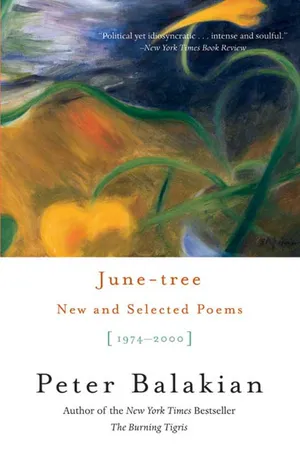
June-tree
eBook - ePub

June-tree

New and Selected Poems, 1974-2000

  1. 192 pages
  2. English
  3. ePUB (mobile friendly)
  4. Available on iOS & Android
eBook - ePub

June-tree

New and Selected Poems, 1974-2000

Frequently asked questions

Yes, you can cancel anytime from the Subscription tab in your account settings on the Perlego website. Your subscription will stay active until the end of your current billing period. Learn how to cancel your subscription.
At the moment all of our mobile-responsive ePub books are available to download via the app. Most of our PDFs are also available to download and we're working on making the final remaining ones downloadable now. Learn more here.
Perlego offers two plans: Essential and Complete
  • Essential is ideal for learners and professionals who enjoy exploring a wide range of subjects. Access the Essential Library with 800,000+ trusted titles and best-sellers across business, personal growth, and the humanities. Includes unlimited reading time and Standard Read Aloud voice.
  • Complete: Perfect for advanced learners and researchers needing full, unrestricted access. Unlock 1.4M+ books across hundreds of subjects, including academic and specialized titles. The Complete Plan also includes advanced features like Premium Read Aloud and Research Assistant.
Both plans are available with monthly, semester, or annual billing cycles.
We are an online textbook subscription service, where you can get access to an entire online library for less than the price of a single book per month. With over 1 million books across 1000+ topics, we’ve got you covered! Learn more here.
Look out for the read-aloud symbol on your next book to see if you can listen to it. The read-aloud tool reads text aloud for you, highlighting the text as it is being read. You can pause it, speed it up and slow it down. Learn more here.
Yes! You can use the Perlego app on both iOS or Android devices to read anytime, anywhere — even offline. Perfect for commutes or when you’re on the go.
Please note we cannot support devices running on iOS 13 and Android 7 or earlier. Learn more about using the app.
Yes, you can access June-tree by Peter Balakian in PDF and/or ePUB format. We have over one million books available in our catalogue for you to explore.

Information

Publisher
Harper
Year
2010
Print ISBN
9780060556174
eBook ISBN
9780062032454

FROM DYER’S THISTLE (1996)

August Diary

8/1

From here groomed fields and clumps of trees,
a silo of corrugated tin and a white barn blur.
Unseasonable cool days,
high, blue, a few clouds like ripped pillows
as if this were a lip of the North Sea
and I could look out and imagine Denmark.
But I’m in my office three floors up.

8/3

In Armenian there’s a word—garod—rhymes with “maud.”
The beautiful ones are not faithful
and the faithful ones are not beautiful—
a student said that about some Pavese translations,
here in my office.
Should I tell you what garod means?

8/5

What’s happening in Spitak and Sarajevo and the West Bank
is splayed like the cortex of a silicon chip in the fuzzy air.
Maria, the physician from Armenia, was 25 & had one plastic arm and one real arm. I met her in East Hampton on the deck of a house on the dunes.
After the earthquake she had no husband,
no parents, and only one child.
“I’m in a good mood today,” she said, “let’s talk about
something else.” I poured her an Amstel Light.

8/10

The coolness intrudes—
month of wind-sprints and retching for the coach.
It comes back like nerve ends after surgery.
Along a country road cicadas rattling.
Chicory and sweet pea intruding on the ripe barley.
I picked up some seed packs from a junk shop on Rt. 20,
a tomato blazed in red ink/1926, Fredonia, N.Y.

8/11

What’s between us? The red ink of the tomato?
How does an image stay? Or is it always aftermath?
The way deep black reflected the most light in Talbot’s first calotypes.
But garod: tongue of a snake,
meaning exile, longing for home.
Thomas Wedgwood got images by getting sunlight
to pass through things onto paper brushed with silver nitrate:
wings of a dragonfly, the spine of an oak leaf—
fugitive photograms. But he couldn’t stop the sun
until it turned the paper black.
Stop the light before it goes too far?
Or is desire what garod means?
Longing for a native place.

8/17

Maria said she was learning how to connect nerve endings
in the hand so hands and arms would work again.
There were so many in Armenia without working hands and arms.
At the end of each dendrite is a blurred line
like the horizon I’m squinting.
Image of the other:
light-arrested; not the image of ourselves.

8/21

After digging scallions one day Dickinson defined freedom:
Captivity’s consciousness, so’s liberty.
Maybe garod is about the longing for the native place
between two selves.

8/22

I love the brute force of silence in Roger Fenton’s
Sebastopol from Cathcart’s Hill, 1855. The Crimean inner war.
The artlessness of silver is like my tongue in your wet space,
or like the news photos that bring us the pressure of disaster.
Beloved topography,
garod then must mean yearning.
Is that how we loved under the rattling Nippon porcelain,
in the light calotyped by the fire escape?

8/25

garod: the grain chute that spills
into a dark barn which is endless,
like the self when it’s out of reach.
Are we so lonely that a constellation
could blacken and fill up that same barn,
and that be me or you?
But still we’re piss and oats and stock in there.
We’re like civet, who wouldn’t love it.

8/31

the new glass-plate pictures:
transparent as air, Szarkowski wrote
like windows
the fragmentary, scruffy, particularity
of real living behind them—

Physicians

1

Above school kids in Episcopal
jackets cherubs are singing
to the beautiful fake lapis
of St. John the Divine
and from this side chapel
I see through the blue
to the 6th floor of St. Luke’s
where my father’s heart caved in.
In the thirties my grandfather
made his rounds three floors down.
In the weak sun the black rocks
by a shepherd’s robe seem piled
like fat medical texts
or small suitcases full of Dickens
in German my grandfather translated
to learn English so he could pass
his exam in the Empire State,
to use his silver instruments
on the eyes ears nose and throat.
In a snapshot he’s large-eyed, glazed,
as if he should’ve followed
his cousin, the Bishop, to a cave.
Instead he climbed down
the catastrophes of New World
faces, the warped shapes
that flare up the senses.
Tubes lit in the throat.
The auscultated fog
of the ear tuned
to pass the pitches
of the world. I think of him
scoping the cochlea,
that purgatory
where the screech
of a yellow Checker
and the mute twittering
of Satchmo’s horn
were white light.
Down the ducts of joy and pain
my grandfather called tears
(not lachrymae Christi),
but the fissure between two continents
that sent him with Armenia’s
refugees along the junked canals,
the Dardanelles, the Atlantic.
Eye to eye with a lens,
he could see the retina’s
orange spot,
and it was a floating nation.
On a clean meta...

Table of contents

  1. Cover
  2. Title Page
  3. Dedication
  4. Contents
  5. New Poems
  6. From Dyer’s Thistle (1996)
  7. From Reply From Wilderness Island (1988)
  8. From Sad Days of Light (1983)
  9. From Father Fisheye (1979)
  10. Notes
  11. Acknowledgments
  12. About the Author
  13. Also by Peter Balakian
  14. Author’s Note
  15. Copyright
  16. About the Publisher