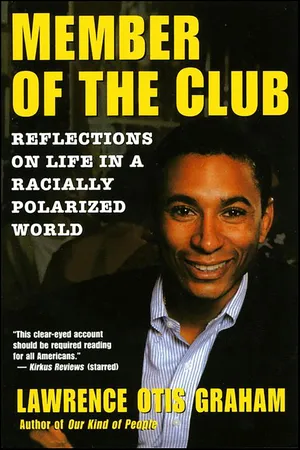
I DRIVE UP the winding lane past a long stone wall and beneath an archway of sixty-foot maples. At one bend of the drive, a freshly clipped lawn and a trail of yellow daffodils slope gently up to the four-pillared portico of a white Georgian colonial. The building’s six huge chimneys, the two wings with slate gray shutters, and the white-brick facade loom over a luxuriant golf course. Before me stands the one-hundred-year-old Greenwich Country Club—the country club—in the affluent, patrician, and very white town of Greenwich, Connecticut, where there are eight clubs for fifty-nine thousand people.
I’m a thirty-year-old corporate lawyer at a Midtown Manhattan firm, and I make $105,000 a year. I’m a graduate of Princeton University (1983) and Harvard Law School (1988), and I’ve written ten nonfiction books. Although these might seem like impressive credentials, they’re not the ones that brought me here. Quite frankly, I got into this country club the only way that a black man like me could—as a $7-an-hour busboy.
After seeing dozens of news stories about Dan Quayle, Billy Graham, Ross Perot, and others who either belonged to or frequented white country clubs, I decided to find out what things were really like at a club where I heard there were no black members.
I remember stepping up to the pool at a country club when I was ten and setting off a chain reaction: Several irate parents dragged their children out of the water and fled. When the other kids ran out of the pool, so did I—foolishly thinking that there was something in the water that was going to harm all of us. Back then, in 1972, I saw these clubs only as places where families socialized. I grew up in an affluent white neighborhood in Westchester, and all my playmates and neighbors belonged to one or more of these private institutions. Across the street, my best friend introduced me to the Westchester Country Club before he left for Groton and Yale. My teenage tennis partner from Scarsdale introduced me to the Beach Point Club on weekends before he left for Harvard. The family next door belonged to the Scarsdale Golf Club. In my crowd, the question wasn’t “Do you belong?” It was “Where?”
My grandparents owned a Memphis trucking firm, and as far back as I can remember, our family was well off and we had little trouble fitting in—even though I was the only black kid on the high school tennis team, the only one in the orchestra, the only one in my Roman Catholic confirmation class.
Today, I’m back where I started—on a street of five- and six-bedroom colonials with expensive cars and neighbors who all belong somewhere. Through my experiences as a young lawyer, I have come to realize that these clubs are where businesspeople network, where lawyers and investment bankers meet potential clients and arrange deals. How many clients and deals am I going to line up on the asphalt parking lot of my local public tennis courts?
I am not ashamed to admit that I one day want to be a partner and a part of this network. When I talk to my black lawyer or investment-banker friends or my wife, a brilliant black woman who has degrees from Harvard College, Harvard Law School, and Harvard Business School, I learn that our white counterparts are being accepted by dozens of these elite institutions. So why shouldn’t we—especially when we have the same credentials, salaries, social graces, and ambitions?
My black Ivy League friends and I know of black company vice presidents who have to ask white subordinates to invite them out for golf or tennis. We talk about the club in Westchester that rejected black Scarsdale resident and millionaire magazine publisher Earl Graves, who sits on Fortune 500 boards, owns a Pepsi distribution franchise, raised three bright Ivy League children, and holds prestigious honorary degrees. We talk about all the clubs that face a scandal and then run out to sign up one quiet, deferential black man who will accept a special “limited-status” membership, remove the taint, and deflect further scrutiny.
I wanted some answers. I knew I could never be treated as an equal at this Greenwich oasis—a place so insular that the word Negro is still used in conversation. But I figured I could get close enough to understand what these people were thinking and why country clubs were so set on excluding people like me.
MARCH 28 TO APRIL 7, 1992
I invented a completely new résumé for myself. I erased Harvard, Princeton, and my upper-middle-class suburban childhood from my life. So that I’d have to account for fewer years, I made myself seven years younger—an innocent twenty-three. I used my real name and made myself a graduate of the actual high school I attended. Since it would be difficult to pretend that I was from “the street,” I decided to become a sophomore-year dropout from Tufts University, a midsize college in suburban Boston. My years at nearby Harvard and the fact that my brother had gone there had given me enough knowledge about the school to pull it off. I contacted some older friends who owned large companies and restaurants in the Boston and New York areas and asked them to serve as references. I was already on a short leave of absence from my law firm to work on a book.
I pieced together a wardrobe that consisted of a blue polyester blazer, white oxford shirt, ironed blue slacks, black loafers, and a horrendous pink, black, and silver tie, and I set up interviews at clubs. Over the telephone, five of the eight said that I sounded as if I would make a great waiter. During each of my phone conversations, I made sure that I spoke to the person who would make the hiring decision. I also confirmed exactly how many waiter positions were available, and I arranged a personal interview within forty minutes to an hour of the conversation, just to be sure that they could not tell me that no such job was available.
“We don’t have any job openings—and if you don’t leave the building, I will have to call security,” the receptionist said at the first club I visited in Greenwich.
I was astounded by the speed with which she made this remark, particularly when I saw that she had just handed an application to a young-looking Hispanic man wearing jeans, sneakers, a T-shirt, and sunglasses. “I’m here to see Donna, your maître d’,” I added defensively as I forced a smile at the pasty-looking woman who sat behind a window.
“There’s no Donna here.”
“But I just spoke to her thirty minutes ago and she said to come by to discuss the waiter job.”
“Sorry, but there are no jobs and no one here named Donna.”
After convincing the woman to give me an application, I completed it and then walked back into the dining room, which was visible from the foyer.
I came upon a white male waiter and asked him, “Is there a Donna here?”
“The maître d’?” he asked. “Yeah, she’s in the kitchen.”
When I found Donna and explained that I was the one she had talked to on the phone forty minutes earlier, she crossed her arms and shook her head. “You’re the ‘Larry’ I talked to on the phone?”
“Yes,” I answered.
“No way.”
“I beg your pardon,” I said.
“No. No way,” she said while refusing to take the application I waved in front of her.
“We just talked on the phone less than an hour ago. You said I sounded perfect. And I’ve waited in three different restaurants—I’ve had two years of college— You said you had five waiter jobs open— I filled out the application— I can start right away—”
She still shook her head. And held her hands behind her back—unwilling to even touch my application. “No,” she said. “Can’t do it.”
My talking did no good. It was 1992. This was the Northeast. If I hadn’t been involved, I would never have believed it. I suddenly thought about all the times I quietly disbelieved certain poor blacks who said they had tried to get jobs but no one would hire them. I wanted to say then and there, “Not even as a waiter?”
Only an hour earlier, this woman had enthusiastically urged me to come right over for an interview. Now, as two white kitchen workers looked on, she would only hold her hands tightly behind her back and shake her head emphatically. So I left.
There were three other clubs to go to. When I met them, the club managers told me I “would probably make a much better busboy.”
“Busboy? Over the phone, you said you needed a waiter,” I argued.
“Yes, I know I said that, but you seem very alert, and I think you’d make an excellent busboy instead.”
In his heavy Irish brogue, the club manager said he needed to give me a “perception test.” He explained it this way: “This ten-question test will give us an idea of your perception, intellectual strength, and conscious ability to perform the duties assigned to you as a busboy.”
I had no idea how much intellectual strength and conscious ability (whatever that meant) could be required of a busboy, but here are some of the questions he asked me:
- If there are three apples and you take two away, how many do you have?
- How many of each species of animal did Moses put on his new ark?
- It’s 1963 and you set your digital clock to ring at 9:00 A.M. when you go to bed at 8:00 P.M. How many hours will you sleep?
- If a house gets southern exposure on all four sides, what color is the bear that walks by the house?
And the responses
- I answered “one apple” because I thought this was a simple math question, as in “three minus two equals one,” but the correct answer was “two” because, as the manager said, “You’ve got to think, Larry—if you take away two apples and put them in your pocket, you’ve got two apples, not one.”
- Fortunately, I answered this question as it was presumably designed to smoke out any applicants who hadn’t been raised in a Judeo-Christian culture. It was Noah, not Moses, who built an ark.
- I scored major credibility points here by lying and saying, “Wow, I wasn’t even born yet in 1963.” The “right” answer was that there were no digital clocks in 1963. I took his word for it.
- Although I believed that a house could get southern exposure on all four sides only at the South Pole—and thus the bear had to be a white polar bear—I was told that I was “trying to act too smart” and that all bears are, of course, brown.
APRIL 8 TO 11
After interviewing for advertised waiter jobs at five clubs, I had gotten only two offers—both for nonwaiter jobs. One offer was to split my time as a towel boy in the locker room and a busboy in the dining room. The second offer—which followed a callback interview—was to work as a busboy. When I told the club manager that I had only wanted a waiter job, he responded, “Well, we’ve discussed it here and everyone would feel more comfortable if you took a busboy job instead.”
“But I’ve never worked as a busboy,” I reminded him.
He nodded sympathetically. “People here have decided that it’s busboy or nothing.”
Given these choices, I made my final job selection in much the way I had decided on a college and a law school: I went for prestige. Not only was the Greenwich Country Club celebrating its hundredth anniversary but its roster boasted former president Gerald Ford, baseball star Tom Seaver, former Securities and Exchange Commission chairman and U.S. ambassador to the Netherlands John Shad, as well as former Timex spokesman John Cameron Swayze. Add to that a few dozen Fortune 500 executives, bankers, Wall Street lawyers, European entrepreneurs, a Presbyterian minister, and cartoonist Mort Walker, who does Beetle Bailey. (The Greenwich Country Club did not respond to any questions about the club and its members.)
For three days, I worked on my upper-arm muscles by walking around the house with a sterling-silver tray stacked high with heavy dictionaries. I allowed a mustache to grow in, then added a pair of arrestingly ugly Coke-bottle reading glasses.
APRIL 12 (SUNDAY)
Today was my first day at work. My shift didn’t start until 10:30 A.M., so I laid out my clothes at home: a white button-down shirt, freshly ironed cotton khaki pants, white socks, and white leather sneakers. I’d get my official club uniform in two days. Looking in my wallet, I removed my American Express Gold Card, my Harvard Club membership ID, and all of my business cards.
When I arrived at the club, I entered under the large portico, stepping through the heavy doors and onto the black-and-white checkerboard tiles of the entry hall.
A distracted receptionist pointed me toward Mr. Ryan’s office. (All names of club members and personnel have been changed.) I walked past glistening silver trophies and a guest book on a pedestal to a windowless office with three desks. My new boss waved me in and abruptly hung up the phone.
“Good morning, Larry,” he said with a sufficiently warm smile. The tight knot in his green tie made him look more fastidious than I had remembered from the interview.
“Hi, Mr. Ryan. How’s it going?”
Glancing at his watch to check my punctuality, he shook my hand and handed me some papers. “Oh, and by the way, where’d you park?”
“In front, near the tennis courts.”
Already shaking his head, he tossed his pencil onto the desk. “That’s off-limits to you. You should always park in the back, enter in the...