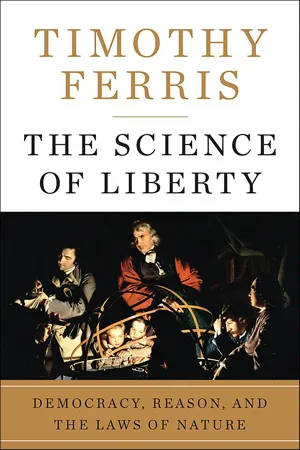
A "thoughtful and thoroughly entertaining" look at the historical connections between science and liberal democracy, and the forces that threaten both (
The Wall Street Journal).
In
The Science of Liberty, award–winning author Timothy Ferris—called "the best popular science writer in the English language today" by the
Christian Science Monitor and "the best science writer of his generation" by the
Washington Post—makes a passionate case for science as the inspiration behind the rise of liberalism and democracy. Ferris argues that just as the scientific revolution rescued billions from poverty, fear, hunger, and disease, the Enlightenment values it inspired has swelled the number of those living in free and democratic societies from less than 1 percent of the world population four centuries ago to more than a third today. He also surveys the forces that have opposed science and liberalism—from communism and fascism to postmodernism and fundamentalism—in a sweeping, stunningly original intellectual history that transcends antiquated concepts of right and left.
"Important, timely, and splendidly written." —
The Washington Post
"Engaging . . . Ferris usefully reminds us that science was an integral part of the intellectual equipment of the great pioneers of political and individual liberty." —
The New York Times Book Review
"A passionately crafted and articulate exploration of the relationship between science and democracy . . . show[s] how science and democracy working in symbiosis can thrive and—the author suggests, using the antiexamples of Hitler's Germany and Stalin's Soviet Union—can just as easily die." —
Bookmarks
"An important and extremely readable book . . . Ferris is one of America's most skilled communicators about science . . . He shows himself a fascinating historian too." —
San Francisco Chronicle
- 384 pages
- English
- ePUB (mobile friendly)
- Available on iOS & Android
eBook - ePub
About this book
Information
Topic
PhilosophySubtopic
DemocracyCHAPTER ONE
SCIENCE & LIBERTY
Liberty…is the great parent of science and of virtue; and…a nation will be great in both, always in proportion as it is free.
—THOMAS JEFFERSON TO JOSEPH WILLARD, 1789
Science as subversion has a long history.
—FREEMAN DYSON, 1989
Over the past few centuries, two transformations—one scientific, the other democratic—have altered the thinking and the well-being of the human species. The scientific revolution is still gathering momentum, but has already revealed more about the universe than had been learned in all prior history, while technological applications of scientific knowledge have rescued billions from poverty, ignorance, fear, and an early grave. The democratic revolution has spread freedom and equal rights to nearly half the world’s inhabitants, making democracy the preference of informed peoples everywhere.
These two transformations were linked, and remain so today: Every scientific nation in the world at the close of the twentieth century was a liberal, or at least partly liberal, democracy (meaning a state that guarantees human rights to its citizens, who elect their leaders). But how are they linked?
The scenario most of us learned in school presents the transformation in three acts—the Renaissance, the Scientific Revolution, and the Enlightenment. In the Renaissance (meaning “rebirth,” from around 1450 to 1600), classical Greek and Roman writings became available to Europeans through trade with the Arab world, producing an outpouring of humanistic art and thought along with a few green shoots of science—as when Copernicus in 1543 demonstrated that the motions of planets in the sky could as readily be explained by the earth orbiting the sun as by the old earth-centered cosmology. The resulting brew of humanistic and scientific thinking eventually produced the Enlightenment, which in turn sparked the democratic revolution: Hence the Enlightenment is often dated as beginning with the English Revolution of 1688 and ending with the French Revolution of 1789. Meanwhile there was for some reason a scientific revolution, and so the modern world emerged.
The traditional scenario works reasonably well as a framework of study, but it portrays the simultaneous rise of science and liberal democracy as little more than a series of coincidences. The situation becomes clearer if we ask what was new: What was the innovative ingredient—the crystal dropped in the supersaturated liquid, suddenly solidifying it—without which the democratic revolution would not have occurred?
This book argues that the new ingredient was science. It maintains that the democratic revolution was sparked—caused is perhaps not too strong a word—by the scientific revolution, and that science continues to foster political freedom today. It’s not just that scientific creativity has produced technological improvements, which in turn have enhanced the prosperity and security of the scientific nations, although that is part of the story, but that the freedoms protected by liberal democracies are essential to facilitating scientific inquiry, and that democracy itself is an experimental system without which neither science nor liberty can flourish.
To investigate this proposition and its implications, this book attempts to do three things.
First, it explores the historical link between science and liberty from the Renaissance through the end of the eighteenth century, examining science as an ongoing enterprise that requires freedom of speech, travel, and association. It maintains that scientific skepticism is corrosive to authoritarianism, and that scientific experimentation provides a better model for governance than any of the systems that preceded it.
Second, the book traces the development of the democratic and scientific societies from the eighteenth century onward, to see how the ideas and practices of science influenced their social policies. To some extent this amounts to testing the argument by making retroactive predictions about what should have happened if, indeed, science promotes liberty and democracy. Admittedly such a process is fraught with potential for abuse—anyone today, knowing how things turned out, can sift through the evidence for facts which suit his case—but such are the hazards of history.
Finally the world today is examined by the lights of science and liberty—taking into account powerful antiscientific forces that have cast shadows across our times—revealing, amid a welter of problems, surprisingly ample grounds for hope.
The word science comes from the Latin scientia, meaning “knowledge.” In that broad sense of the word Anaximander of Miletus may be called a biologist for having proposed, in the sixth century BC, that humans were descended from fish, and Aristarchus of Samos an astronomer, since he hypothesized in the third century BC that the earth orbited the sun. The trouble with this approach is that it makes a scientist out of any philosopher who happened to voice a reasonably accurate opinion on a subject that has since become a science. To speculate and be proved right is not in itself to do science: As the American philosopher Alfred North Whitehead noted, “Everything of importance has been said before by somebody who did not discover it.” The essence of science is experimentation, and scientific experiments were carried out by only a few ancient thinkers, among them Eratosthenes of Cyrene, who made a geometrical measurement of Earth’s diameter in the third century BC; Strato of Lampsacus, who experimented with vacuums and compressed air at about the same time; and Galen, who dissected animal and human corpses a bit later. So for the sake of clarity this book uses the term science to mean what is often called modern science—that is, research involving observation and experiment, conducted as an ongoing social enterprise by career scientists working in laboratories and contributing to professional conferences and journals.
Liberty means the observance of human rights and freedoms. In practice the governments that have done so have almost all been liberal democracies, so the rise of liberty is roughly equated with the rise of liberal democracy. This process got off to a slow start, but has accelerated during the last hundred years. In 1900 there was not a single liberal democracy in the world (since none yet had universal suffrage); by 1950 there were twenty-two. As of 2009, despite recent reversals, there were eighty-nine democracies, comprising 46 percent of the world population.
The claim that science flourishes only in liberal-democratic environments rests on five assertions.
First, science is inherently antiauthoritarian. In order to qualify as scientific, a proposition must be vulnerable to experimental testing. If it repeatedly fails such tests it tends to fall by the wayside, regardless of who supported it or how much it may have seemed to make sense. The verdict of experiment has rudely dismissed the pronouncements of great thinkers from Aristotle (who thought that men and women were born with a different number of teeth) to Einstein (who insisted that quantum physics must be deterministic), and has sufficed to unhorse the claims of alchemists who sought to turn lead into gold and the folk wisdom behind a thousand racial, ethnic, and sexual stereotypes. The very process of doing first-rate science—of making important discoveries rather than merely refining old ideas—depends on unfamiliar and sometimes unpopular ideas being freely promulgated, discussed, and in some instances accepted. The fact that millions of people today are open to new ideas and skeptical about political or intellectual authority is largely due to the rise of science.
Second, science is self-correcting. Corrupted data, ill-begotten theories, and instances of outright fraud may not be caught at once, but if significant are unlikely to go undetected for long. When a scientist makes a major discovery, his or her colleagues flock to it, seeking to exploit and expand it as best they can, and such attentions are not entirely benign: Each new generation of scientists seeks to build a reputation by exposing weaknesses in the theories of its elders and replacing them with newer and more commodious theories. In this manner science presents a model for liberal governance, where it is similarly useful—although often frustrating—for plans and proposals to be widely debated and repeatedly altered before being enacted. Indeed a major failing of liberal democracies is that they are not yet sufficiently self-correcting: Programs that fail to accomplish their intended aims frequently survive anyway, by virtue of their popularity among the few who benefit from them or the many who assume that they are working.
Third, science in order to flourish must draw on all available intellectual resources. Nations aspiring to compete in the front ranks of science and technology cannot afford to suppress any element of their society—since none has a monopoly on brainpower—and so are obliged to educate their people and to maximize individuals’ opportunities to advance on their merits. Liberal democracy approaches this ideal more closely than any other known system. As Francis Bacon put it, “There is but one state of learning, and that ever was and ever will be the democratic.”
Fourth, science is powerful. Knowing things is empowering in itself, and the power of applying science to technology is so much a fact of modern life as to hardly require comment, whether you are using a mobile phone to find work in an African village or the Internet to chart your stock holdings. The power provided by science and technology is obvious in military matters, but it also drives national economies in countless ways. Historically, economic growth has proceeded apace in nations where science has flourished, while the local clocks in the less scientific and technological nations have run more slowly.
Finally, science is a social activity. In the early days when almost nothing was known about how the world worked, an isolated experimenter could make important discoveries, but to make progress today requires the combined talents of many participants. Even a solitary scientist needs to stay in touch with the literature, and in big sciences like experimental high-energy physics, collaborations have become so extensive that the number of contributors listed on the front of a technical paper may exceed that of its readers. The further science progresses down this road, the more it requires freedom of speech, travel, and association. Its resemblance to democratic institutions is clear. As John Dewey maintained, “Freedom of inquiry, toleration of diverse views, freedom of communication, the distribution of what is found out to every individual as the ultimate intellectual consumer, are involved in the democratic as in the scientific method.” Authoritarian governments such as Nazi Germany, the Soviet Union, and communist China tried to address this issue by encapsulating scientists in special zones of relative freedom, but such partial measures had only partial success: The local clocks not only slowed down but sometimes stopped or went backward.
These claims may be tested against the verdict of history by applying the journalistic “five Ws”—who, when, what, where, and why—to the changes that have created the modern world.
Who implemented the democratic revolution? If its cause was science, disproportionately high numbers of scientifically minded individuals should be found among the instigators of the democratic revolution. And so they are. The Whig insurgents who brought about the English Revolution were largely proponents of science, while their opponents tended to be traditionalists disinclined toward scientific innovation. The American Revolution was incited and carried out in disproportionate measure by amateur scientists like Thomas Paine, Benjamin Franklin, and Thomas Jefferson. And scientists have been found at the forefront of political reforms down to the present day, from dissidents in communist China to planetary scientists struggling to alert governments to the hazards of global warming.
When did they do these things? Science arose to prominence immediately prior to the Enlightenment—as would be expected if, indeed, science was the one indisputably new ingredient in the social and intellectual ferment that produced the Enlightenment and the democratic revolutions that followed. The principal Enlightenment catalyst was the publication, in 1687, of Isaac Newton’s Principia, which subsumed prior astronomy into a unified theory of gravitation that could be employed to predict natural phenomena ranging from tides to the orbits of comets. This thunderclap caught the startled attention of thinkers throughout the Western world, scientific and otherwise. The Principia put teeth in reason, demonstrating with unprecedented power and scope that mathematical analysis combined with careful observations could expose an elegant simplicity underlying the complex motions of the planets across the sky. In exposing laws of nature it promoted the idea that there are natural laws of human affairs as well, and natural human rights. Newton’s book also acted as a kind of vaccine against the predations of superstition and faith-based authoritarianism, making them look paltry by comparison to what scientific and political empiricism could accomplish. The empiricist physician John Locke, whose doctrine of natural rights became the polestar of the Declaration of Independence, was Newton’s closest friend—aside, perhaps, from the diarist Samuel Pepys, himself enough of a promoter of science to be elected president of the Royal Society—and Locke described his own philosophical accomplishments as subordinate to those of Newton. Other prime movers of the Enlightenment influenced by Newtonian science included Adam Smith, Fontenelle, Bayle, Montesquieu, Condillac, Diderot, Voltaire, La Mettrie, Leibniz, Spinoza, Holbach, and Buffon. The French Encyclopédie, a seminal Enlightenment tome, was dedicated to Bacon, Locke, and Newton; Thomas Jefferson in 1789 commissioned a composite portrait of these enthusiasts of science, calling them “the three greatest men that have ever lived, without any exception.”
What became of the liberal democracies? If indeed it was to science that they owed their birth they should have become world leaders in science, and so they did. England—precocious in democracy, having established one of the world’s first parliaments—wielded a far greater scientific influence than its population would otherwise have indicated. The United States became both the world’s oldest constitutional democracy and its scientific and technological leader. Small nations that became democratic early on, such as the Netherlands, made significant contributions to science, while mightier nations that only later became democracies, such as Spain, experienced a retarded progress toward scientific significance.
Where did the first democracies appear? Precisely in those states where science and technology were most advanced—in England, America, and the Netherlands, and (more fitfully) in France, Italy, and Germany.
Why did this happen? Because—or so this book maintains—science demanded liberty and demonstrated its social benefits, creating a symbiotic relationship in which the freer nations were better able to carry on the scientific enterprise, which in return rewarded them with knowledge, wealth, and power. This process continues today. It is difficult to think of any large-scale human activity that has not benefited from science—from feeding the poor to growing a business, from expanding an economy to protecting the environment, from educating the young to improving the welfare of the elderly.
That much constitutes what might be called the positive argument for a link between science and liberty—that on the whole, science has flourished in free societies and fared poorly in nations with illiberal governments. But what about negative examples—illiberal regimes under which science seemed, however briefly, to have risen to imposing heights? This book pays particular attention to the three most powerful totalitarian regimes of the twentieth century—Hitler’s Germany, Stalin’s Russia, and Mao’s China—which, during World War II and the Cold War, were widely viewed by their adversaries as scientific and technological juggernauts. Were this assessment accurate, the case for the science–liberty link would be badly undermined.
All three nations had strong intellectual and creative traditions that included at least some scientific attainments. Twentieth-century Germany, where democratic reforms had been rising and falling like a ship in a choppy sea, had a similarly sporadic career in science, highlighted by the geographical exploits of Alexander von Humboldt, the optical experiments of Joseph von Fraunhofer, and the theoretical physics of Max Planck and Albert Einstein. Russia had an Academy of Sciences where botanical and zoological research was conducted, and could boast as well of Dmitry Mendeleyev’s periodic table of chemical elements, Vasily Struve’s studies of stars, and Fyodor Bredikhin’s work on comets. China could point to a history of technological attainment stretching back thousands of years, including the invention of paper and gunpowder and the preservation of extensive astronomical records. So if these nations failed to make significant scientific progress while under illiberal rule, the fault cannot have been a lack of indigenous talent. Nor could it be blamed solely on a lack of resources, since all three of the repressive regimes that befell these nations funneled vast resources into programs designed to promote scientific and technological progress.
Yet fail they did. The communist ideology espoused by Stalin and Mao talked a great deal about science—indeed it portrayed itself as a scientific form of government, its universal triumph as inevitable as the outcome of a demonstrative experiment in a high-school physics class—but was unable to adapt when social experiments failed. Instead, each was proclaimed a great success by the controlled news media, to be followed by another Five Year Plan or Great Leap Forward based on faith rather than empirical evidence. The Nazis imagined that science could be put to work generating technical advancements while substantiating their weird biological and cosmological notions. All three regimes tried to exploit their most talented scientists, but wound up silencing, imprisoning, or murdering many of them.
The technological achievements of these totalitarian regimes—such as Germany’s rocket program and the Soviet space effort—impressed and alarmed many in the liberal nations, but were based on little more than the momentum of earlier science plus the short-term torque of intense government spending: As Nikita Khrushchev wryly described the Soviet space program to his son, in 1961, “We have nothing to hide: We have nothing, and we must hide it.” In the end, totalitarian science collapsed in a morass of scandals (the Lysenko affair, sadistic Nazi “medical experiments”) and in catastrophes such as the mass famines that resulted from communist agricultural reforms, killing millions.
The spectacular failure of totalitarian science spotlighted the futility of attempting to treat science as a tool that could be divorced from its ethical imperatives. It is often said that science is ethically neutral—that it shows how things are, not how they ought to be—but...
Table of contents
- Cover
- Title Page
- Dedication
- Epigraph
- Contents
- Chapter One
- Chapter Two
- Chapter Three
- Chapter Four
- Chapter Five
- Chapter Six
- Chapter Seven
- Chapter Eight
- Chapter Nine
- Chapter Ten
- Chapter Eleven
- Chapter Twelve
- Acknowledgments
- Notes
- Searchable Terms
- About the Author
- Other Books by Timothy Ferris
- Credits
- Copyright
- About the Publisher
Trusted by 375,005 students
Access to over 1.5 million titles for a fair monthly price.
Study more efficiently using our study tools.
Frequently asked questions
Yes, you can cancel anytime from the Subscription tab in your account settings on the Perlego website. Your subscription will stay active until the end of your current billing period. Learn how to cancel your subscription
No, books cannot be downloaded as external files, such as PDFs, for use outside of Perlego. However, you can download books within the Perlego app for offline reading on mobile or tablet. Learn how to download books offline
Perlego offers two plans: Essential and Complete
- Essential is ideal for learners and professionals who enjoy exploring a wide range of subjects. Access the Essential Library with 800,000+ trusted titles and best-sellers across business, personal growth, and the humanities. Includes unlimited reading time and Standard Read Aloud voice.
- Complete: Perfect for advanced learners and researchers needing full, unrestricted access. Unlock 1.5M+ books across hundreds of subjects, including academic and specialized titles. The Complete Plan also includes advanced features like Premium Read Aloud and Research Assistant.
We are an online textbook subscription service, where you can get access to an entire online library for less than the price of a single book per month. With over 1.5 million books across 990+ topics, we’ve got you covered! Learn about our mission
Look out for the read-aloud symbol on your next book to see if you can listen to it. The read-aloud tool reads text aloud for you, highlighting the text as it is being read. You can pause it, speed it up and slow it down. Learn more about Read Aloud
Yes! You can use the Perlego app on both iOS and Android devices to read anytime, anywhere — even offline. Perfect for commutes or when you’re on the go.
Please note we cannot support devices running on iOS 13 and Android 7 or earlier. Learn more about using the app
Please note we cannot support devices running on iOS 13 and Android 7 or earlier. Learn more about using the app
Yes, you can access The Science of Liberty by Timothy Ferris in PDF and/or ePUB format, as well as other popular books in Philosophy & Democracy. We have over 1.5 million books available in our catalogue for you to explore.