eBook - ePub
A Teacher's Guide to American Tapestry
Common-Core Aligned Teacher Materials and a Sample Chapter
- English
- ePUB (mobile friendly)
- Available on iOS & Android
eBook - ePub
A Teacher's Guide to American Tapestry
Common-Core Aligned Teacher Materials and a Sample Chapter
Trusted by 375,005 students
Access to over 1.5 million titles for a fair monthly price.
Study more efficiently using our study tools.
Information
Subtopic
Historical BiographiesIndex
HistoryTeacher’s Guide
About This Book
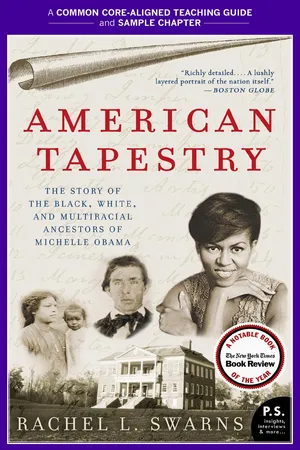
In American Tapestry: The Story of the Black, White, and Multiracial Ancestors of Michelle Obama the author, Rachel L. Swarns, details the recently discovered family history of the First Lady of the United States. It is the remarkable story of an American family that went from slavery to the White House in five generations, and it is a history that provides a very personal and relevant lens with which to view American history from the 1800’s to 2012. Swarns masterfully shows how history can be lost through distance and silence, and then reclaimed using research and DNA technology. Although Michelle Obama’s family’s story deals with a painful chapter in our nation’s history, it is, in the end, both a message of hope and a powerful reminder of the American Dream.
American Tapestry: The Story of the Black, White, and Multiracial Ancestors of Michelle Obama meets the standard for Range of Reading and Level of Text Complexity for all high school grade levels. Schools are encouraged to adopt the text at the grade level where it best fits with ELA and Social Studies curriculum. It is a perfect compliment to courses in American History, American Literature, and Multicultural Literature.
The questions and activities in this teaching guide were written to support standards-based instruction and are directly linked to many of the Common Core State Standards for ELA and Social Studies. The primary areas of connection are in the ELA standards for Reading: Informational Texts for grades 11–12 and in the literacy standards for Key Ideas and Details and Craft and Structure in History/Social Studies. A complete list of the Common Core State Standards can be found at http://www.corestandards.org/the-standards.
BEFORE YOU READ
Ask students to create a family tree from memory. How many generations can they identify? Spend some time discussing how family history gets lost and how it gets preserved. How does it make them feel to think that one day their descendants may not be able to name them? Why is it important to learn about our own family history? CCSS.ELA-Literacy.SL.11-12.1
NOTE TO TEACHERS
American Tapestry reveals a family history that is as rich and complex and the history of our nation. The interwoven narratives may be, at times, a challenge for students to contextualize. As you begin a study of this book, teachers are encouraged to use large sheets of chart paper for each of Michelle Obama’s ancestors to create a family tree in the classroom (a complete genealogy chart can be found on the front and end pages of the book). Students should fill in each person’s chart with key facts and details that they discover during their reading. CCSS.ELA-Literacy.RI.11-12.4
OTHER RESOURCES
For additional guides aligned to the common core, please visit academic.hc.com/commoncore
Prologue
CCSS.ELA-Literacy.RI.11-12.1
CCSS.ELA-Literacy.RH.11-12.1 CCSS.ELA-Literacy.RH.11-12.2
1. Rachel L. Swarns says that Melvinia’s decision to stay in Jonesboro, Georgia after the end of the Civil War was “the only message Melvinia would ever leave.” What message do you think her choice might be sending? What could it suggest about her relationship with the white man that fathered her children?
2. How long did Melvinia stay in Jonesboro before she headed north?
3. How many generations separate Melvinia and her descendant Michelle Obama?
4. When did Michelle Obama learn about Melvinia? How much of her ancestry did she know about when her husband was elected as President of the United States?
5. How many of your direct ancestors (grandparents, great grandparents) do you know by name? How much information do you know about them?
6. How are Jewell Barclay and Joan Tribble connected to Michelle Obama? Describe the similarities and differences between Ms. Barclay and Ms. Tribble.
7. What information about her ancestry did Michelle Obama share with guests at the first Thanksgiving dinner that she hosted in the White House? What did she say about the way learning that one of her direct ancestors had been a slave affected her?
8. How did Ms. Barclay and Ms. Tribble find out about their potential connection to Michelle Obama? Describe their reactions to the news. Why was it more difficult for Ms. Tribble to accept?
9. Describe the primary sources that Ms. Swarns used to research Michelle Obama’s family ancestry.
10. Was it surprising for you to learn how prevalent mixed-race ancestry was in the late 1800s? At that time, was it legal for people of different races to marry or have children together?
11. What factors make it especially difficult to trace the ancestry of many African American families?
12. As First Lady of the United States, how did Michelle Obama bring attention to the issue of slavery?
13. Explain how DNA testing could help answer questions about Michelle Obama’s ancestry.
14. At the end of the prologue, Swarns writes that “Even in these contemporary times, when so many Americans embrace their multiracial roots, there are those among the living would prefer such old secrets to sleep with the dead, to remain untouched, unresolved.” If your family history contained a potentially painful secret, would you want to know about it? Explain your answer.
Part I: Migration
PHOEBE THE WANDERER
CCSS.ELA-Literacy.RI.11-12.4
CCSS.ELA-Literacy.RH.11-12.1 CCSS.ELA-Literacy.RH.11-12.2
1. What are the connotations of the word “wanderer”? What type of personality do you think a person needs to become a wanderer?
2. How long after the Civil War was Phoebe Moten born? Would she have been born free or a slave? Would she have known people that had been enslaved?
3. What are sharecroppers? How is sharecropping different from slavery? How is it similar?
4. How old was Phoebe when she left Villa Ridge and headed north?
5. Define the term “mulatto.” What are the connotations of this word today? What were the connotations of the word in the 1800’s?
6. After the Civil War, why did many people with multiracial roots choose to stay quiet about their parentage?
7. Right after the Civil War, what was life in Villa Ridge like for African Americans? How did it begin to change in the mid 1880s?
8. What personal tragedies preceded Phoebe’s decision to leave Villa Ridge?
9. Who was Phoebe’s first husband? Why did Phoebe select a December wedding date? What tragedy struck shortly after their union? How did this tragedy affect Phoebe?
10. What was “housekeeping”? What were the benefits of this type of work? What were the drawbacks? How did Phoebe’s decision to seek work as a domestic shape the rest of her life?
ST. LOUIS
CCSS.ELA-Literacy.RI.11-12.1
CCSS.ELA-Literacy.RH.11-12.1 CCSS.ELA-Literacy.RH.11-12.2
1. What sorts of stories did Phoebe tell her children? What do these stories reveal about her personality?
2. What record exists to let historians know that Phoebe briefly lived in Edwardsville?
3. Describe Phoebe’s second husband, James Preston Johnson. Why was he a good fit for Phoebe? What secret did she keep from him?
4. Where did Phoebe and James move? What was the city like at the turn of the century?
5. Describe the living conditions for poor immigrants and migrants in the city of St. Louis.
6. What were race relations like in St. Louis? What sorts of opportunities did African Americans have?
7. What did John W. Wheeler, owner of the black newspaper, Palladium, urge parents to do?
8. Where did Phoebe and James go after leaving St. Louis? What events may have led to their decision to move?
SIREN SONG OF THE NORTH
CCSS.ELA-Literacy.RI.11-12.1 CCSS.ELA-Literacy.RI.11-12.4
CCSS.ELA-Literacy.RH.11-12.1 CCSS.ELA-Literacy.RH.11-12.2
1. Explain the allusion in this chapter’s title. What does the use of the term “siren song” f...
Table of contents
- Contents
- Sample Material
- Teacher’s Guide
- Buy the Book
- About the Authors
- Copyright
- About the Publisher
Frequently asked questions
Yes, you can cancel anytime from the Subscription tab in your account settings on the Perlego website. Your subscription will stay active until the end of your current billing period. Learn how to cancel your subscription
No, books cannot be downloaded as external files, such as PDFs, for use outside of Perlego. However, you can download books within the Perlego app for offline reading on mobile or tablet. Learn how to download books offline
Perlego offers two plans: Essential and Complete
- Essential is ideal for learners and professionals who enjoy exploring a wide range of subjects. Access the Essential Library with 800,000+ trusted titles and best-sellers across business, personal growth, and the humanities. Includes unlimited reading time and Standard Read Aloud voice.
- Complete: Perfect for advanced learners and researchers needing full, unrestricted access. Unlock 1.5M+ books across hundreds of subjects, including academic and specialized titles. The Complete Plan also includes advanced features like Premium Read Aloud and Research Assistant.
We are an online textbook subscription service, where you can get access to an entire online library for less than the price of a single book per month. With over 1.5 million books across 990+ topics, we’ve got you covered! Learn about our mission
Look out for the read-aloud symbol on your next book to see if you can listen to it. The read-aloud tool reads text aloud for you, highlighting the text as it is being read. You can pause it, speed it up and slow it down. Learn more about Read Aloud
Yes! You can use the Perlego app on both iOS and Android devices to read anytime, anywhere — even offline. Perfect for commutes or when you’re on the go.
Please note we cannot support devices running on iOS 13 and Android 7 or earlier. Learn more about using the app
Please note we cannot support devices running on iOS 13 and Android 7 or earlier. Learn more about using the app
Yes, you can access A Teacher's Guide to American Tapestry by Rachel L. Swarns,Amy Jurskis in PDF and/or ePUB format, as well as other popular books in History & Historical Biographies. We have over 1.5 million books available in our catalogue for you to explore.