This rich and rewarding volume collects more than two dozen of the most memorable opening and closing arguments made by top prosecutors and defense attorneys of the last one hundred years. Carefully selected to explore every major aspect and challenge of the legal process, these speeches highlight the tactics and strategies, colorful language, and stirring rhetoric that lawyers use to win judge and jury to their side. With a shrewd eye for courtroom stratagems and a keen understanding of the social currents that shape them, Manhattan assistant district attorney Joel Seidemann introduces and illuminates each speech from an insider's perspective. Arguments from landmark trials are included to reveal the smartest tricks of the trial lawyer's trade and demonstrate the power of an impassioned presentation to tip the scales toward the fulfillment of justice.
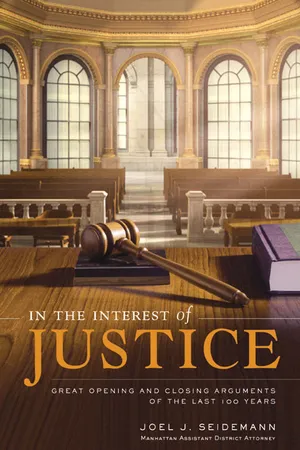
- 384 pages
- English
- ePUB (mobile friendly)
- Available on iOS & Android
eBook - ePub
About this book
Information
1
A Tale of Two Verdicts
The O. J. Simpson Case
ON THE EVENING OF June 12, 1994, Steven Schwab of Brentwood, California, was walking his dog near his home when he saw an Akita standing and barking loudly in the middle of the street, its legs and paws covered in blood. Failing to find the animal’s owner, Schwab left it in the temporary care of a neighbor, Sukru Boztepe, who then took the apparently ownerless dog for a walk. Instantly, it pulled him in the direction of a walkway leading to a nearby condominium, where Mr. Boztepe made a gruesome discovery: the body of a young woman lying dead in a pool of blood, with stab wounds to her neck and a gaping slash across her throat. He immediately called the police to the scene, where they discovered the dead body of a young man with knife wounds to the neck, leg, chest, and stomach only a few feet away from the woman. The female victim was Nicole Brown Simpson, the estranged wife of former football star and sportscaster O. J. Simpson, and the young man was Ronald Goldman, whose kindness in returning a set of eyeglasses cost him his life.
This unlikely discovery in an affluent suburb of Los Angeles launched a new chapter in the annals of American legal jurisprudence, obsessing the media, dividing the country, and generating a wave of tragic pop-culture notoriety unseen since the murders of John F. Kennedy and John Lennon.
Within days of the double murder, the Los Angeles Police Department focused on Simpson as the likely killer and offered him the chance to surrender. Instead of turning himself in, he slipped out of the home of his lawyer, Robert Kardashian, and took off in his Ford Bronco, leading the police on a sixty-mile car chase involving more than twenty-five police cars. As his friend drove the getaway car, O. J. sat in the back, holding a Magnum pistol to his head and threatening to kill himself. This surreal car chase was broadcast live all over America and much of the world. It was a moment so indelible in the collective consciousness that most people still remember where they were when they watched the events on television.
O. J. Simpson was famously prosecuted twice: first in criminal court, where he was acquitted of first-degree murder charges after an eleven-month trial and less than four hours of deliberations, and then in civil court, where he was found guilty of the wrongful death of Ronald Goldman and the battery with oppression and malice of both Goldman and Nicole Brown Simpson. I have featured the opening argument in the civil case first because it offers a much clearer narrative of the night’s dreadful events.
Sharon Rufo Et Al. v. Orenthal James Simpson
Excerpts from Plaintiff Attorney Daniel Petrocelli’s Opening Statement, October 1996
On a June evening, the twelfth of June, 1994, Nicole Brown Simpson just finished putting her ten-year-old daughter, Sydney, and her six-year-old son, Justin, to bed. She filled her bathtub with water. She lit some candles, began to get ready to take a bath and relax for the evening.
The phone rang. It was 9:40 P.M. Nicole answered. It was her mother, saying that she had left her glasses at the restaurant nearby in Brentwood, where the family had all celebrated Sydney’s dance recital over dinner, just an hour before. Nicole’s mother asked if Nicole could please pick up her glasses from the restaurant the next day. Nicole said, of course and hung up.
Nicole then called the restaurant and asked to speak to a friendly young waiter there. Nicole asked this young waiter if he would be kind enough to drop her mother’s glasses off. The young man obliged and said he would drop the glasses off shortly after work, on his way to meet his friend. The young man’s name was Ron Goldman. He was twenty-five years old.
With the glasses in hand, Ron walked out of the restaurant to his apartment nearby, to change. He left the restaurant at 9:50 P.M. After Ron changed, he got into his girlfriend’s car, parked in his garage, and drove the short distance to Nicole Brown Simpson’s home at 875 South Bundy Drive in Brentwood. Ron parked the car on the side street, walked to the front of Nicole’s condominium, and turned up the walkway to the front gate. Just past the front gate were steps leading to Nicole’s condominium.
Ronald Goldman never made it past those steps. It was at that front gate that Ron spent the last few savage minutes of his life. It was there that his brutalized body was found next to Nicole Brown Simpson’s slain body, with her mother’s glasses lying next to him on the ground in an envelope. Ron Goldman’s young life ended because he agreed to do a friend a favor, only to come upon her rageful killer and his.
He might have run from danger, but he did not. Ron Goldman died, ladies and gentlemen, with his eyes open. And in the last furious moment of his life, Ron saw through those open eyes the person who killed his friend Nicole. And for that reason he too, had to die. And the last person Ron Goldman saw through his open eyes was the man who took his young life away: the man who now sits in this courtroom, the defendant, Orenthal James Simpson. Ladies and gentlemen, we will prove to you that Ronald Goldman and Nicole Brown Simpson died at the hands of the defendant.
My name is Daniel Petrocelli. With me are Edward Medvene, Peter Gelblum, Yvette Molinaro, Thomas Lambert. We all represent the Estate of Ronald Goldman and Ronald’s father, Fred, in this, his last fight for justice for his son.

In this trial we will present to you an extraordinary amount of evidence undeniably pointing to O. J. Simpson as the person who killed Ronald Goldman and Nicole Brown Simpson on the evening of June twelve. This evidence includes Mr. Simpson’s blood leaving the scene of the murder at Nicole’s condominium; his blood dripping to the ground from the fingers of his left hand; Mr. Simpson’s blood on the glove he wore when he killed Ron and Nicole; Mr. Simpson’s blood in his car that he used to drive from Bundy to his home at Rockingham, five minutes away; Mr. Simpson’s blood on the driveway of his home; Mr. Simpson’s blood inside his home; Ron’s blood in Mr. Simpson’s car; Nicole’s blood in Mr. Simpson’s car; Ron’s blood on Mr. Simpson’s glove; Nicole’s blood on Mr. Simpson’s glove; Nicole’s blood on the socks in Mr. Simpson’s bedroom; Mr. Simpson’s own blood on his socks; Mr. Simpson’s size-twelve shoe prints in the blood of Nicole, leaving the scene of the murder, exiting toward the back of the condominium; hair matching Mr. Simpson’s hair in the knit cap he left behind at the scene of the murders; hair matching Mr. Simpson’s hair on Ronald Goldman’s shirt; strands of Nicole’s hair and Ron’s hair on the glove Mr. Simpson dropped on the side of his house, trying to get onto his property so no one would see him; rare carpet fibers from Mr. Simpson’s Bronco found in the knit cap that he left at the scene of the murders; matching blue-black cotton fibers found on Ronald Goldman’s shirt; the glove at Rockingham and Mr. Simpson’s socks in the bedroom, tying all three together; cuts and bruises to Mr. Simpson’s left hand during his brief but violent attacks on Ron and Nicole, cuts that to this day Mr. Simpson cannot and will not explain.
We will prove to you that Mr. Simpson has no alibi during the time when the murders were committed. He cannot identify a single person who can account for his whereabouts during the time of the murders. Not one person will take this stand and testify that he was with Mr. Simpson or spoke to Mr. Simpson during the time of these murders.
We will prove how Ron and Nicole were killed quickly and savagely. They were defenseless against a man so large, powerful, strong, armed with a six-inch knife, and in a total state of rage. Nicole had no chance to fight, and died within moments of the gaping cut to her throat. Ron tried to fight, but, trapped in a small, caged area, he was cut down swiftly.
We will prove to you that Mr. Simpson committed the murders and sped back home, just in time to drive to the airport and catch a plane that he desperately needed to catch to have any hope of an alibi. In his extreme panic and hurry, Mr. Simpson left behind a trail of incriminating evidence, starting right at the murder scene and leading right into his bedroom.
We will prove to you that Mr. Simpson was embroiled in a deeply emotional conflict with Nicole Brown Simpson after she had just ended any last attempt at reconciliation between the two. We will describe to you the rejection and pain this caused Mr. Simpson in detail, the buildup of tension, emotion, and anger between Mr. Simpson and Nicole in the last weeks and days leading up to her murder.
We will prove that Mr. Simpson killed Ronald Goldman because he would have been a witness to the rageful attack and murder of Nicole, a witness who would have testified in this trial, a young man who simply, and frankly, happened to be at the wrong place at the wrong time.
We will prove to you how Mr. Simpson’s own words and actions following the murders revealed then, and still reveal today, his guilt for these deaths. You will hear Mr. Simpson on tape, just hours after the murder, unable to explain his actions during the time of the murders. You will hear him make very incriminating statements that he will now try to contradict.
We will tell you about Mr. Simpson’s flight from the police when they came to arrest him and his apparent thoughts of taking his life, thoughts that are consistent only with a person who had killed and that are totally inconsistent with a man whose children had just lost their mother at the hands of a stranger. You will hear how this man came back to Los Angeles on the day after the murders and huddled with lawyers, rather than huddle with his children.
| MR. BAKER: | I object, Your Honor. That’s argument. |
| THE COURT: | Sustained. |
| MR. PETROCELLI: | We will reveal to you lies and deceptions in the sworn testimony of Mr. Simpson when questioned under oath for the first time about his involvement in these murders. We will prove to you that when asked all the important questions about his involvement in these murders, O. J. Simpson could not, would not, and did not tell the truth. |
| And finally, ladies and gentlemen, we will show that when faced with the truth of his blood, his hair, his clothing, his gloves, his shoes, his Bronco, his rage, his motive, his words, and his actions, you will see how Mr. Simpson in this trial will resort to theories of police conspiracies, frame-ups, cover-ups and incompetence, to try to explain away all of the incriminating evidence. And we will show you that there is not one ounce of proof, and not one ounce of truth, to any of these things. | |
| We will demonstrate to you that far from these theories born out of desperation, there is only one. | |
| MR. BAKER: | I object. “Born out of desperation” is argument. |
| THE COURT: | Sustained. |
[PETROCELLI resumes.]
We will prove to you that there is only one real and true and honest answer why all the evidence in this case points to O. J. Simpson. And that is because he is the person who killed Ronald Goldman and Nicole Brown Simpson.
I’d like to start with talking about the two victims in the case, Ronald Goldman and Nicole Brown Simpson. Ron grew up in Illinois. His parents got divorced when he was a young boy. He and his little sister, Kimberly, went to live with their father, Fred. When Ron was eighteen, Ron, Kim, Fred, and Fred’s new wife, Patty, all moved to Agoura, California. Ron took to Southern California like a fish to water. He excelled at tennis; he loved to play softball. He got a job taking care of cerebral palsy patients. He was the only person at Pierce College who applied for a job helping to take care of inner-city kids to turn their lives around.
He was twenty years old when he moved out of his family’s home, eventually winding up in Brentwood, where he loved the friendly atmosphere. He was a happy, outgoing, always smiling, handsome young man, who made friends quickly. He worked in odd jobs here and there to support himself. He did a little modeling, and he dreamed of opening up a restaurant. And in February of 1994, to pay the bills, he got a job at a trendy Italian restaurant called Mezzaluna, as a waiter.
He was single. He had a girlfriend; he had lots of friends; he loved his family; he was one of those people who was always there for others, and ultimately he died doing that. He was a young man, barely twenty-five years old, with his whole life ahead of him.
Nicole Brown Simpson was thirty-five years old when she was killed. She was recently divorced from her ex-husband, O. J. Simpson. She had her two children living with her, Sydney and Justin. She was a full-time devoted mother. She lived in a condominium in Brentwood.
She met Mr. Simpson at the age of eighteen, right after high school. And from that moment they were together. They lived together; they were married in 1985, and they had two children. They had a very tempestuous relationship, passionate at times, violent at other times, one of those relationships where they couldn’t live with each other and they couldn’t live without each other.
Nicole left Mr. Simpson in January of 1992, filed for divorce, and moved into her own apartment with her children. A year or so later, the divorce was final. After the divorce was final, she and Mr. Simpson decided they would try and reconcile, not living together, but they would start dating. This was about spring of 1993. They then spent the next year, till about three weeks before her death, trying to make this reconciliation work. Three weeks before she was killed, Nicole decided it was not working, and she ended it. One month later she was dead.
O. J. Simpson, the defendant, of course, was a celebrity football star, film actor, and sportscaster, a man who grew up poor and became rich and famous, a charismatic and a charming man, but, in the eyes of the law, a man no different from anyone else.
Now, I’d like to begin the evidence proving the murders by talking about the time when Ron and Nicole were killed. The reason for doing this is simple: After identifying when the murders occurred, we will show you that Mr. Simpson had the opportunity and the time to commit the murders.
We will show you that during this time he has no alibi. Nicole had gone to a dance recital for her daughter, went to dinner at Mezzaluna, left at around 8:30, got some ice cream with the kids, and got home before 9:00, and she put the kids to bed. She received a phone call from her mom at 9:40, asking about the glasses. Her mom asked Nicole to pick them up for her the next day. Instead of picking them up the next day, Nicole called Mezzaluna, spoke to the manager, Karen Crawford, then asked to speak to Ron Goldman and asked Mr. Goldman to bring them over.
Ron left Mezzaluna at 9:50 to go home first, change, and then deliver the glasses. Before Ron left, he spoke to his friend at the restaurant who was tending bar that night, Stewart Tanner, and he made plans with Stewart Tanner and another person to meet together after work in Marina del Rey. Ron then left the restaurant, walked a few minutes to his home, went up to his apartment, and changed out of his waiter’s clothes and put on a pair of jeans, a shirt, and some new shoes. It took Ron about five minutes to get to his apartment. Ron apparently did not shave, from the autopsy pictures that we will show. He left his home and drove his girlfriend’s car a short distance to Nicole’s condominium. He parked on Dorothy Street, around the corner.
He walked up to Nicole’s front gate. The time was sometime after ten o’clock P.M. At 10:50 P.M., fifty minutes later, a man named Louis Karpf, who lived right next door to Nicole’s condominium, walked out to his mailbox on Bundy to pick up his mail, having just gotten back from the airport. He saw Nicole’s dog, a very large Japanese attack dog called an Akita, out in the street, barking. In fact, the dog frightened Mr. Karpf, so he retreated back up onto his property. Then, when the dog moved away, Mr. Karpf continued to his mailbox and got his mail.
A few minutes later, another man is walking his dog from his apartment up the street and around the corner. His name is Steven Schwab. They’re just citizens living in Brentwood. They have no ax to grind. Mr. Schwab came by and saw the dog, Nicole’s Akita, out in the middle of the street on Bundy and Gorham. And he saw that the dog had blood on his paws, on his legs. The time was 10:55 P.M. Mr. Schwab, with his own dog, saw the dog was wandering aimlessly and barking in a very agitated way. And he decided to take the dog and go home, try to find the owner, call up the animal shelter. He got home, wasn’t having any luck, and he asked a neighbor who lived in the same complex, a fellow by the name of Sukru Boztepe, if he could take care of the dog. Mr. Boztepe said sure, and he and his wife started to tend to the dog. And then they decided to take the dog out for a walk, because the dog was agitated, and maybe they could find the dog’s owner. They then took the dog for a walk, and the dog pulled Mr. Boztepe on a leash which Mr. Schwab gave Mr. Boztepe in the direction of Nicole Brown Simpson’s condominium. In fact, right to the sidewalk where the walkway led up to her body. The dog stopped at that point and looked down the walkway. And Mr. Boztepe saw that the dog was staring. And he then looked, and it was extremely dark, even though he was right in front of the sidewalk there. He did not see anything until the dog turned his head toward the bodies, and then Mr. Boztepe looked and saw Nicole’s body laying at the bottom of the stairs in a pool of blood. Mr. Boztepe then quickly raced across the street and knocked on neighbors’ doors to get somebody to call the police. And eventually the police were summoned. They arrived a little after midnight.
So we know that these murders occurred sometime after 10:00, when Ron left his apartment, and sometime before 10:50 when Mr. Karpf saw Nicole’s dog out in the street. And five minutes later Mr. Schwab saw it with blood. There’s anothe...
Table of contents
- Cover
- Title Page
- Dedication
- Contents
- Introduction
- 1: A Tale of Two Verdicts
- 2: Celebrity Crime in the Spotlight
- 3: The Green Beret Doctor of Death
- 4: When Criminals Crave the Limelight
- 5: Street-Crime Sorrows
- 6: An Uphill Battle
- 7: In the Name of 6 Million
- 8: A Victim of the War on Crime
- 9: A War of the Worldviews
- 10: A Confederacy of Dunces
- 11: An Epic Affair
- 12: The Silkwood Mystery
- 13: Carnage in Oklahoma
- 14: A Mother’s Nightmare
- 15: High Times and Nepotism at the Koch Court
- Conclusion
- Sources
- Searchable Terms
- Acknowledgments
- E-Book Extra
- About The Author
- Credits
- Copyright
- About the Publisher
Trusted by 375,005 students
Access to over 1.5 million titles for a fair monthly price.
Study more efficiently using our study tools.
Frequently asked questions
Yes, you can cancel anytime from the Subscription tab in your account settings on the Perlego website. Your subscription will stay active until the end of your current billing period. Learn how to cancel your subscription
No, books cannot be downloaded as external files, such as PDFs, for use outside of Perlego. However, you can download books within the Perlego app for offline reading on mobile or tablet. Learn how to download books offline
Perlego offers two plans: Essential and Complete
- Essential is ideal for learners and professionals who enjoy exploring a wide range of subjects. Access the Essential Library with 800,000+ trusted titles and best-sellers across business, personal growth, and the humanities. Includes unlimited reading time and Standard Read Aloud voice.
- Complete: Perfect for advanced learners and researchers needing full, unrestricted access. Unlock 1.5M+ books across hundreds of subjects, including academic and specialized titles. The Complete Plan also includes advanced features like Premium Read Aloud and Research Assistant.
We are an online textbook subscription service, where you can get access to an entire online library for less than the price of a single book per month. With over 1.5 million books across 990+ topics, we’ve got you covered! Learn about our mission
Look out for the read-aloud symbol on your next book to see if you can listen to it. The read-aloud tool reads text aloud for you, highlighting the text as it is being read. You can pause it, speed it up and slow it down. Learn more about Read Aloud
Yes! You can use the Perlego app on both iOS and Android devices to read anytime, anywhere — even offline. Perfect for commutes or when you’re on the go.
Please note we cannot support devices running on iOS 13 and Android 7 or earlier. Learn more about using the app
Please note we cannot support devices running on iOS 13 and Android 7 or earlier. Learn more about using the app
Yes, you can access In the Interest of Justice by Joel Seidemann in PDF and/or ePUB format, as well as other popular books in Law & Communication Studies. We have over 1.5 million books available in our catalogue for you to explore.