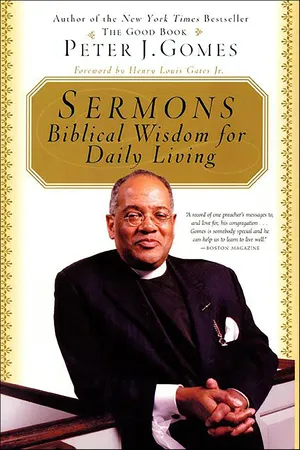
The man Time magazine hailed as one of America's finest preachers presents a collection of forty timeless addresses to guide us through the year. With his characteristic eloquence and compassion, quoting from scripture as well as from T.S. Eliot and Woody Allen, Gomes offers us the tools we need to understand the wisdom of the Bible and the joy and inspiration it can bring to everyday life.
- 256 pages
- English
- ePUB (mobile friendly)
- Available on iOS & Android
eBook - ePub
About this book
Information
Topic
Teologia e religioneSubtopic
CristianesimoPart One
SEASONS
ADVENT 1
The Art of Impatient Living
Text: Be patient, therefore, brethren, until the coming of the Lord.
James 5:7
I am going to ask you to do a very difficult thing, and that is to forget all the seasonal trappings that surround you and seduce you into thinking that Advent has anything at all to do with Christmas as you and I understand it; I wish that there was a way that I could make this all disappear. I want you to clear away all of the “let’s get ready for Christmas” stuff, all of this manufactured cheer and happy expectation of something that once happened; clear the decks, rather, and get ready for something that has not yet happened, for that is the agenda of the entire season of Advent.
Having asked you to do that, now I ask you to think about an extraordinary set of verses from the Epistle of James: “Be patient, therefore, brethren, until the coming of the Lord….” The Lord is coming, not in retrospect, not in a rehearsal of things that happened once long ago. The Lord is coming in a way and in a form that we have not yet experienced. We wait for that which we have not yet seen. We work for that which has not yet been accomplished. That is the Advent agenda, and it is so often thrown off course by Christmas as simply a recollection of something that happened long ago and far away. The world is welcome to Christmas; we Christians hardly have any claim on it at all anymore; but Advent and its expectations, its call for patience, its earnest waiting—that belongs to us, and how we reconcile the patience of Advent with the impatience of human, modern living is the problem and the opportunity of the moment.
Now one of the reasons that the Bible and the Christian faith lack credibility to most of us, one of the reasons that they are both unbelievable and uncompelling, is that they ask us to do things that are manifestly undoable. They ask us to believe things that, if not believable or true, are at least unlikely. One of the reasons that the Advent season is manifestly an unsatisfactory season for Christians is that it, too, is based on assumptions too difficult to accept, expectations too unreal to contemplate, a phantom of truths that do not conform with the facts.
We know what we are meant to believe; the lessons tell us, the prayers tell us, the hymns are full of it. Light over darkness, hope over despair, gentleness and meekness over might and power—these are all the clichés of Advent. We know that Advent is not meant to be merely a retrospective of things past but an anticipation of things to come. Advent is not Christmas but judgment, not cheap synthetic joy but divine and ultimate justice, and we know that as well.
Somehow we hope that the church will be that place where our impossible expectations and our manifest needs are met and reconciled. That is presumably why we keep coming week after week and year after year. We know that Jesus says that the meek shall inherit the earth but we do not believe that that is likely, or likely in any reasonable time. We know that we are to forgive those who have hurt us, but we also know that except in rare and wonderful circumstances it is very difficult to bring ourselves to do it. Today in James’s epistle we hear that we are to be patient unto the coming of the Lord—yet one more case of a faith that is too good to be true, of human aspirations flying in the face of human nature.
It is not our nature to be patient. I know this, for I am among the most impatient of people. Patience, some would say, like modesty, belongs to those who need it, and most people who need patience are people who have not yet succeeded in their ambition or their enterprise, people who have not yet achieved, either by their own standards or by our standards. In other words, patience is for failures, for losers, for wimps, for those who have to take the long view because they cannot succeed in the short run. Notice that it is always the achiever who tells the less-than-achieved to be patient, and how patronizing and silly it sounds. First it sounds patronizing and silly to the one who wants to succeed and who has not, and to whom the counsel of patience is discouraging. All piano students, for example, and all beginning athletes know this. Someone who is wonderfully adept at the piano says, “Oh, be patient. It will come.” You don’t believe it, and it is not a counsel of encouragement, it is a counsel of discouragement; and to the one who is not interested in achieving the skills in the first place, a counsel of patience is a further irritant and hardly a stimulus. All bad students of mathematics and arithmetic, for example, and all bad students in Hebrew, in Greek, in Latin, and in French know this. If you don’t care, and you’re not good, and someone tells you to be patient, that is an insult and an irritant.
Patience implies passivity, and we wish not to be passive, we wish not merely to be spectators at somebody else’s spectacle of achievement. We want to do what it takes to get things done. We want the more agreeable counsel of James earlier in his epistle where he says, “Be ye doers of the word and not hearers only.” That we can understand, for practical, sensible, questioning Christians like ourselves want always to know what we can do. We don’t want to hear what we must endure or bear or suffer through. We don’t want to be told to wait. We want to get on with it, whether it is worth getting on with or not.
We are not given to waiting. We are not willing to accept the principle that James offers: “Behold, we call those happy who were steadfast.” We know that no one gets anywhere by being patient. “Be patient, therefore, brethren, until the coming of the Lord. Behold, the farmer waits for the precious fruit of the earth, being patient over it until it receives the early and the late rain. You also be patient.” Rural, bucolic advice for others but not for sensible urbanites such as ourselves.
My father was a farmer, and he raised that most rare and exotic crop peculiar to New England, cranberries, a tough and exotic piece of fruit not given to easy entreaty or easy growth. Cultivation of the cranberry is a very delicate and demanding art, for it is as difficult to raise as it is tart to taste, which moral tale was early implanted upon me, this son of a cranberry grower. I watched my father at work all of his life, indeed, to nearly the very day of his death, working the ground; and whenever I think of my father I think of this text from James about the farmer patiently waiting for the early and the late rains, and when I read that text in James, I invariably think of my father. Whenever I do this remembering I am reminded that while patience is the essence of farming, the farmer is anything but a passive participant in the process. The farmer is not passive. To farm is to live all of one’s hours in and for one’s work. Bankers, lawyers, teachers, generals, engineers, and academics know nothing of what real vocational commitment is, but the farmer eats, sleeps, and drinks every day that process of activity and of patience.
One day when we were in the garden and I a young fellow, I told my father that I thought I wanted to go into the ministry. He looked at me, and he said, without changing any one of his attitudes toward his hoeing, “I always hoped that my son would do honest work.” I knew what he meant. The farmer lives in proximity to two ultimate truths, which are held in balance by the authority of his own experience. Ultimate truth number one is that the harvest is the result of incredible patience; and ultimate truth number two is that the harvest is the result of incredible work. Yes, he waits and hopes for the autumn and the spring rains, and there is nothing that he can do to induce them. That is where patience comes in. That is where relying on forces beyond one’s control comes in. In that season of waiting, however, he is hardly idle, for the farmer does all the work that can and must be done, knowing that time and God alone will bring to fruition what he expects and assists. I have never known an idle farmer who was a good farmer. It is constant work, but the work is full of expectation and fueled by labor and experience. The farmer knows that what is expected is worth waiting for. The farmer also knows that what is worth waiting for is also worth working for, and that is why the farmer is commended by James in this most practical of epistles. James is not writing to farmers, he is writing to a fairly sophisticated audience of people like ourselves who, in having lost the use of their hands in the fields, are now held hostage to the fantasies and disappointments of their minds.
Now, aside from the useful counsel of patience in the face of our natural and reasonable impatience, what is it for which we are encouraged to wait? What is the harvest toward which we promise the incredible energy of our impatience? Well, hold on to your seats, for it is nothing less than the coming again in glory of Jesus Christ! That is what we wait for, the return of the Lord, and not as a tiny baby or as an idea mugged by a gang of angry facts and circumstances, but as the fruition of the divine plan and human hope; and in the second time round it will be got right. The second coming of Jesus is rarely phrased in terms of births and babies and attendant angels; it is almost invariably phrased in terms of ideas that have been translated into ideals, and ideals that are translated into reality. The second coming of Jesus is accompanied by truth triumphant over mere fact, by justice and righteousness and mercy triumphant over a mere accommodation with present circumstances, of joy triumphant over mere pleasure, of peace triumphant over the mere absence of overt hostility.
There is no point in waiting for a return of something that never was. There is no hope in history, no age, no season to which we could return when everything would be fine. There is no place where it works. In essence, there is no place better than where we are right now, and where we are right now doesn’t work. So the only place where we can invest, where there is a harvest worth aspiring to, is in the future, and it is given flesh and blood and bone and purpose in the form of Jesus Christ. We look forward to a new heaven and a new earth in which the promise of the creation is to be fulfilled.
This is the language of Advent, and you can understand in some measure why the world is quite content to leave it to us. It is ours without claim or competition, for one cannot make a growth industry out of Advent expectations. This is not merely a “waiting around for something interesting to happen,” but, as with the farmer, a working for that for which we wait. That is what, for Christians, the art of impatient living is all about: working well for that for which we wait. Waiting alone will not do. Working for the sake of keeping out of mischief and keeping busy will not do. Working well for that for which we wait, that is the essence of our peculiar Advent hope.
If you want an example of the pattern of which I speak, look not to yourselves nor even to your neighbors, but look to God. Look at God, who is the personification of patience itself; God, who does not give up on the creation although there is plenty of opportunity and reason to do so; God, who does not give up on his creatures; God, who will not throw away the opportunity for redemption until you and I are in fact ready to be the harvest of God. The patience of God, not of Job, is what it takes to turn our impatience from action in the absence of hope to hopeful, hope-filled action in anticipation of hope. Advent hope is not an invitation to easy, silly optimism, nor an invitation to mindless despair or hope held hostage to experience. The only hope worth having and the only harvest worth waiting for is the ultimate confidence which translates the energy of impatience into the art of expectant living in the here and now, of which the farmer is the model.
Be patient, therefore…until the coming of the Lord. Behold, the farmer waits for the precious fruit of the earth, being patient over it until it receives the early and the late rain. You also be patient…for the coming of the Lord is at hand.
ADVENT II
Hail, Mary, Full of grace
Text: And Mary said, “Behold, I am the handmaid of the Lord; let it be to me according to your word.”
Luke 1:38
You will doubtless recognize the title of my sermon as the opening words of the most famous and widely used form of Roman Catholic devotion, the “Hail, Mary” or “Ave Maria.” “Hail Mary, full of grace, the Lord is with Thee. Blessed art thou among women, and blessed is the fruit of thy womb, Jesus.” We have heard it on the radio at the noon hour; we hear it as the last words of faithful Catholics before their deaths; we know it as the inspiration of music and poetry; and we doubtless never expected to hear a sermon on it in The Memorial Church, for familiar as the words are, and as universal as is our respect and even affection for Mary, we children of the Reformation simply do not know what to do with Mary.
The story is told that when Dean William Ralph Inge, the late “gloomy dean” of St. Paul’s Cathedral in London, died and was ushered into the presence of God, Jesus came down from God’s right hand and said, “Ah, Mr. Dean, welcome to heaven; I know you have met my Father, but I don’t believe you have met my Mother.” Who is this woman, we might ask, and why are they making such a fuss over her? Part of our problem with Mary is, I suspect, that we know her to be a woman, and we believe her to be a Catholic, and even in these enlightened days far removed from the intolerance of an earlier time, such an identity creates a problem for us Protestants. Yet it is impossible to consider the advent of our Lord and the will of God in that advent without considering this woman who becomes for us the means of the new creation. We are not certain what to do with her but the question is wrongly put, for it is not so much what we are to do with Mary as it is what God does with Mary. How is she used as an instrument of his purpose?
Someone has said that the angel Gabriel has a lot to answer for, for it is he who interrupts what we might imagine to be the ordinary routine of the life of this young woman about to be married to a carpenter of Nazareth. It is clear that his visit to her was neither anticipated nor particularly welcomed: “But she was greatly troubled at the saying, and considered in her mind what sort of greeting this might be.” So much troubled was she that reassurances were needed, and the angel said to her, “Be not afraid, Mary, for you have found favor with God.”
It is not an easy thing to be confronted with a message from God. We pray that God will hear our prayers and draw near to us; we pray with ease, and some of us with frequency, but perhaps we pray with such ease and relative frequency because we do not expect any response. Good and faithful people have got along quite well enough with God where he ought to be; the trouble begins when God begins to have more than his usual distant commerce with us. The summons to Mary, for that is what it was, was no different from the summons to Moses, Abraham, Isaiah, and Jeremiah. They all found themselves surprised by the call of God; they all found themselves annoyed, not so much at their own unworthiness for such a high calling, for that would came later, but annoyed at the more practical level of inconvenience. Moses, Abraham, Isaiah, Jeremiah, and Mary, especially Mary, all had other things to do, important, urgent things, the fulfillment of their own destinies, the carrying forth of their own lives, choices, options, and challenges. Mary joins the line of unwilling and troubled prophets for whom God’s call is an unsolicited interruption of the routine: “She was greatly troubled at the saying, and considered in her mind what sort of greeting this might be.”
“Why me?” “Why now?” “Why Mary?” What had she done to deserve this distinction? Is there some particular virtue or worthy quality in her life that commends her to the attention of God? The angel says simply, “Hail, O favored one” or, as the Authorized Version has it, “Hail, thou that art highly favored.” The salutation tells the tale: “Hail, Mary, full of grace,” for the angel means to say to her that she is chosen not because of her special grace and quality but rather that she is full of grace and filled with favor because she is chosen by the will of God. God does not choose us to fulfill his purposes because we are worthy of such a choice, or because we are good enough to do what he wishes; we have not won some prize competition, or passed a Rhodes scholarship final interview, as it were. No. God chooses for reasons known only to him, and it is the choice that confers the favor. When God chooses you, you are chosen. Just as there was no particular reason for God to choose Israel as his peculiar people, there was no reason, at least known to us, to choose Mary as the mother of Jesus.
We waste our time in seeking out the special hidden, secret qualities that commend God’s choices to him; to be God means never having to exp...
Table of contents
- Dedication
- Contents
- Foreword
- Introduction
- Part One: Seasons
- Part Two: Themes
- About the Author
- Also by Peter J. Gomes
- Copyright
- About the Publisher
Trusted by 375,005 students
Access to over 1.5 million titles for a fair monthly price.
Study more efficiently using our study tools.
Frequently asked questions
Yes, you can cancel anytime from the Subscription tab in your account settings on the Perlego website. Your subscription will stay active until the end of your current billing period. Learn how to cancel your subscription
No, books cannot be downloaded as external files, such as PDFs, for use outside of Perlego. However, you can download books within the Perlego app for offline reading on mobile or tablet. Learn how to download books offline
Perlego offers two plans: Essential and Complete
- Essential is ideal for learners and professionals who enjoy exploring a wide range of subjects. Access the Essential Library with 800,000+ trusted titles and best-sellers across business, personal growth, and the humanities. Includes unlimited reading time and Standard Read Aloud voice.
- Complete: Perfect for advanced learners and researchers needing full, unrestricted access. Unlock 1.5M+ books across hundreds of subjects, including academic and specialized titles. The Complete Plan also includes advanced features like Premium Read Aloud and Research Assistant.
We are an online textbook subscription service, where you can get access to an entire online library for less than the price of a single book per month. With over 1.5 million books across 990+ topics, we’ve got you covered! Learn about our mission
Look out for the read-aloud symbol on your next book to see if you can listen to it. The read-aloud tool reads text aloud for you, highlighting the text as it is being read. You can pause it, speed it up and slow it down. Learn more about Read Aloud
Yes! You can use the Perlego app on both iOS and Android devices to read anytime, anywhere — even offline. Perfect for commutes or when you’re on the go.
Please note we cannot support devices running on iOS 13 and Android 7 or earlier. Learn more about using the app
Please note we cannot support devices running on iOS 13 and Android 7 or earlier. Learn more about using the app
Yes, you can access Sermons by Peter J. Gomes in PDF and/or ePUB format, as well as other popular books in Teologia e religione & Cristianesimo. We have over 1.5 million books available in our catalogue for you to explore.