![]()
CHAPTER 1
ONE AFTERNOON not long ago, on a welcoming cool day toward the end of summer, a twenty-nine-year-old woman named LaSheena sat on the hood of an SUV outside the Dearborn Homes, a housing project on the South Side of Chicago. She had a beaten-down look in her eyes but otherwise seemed youthful, her pretty face framed by straightened hair. She was dressed in a baggy black-and-red tracksuit, the kind she’d worn since she was a kid. Her parents rarely had money for new clothes, so she used to get her male cousins’ hand-me-downs, and the habit stuck.
LaSheena was talking about how she earns her living.
She described four main streams of income: “boosting,” “roosting,” cutting hair, and turning tricks.
“Boosting,” she explained, is shoplifting and selling the swag. “Roosting” means serving as a lookout for the local street gang that sells drugs. She gets $8 for a boy’s haircut and $12 for a man’s.
Which job is the worst of the four?
“Turning tricks,” she says, with no hesitation.
Why?
“ ’Cause I don’t really like men. I guess it bothers me mentally.”
And what if prostitution paid twice as much?
“Would I do it more?” she asks. “Yeah!”
THROUGHOUT HISTORY, IT has invariably been easier to be male than female.Yes, this is an overgeneralization and yes, there are exceptions, but by any important measure, women have had it rougher than men. Even though men handled most of the warfare, hunting, and brute-force labor, women had a shorter life expectancy. Some deaths were more senseless than others. Between the thirteenth and nineteenth centuries, as many as 1 million European women, most of them poor and many of them widowed, were executed for witchcraft, taking the blame for bad weather that killed crops.
Women have finally overtaken men in life expectancy, thanks mainly to medical improvements surrounding childbirth. In many countries, however, being female remains a serious handicap even in the twenty-first century. Young women in Cameroon have their breasts “ironed”—beaten or massaged by a wooden pestle or a heated coconut shell—to make them less sexually tempting. In China, foot binding has finally been done away with (after roughly one thousand years), but females are still far more likely than males to be abandoned after birth, to be illiterate, and to commit suicide. And women in rural India, as we wrote earlier, continue to face discrimination in just about every direction.
But especially in the world’s developed nations, women’s lives have improved dramatically. There is no comparing the prospects of a girl in twenty-first-century America or Britain or Japan with her counterpart from a century or two earlier. In any arena you look—education, legal and voting rights, career opportunities, and so on—it is far better to be a woman today than at any other point in history. In 1872, the earliest year for which such statistics are available, 21 percent of college students in the United States were female. Today, that number is 58 percent and rising. It has truly been a stunning ascendancy.
And yet there is still a considerable economic price to pay for being a woman. For American women twenty-five and older who hold at least a bachelor’s degree and work full-time, the national median income is about $47,000. Similar men, meanwhile, make more than $66,000, a premium of 40 percent. The same is true even for women who attend the nation’s elite universities. The economists Claudia Goldin and Lawrence Katz found that women who went to Harvard earned less than half as much as the average Harvard man. Even when the analysis included only full-time, full-year employees and controlled for college major, profession, and other variables, Goldin and Katz found that the Harvard women still earned about 30 percent less than their male counterparts.
What can possibly account for such a huge wage gap?
There are a variety of factors. Women are more likely to leave the workforce or downshift their careers to raise a family. Even within high-paying occupations like medicine and law, women tend to choose specialties that pay less (general practitioner, for instance, or in-house counsel).
And there is likely still a good amount of discrimination. This may range from the overt—denying a woman a promotion purely because she is not a man—to the insidious. A considerable body of research has shown that overweight women suffer a greater wage penalty than overweight men. The same is true for women with bad teeth.
There are some biological wild cards as well. The economists Andrea Ichino and Enrico Moretti, analyzing personnel data from a large Italian bank, found that female employees under forty-five years old tended to miss work consistently on twenty-eight-day cycles. Plotting these absences against employee productivity ratings, the economists determined that this menstrual absenteeism accounted for 14 percent of the difference between female and male earnings at the bank.
Or consider the 1972 U.S. law known as Title IX. While broadly designed to prohibit sex discrimination in educational settings, Title IX also required high schools and colleges to bring their women’s sports programs up to the level of their men’s programs. Millions of young women subsequently joined these new programs, and as the economist Betsey Stevenson discovered, girls who play high-school sports are more likely to attend college and land a solid job, especially in some of the high-skill fields traditionally dominated by men. That’s the good news.
But Title IX also brought some bad news for women. When the law was passed, more than 90 percent of college women’s sports teams had female head coaches. Title IX boosted the appeal of such jobs: salaries rose and there was more exposure and excitement. Like the lowly peasant food that is “discovered” by the culinary elite and promptly migrates from roadside shacks into high-end restaurants, these jobs were soon snapped up by a new set of customers: men. These days, barely 40 percent of college women’s sports teams are coached by women. Among the most visible coaching jobs in women’s sports are those in the Women’s National Basketball Association (WNBA), founded thirteen years ago as a corollary to the men’s NBA. As of 2009, the WNBA had 13 teams and just 6 of them—again, fewer than 50 percent—were coached by women. This is actually an improvement from the league’s tenth anniversary season, when only 3 of the 14 coaches were women.
For all the progress women have made in the twenty-first-century labor market, the typical female would come out well ahead if she had simply had the foresight to be born male.
THERE IS ONE labor market women have always dominated: prostitution.
Its business model is built upon a simple premise. Since time immemorial and all over the world, men have wanted more sex than they could get for free. So what inevitably emerges is a supply of women who, for the right price, are willing to satisfy this demand.
Today prostitution is generally illegal in the United States, albeit with a few exceptions and many inconsistencies in enforcement. In the early years of the nation, prostitution was frowned upon but not criminalized. It was during the Progressive Era, roughly from the 1890s to the 1920s, that this leniency ended. There was a public outcry against “white slavery,” in which thousands of women were imprisoned against their will to work as prostitutes.
The white slavery problem turned out to be a wild exaggeration.
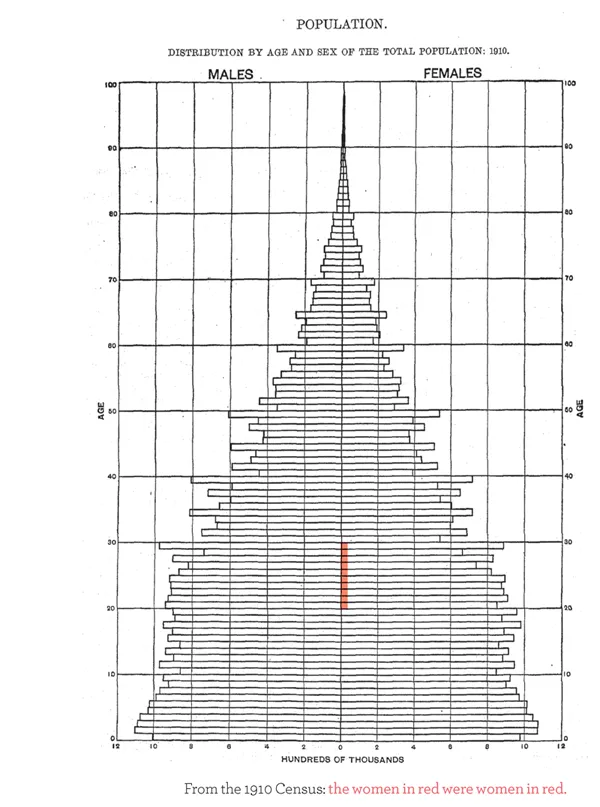
The reality was perhaps scarier: rather than being forced into prostitution, women were choosing it for themselves. In the early 1910s, the Department of Justice conducted a census of 310 cities in 26 states to tally the number of prostitutes in the United States: “We arrive at the conservative figure of approximately 200,000 women in the regular army of vice.”
At the time, the American population included 22 million women between the ages of fifteen and forty-four. If the DOJ numbers are to be believed, 1 of every 110 women in that age range was a prostitute. But most prostitutes, about 85 percent, were in their twenties. In that age range, 1 of every
50 American women was a prostitute.
The market was particularly strong in Chicago, which had more than a thousand known brothels. The mayor assembled a blue-ribbon Vice Commission, comprising religious leaders as well as civic, educational, legal, and medical authorities. Once they got their hands dirty, these good people realized they were up against an enemy even more venal than sex: economics.
“Is it any wonder,” the commission declared, “that a tempted girl who receives only $6 per week working with her hands sells her body for $25 per week when she learns that ...