Read people, bet wisely, and strategize to win: "You'll be able to see what's happening under the surface at work, and prepare for whatever may be ahead." —Marshall Goldsmith, #1
New York Times–bestselling author of
Triggers
In this guide, a career advisor reveals the tells, blind spots, secrets, and unspoken rules you need to know in order to play the game—and even win against those who've been dealt better cards, like high-status college degrees or family connections (or just a more supportive boss).
The most successful people don't rely on luck—because they know it always comes and goes. Instead, they prepare for the setbacks that are inevitable in any job and use smart strategies to manage them. In
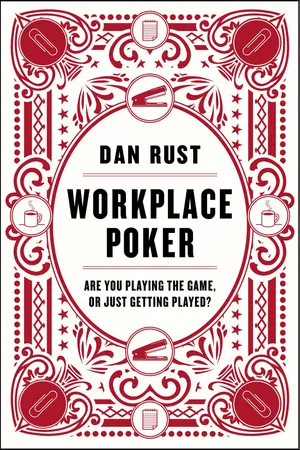
Workplace Poker, Dan Rust gives you the strategies you need to accelerate your career, and prevent setbacks from stalling your progress or spiraling it downward. The trick, he reveals, is to "play the game under the game." If you're talented, ambitious, and hardworking, but feel your career is frustratingly bogged down, you'll find insight and skills to adapt to every hurdle, turning adversity into advantage and struggle into strength, including:
• Recognizing your own "blind spots" and what to do about them
• Mastering strategic and authentic self-promotion
• Enhancing your personal charm and likeability
• Achieving the high energy, both mental and physical, necessary to drive an exceptional career trajectory
• Developing an interest in "corporate anthropology" and the complex human dimensions of business
• Neutralizing the career-stalling impact of difficult or dysfunctional colleagues
• Owning—and learning from—career missteps and failures
Smart, funny, and relatable, Rust shares stories of individuals who've applied these capabilities in real world situations, and provides short, focused exercises to help you think about yourself and your own career. With
Workplace Poker¸ you can get out of you own way—and play to win.
- 304 pages
- English
- ePUB (mobile friendly)
- Available on iOS & Android
eBook - ePub
About this book
Information
Subtopic
Unternehmenskultur1
Poker on a Unicycle
The most profound business lesson of my life occurred more than twenty years ago, mid-afternoon in a bar near the horse racetrack just north of San Diego. The sun was shining brightly outside but the bar was dimly lit and I was sitting in the darkest corner at a table with six men and two women. Even in the low light I could see the anxiety on their faces.
The company we all worked for had abruptly gone out of business that morning. We showed up for work and the doors were locked. A note taped inside the glass of the front door said the business was shut down. Permanently. This was just before payday, so many of us spent the morning making phone calls, trying to get answers and some assurance that we would receive our final paychecks. Although our frantic calls to the home office went unanswered, a few of us did reach people at some of the other regional offices. But nobody seemed to have the full picture of what was happening. We eventually figured out that about half of the regional offices had been shut down. And the other half had been instructed to operate “business as usual” and minimize contact with anyone from the closed regions. So no one wanted to talk to us. And even if they did, no one knew what was going on. After a tense morning, the bar seemed to be a natural choice for a few of us to gather and try to sort things out.
Final paychecks never arrived. Later we discovered that a year earlier the company had spun off half of their regional offices as a separate business with different owners. These were the offices that had just been abruptly shut down. Some spent years trying to chase down the owners and get the back pay to which they were entitled. As far as I know, none of us ever got a dime.
So our small group sat in the bar for most of the afternoon working through the stages of grief and loss. First denial, with imported beer on tap. “This has got to be a mistake. I can see why they would shut down Austin and Oklahoma City, but San Diego? No way!”
Then anger, with shots of tequila. The agave good stuff. “Those damn kiss asses at corporate are all idiots and the little guys always get screwed!”
Then there was bargaining, with a chaotic mix of gin, whiskey, vodka, and one white wine spritzer. (It was the late eighties, so don’t judge.) “Maybe if we reduce our operating expenses and cut back on overtime we could show them how profitable the business here could be!”
We never really got to the acceptance stage, but I did buy a round of brandy for everyone. That was about the point when Tony walked through the door and up to our table. Someone looked up at him and slurred, “’Bout time . . . you gotta casshh up.”
“Sorry, I can’t,” Tony said. “I’ve got a couple of job interviews this afternoon.”
He stood before us, smiling and upbeat and wearing a nice interview suit. We all stared at him silently, the way you look at a strange animal at the zoo—a striped tapir with one red eye, or an ocelot with five legs. Any decent group of human beings would have felt good for him and given him encouragement. All he got from us was “What the hell?”
Tony had been a telemarketer, relatively low on the corporate totem pole, spending most of his working days in a cubicle talking to prospective customers on the telephone. We didn’t interact with him much at work, but we all liked him. He kept his head down, did his job well, and always seemed to be in a good mood.
He sat down with us and asked the waitress for a glass of ice water. He was annoyingly peppy and pleasant, sipping at his stupid cold water and trying to cheer us up. When someone asked him how he got a job interview so quickly he said, “It wasn’t quick really, these interviews have been in the works for a while.”
“These interviews? Meaning more than one?” I asked.
“Yeah, I’ve got a few solid opportunities in the works. And the one this afternoon is my third at the company, I think they’re going to make me an offer today.”
We all watched as the ocelot grew another leg. “What the hell?” someone said again. It might have been me.
“Come on, you guys,” Tony said. “This couldn’t have been a big surprise to you. The only shocker is that it took this long for them to shut down the business.” He went on to describe things he had seen and heard over the past year that led him to the conclusion our office was doomed along with seven other regional locations. So of course he had started interviewing for a new job many months ago.
Tony seemed to know things he just couldn’t (or shouldn’t) know. Somehow he knew how each of the regional offices ranked in terms of profitability, although this information was tightly protected by the corporate home office. He knew that our region and seven others were actually owned by a separate corporate entity. He knew some of our competitors had heard rumors about how the business might be consolidated and high-value real estate might be sold off because the founder was “cashing out” in advance of an ugly divorce. Tony didn’t have the time to explain how he acquired all of this information because he had to leave for his job interview.
We wished him good luck as he headed off, then proceeded to snidely rip him apart once he was gone. “Who do you suppose he’s screwing at the home office?” someone asked. We continued drinking until happy hour ended and the prices tripled (and there were no more free drinks for the ladies). By then we all agreed that Tony must have done something illegal or unethical to get so much inside information, and while we certainly would have liked to be interviewing for new jobs just as quickly, it was better to have higher standards. Or something stupidly self-righteous like that.
A few weeks later I had lunch with Tony. By then the alcohol had worn off, Tony was happily at work in his new role as a telemarketing manager, and I was sending out tons of résumés to prospective employers. My head was clear—the panic of joblessness will do that for you—and I really wanted to know more about how Tony had seen the troubles coming long before they actually arrived.
We had a lengthy and illuminating conversation, but I’ll give you the short version. Tony wasn’t sleeping with anyone at the home office. He didn’t have unique access to information that any one of us could not also have acquired. But he did pay attention in a way the rest of us didn’t. He noticed things and looked for things the rest of us ignored.
Tony talked to me about his perception of many of those we worked with. He noted their individual communication styles, what seemed to motivate them and how they made decisions.
“Do you ever notice how the district director really chooses his words carefully, while the vice president is more open and willing to just talk with us casually, like a real person?” he asked. I nodded. I really liked the VP’s personality and communication style. “Well, I think it’s because the director really isn’t comfortable giving us false information, so he carefully chooses his words. But the vice president, he’s totally comfortable with just saying whatever he needs to, with a big smile, whether it’s true or not.”
I was surprised that Tony’s take on the two men was so different, and obviously more accurate, than my own. I wondered why a guy who did most of his work in a cubicle, with minimal interaction, had even bothered to think about these things. And beyond the thinking, the fact that he was so discerning, that he was able to see so deeply into the personalities and characteristics of these people, it frankly floored me.
In addition, Tony had carefully observed how our key leaders communicated and interacted with employees, so when they sent out memos, gave speeches, or visited the office to check in on the staff, Tony was reading between the lines, discerning the reality behind the corporate-speak. He wasn’t judgmental or critical as he described this to me. If anything he was flat and unemotional—like a psychologist with a patient on the couch—he just observed carefully and noted their behaviors.
At our last company holiday party Tony noticed that the founder’s wife was absent, while in the past she had been heavily involved in every aspect of planning and was always a significant presence at these events. We were told that she wasn’t feeling well. Tony didn’t buy it, especially after he met the founder’s new lovely young “assistant.”
When a few of our key employees left the company to work for a competitor, Tony maintained friendships with them and was able to stay current with what our competitors were learning and saying about our business. Sometimes competitors know what’s happening within a company long before the employees do.
When our paychecks were suddenly issued by a new bank and the corporate name on the checks was slightly different, the rest of us just shrugged it off as a minor curiosity. Tony, on the other hand, did the research to find out what was behind the change. This led him to understand that the business had been split into two separate corporate entities. Operationally almost nothing had changed, so the rest of us didn’t really notice. But in the end, when we were trying to get our final paychecks, it was a big deal.
The point of sharing these details with you is not to revisit painful events that occurred over twenty years ago. I have a therapist for that. The point is to highlight the huge lesson I received from Tony. His deeper understanding of our work environment allowed him to be better prepared, to plan for and not be ambushed by a sudden turn of events. While most of the rest of us spent many months looking for new jobs (often settling for less than what we really wanted), Tony was able to be proactive and drive his job search from a position of strength. From that day forward I saw the value of Tony’s insight and I began to pay closer attention to the people I worked with.
Over the years I’ve met many more “Tonys” who strive for a deeper understanding of the people with whom they work. They are able to deal more productively with a broad range of individuals, they are able to navigate office politics more effectively, and all of this helps them gain a more accurate and thoughtful perception of the particular corporate culture within which they work. I have come to view this ability—really a set of skills and capabilities—as the single most reliable predictor of one’s career success.
It’s tempting to oversimplify what it takes to read people well. Humans are complex creatures and to truly discern an individual’s motivations, fears, wants, needs, perceptions, habits, and attitudes can seem overwhelming and inherently imperfect. This is why so many people just overlook what’s happening beneath the surface of human actions. It’s easier to just put your head down and focus on doing good work, hoping that will be enough. Often it isn’t.
But the complexity presents an opportunity. This is why jury consultants are highly paid to divine a prospective juror’s mind-set, why successful negotiators focus on psychology as much as deal terms, and why poker players who can read their opponents well are able to win big—sometimes millions of dollars big.
TOUGHER THAN A CARD GAME
The key to poker mastery isn’t reading the cards, it’s reading the people. It can take a lifetime to truly master the ability to recognize the “tells” of other players during a game. But as difficult as it is, poker is relatively easy compared to reading people in your everyday work life.
In a typical poker game everyone has the same objective (to win the most money or poker chips) and there is a specific structure to which everyone adheres. The rules of the game are clear, and as each card hand is dealt there is a common process—everyone places their bets in a predetermined order, etc. The goal in reading the facial expressions and body language of other players is generally to answer one question: To what degree are they bluffing? Cheating may occur, but when it is detected there is generally no question that the cheating was wrong and the punishment should be severe.
In the workplace there is less predictability and much more complexity because humans are intricate emotional and psychological creatures, and each of us has multiple, sometimes contradictory, motivations. In workplace poker the stakes are always high, everyone bluffs on occasion, and cheaters sometimes win. The rules of the game are seldom clear, and can change quickly. It’s like playing poker while riding a unicycle and juggling kittens with one hand.
Rather than just wanting to win the most poker chips, at work a person could easily be motivated to:

There are obvious conflicts between some of these motivations, but that is how most of us are built. We want to do and be and experience many different things, and generally our strongest motivations at any given moment focus on what we are lacking or feel unlikely to achieve. The promotion you are striving for (and unsure of) is a much more dominant motivator than the annual bonus that is almost certain to occur.
We tend to want most that which feels just slightly out of our grasp.
So when you are trying to understand a person’s strongest motivations, ask yourself what it is they seem to want that is just not quite achievable right now. Often these deepest motivations are not openly shared with others. For example:
Highly ambitious people often feign a lack of interest in the career climb (“I have a passion for doing this job well, I’m really not focused on the next one.”) while in fact they are planning their progress like a chess game, always three or four moves in advance. Their most INTENSE desire is the NEXT step up the career...
Table of contents
- Dedication
- Contents
- Introduction
- 1. Poker on a Unicycle
- 2. Ballet in a Minefield
- 3. Take the Hit
- 4. Fuel Your Fire
- 5. Velcro Butterflies and Teflon Rhinos
- 6. Enjoy the Show
- 7. Likable and Lucky Charmers
- 8. Buddha, Spock, Patton, and Sherlock
- 9. Like a Rubber Cat
- Conclusion
- Acknowledgments
- About the Author
- Credits
- Copyright
- About the Publisher
Trusted by 375,005 students
Access to over 1.5 million titles for a fair monthly price.
Study more efficiently using our study tools.
Frequently asked questions
Yes, you can cancel anytime from the Subscription tab in your account settings on the Perlego website. Your subscription will stay active until the end of your current billing period. Learn how to cancel your subscription
No, books cannot be downloaded as external files, such as PDFs, for use outside of Perlego. However, you can download books within the Perlego app for offline reading on mobile or tablet. Learn how to download books offline
Perlego offers two plans: Essential and Complete
- Essential is ideal for learners and professionals who enjoy exploring a wide range of subjects. Access the Essential Library with 800,000+ trusted titles and best-sellers across business, personal growth, and the humanities. Includes unlimited reading time and Standard Read Aloud voice.
- Complete: Perfect for advanced learners and researchers needing full, unrestricted access. Unlock 1.5M+ books across hundreds of subjects, including academic and specialized titles. The Complete Plan also includes advanced features like Premium Read Aloud and Research Assistant.
We are an online textbook subscription service, where you can get access to an entire online library for less than the price of a single book per month. With over 1.5 million books across 990+ topics, we’ve got you covered! Learn about our mission
Look out for the read-aloud symbol on your next book to see if you can listen to it. The read-aloud tool reads text aloud for you, highlighting the text as it is being read. You can pause it, speed it up and slow it down. Learn more about Read Aloud
Yes! You can use the Perlego app on both iOS and Android devices to read anytime, anywhere — even offline. Perfect for commutes or when you’re on the go.
Please note we cannot support devices running on iOS 13 and Android 7 or earlier. Learn more about using the app
Please note we cannot support devices running on iOS 13 and Android 7 or earlier. Learn more about using the app
Yes, you can access Workplace Poker by Dan Rust in PDF and/or ePUB format, as well as other popular books in Persönliche Entwicklung & Unternehmenskultur. We have over 1.5 million books available in our catalogue for you to explore.