- 341 pages
- English
- ePUB (mobile friendly)
- Available on iOS & Android
eBook - ePub
About this book
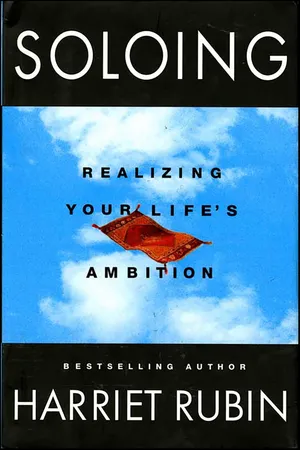
Soloing has two meanings: "going it alone" and being "complete in yourself." . . . But you don't just leave--a company/a career/a paycheck--and cross over to a more satisfying life. There's more to it. There is a mysterious passage to be negotiated, a delicate transition required to go from alone-in-the-desert to complete-in-yourself.Harriet Rubin, bestselling author of The Princessa: Machiavelli for Women, returns with inspiring advice for professionals dreaming of crossing over from a corporate world of prescribed boundaries to the limitless opportunities of soloing. She describes how people can do great things--things they would never be able to accomplish inside the corporate structure--when they manage or lead no one.As one successfully navigates the passage toward a truer sense of self that Rubin describes, four invaluable freedoms await:
- The first freedom is regaining your sense of identity.Walk out of any big company and who are you, stripped of that mighty identity? Potentially bigger and better than before. Who were you before the corporate you? To get back one's sense of self is why people go solo.
- The second freedom is independence.Why is working alone so important in doing great work, given that it's also the scariest part? Imagine having complete command and control over your time and the work you do. This is how soloists realize their great strengths: They are reduced to themselves.
- The third freedom is income.You can earn in one year what you earned in two before. Do you work harder to do this? Yes. Do you enjoy it more? Yes. Solo money is alive. Unlike a salary doled out like an allowance from parents, the money earned by soloing is a true emblem of a person's worth.
- The fourth freedom is illumination.A professional builds a career, but a soloist builds a portfolio and a life free of boredom, full of challenge. Direct contact with work itself is direct contact with life.
With insights as diverse as Henry David Thoreau's "I want to be sure the world doesn't change," and Michael Jordan's response to the statement: "There's no 'I' in team,"--"That's right, but there is an 'I' in win,"--Rubin gives readers the chance to bring their dreams into alignment with reality.
Information
Topic
Personal DevelopmentSubtopic
EntrepreneurshipPart I INVENT YOURSELF
Definition
I. Your Work Was Your Life. Now Let Your Life Be Your Work
“Solo” for me conjures up images of adventurers who never hyperventilate: Charles Lindbergh, who risked his life flying across the Atlantic in a tin plane of the strength tuna is packed in today. Or Reinhold Messner, called the Michael Jordan of alpinists—accurate if Jordan faced death climbing Everest alone and without oxygen. Or Billie Holiday, wanting “to get all the feeling, eat all the good foods, experience every experience, and sing,” so she could revise the sound of the blues for all who came after her. When I walked out of the organization I’d served for ten years—determined not to manage or lead any living creature, not even a dog on a leash—I didn’t think I had anything in common with those brave souls. I wasn’t exactly walking off a cliff into some frightful new dimension. But in fact, I was. It was a dangerous, cold, and very lonely walk off a cliff called Security. It was worth the trip. In Solo Land, work and freedom are synonyms, not opposites. When I got over the fear, I felt something of the thrill that lured those great adventurers to the brink: the sheer aliveness of believing in myself and what I was doing enough to do it solo.
I’m the last person in the world who ever should have had the guts or the need to leave the corporation. I grew up dirt-poor, so I was eternally grateful for my paycheck. I loved organizational life. I celebrated it by starting a business books company at Doubleday in 1989. I was not only a citizen of the corporate world, I promoted its ideas by publishing such best-selling authors as Peter Senge, Andy Grove, Faith Popcorn, and Don Peppers. I was a success. I didn’t have to leave. Most days I didn’t want to leave. I liked the oatmeal in the company cafeteria.
And yet, the routine was beginning to get to me. Though I was publisher of my own imprint, I had authority over nothing. Not even paper stock. A good book went to press and came out looking like “beaver lick”—if a beaver licked it, the paper would dissolve—because “quality” systems demanded the cheapest possible paper that would still hold ink. This was the profit machine I had to keep feeding, at the expense of my own reputation. I began to wonder, why?
I had no answer until a Buddhist monk came to see me. We were talking about a book he might write, when he suddenly asked: “What do you do when you reach the top of a forty-foot pole?” When I worked in publishing, I had a ready answer for everything. “You climb back down and look for another pole,” I said. Silence. “I mean you relax and enjoy the view. No, wait. You think about how you got into that position in the first place.” The monk was packing up his interest in me. “I’ve got it!” I shouted. “You dial 911.” He changed the conversation. I realized I’d been saying “you” as if he’d asked the question about some third party. The monk was asking about me. I’d reached the top of the pole of publishing, something he saw more clearly than I.
There was something worse than topping-out: Forty feet wasn’t a height to be at all proud of.
Some riddles demand doing, not thinking, to solve them. By the time I left Doubleday three years after this visit, I knew that at the top of the pole, you keep on climbing without a ladder, without a prop. Climbing with a ladder is hard. Climbing without a ladder is harder. It’s exhilarating. It’s soloing.
I left because I wanted more and I thought I might actually have a shot at getting it. I left because I was tired of telling bosses and clients, “You’re right,” when I knew they were wrong. I left because I got to be so good at serving, I thought: “Why not serve me?” So I walked out. SOLO. I was free for the first time in, well, my whole life! I had no appointments, no boss, no corporate politics, no pasted-on smile. I came to believe that everything I’d published about managing and leading was a lie. Corporations, for all their vaunted systems of management, weren’t exactly turning out great work. That’s what I wanted to try my hand at. To do great work, you couldn’t be responsible for anyone but you. That was the only way to be honest to yourself, and to test yourself to the core. To do important work, thrilling work, you had to go it alone. Same as an artist.
Soloing is a lot like being an artist. Soloing demands creativity. Self-discipline. Self-leadership. An ability to see the world in a grain of sand, because your span of control shrinks, but your power to influence others expands. Most of all, soloing demands courage: the gumption to be opinionated and stand up for your own visions. This last is not as easy as it sounds.
One image beckoned me like an oasis: the image of Picasso grinding up lapis and sapphires to make the haunting blue paint of his famous blue period. He stretched his own canvases. He locked himself in a basement workroom to create pictures of his own imagination. He left for an absinthe when he wanted and came back when the visions in his mind drove him to make something of the sapphire blue and the stark white canvas. I wanted to touch my work with that kind of testing intimacy. I wanted to see if I could make a success of myself on my own terms, not by anybody else’s rules. I wanted to believe work could be more than a four-letter word. I knew it was for some.
But I was months away from absinthes or the blue of sky and dreams, or the life of an artist. When I walked out of the Ze Tower, as we called Doubleday headquarters because the skyscraper seemed like the place you’d take an innocent bride and cut off her head, I felt beheaded—or was that just lightheaded?—walking around the goal-oriented Manhattanites like a bit of a freak. I had no idea where to go next on that bright Friday when the world stretched out before me like an endless weekend. I was floating on a magic carpet. I didn’t have to be anywhere. Whom do you belong to when you belong nowhere? Who are you when you leave?
I didn’t know where my next job would be coming from. My expertise was in publishing books, but my solo dream was to write them and consult, speechify, and study. I didn’t know if I could do any of these dream jobs. I didn’t have any contacts in these fields who trusted me to deliver on my promises. I was scared. To some extent, it was great to feel anything for a change, even fright.
Then I looked down. I was out on a limb. Except for a handful of people who’d left big companies and disappeared soon after, no one I really knew had made the trip before me. Where was everybody? Was I suddenly with them, lost among the ghosts?
UH OH
There is a lot of advice available for people who take another job, for people who leave to start up a company, even for people who decide to loaf and travel. But there was nada for the soloist. I had no guide to prepare me for the disorienting experiences ahead.
When I think back to that time, I remember feeling so totally alone that I took to calling AT&T at dinnertime to query them about their One Rate Plan. It was often the one conversation of the day. My first week out, I felt like some little gutter girl, watching people step right over me as they headed into big fancy restaurants in their big fancy clothes. I had become so small they didn’t even have to push me aside to clear the sidewalk. I just blew away under the sound of their laughter. On the one hand, I was happy to have given up the superficial life of dinners on an expense account that had no limit. Goodbye to the maitre d’s who kissed my hand because it held company plastique. And yet, I wondered if I would ever eat off a white tablecloth again with all that cutlery laid before me as if I were a brain surgeon about to save a life.
That wasn’t the real me—and it also wasn’t the fake me anymore. I ate one meal a day solo: ostensibly to save money, but really because I didn’t think I was worth feeding. I stopped seeing friends because I was afraid to spend a dime on unessential “pleasures.” I would walk past bookstores where I used to waltz right in and proudly pay retail. Now I wouldn’t even look in the windows, afraid to be tempted. I overdid the discipline, working fourteen hours a day trying to land assignments, jobs, anything.
And I didn’t even know what work was. Should I be cold-calling strangers to get gigs? Should I be submitting proposals? What kind of work did I want? Here I was alone in my apartment. Who would find me unless I died?
I had to learn how to get out of the Lost and into the Found in terms of my career. But I also had to come to grips with the fact that I was on an emotional roller-coaster. I was thrilled to be free of office politics and meetings that I hated. But then I’d write a rent check and I’d be a mess, back at ground zero. How could I be terrified one minute and ecstatic the next?
The truth is that soloing is a dramatic turn of events. Emotions spike the way physiologists say they do for someone standing in front of a firing squad, or careening into a car wreck, or saying, “I do” before the judge. Soloing was not like stepping into another job. It was not like the first day of school. It was not like waking up next to a total stranger and wondering how you were going to get this lox out of your bed. Soloing didn’t have any quick fix.
Bubba, my pal from Houston, called. “You don’t sound so good,” he said. “Maybe I made a mistake,” I just about wailed. “Sounds like Sadie talking,” he said, meaning I was sounding like my own mother, who’d always played life safe and died just a month before, mad at the world and with just enough of a life’s savings to cover her funeral. That got my gumption up. I wasn’t going to end up safe. But was there a place—a perch—between safe and sound? Couldn’t I be a little of both: sound, as in solid and real; and safe as in confident?
YOU’RE ON YOUR OWN
I deal with desperation this way: I don’t overeat, I overwork. I begged a magazine editor for an assignment to interview Peter Drucker, the business guru, then eighty-nine, the old man of the solo sea. He liked the topic of the lone worker, and to my surprise, he agreed to the interview. Drucker is an acclaimed management expert, but he is also a soloist, a lone worker who refused for years to let his local university, Claremont College, start a business school in his honor because of his fear of becoming a person who has to take meetings. A management expert who hated groups? If anybody had advice worth following into this Unknown, it was Peter. I convinced Inc. to send me out to interview Drucker, and thereby get myself some good advice.
Drucker gave me two pieces of advice: (1) It takes three years to break even financially as a solo. (2) To learn anything, you have to be prepared to teach it. He was right about the second and I proved him wrong about the first.
Doing that assignment and working on a new book proposal were temporary distractions from the fears. But the real piece of luck was to come.
George Gendron, editor of Inc.—a magazine for small businesses—asked me to write a series of articles about the experience of going solo, which I did for nearly a year. It was Drucker’s advice, magically come to life. I learn how to solo by teaching others. I would write about what I was doing and revise my experience as I went along. I was Inc.’s guinea pig and my own as well. When the first diary hit the stands, no one at Inc. was prepared for the outpouring of letters that came in. George said he hadn’t seen that much response to any story he’d published in his twenty-five-year career. People dreamed of doing the same and wanted advice from someone who’d “crossed over.” One didn’t just leave a company and go solo the way one left a job for another. One needs a road map to make the journey.
I learned that the word solo has two meanings: “going it alone” and being “complete in oneself.” Those who go it alone outside a corporate structure often are alone; they are like those movie images of a lone wraith crawling on hands and knees through the desert, pleading to the vacant sky, “Water, water.” They are parched for information and companionless in a world of millions of grains of sand. They have no guides and no communities. They want to have a better life by being free to work on their own, to manage no one but themselves, to find the success that is the true measure of their worth.
But you don’t just leave a company/a career/a paycheck and cross over. You don’t just step out of the chorus line and onto center stage. There’s more to it. There is a passage to be negotiated, a delicate transition required to go from alone-in-the-desert to complete-in-yourself. Those who dream of soloing want the courage to make the same crossing: from dependence to freedom. From the security in a job to excitement. From the fast track to a different path.
That’s what this book is about: the knowledge one needs to cross over into a world where work and freedom are one and the same thing. This book is about becoming a soloist.
SOLOING AS A RELIEF FROM UNBEARABLE URGES
Why do this? It seems self-indulgent to quit a paying job because you’re tired of being hassled or think you have more to offer the world. But for many, these convictions are as important as eating and breathing. Years ago I read that Steve Jobs, cofounder of Apple Computer, believed he’d die at age thirty (he’s now forty-five) so he lived every day at full throttle, risking everything. Life is too short. Consultant Tracy Goss likes to say, “Someday somebody is going to come along and throw dirt on your face, so why not go all out?” Why not make your life your work rather than vice versa? Most of us aren’t going to create an Apple. But we can create or re-create our own lives. You won’t even know what you’re missing as a corporado, but on the other side, here are the benefits that wait for you:
Soloing, you get back your sense of identity, of being yourself. Corporadoes cut their characters down to fit a corporate culture and lose themselves in the process. Who are you out from under those fluorescent lights? What do you really look like without that counterfeit smile plastered on your face? Who is the you who hasn’t been robbed of your identity by bosses and others taking credit for work you’ve done? True identity is authenticity. You can only please people for so long until it starts to feel like a sickness. Then you need to go solo just to remember who you are.
Why when we are young do we think we needed organizations to get a start in life? And where did we get this idea that organized work could make a person feel fulfilled? The organization is a machine, sometimes an efficient one. But to find “the force,” Ben Kenobi says to Luke Sky walker in Star Wars:
Turn off your computer, turn off jour machine and do it yourself, follow your own feelings, trust your feelings.
Henry DavidThoreau, America’s first great soloist, had a brilliant idea for how to achieve happiness and success. He abandoned a meek civil service job on July 4, 1845 (Independence Day!) and moved—solo—to a pond he would soon make ...
Table of contents
- Cover
- Title Page
- Dedication
- Contents
- Preface
- Part I - INVENT YOURSELF
- Part II - THE BUSINESS OF BEING YOURSELF
- Resources and More
- Acknowledgments
- Also by Harriet Rubin:
- Copyright
- About the Publisher
Trusted by 375,005 students
Access to over 1.5 million titles for a fair monthly price.
Study more efficiently using our study tools.
Frequently asked questions
Yes, you can cancel anytime from the Subscription tab in your account settings on the Perlego website. Your subscription will stay active until the end of your current billing period. Learn how to cancel your subscription
No, books cannot be downloaded as external files, such as PDFs, for use outside of Perlego. However, you can download books within the Perlego app for offline reading on mobile or tablet. Learn how to download books offline
Perlego offers two plans: Essential and Complete
- Essential is ideal for learners and professionals who enjoy exploring a wide range of subjects. Access the Essential Library with 800,000+ trusted titles and best-sellers across business, personal growth, and the humanities. Includes unlimited reading time and Standard Read Aloud voice.
- Complete: Perfect for advanced learners and researchers needing full, unrestricted access. Unlock 1.5M+ books across hundreds of subjects, including academic and specialized titles. The Complete Plan also includes advanced features like Premium Read Aloud and Research Assistant.
We are an online textbook subscription service, where you can get access to an entire online library for less than the price of a single book per month. With over 1.5 million books across 990+ topics, we’ve got you covered! Learn about our mission
Look out for the read-aloud symbol on your next book to see if you can listen to it. The read-aloud tool reads text aloud for you, highlighting the text as it is being read. You can pause it, speed it up and slow it down. Learn more about Read Aloud
Yes! You can use the Perlego app on both iOS and Android devices to read anytime, anywhere — even offline. Perfect for commutes or when you’re on the go.
Please note we cannot support devices running on iOS 13 and Android 7 or earlier. Learn more about using the app
Please note we cannot support devices running on iOS 13 and Android 7 or earlier. Learn more about using the app
Yes, you can access Soloing by Harriet Rubin in PDF and/or ePUB format, as well as other popular books in Personal Development & Entrepreneurship. We have over 1.5 million books available in our catalogue for you to explore.