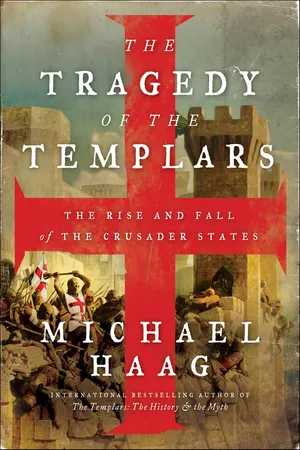
The acclaimed medieval historian chronicles the rise of Templar powers in the Levant—and the saga of their destruction.
Founded on Christmas Day 1119 in Jerusalem, the Knights Templar was a religious order dedicated to defending the Holy Land and its Christian pilgrims in the decades after the First Crusade. Legendary for their bravery and dedication, the Templars became one of the wealthiest and most powerful bodies of the medieval world—and the chief defenders of Christian society against growing Muslim forces.
In
The Tragedy of the Templars: The Rise and Fall of the Crusader States, Haag masterfully details the conflicts and betrayals that sent this faction of powerful knights spiraling from domination to condemnation.
This stirring and thoroughly researched work of historical investigation includes maps and full-color photographs of important cultural sites, many of which doubled as battlefields during the Crusades.
- 448 pages
- English
- ePUB (mobile friendly)
- Available on iOS & Android
eBook - ePub
About this book
Information
PART I
The Middle East before the Crusades

WHEN THE TURKS EMERGED from the steppes of Central Asia and captured Baghdad, they became the masters of what had been an Arab empire. The Turks also became the new champions of Islam, the religion brought by the Arabs when they stormed out from the deserts of Arabia to invade and occupy the fertile lands of the Middle East in the seventh century AD, lands that had been part of the Graeco-Roman world for a thousand years and in the case of Palestine had been home to the Jews for twice as long.
Already since the second millennium BC the Middle East had known the rule of successive rival empires, including the Egyptians, Hittites, Assyrians and Persians. In the early fifth century BC, when the Persians also tried to extend their empire into Europe, they were famously repulsed by the Greeks at Marathon, Salamis and Plataea, and a century and a half later, in 333 BC, when Alexander the Great carried the war into Asia and defeated the Persian king Darius III at the battle of Issus, near the present-day Turkish–Syrian border, the entire Middle East came under the rule and cultural influence of the Greeks. By the end of the first century BC the Greeks in turn had been superseded by the Romans, whose empire embraced all the lands round the Mediterranean. This was the world that gave rise to Christian civilisation.
1
The Christian World
THE ROMANS RULED PALESTINE through Herod the Great, king of Judea, who constructed the vast platform known as the Temple Mount over a rocky hill to support his gigantic Temple built around 25–10 BC on the site of Solomon’s original Temple of nearly a thousand years earlier. It is Herod’s Temple that is referred to in the Gospel of Mark 13:1–2, when a disciple says to Jesus, ‘Master, see what manner of stones and what buildings are here!’, to which Jesus replies, ‘Seest thou these great buildings? There shall not be left one stone upon another, that shall not be thrown down.’ And it was this temple that, duly bearing out the prophecy, was destroyed by the Roman emperor Titus in AD 70 in the course of putting down a Jewish rebellion. During a second Jewish revolt the rebels occupied Jerusalem in AD 132 and intended to rebuild the Temple, even striking coins bearing its image. But the Romans returned in force and crushed the revolt completely. Jerusalem became a pagan city, Colonia Aelia Capitolina. All traces of the Temple were obliterated in AD 135, and statues of Hadrian the conqueror and of Jupiter were erected on the site. Thereafter Jews were forbidden by official Roman decree to enter Jerusalem, although from time to time tacit permission was given for them to enter the precincts of the former Temple. Nothing remained, only the desolate rock, and here the Jews poured libations of oil, offered their prayers and tore their clothes in lamentation.
Meanwhile, starting in the Middle East during the first century AD and extending across North Africa and Europe, Christianity took hold throughout the Roman Empire, not by force of arms nor because it was imposed or even encouraged by the state, but rather in the teeth of the most ferocious imperial opposition. Despite suffering terrible persecutions for their faith, Christians numbered about one-seventh of the population by the early fourth century, and their influence went far wider. The Christian doctrine of equality of the individual soul gave it a universal appeal, it was well organised, and it attracted some of the best minds of the time, who in rooting its theology in Greek philosophy made it intellectually acceptable. By promulgating in AD 313 the Edict of Milan, which tolerated Christianity and gave it rights in law, Constantine won the support of the strongest single group in the Roman world. Constantine was baptised only on his deathbed in 337, but his conversion had already occurred in 312, when his vision of the Cross accompanied by the words εν τούτῳ νίκα, usually rendered in Latin as in hoc signo vinces – ‘in this sign you will conquer’ – preceded his victory against the rival emperor Maxentius at the battle of the Milvian Bridge outside Rome, a battle in which he had the Cross emblazoned on the shields of his soldiers and carried aloft as their standard.1 During Constantine’s lifetime and in the reigns of his successors, Christianity flourished under imperial patronage, and by the end of the fourth century dominated the empire. In 392 the Emperor Theodosius I declared Christianity the official religion of the Roman Empire: henceforth paganism was proscribed. During his reign temples throughout the empire were in whole or in part destroyed and churches built, so that in Damascus, for example, the great temple of Jupiter was rebuilt as the Church of St John the Baptist, and throughout Egypt churches were built within the temples of the pharaonic gods.
In what had already been the universal Roman Empire, Christianity added a new dimension of unity between the diversity of local cultures. Christian ideas and images were shared from the Thames to the Euphrates, from the Rhine to the Nile. The word ‘catholic’ means universal and all-embracing and was the word used to describe the original Christian Church. It was a universal Church, and the faithful travelled freely from one end of Christendom to the other. Tens of thousands of pilgrims travelled to the lands of the Gospels, to visit the holy sites and to obtain the blessings of monks and other holy ascetics there. And they came not only from the West but also from the East. ‘Not only do the inhabitants of our part of the world flock together’, wrote the fifth-century Syrian monk Theodoret of Cyrrhus, ‘but also Ishmaelites, Persians, Armenians subject to them, Iberians, Homerites, and men even more distant than these; and there came many inhabitants of the extreme west, Spaniards, Britons, and the Gauls who live between them. Of Italy it is superfluous to speak.’2
Pilgrimages are practised among all the world’s religions, but during its first three centuries Christianity was a persecuted faith and it was not safe or practical to go on a pilgrimage. Yet despite the danger to their lives, Christians did go on pilgrimages from an early date. Already in the early second century a ‘cave of the Nativity’ was being shown at Bethlehem; people wanted to see sites associated with the life and death of Jesus.
The era of pilgrimages really got under way with the end of persecutions following Constantine’s Edict of Toleration in 313. The pace was set by the emperor’s own mother, the empress Helena, who visited Palestine in 326–8. That she was a woman was typical of pilgrimages, for the truth about women in pagan societies was that their worth was judged almost exclusively on their success as sexual and reproductive beings, whereas Christianity, once it had been legitimised by Constantine, was liberating for women in numerous ways, not least in providing them with an excuse for going on long journeys away from home. As his mother travelled from site to site, Constantine ordered and financed the construction of churches to celebrate the central events of Christian belief. In Bethlehem, Constantine built the Church of the Nativity, and in Jerusalem he built the Church of the Holy Sepulchre on the spot, discovered by Helena herself, where Jesus was entombed and then rose again on the third day.
But exactly who was this risen Jesus? No sooner had Constantine tolerated Christianity than competing answers to this question threatened to split the universal church. The argument was not over whether Jesus was divine – his divinity was almost universally agreed – rather, it was over the nature of that divinity, and it was during Constantine’s reign that the first great heresy emerged – Arianism, named after a priest of Alexandria.
Arius argued that, as Jesus was the Son of God, then surely he was younger than God: an appealing notion that brought Jesus closer to mankind and emphasised his human nature. But another Alexandrian, a bishop called Athanasius, saw a danger. If Jesus was younger than God, so there must have been a time when Jesus was not. This challenged the unity of the godhead – the Father, the Son and the Holy Spirit – and opened the way to regarding the nature of Jesus as being not of the same substance as God’s. Indeed in time Jesus might be seen merely as a good man, while God would become less accessible and more remote. The counter-argument of Athanasius was that no distinction could be made between Christ and God, for they were of the same substance.
Seeing the Christians within his empire divided between the arguments of Arius and Athanasius, in 325 Constantine summoned the First General Council of the Church at Nicaea, a Greek city of north-west Asia Minor in what is now Turkey. Two hundred and twenty bishops were in attendance, from Egypt and Syria in the East to Italy and Spain in the West. The divine nature of Jesus Christ was argued from both the Arian and the Athanasian points of view, and when the bishops balloted on the issue, it was decided in favour of Athanasius by 218 votes to two. This Nicene Creed became the official position of the universal Church, but although it is the creed of both the Roman and Orthodox Churches in our own day, Arianism flourished in various parts of the Roman Empire for many centuries to come and allowed many Christians in the East to mistake the advent of Islam as nothing more than a version of their own belief.
Constantine also faced a problem brought about by the great size and diversity of the Roman Empire. The separate military threats it faced across the Rhine–Danube frontier in the West and the Euphrates in the East made its governance unwieldy. Constantine’s solution was to establish a new imperial capital at the ancient city of Byzantium on the Bosphorus, the strategic meeting point of Europe and Asia. Beautifying the city and enlarging the circuit of its walls, in 330 he dedicated Nova Roma, as he called Byzantium, to Jesus Christ – although it quickly became known as the city of Constantine, Constantinople.
On the death of the emperor Theodosius I in 395 a more radical step was taken, and the Roman Empire was formally divided into a western empire ruled from Rome and an eastern empire ruled from Constantinople. Greek culture and language increasingly reasserted themselves in the East Roman Empire, which, taken together with its Christian foundations, has led historians to give it a different name, the Byzantine Empire. But long after Rome fell to Germanic invaders in 476, and throughout its struggle in the Middle Ages against Islam, and indeed right up to the last when Constantinople fell to the Ottoman Turks in 1453, the emperors and their subjects in the East called themselves Romans and spoke of their empire as the Roman Empire.
Palestine was part of this Christian empire. Jews in significant numbers inhabited lower and upper Galilee and the Golan as well as Caesarea on the coast, but Christians became the majority during the Byzantine period.3 And not only was Palestine predominantly Christian, but for people all over Europe, North Africa and the Middle East, Palestine was a shared Christian landscape. ‘All we, the faithful, worship the cross of Christ as his staff: his all-holy tomb as his throne and couch: the manger and Bethlehem, and the holy places where he lived as his house [. . .] we reverence Jerusalem as his city; we embrace Nazareth as his country; we embrace the river Jordan as his divine bath’, wrote Leontius of Byzantium, who travelled to Palestine in the early 500s.4
This feeling for Palestine contributed to the social and economic well-being it enjoyed during the Byzantine period, reflected in the tremendous growth of population, which in numbers and density reached a peak it would not see again until the twentieth century.5 Just as Palestine was central to Christian sentiment, so it figured favourably in the imperial concerns and attentions of Constantinople and of people throughout the Christian world. Emperors, ecclesiastics and wealthy believers invested enormous funds in the country to take care of the spiritual and material needs of pilgrims, monks and the local inhabitants, so that its cities expanded, agriculture flourished and even the Negev desert was irrigated and brought under cultivation. Syria and Lebanon also enjoyed prosperity under Byzantine rule, reflected especially in the profusion of both secular and religious buildings in the northern highlands, in the Hauran in the south and in Damascus too, all rich in variety and innovation, drawing on both metropolitan and local architectural styles. Peace and security contributed to this well-being and growth. Under Byzantine protection Palestine and its neighbours were free from wars and their destruction; no foreign armies crossed the country causing damage on their way. But then came the titanic struggle with the Persians, followed by the Arabs afire with the faith of Islam.
After the fall of Rome to the barbarians in 476 the Byzantines managed to recover a great deal of Roman territory in the West, so that by the mid-sixth century their empire included almost all of Mediterranean Europe except for France and the interior of Spain, nearly all of northern Africa, as well as Asia Minor and the Middle East. But in 568 northern Italy was invaded by a new German tribe, the Lombards. The empire managed to hold no more than Ravenna, while Rome was preserved only by the energy of its pope, Gregory I, who in the process established the temporal power of the papacy. As its Western links dissolved, the Byzantine Empire became a decidedly Greek empire. Instead of taking the Latin title of imperator when he came to the imperial throne at Constantinople in 610, Heraclius took the Greek basileus, and it was Heraclius also who decreed that Greek, for centuries the language of the educated class, was to replace Latin as the official language of the empire. Roman in conception, Greek in language and culture, Christian in faith, the empire was also composed of people of many backgrounds. Heraclius himself was of Armenian descent, and his rise was part of the pattern of increasing Armenian prominence in Byzantine society, a consequence of their homeland serving since the second half of the sixth century as the battleground between the empire and Persia.
The Persian state religion was Zoroastrianism, and wherever it spread Christianity was persecuted. In 611 the Persians launched their conquest of Syria; Antioch fell to them in the same year, and in 613 they sacked Damascus, decimating its people by murder and captivity. The Persians captured Jerusalem in 614 and advanced into Egypt, taking Alexandria in 619. At Jerusalem, after a three-week siege, the Persians rushed into the city ‘like infuriated wild beasts’ and slaughtered the entire Christian population, wrote Antiochus Strategos, a monk at the Greek Orthodox monastery of St Saba outside Jerusalem, who was an eyewitness to the events. When the walls were breached, the defenders
hid themselves in caverns, fosses, and cisterns in order to save themselves; and the people in crowds fled into churches and altars; and there [the Persians] destroyed them. [. . .] Like mad dogs they tore with their teeth the flesh of the faithful, and respected none at all, neither male nor female, neither young nor old, neither child nor baby, neither priest nor monk, neither virgin nor widow.
In the midst of this horrific slaughter the Persians set fire to the Church of the Holy Sepulchre and looted the city of its treasures, including the True Cross, discovered by the empress Helena and Christendom’s holiest relic. The death toll was 66,509 Christians, a figure given by Antiochus on the authority of a fellow monk who kept a count as he searched for corpses and helped bury them. The litany is long, and this is just a sample:
In the church of Saints Cosmas and Damian we found 2212 souls. [. . .] In the lane of St Kiriakos we found 1449 souls. [. . .] And we found at the spring of Siloam 2818 souls. [. . .] In the monastery of Saint John we found 4219 souls. [. . .] We found in the grottos, fosses, cisterns, gardens, 6917 souls. At the Tower of David we found 2210. [. . .] Just where the enemy overthrew the wall of the city we found 9809 souls
and so on.6 According to the contemporary Armenian historian Sebeos, the Persians themselves arranged for the dead to be counted, and he gives a hardly less appalling figure of 57,000.7 Archaeologists have discovered mass graves confirming that a great massacre did...
Table of contents
- Maps
- Dedication
- Contents
- Prologue
- Part I: The Middle East before the Crusades
- Part II: The Turkish Invasion and the First Crusade
- Part III: The Founding of the Templars and the Crusader States
- Part IV: The Templars and the Defence of Outremer
- Part V: Saladin and the Templars
- Part VI: The Kingdom of Acre
- Part VII: Aftermath
- Photo Section
- Bibliography
- Notes
- Index
- About the Author
- Back Ad
- Also by Michael Haag
- Credits
- Copyright
- About the Publisher
Trusted by 375,005 students
Access to over 1.5 million titles for a fair monthly price.
Study more efficiently using our study tools.
Frequently asked questions
Yes, you can cancel anytime from the Subscription tab in your account settings on the Perlego website. Your subscription will stay active until the end of your current billing period. Learn how to cancel your subscription
No, books cannot be downloaded as external files, such as PDFs, for use outside of Perlego. However, you can download books within the Perlego app for offline reading on mobile or tablet. Learn how to download books offline
Perlego offers two plans: Essential and Complete
- Essential is ideal for learners and professionals who enjoy exploring a wide range of subjects. Access the Essential Library with 800,000+ trusted titles and best-sellers across business, personal growth, and the humanities. Includes unlimited reading time and Standard Read Aloud voice.
- Complete: Perfect for advanced learners and researchers needing full, unrestricted access. Unlock 1.5M+ books across hundreds of subjects, including academic and specialized titles. The Complete Plan also includes advanced features like Premium Read Aloud and Research Assistant.
We are an online textbook subscription service, where you can get access to an entire online library for less than the price of a single book per month. With over 1.5 million books across 990+ topics, we’ve got you covered! Learn about our mission
Look out for the read-aloud symbol on your next book to see if you can listen to it. The read-aloud tool reads text aloud for you, highlighting the text as it is being read. You can pause it, speed it up and slow it down. Learn more about Read Aloud
Yes! You can use the Perlego app on both iOS and Android devices to read anytime, anywhere — even offline. Perfect for commutes or when you’re on the go.
Please note we cannot support devices running on iOS 13 and Android 7 or earlier. Learn more about using the app
Please note we cannot support devices running on iOS 13 and Android 7 or earlier. Learn more about using the app
Yes, you can access The Tragedy of the Templars by Michael Haag in PDF and/or ePUB format, as well as other popular books in History & European Medieval History. We have over 1.5 million books available in our catalogue for you to explore.