![]()
——
1
——
A Winning Combination:
A Vision with a Strong
Game Plan
“Capital isn’t scarce; vision is.”
—SAM WALTON
“Setting a goal is not the main thing. It is deciding how you will go about achieving it and staying with that plan.”
—TOM LANDRY
Corporate legends abound about CEOs who have a vision assuring future market dominance. I recall that one such mogul, founder of a retail apparel chain, experienced his vision on a mountaintop in Colorado. Another visionary, the wealthy owner of automobile dealerships, was sailing alone at sea amidst a ferocious storm that nearly capsized his boat, when his revelation came. While visions of this nature enhance corporate folklore, I suspect they are dramatically exaggerated. I believe it more likely that a vision begins with a vague idea that slowly evolves over time, repeatedly changing form before fully crystallizing.
When Sam Walton, founder of Wal-Mart, opened a small Ben Franklin store in Newport, Arkansas, shortly after World War II, his aim was merely to outsell his across-the-street competition. His goal was to be the town’s number one five-and-ten-cent store. When he lost his lease in 1950, he moved to Bentonville where he opened Walton’s Five and Dime. Walton had no plans of grandeur—the thought of becoming the world’s largest retailer had not entered his mind. Walton just wanted the best five-and-dime store in Bentonville. After he opened other small stores, he gradually upgraded his vision to operating the biggest chain store in Arkansas. When one success followed another, Walton refined and elevated his purpose. Sam Walton didn’t start out wanting to be the world’s largest retailer, nor was it his ambition to be the world’s largest company. Yet, at the end of 2003, that’s exactly what Wal-Mart had become.
I have read the biographies of many Fortune 500 CEOs, and I don’t recall a single one who started out with a lofty vision of someday being the top honcho. People who have low entry jobs are more focused on their current position, and only after doing well do they set their sights on advancement. They repeat this process as they advance up the corporate ladder. Having a grand vision of the future is a good thing, but it’s more realistic to establish a series of smaller goals, and as you achieve one, set your sights higher on yet another. Remember too, you can alter your vision as you go along.
So, rarely does one start out with a well-defined, giant-sized vision. More often, an individual begins with an attainable vision followed by a series of still more attainable visions, and continually raises the bar with each achievement along the way. In the beginning stages, their visions are nothing more than abstract thinking. However, with a game plan, men and women implement such visions into something quite concrete. Think about it. Doesn’t every success start in one’s mind? More than 10 million copies have been sold since Napoleon Hill wrote Think and Grow Rich in 1937. In his classic book, Hill stated, “What the mind can conceive, man can achieve.” He espoused that every achievement begins with an idea.
For example, when our forefathers founded our nation in 1776, they didn’t have a vision of America in the 21st century. How could they? They did, however, have a conceptual vision about the freedom that future generations would enjoy. Likewise, when the Computing-Tabulating-Recording Company was founded in 1911, a firm that later changed its name to IBM, founder Thomas Watson Sr. could not have possibly envisioned that his business would evolve into today’s multibillion-dollar international computer company.
Certainly having a vision provides direction. The vision by itself, however, must be followed up with a game plan. And it is the game plan that provides a road map for how to move forward to one’s destination. Bear in mind that there is an important difference between a vision and a game plan. Your game plan pertains to the specifics of how to achieve your vision. Hence it is about implementation.
IN MY CASE, THERE WAS no dream in the middle of the night. No light bulb suddenly came on revealing how I could someday be a sports agent for NFL coaches. In fact, nothing in my life remotely suggested this was my calling. I played varsity football for two years at Santa Clara University, making football my number one priority. Then something happened to me in my sophomore year that replaced my thoughts of football. I took a history course taught by Professor George Giacomini, a brilliant educator who made me want to be a historian. That’s right, he made me. He was so excited about history that I figured, “If anyone can be so enthusiastic, so committed, and so passionate about something, I’ve got to know more about it.”
I majored in United States history, and for the next 25 years, I taught history to several thousand high school and junior college students. If I have impacted a single student the way Professor Giacomini influenced my life, I will consider myself to have had a successful teaching career.
I WILL SPARE YOU THE blow-by-blow details of my first years out of college. Let’s fast-forward to my life as a married man with children when I was teaching high school at Santa Teresa High School, a public high school in San Jose, California. At this point, I was also chairman of the history department. Those were very good years for me. I taught history, which I loved, and to supplement my income I also coached football—my second passion. I loved my work. There was only one hitch. With a growing family, we had to budget our money and watch every penny. To make ends meet, I opted to receive my teaching salary over a 10-month period, and I taught history courses at junior college and high school during the summer months to supplement my income. But in 1978, the State of California elected to reduce taxes for homeowners and, as a result, massive budget cuts were made with police and fire departments, libraries, and schools coming out on the short end. While I didn’t lose my full-time teaching job, my summer teaching jobs were eliminated. For a while, I sold real estate, and one year as a part-time agent, my sales commissions were $30,000, nearly equal the $35,000 I was paid for teaching and coaching.
In the mid-1970s, Santa Teresa High School and Oak Grove High School became sister schools, sharing the same building with double sessions. As a consequence, Rich Campbell, a gifted athlete at Oak Grove, became the quarterback at Santa Teresa, where I taught and coached. A football standout, in his senior year he was one of the most sought after high school quarterbacks in the country. As his mentor, I helped him choose the University of California. Rich went on to be an All-American, and in his senior year, he asked me to be his agent. He signed with the Green Bay Packers as the sixth pick in the first round—the first quarterback to be drafted in 1981. He received a contract worth $1.25 million with a half-million-dollar signing bonus. Back then, my commission on this single transaction exceeded my annual teacher’s salary. To my knowledge, no other high school teacher has ever represented anyone who was a first-round NFL draft choice.
While at Santa Clara University, I majored in American history with an emphasis diplomatic history. This education prepared me to understand negotiation, mediation, and arbitration, an ideal background for dealing with sports teams. Plus, all of my life I had played football, coached football, and counseled athletes. My experience as a real estate agent and insurance broker provided a good foundation for contractual work I do today.
Having an athlete like Rich Campbell fall into my lap was truly a blessing. Hundreds of sports agents never in their entire career represent an athlete of this caliber. A lot of people credited it to dumb luck, saying it couldn’t happen again in a hundred years. But it did—two years later in 1983. Dave Stieb, who was a punter at Oak Grove, was also a star baseball player. I coached his older brother Steve at Oak Grove High School. Dave also asked me to be his agent. Dave pitched for the Toronto Blue Jays for 15 years and was a seven-time All-Star—a record for a major-league starting pitcher. During the 1980s, several other athletes approached me to be their agent. I also represented Mervyn Fernandez, a San Jose State football standout named player of the year in the Canadian League. In 1986, I met Al Davis for the first time when Fernandez jumped leagues and received a signing bonus to don an Oakland Raiders uniform. That same year, I represented Nick Vanos, a seven-foot, two-inch center for nearby Santa Clara University. Nick was drafted by the Phoenix Suns but would tragically die in a plane crash.
Later in the ’80s, when I was working with a law firm that reviewed contracts for my sports agency work, one of the paralegals approached me.
“Would you be interested in representing my nephew, Don Beebe, from Chadron State?” she asked. “He’s a wide receiver from the small school in Nebraska. There’s a problem though. I think he may be too small for the NFL. He’s only 5’ 11” and weighs 175. But he’s a real speedster.”
“How fast is he?” I asked.
“He runs the 40 in 4.2.”
“I’d like to meet him, but are you sure it wasn’t 5.2 seconds?”
I knew his size hurt his chances of getting into the NFL, but I had to be in Chicago anyway, and Don agreed to meet me there with his wife, Diana.
“You’re really that fast?” I asked him.
“Do you want me to prove it to you?”
“I believe you, but yes, I’d like some confirmation.”
He entered, unattached, the Kansas Relays, and sure enough, he ran in near world-record time. The Buffalo Bills drafted him in the third round, and he enjoyed a 10-year career in the NFL. Beebe is one of only three players to have played in six Super Bowls.
I also represented Robin White, who won the U.S. Open doubles for women in 1988. So there I was, a history teacher moonlighting as a sports agent to make extra money. And there I was, representing world class athletes: a first-round quarterback draft choice in the NFL, an All-Star baseball pitcher, an MVP of the Canadian Football League, a starting center in the NBA, and a doubles champion in the U.S. Open. It was incredible—if you read it in a novel, it wouldn’t seem believable.
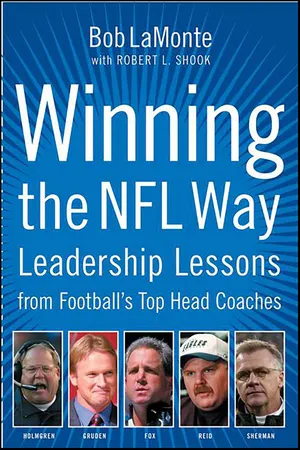
THE NEXT STEP IN MY budding sports agenting career occurred, however, when I met another high school teacher who also taught history and coached football. I previously knew Mike Holmgren only by reputation. Three years my junior, he was a star quarterback at Lincoln High School in San Francisco, the “Prep Player of the Year” in 1965. A 3,592-yard passer in his senior year, he was one of the most highly recruited football players in the country. Holmgren received a full ride at the University of Southern California.
With O. J. Simpson in the backfield, the Trojans were a running team; as a result the six-foot-five Holmgren spent most of his college days warming the bench while Coach John McKay used quicker, smaller quarterbacks. He was also cursed with a dislocated thumb, sprained ankle, and a shoulder injury during his senior year. Even so, in 1970, he was an eighth-round draft choice of the then St. Louis Cardinals. His pro career as a player was short-lived, lasting only one year. He then returned to his alma mater, Lincoln High School, to teach history and coach football. In 1975, he took a teaching and coaching job at Oak Grove High School. I was teaching at Santa Teresa High School, and at the time, we were on double session with Oak Grove because my school’s building was under construction. The two schools shared the same facilities; from 7:00 A.M. to noon, our football team practiced while Oak Grove students attended classes. Then we reversed it—our students attended classes from 1:00 to 5:00 P.M. and their team practiced. During this period, Mike Holmgren and I became good friends.
In 1980, five years after his arrival at Oak Grove, he said to me over lunch, “I’ve been offered a job as the offensive coordinator/quarterbacks coach at San Francisco State. Everyone I’ve talked to so far tells me I’d be out of my mind to take it. Still I wanted your opinion, Bob. Should I take it?”
At the time, Mike and Kathy had twin daughters and she was pregnant with a third child. Taking the new job would mean taking a hefty cut in pay.
“Mike, football is your passion,” I said. “Take a leave, and if it’s not for you, then you can get your job back.”
“Everyone else tells me not to do it. You’re the only one who thinks differently. They tell me to stick with my present high school job.”
“You’re a brilliant coach, Mike,” I assured him. “The best I’ve ever seen. Take the opportunity and run with it. If you pass it up, you may regret it the rest of your life.”
“Thanks for the vote of confidence,” he replied. “I needed that.”
“While we’re at it, Mike, I’d like your opinion on something,” I said. “I’ve been thinking about becoming a sports agent. The Campbell family talked to me about representing their son. What do you think?”
“Go for it,” he answered. “You’re a natural. You have their trust, and in my opinion that’s everything.”
Holmgren took the job, and one year later moved on to coach quarterbacks at Brigham Young University. During his four-year stint at BYU, he worked under the great head coach Lavell Edwards. He also worked with Cougars quarterback Steve Young, the future All-Pro who played with the San Francisco ’49ers. In 1984, Brigham Young had a 13-0 record and was the top-ranked college football team in the country.
In 1986, Holmgren signed on with the ’49ers as quarterbacks coach, where he worked with Joe Montana, one of the all-time best NFL passers. He also had the good fortune to work under legendary head coach Bill Walsh, the man credited with being the innovator of the West Coast offense, a strategy that calls for a strong passing game, with many quick, short passes geared to result in long runs by receivers. In 1989, Holmgren was named the team’s offensive coordinator. That same year, Holmgren’s unit led the NFL in total offense. He was a hot property and other teams pursued him with head coach offers. Up until this point, I had been advising him strictly as a friend because in those days few head coaches—much less, assistant coaches—were represented by an agent.
At this point in his career, he asked me to be his agent and I agreed. I got him a richer contract with the ’49ers as an offensive coordinator than many NFL head coaches received. I realized it was a good time to represent NFL coaches, because players’ salaries had begun to escalate and coaches’ salaries were lagging behind. They would, I figured, have to balance out eventually because, as I recognized, head coaches were undervalued. As a consequence, I decided to specialize in representing coaches rather than players.
During Holmgren’s tenure with the team, the ’49ers posted a 71-23-1 record, and were in postseason games for five consecutive years. San Francisco beat Cincinnati in Super Bowl XXIII and the following year beat Denver in Super Bowl XXIV.
As the ’49ers’ offensive coordinator, Holmgren earned such a sterling reputation that he was better known than most NFL head coaches. It was just a matter of time before he would be tapped for a head coach position. Predictably, in 1992, he left San Francisco to coach the Green Bay Packers. He did it without ever having been a head coach at the high school or college level.
It wasn’t long after the new year 1992 had began when Mike Holmgren stood in the lobby of the Packers’ reception area waiting to be interviewed for his first job as a head coach. A large mural, a collage of the all-time great Packers players and coaches, instantly caught his attention. His eyes focused on the team’s celebrated head coach, Vince Lombardi. In the nine years that Lombardi had been in Green Bay, starting in 1959, the team amassed a phenomenal 98-30-4 record, including an unprecedented winning streak of nine playoff games. Under Lombardi, the team had won five world championship titles (1961, ’62, ’65, ’66, and ’67). No wonder the Super Bowl winner is the recipient of the Vince Lombardi Trophy, the highest honor in professional football. A quarter of a century had passed at the time of Holmgren’s arrival in Green Bay, and no Packers coach had come close to filling Lombardi’s shoes. The great coach died in 1970 at age 57; over the years, Lombardi has been lionized. Millions of football aficionados hail him as the game’s greatest head coach ever.
“Standing there, I thought about some of the coaches that followed Lombardi,” Holmgren recalls, “Dan Devine, Bart Starr, and Forrest Gregg. None had a career coaching record that exceeded .500. Lombardi’s was an amazing .758. Starr and Gregg had played under Lombardi, and had been close to him. It was natural they’d try to emulate him, but he set an almost impossible standard. So when I came for my interview, I thought to myself that I was not a part of the old Green Bay Packers. In ...