- 352 pages
- English
- ePUB (mobile friendly)
- Available on iOS & Android
eBook - ePub
About this book
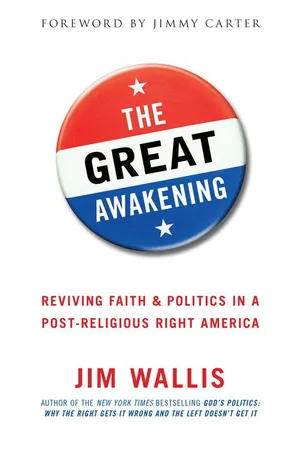
Now in paperback: the bestselling author of God's Politics revives our hope in a politics that reflects our highest common values and offers a roadmap for solving our biggest social problems.
Information
Topic
Teologia e religioneSubtopic
Governo americano1
REVIVAL TIME
When Faith Changes Politics
Arriving in Atlanta recently for a speaking appearance, I was happy. For any preacher, Atlanta is a wonderful place to be, a place where preaching is an art form. On this occasion, I returned to a favorite place—Ebenezer Baptist Church, the home congregation of Dr. Martin Luther King Jr. The pastor, Rev. Joe Roberts, was about to retire, and he welcomed me back warmly, “You’ve been to the old Israel, but now you’re in the new Israel” (referring to the old historic church on Auburn Avenue and the brand-new sanctuary across the street where two thousand people had gathered that evening).
I remembered. It was indeed the old place I’d been to before, on the occasion of the first annual national holiday for the birthday of Dr. Martin Luther King Jr. For their Peace and Justice service, Ebenezer had invited a young white preacher. I was excited, but very nervous. When I stepped into that historic pulpit, I froze. Dr. King had preached here, so had his father, “Daddy” King, and so had countless leaders of the civil rights movement and the leading black pastors of our time. What was a young white kid from Detroit doing in this pulpit? I was, you might say, a little tentative as I began. “Well, Martin Luther King Jr. was for justice and…p-p-peace,” I stammered, “…and probably we should be too.” It was something short of powerful.
But then, from the lower left side of the church, a voice boomed back at me. “Oh, help him, Lord, help him! C’mon young man, you’re supposed to preach.” So I started to—a little. “Aw, you’re not there yet!” he bellowed. He, of course, was enacting the “call and response” tradition of the black church, which I have grown to love. The old man was the “amen corner” of Ebenezer Baptist Church, and he proceeded with a litany of “well,” “yes sir,” “mercy, mercy,” “preach it now,” and lots of “amens” until I was proclaiming, prancing, and sweating—preaching my heart out until I was thoroughly exhausted when I finally finished. Afterward, I rushed down to my amen corner, whose name was Deacon Johnson. “You just pulled that sermon out of me,” I exclaimed, breathless. Standing tall, he put his hands on my shoulders and smiled at me. “Son,” he said, “I’ve raised up many a preacher in my time.”
Deacon Johnson has passed now, Rev. Roberts told me, but I will always remember him. Just as Deacon Johnson had pulled the best out of me, I reflected that night in Atlanta, that pulpit at Ebenezer Baptist Church (and the civil rights movement rooted there) had called out the very best from the American people. The truth is that we’ve got some bad stuff in us as Americans, but we’ve got some good stuff, too. Bad religion calls forth our worst stuff, but good religion calls out our best. I smiled as I remembered how Deacon Johnson had raised me up that night, and I climbed into the Ebenezer pulpit once again. It’s time for some good religion tonight, I said to myself.
Two of the great hungers in our world today are the hunger for spirituality and the hunger for social justice. The connection between the two is the one the world is waiting for, especially the new generation. And the first hunger will empower the second.
Those on the Religious Right did it wrong, allowing their religion to become too partisan, too narrow, and too ideological. They were used by politics and did plenty of using themselves—using both people and issues to further their own agenda. But I believe their day is over, and we have now entered the post-Religious Right era. That’s not just optimism, but a claim based on serious observation, as this book will point out.
Some people believe the alternative to bad religion is secularism, but that’s wrong, too. The answer to bad religion is better religion—prophetic rather than partisan, broad and deep instead of narrow, and based on values as opposed to ideology. In America (and in most of the developing world), religion is here to stay. The question is not whether faith and spiritual values will be applied to politics, but how? Can faith enter public life in ways that are respectful of democracy, pluralism, and diversity? Could spiritual renewal supply the energy that makes social justice more achievable? Is revival necessary for reform? I believe the answer to all those questions is an emphatic yes, and this book will explain why.
One learns a lot crisscrossing the country for three decades, speaking (and listening) in every part of America and to a multitude of audiences and constituencies. Because much of my speaking is also preaching, I have been with almost every religious denomination and faith community in America, and have watched the relationship between faith and politics significantly affect the issues of society—for good and ill. I’ve also traveled extensively overseas and been an eyewitness to many of the greatest crises the world faces today, as well as the kinds of initiatives and movements capable of changing those realities.
I have been listening, and I’d like to report that many Americans, and in particular many people of faith in this country, believe we can do better with both our religion and our politics—and around the world, people are hoping that we do. Listening to people across America and throughout the world convinces me that it is time for a new kind of politics, and that a better public engagement by faith communities could help get us there. The good news is that many people are ready for both—better religion and better politics. In fact, we may be approaching a new “revival” of faith, one that opens the door for real solutions that transcend partisan politics and leads the way to concrete victories for social justice. I am suggesting that we need nothing less than a powerful movement of faith to renew American politics—one that effectively combines personal conversion and social justice. Personal transformation is necessary for social movements, and social movements are necessary to transform politics.
For all the travels, my base has been inner-city Washington, D.C., the “other Washington”—not far from the capital city’s corridors of power but very distant from the experience of the power brokers who inhabit this place. Coming back and forth has been a spiritual discipline for me. Flying away to speak or organize someplace or journeying the few blocks to meet with the nation’s political leaders—from a place where poor people struggle every day—anchors me in the realities that most of the world’s people know only too well. Place yields perspective (or, as they used to say in the civil rights movement, “Your perspective is shaped by what you see when you get out of bed in the morning”), and the perspectives that shape my faith and my politics come from all the places I’ve been—from midwestern Middle America where I grew up, to the urban war zones I’ve called home for more than three decades, to the foreign capitals and shantytowns I’ve visited where the world is viewed entirely differently than it is by most Americans.
My favorite part of any speaking event is the question-and-answer time—which often turns into “town meetings” in cities across the nation. From those amazing public forums and the countless individual conversations around the edges of them, I feel the hunger of Americans for a new vision of our life together, and the desire to engage their faith in dealing with the urgent problems we face. I don’t speak as a representative of any party; I am not an elected official or political partisan, but rather view the world as a person of faith who believes that real solutions must transcend partisan politics.
I am also happy to report that, despite the big problems we face, there is a lot of good news around the country and across the world. Part of the good news is that many evangelical and Pentecostal Christians are leaving the Religious Right while retaining their commitment to live out their faith in the world. That significant political shift has yet to be fully recognized by the nation’s media and political elites, but it could eventually provide a tipping point on many of the major issues of our time.
I also find many Catholics (especially at some of the nation’s leading Catholic universities) who are rediscovering the depth and breadth of Catholic teaching on social justice and the transforming idea of the common good. But they are not just discovering their own church’s best teachings; they are also experiencing a rebirth of faith themselves, and making it personal. This personal renewal of faith and spirituality is also occurring in some of the declining mainline Protestant churches as they discover their mission in the world. Wherever renewal is happening in the old denominations, it usually occurs around the deepening or reawakening of spirituality and even evangelism. In fact, many are learning that the social mission of the church in the world will never be accomplished without the fire and passion that comes from personal faith. The social gospel cannot be sustained without a personal experience of Jesus, who brings the good news. The leader of one of those churches, Wesley Granberg-Michaelson of the Reformed Church in America, points out that the real difference today is not between evangelical churches and liberal churches, but between churches that are settled and those that are missional.
I am especially encouraged by a new generation of black pastors who want to move beyond merely eulogizing the civil rights movement and make their own history for justice. Similarly, young Latino pastors, many of them Pentecostal, are making the critical connection between evangelism and social justice. New generations of Asian-American Christians are moving beyond the protective conservatism of their parents to a more outward-looking faith directed into their communities. Emerging immigrant churches are rapidly changing the demographics and the perspective of U.S. Christianity. These Christians are people of color whose dynamic faith is a clear alternative to the white churches—more theologically conservative than liberal Protestantism and more socially progressive than their white-middle-class evangelical counterparts. That makes these diverse American Christians more like the rapidly growing global church. Their mixture of a strong and vibrant personal faith with a passionate commitment to social justice (including for their own congregants, who themselves are often poor) is exactly the combination that can spark revival.
Jewish renewal is under way in many synagogues, where I have found worship as lively as in any church, and where people are rediscovering their own traditions of shalom (peace, wholeness, and justice) and tikkun (to repair and heal the world). And very thankfully, a growing number of young Muslims (including many impressive women I meet while teaching my classes at Harvard) are working toward a new kind of Islam that challenges extremists.
Then, too, there is the rapidly expanding “new denomination” of those who say they are “spiritual but not religious” and believe that political solutions will require a moral commitment. Whether or not they are drawn to religion (some are and some aren’t), this new generation of young people is eager to make a difference and hungry to find that critical connection between spirituality and social justice. It’s not just college students I’m talking with, but high school, middle school, and even elementary school youth who are all eagerly joining the conversation about how we can change the world. In a postmodern and, for many, a post-Christian world, young activists are searching for something to be the engine that drives their passion for justice and a solid foundation for their lives. And when they see a lived-out faith that really is committed to justice, it often becomes evangelistic for them. Almost every week young people say to me, “I’ve been an activist for years, but now I’m seeking the faith to sustain my life.”
These are the people I regularly meet on the road. Taken together, their constituencies comprise a large and influential number of Americans, and they are mirrored in their counterparts I’ve met around the world. Acting together, they could create the kind of social movements that have historically made a big difference on the great moral issues of history.
Revival and Reform
Kathleen Kennedy Townsend is the eldest child of Robert Kennedy and was formerly the lieutenant governor of Maryland. In her book Failing America’s Faithful she reflects on America’s revivalist history. “Throughout history, faith has gone underground only to emerge again in Great Awakenings, readying people for spiritual exploration. There are moments in history where people are ready and able to see the connection between the rituals of prayer and worship and the larger effort of improving God’s world—and I believe we are now approaching just such a time.”1
In 2007 we commemorated the two hundredth anniversary of the ending of the slave trade by Great Britain. A popular film told the story of William Wilberforce, the British parliamentarian who led the antislavery campaign. As Amazing Grace: The Story of William Wilberforce powerfully portrayed, Wilberforce was a convert in the Wesleyan revivals of eighteenth-century Britain, and his Christian faith was the central driving force behind his relentless battle against slavery. He and a group of fellow Christian parliamentarians and other laypeople known as “the Saints” were behind many social reforms that swept England in the late eighteenth and early nineteenth centuries.
Some years ago, on a trip to England, I walked through the historic Holy Trinity Church on Clapham Common in South London. This Anglican parish was Wilberforce’s home church when he wrote Britain’s anti-slave-trade legislation. The rector at Holy Trinity, Rev. David Isherwood, was very proud to show me around. On the wall were pictures of typically English-looking gentlemen who had helped turn their country upside down. Finally, the rector pointed to an old, well-worn table. “This is the table upon which William Wilberforce wrote the antislavery act,” he said proudly. “We now use this table every Sunday for communion.” I was struck that here, in a dramatic liturgical symbol, the secular and the sacred are brought together with powerful historical force. How did we ever separate them? On this table, the slave trade was outlawed and the body and blood of Christ was celebrated each week. What became of religion that believed its duty was to change its society on behalf of justice?
William Wilberforce and his group of friends profoundly changed the political and social climate of their time. Wilberforce was a convert in a revival that shook his society. His life and his vocation as a member of Parliament were dramatically and forever altered by his newfound faith, and Wilberforce became a force for moral politics. His mentor, John Newton, who worked in the slave trade before he became a minister, became well known for writing the beloved hymn “Amazing Grace.” Later, Newton also used his influence as a religious leader in the battle against slavery. We can read his immortal words “Amazing grace, how sweet the sound, that saved a wretch like me” not only as a testimony of private guilt, individual salvation, and personal piety, but also as a clear and public turning away from the social sin of trafficking in human flesh. Newton wasn’t just suffering from existential angst; he really was a wretch—a slave trader—and had his life transformed by Jesus Christ! Newton’s conversion eventually produced a social and political transformation as well as a personal one. And that is the key to real revival.
The same became true of Wilberforce, who first heard Newton speak when he was young but regarded his real conversion as confirmed following a series of conversations with Newton in 1785-86. At the conclusion of their conversations, Newton said, “The Lord has raised you up for the good of the church and the good of the nation.” Two years later Wilberforce introduced his first anti-slave-trade motion in Parliament. It was defeated, and it would be defeated nine more times before it passed in 1807. It was a historic and moral victory, but Wilberforce wouldn’t be satisfied until slavery was abolished altogether. A new Wilberforce biography notes that “probably the last letter” John Wesley ever wrote encouraged Wilberforce: “Oh, be not weary in well-doing. Go on, in the name of God and in the power of His might.”2 Wilberforce continued working tirelessly toward that goal, year after year. Finally, in 1833, the House of Commons passed a bill abolishing slavery altogether; Wilberforce died three days later, his work finally done.
Similarly in the nineteenth century, American religious revivalism was linked directly with the abolition of slavery and other movements for social reform. As historian Michael Kazin says, “From the Second Great Awakening in the 1820s to the 1920s, there was a period where social movements were infused with the evangelical spirit.”3 Chris tians helped lead the abolitionist struggle, efforts to end child labor, projects to aid working people and establish unions, and even the battle to obtain voting rights for women. Here were evangelical Christians fighting for social justice, precisely because of what God had done for them—an activity with which evangelicals have not been associated in more recent times.
Nineteenth-century American evangelist Charles Finney didn’t shy away from identifying the gospel with the antislavery cause. He was a revivalist and also an abolitionist. For him, the two were closely connected. Finney, who has been called the father of American evangelism, directly linked revival and reform and popularized the altar call. Why? To sign up his converts for the antislavery campaign! They would commit their lives to Christ and then enlist for God’s purposes in the world. That’s the way it always is for revival—faith becomes life-changing, but rather than remaining restricted to personal issues and the inner life alone, it explodes into the world with a powerful force. For Finney, taking a weak or wrong position on social justice was a “hindrance to revival.”
William Jennings Bryan (1860-1925), another seminal figure almost forgotten in modern political discussion, shows that progressive evangelicalism is nothing new, as he linked personal faith to political populism. Bryan is described in a new biography, A Godly Hero, as the most influential American political figure of his time who was not a
U.S. president. Bryan’s biographer, Michael Kazin, writes, “For many of his correspondents, Bryan was not merely a favorite politician. They believed him to be a godly hero who preached that the duty of a true Christian was to transform a nation and world plagued by the arrogance of wealth and the pain of inequality.” A “radically progressive interpretation of the gospels” drove Bryan’s political career, which included “three campaigns for the White House, his work for a dazzling variety of causes both secular and religious, and thirty continuous years of theatrical preaching throughout the nation and the world.” Bryan’s “creed,” says Kazin, “married democracy and pietism in a romantic gospel that borrowed equally from Jefferson and Jesus.”4
In a conversation I had with Kazin, he noted that very few biographers of Bryan were “really able to explain how Bryan could be a conservative in religion and a liberal, even radical, in politics, without seeing any contradiction between the two—because the wisdom about that is that there was this great schism between people who were fundamentalists theologically and people who were liberal politically. Bryan didn’t see any difference between his religion and his politics. He thought they were quite consistent.”5
Martin Luther King Jr.’s personal faith journey and the spiritual power of the black churches were absolutely central to the civil rights movement. Arising clearly out of the black church tradition of America and the Ebenezer congregation his father led, the bright young Martin Jr. was steeped in the intellectual and liberal social gospel tradition during his seminary and postgraduate years. But as the freedom struggle intensified, the faith of Martin Luther King Jr. became much more personal. His theological liberalism was not an adequate foundation for what he would ultimately face. My experience is that the more deeply one moves into the struggle for social justice, the more important personal faith becomes. There is, indeed, a genuine tradition of theological liberalism that leads to a social gospel, but there’s also an evangelical traditi...
Table of contents
- Cover Page
- Title Page
- Dedication
- FOREWORD
- Table of Contents
- introduction SOMETHING IS HAPPENING
- 1 REVIVAL TIME When Faith Changes Politics
- 2 CHANGES IN THE AIR The New Agenda
- 3 HOW TO CHANGE THE WORLD, AND WHY Rules of Engagement
- 4 THE MORAL CENTER Politics for the Common Good
- 5 INCLUSION AND OPPORTUNITY The Welcome Table
- 6 STEWARDSHIP AND RENEWAL
- 7 EQUALITY AND DIVERSITY
- 8 LIFE AND DIGNITY Critical Choices
- 9 FAMILY AND COMMUNITY The False Choice
- 10 NONVIOLENT REALISM
- 11 INTEGRITY AND ACCOUNTABILITY
- 12 WHAT'S ACCEPTABLE, WHAT'S POSSIBLE
- EPILOGUE RED LETTER CHRISTIANS AND JUSTICE REVIVALS
- APPENDIX JIM WALLIS SR. Man of Faith
- NOTES
- INDEX
- ACKNOWLEDGMENTS
- Praise
- ALSO BY JIM WALLIS
- Copyright
- About the Publisher
Trusted by 375,005 students
Access to over 1.5 million titles for a fair monthly price.
Study more efficiently using our study tools.
Frequently asked questions
Yes, you can cancel anytime from the Subscription tab in your account settings on the Perlego website. Your subscription will stay active until the end of your current billing period. Learn how to cancel your subscription
No, books cannot be downloaded as external files, such as PDFs, for use outside of Perlego. However, you can download books within the Perlego app for offline reading on mobile or tablet. Learn how to download books offline
Perlego offers two plans: Essential and Complete
- Essential is ideal for learners and professionals who enjoy exploring a wide range of subjects. Access the Essential Library with 800,000+ trusted titles and best-sellers across business, personal growth, and the humanities. Includes unlimited reading time and Standard Read Aloud voice.
- Complete: Perfect for advanced learners and researchers needing full, unrestricted access. Unlock 1.5M+ books across hundreds of subjects, including academic and specialized titles. The Complete Plan also includes advanced features like Premium Read Aloud and Research Assistant.
We are an online textbook subscription service, where you can get access to an entire online library for less than the price of a single book per month. With over 1.5 million books across 990+ topics, we’ve got you covered! Learn about our mission
Look out for the read-aloud symbol on your next book to see if you can listen to it. The read-aloud tool reads text aloud for you, highlighting the text as it is being read. You can pause it, speed it up and slow it down. Learn more about Read Aloud
Yes! You can use the Perlego app on both iOS and Android devices to read anytime, anywhere — even offline. Perfect for commutes or when you’re on the go.
Please note we cannot support devices running on iOS 13 and Android 7 or earlier. Learn more about using the app
Please note we cannot support devices running on iOS 13 and Android 7 or earlier. Learn more about using the app
Yes, you can access The Great Awakening by Jim Wallis in PDF and/or ePUB format, as well as other popular books in Teologia e religione & Governo americano. We have over 1.5 million books available in our catalogue for you to explore.