"One of the finest biographies of a sadly underrated man . . . [Kaplan is] a master historian and biographer" (Carol Berkin,
Washington Post).
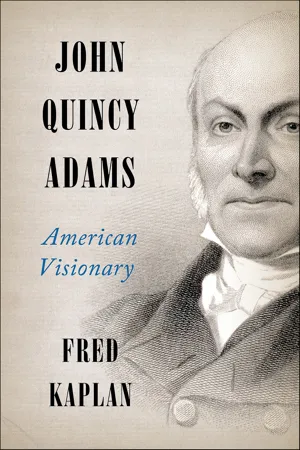
In this fresh and illuminating biography, Fred Kaplan brings into focus the dramatic life of John Quincy Adams—the little-known and much-misunderstood sixth president of the United States and the first son of John and Abigail Adams. In doing so, he reveals how Adams' inspiring, progressive vision guided his life and helped shape the course of American history.
Kaplan draws on a trove of unpublished archival material to trace Adams' evolution from his childhood during the Revolutionary War to his brilliant years as Secretary of State to his time in the White House and beyond. He examines Adams' myriad sides: the public and private man, the statesman and writer, the wise thinker and passionate advocate, the leading abolitionist and fervent federalist.
Meticulously researched and masterfully written,
John Quincy Adams paints a rich portrait of this brilliant leader whose stamp on the young nation is still present in the 21st century.
- 672 pages
- English
- ePUB (mobile friendly)
- Available on iOS & Android
eBook - ePub
About this book
Information
CHAPTER 1
Hooks of Steel 1767–1778
AT 5 A.M. on an intensely hot summer day, President John Quincy Adams left the White House by stagecoach for Quincy, Massachusetts. It was July 9, 1826, just two days short of his fifty-ninth birthday. He had been up the night before “in anxiety and apprehension, until near midnight.” The heat made him miserable. Candlelight attracted insects. There were no screens. The day before, he had gotten three letters from Quincy with the news that his ninety-one-year-old father, the second president of the United States, was on his deathbed. John Quincy had “flattered” himself that his father “would survive this summer, and even other years.” A rider was on his way from Baltimore to tell him he was wrong.
John Adams had died late in the afternoon of July 4. All of Washington already knew that Thomas Jefferson had died a little after 1 P.M. on the same day. Jefferson’s final moments came just a few hours after a plea for a cash subscription for the impoverished former president at the capital’s Independence Day celebration had met with a meager response. The third president had been an intimate member of the Adams family household in Paris when John Quincy was a young man. In 1800, Jefferson, barely and only by the advantage of counting slaves as voters, had defeated Adams’ father’s bid for a second term. It was a nasty campaign, mostly on the Jefferson side. In 1808, as a senator from Massachusetts, John Quincy, in an ironic twist, had earned the hatred of many New England Federalists, who later forced him out of his Senate seat, because he had supported some of Jefferson’s policies. Adams had thought them in the best interests of the country. Even then he had judged Jefferson’s presidency a failure, his personality flawed by self-deception and political hypocrisy. Whether or not Adams would get to Quincy soon enough to see his father one last time was the main thing on his mind. Only some days later did he remark on the obvious coincidence that the second and third presidents of the United States had died on the same day, the fiftieth anniversary of the Declaration of Independence. It seemed to many a miraculous fact. It has become a cliché of American history.
Like his father, John Quincy agreed with Jefferson on at least one fundamental principle: government derived its legitimacy from the consent of the governed. That meant the rule of the ballot box. The differences were a question of the degree to which government should be structured to reflect the dominance of the popular voice. Neither Jefferson nor John Adams favored democracy in the modern sense, and John Quincy had his doubts. What he had no disagreement about with either former president was that political parties were instruments of bad governance; they were manifestations of individual or group self-interest that would undermine republican government. Good government depended on civic virtue rather than personal greed. Parties were organized lobbies in pursuit of power and money. Every president before John Quincy Adams had believed that presidents should be above party. But an immense, and to Adams appalling, change was well under way. His own presidency was under assault by interests that believed all that mattered was power, that the object of politics was to smash the opposition, and that political parties were the necessary vehicles for obtaining power. Power and financial self-interest were inseparable. In this extreme form, the concept was something new in American politics. And it seemed to Adams both awesome and dangerous.
INTENT ON REACHING Quincy as quickly as possible, he sweated profusely and slept badly as he traveled in ceaseless motion. A little less than medium height, paunchy by genetic inheritance and from occasional overeating, Adams had tight lips and a narrow lower face. His dark dress set off a pale complexion, and the vertical intensity of his lower face moved upward and outward, accompanied by gray sideburns, to a mostly bald head. He traveled in public vehicles, without security or advance arrangements, as was normal practice for presidents. He was accompanied by George Washington Adams, his eldest son and personal secretary. He traveled by water and land, in bone-jarring stagecoaches and dirty steamboats that routed him via Baltimore, Philadelphia, and New Brunswick, New Jersey. There the Raritan River allowed egress to the New Jersey waterways. The ferry to New York ran aground twice. At New York City, he boarded a steamboat to Newport and Providence, Rhode Island. This took almost five days of demanding travel. At best the roads were bad and the ride was tedious; in bad weather the crowded steamboats were inoperative.
But the trip was lightning fast compared with the first time he had traveled even half that route. When his father in 1775 had traveled from Boston to Philadelphia to represent Massachusetts in the Continental Congress it had taken fifteen days. Twenty-seven-year-old John Quincy had made that same journey in ten days in 1794, when Philadelphia was the temporary capital of the country. The city of Washington did not yet exist. In Adams’ later years, the trip from Washington to Boston would take only two days. The railroad had transformed travel. Space and distances had contracted, from horseback, stagecoach, sailing vessel, and canal boat, to the additional speed allowed by improved roads, to the steamboat, and, finally, to the space- and time-shattering railroad.
On July 11, 1826, the day Adams arrived in New York, he noted that it was his fifty-ninth birthday, a fact to record in his diary, not to celebrate. The loss of his father dominated his thoughts. He was returning to the place in which he had been born, now absent the man who had been the most important influence on his life. He had loved his father at least as much as he had loved any other human being. Now that the patriarch of the family was dead, the eldest son would have to assume that role—there was no one else capable. And his mood could not help but be touched by his identification with his father’s fate, the only one-term president of the first five of the country. John Quincy might possibly be the second. That, he anticipated, would be a bitter irony. How would he spend the remainder of his life? And where would he spend it? On the steamboat Connecticut, heading rapidly toward Providence, he brooded on “the peculiar circumstances” of his birthday and the question of how long he himself would live. A realist and a fatalist, he had always tried to accept with resignation the unpredictability of such matters. He could not know that he would not rest beside his father for another twenty-two years of intense service to his country.
But whether or not he would have a second term as president, he did have a strong conviction about where he would spend much or all of his remaining years. John Adams’ property in Quincy consisted of two modest eighteenth-century houses on the Plymouth Road, within fifty feet of one another, in the New England saltbox style. In one of them John Quincy had been born and spent the first eleven years of his life. In the other his father had been born. The property extended for over a hundred acres toward the Blue Hills. And there was also a larger house and property a few miles away, named Peacefield by John Adams, that his parents had purchased in 1788 when Adams had returned from his ministerial duties in Europe. It served as his residence until his death. “It is repugnant to my feelings to abandon this place,” John Quincy wrote, “where for nearly forty years [my father] has resided, and where I have passed many of the happiest days of my life. . . . Where else should I go?”
Four days after his birthday, he read his father’s will. It was clear that the property could come into his possession only if he saddled himself with heavy financial obligations. There were other heirs who would need to be satisfied. He immediately decided that, at whatever cost, he would preserve for himself and his descendants the two original houses, with the property that his ancestors had farmed, and the attractive larger house with its orchards and gardens. “Though it will bring me heavily in debt,” John Quincy wrote to his wife Louisa, “I cannot endure the thought of the sale of this place. Should I live through my term of service, my purpose is to come and close my days here, to be deposited with my father and mother.” The land and the vicinity were a sacred ground of family history and personal memories. “Everything about the house is the same. I was not fully sensible of the change till I entered his bed-chamber. . . . That moment was inexpressibly painful, and struck me as if it had been an arrow to the heart. My father and mother have departed. The charm which has always made this house to me an abode of enchantment is dissolved; and yet my attachment to it, and to the whole region round, is stronger than I ever felt it before.”
The attachment was to an idea as well as a place, an idea embodied in John Adams’ values and life. No matter how materially his body was entombed, he remained alive in his son’s life in a living bequest. Just as John Quincy now inherited the Quincy property, he had also inherited from his father something he valued more than wealth. It was an unbreakable and energizing bond, the living tissue of the ideals that his father, his family, and his extended New England world had pledged themselves to in 1776, and the perpetuation of which the son held to be the only possible definition of himself and his country. It was a pledge to union, a union that, despite the repugnant compromises required to create the Constitution, was based on the values expressed in the Declaration of Independence John Adams had helped to create. He had been designated by the Congress as a member of the committee of five appointed to write the document. In the days preceding its creation, he had been one of the leading, most determined, and most passionate voices arguing for total independence immediately. And it was Adams who thought Jefferson best suited, as a Virginian and a stylist, to compose the initial draft. And though Jefferson’s claim that “all men are created equal” was sincere, any honest application by Jefferson and his Southern associates had, at least in their minds, to involve a significant exclusion. For Adams, there was none. In 1836, on the tenth anniversary of his father’s death, when the issue of slavery had begun to dominate his life, John Quincy affirmed the sacred connection in a commemorative poem, “Day of My Father’s Birth.” From his father’s words and life, his own contemporaries could relearn
that freedom is the prize
Man still is bound to rescue or maintain;
That nature’s God commands the slave to rise,
And on the oppressor’s head to break his chain.
Roll, years of promise, rapidly roll round,
Till not a slave shall on this earth be found!
Arriving a few days too late to see his father alive, John Quincy attended a funeral service at the Quincy Congregational Church. “I have at no time felt more deeply affected by [the death of my father],” he wrote in his diary, “than on entering the meeting-house and taking . . . the seat which he used to occupy, having directly before me the pew at the left of the pulpit, which was his father’s, and where the earliest devotions of my childhood were performed. The memory of my father and mother, of their tender and affectionate care, of the times of peril in which we then lived, and of the hopes and fears which left their impressions upon my mind, came over me, till involuntary tears started from my eyes.”
In the afternoon he heard a second sermon from a visiting preacher. It was on a text from Revelation: “Be thou faithful unto death, and I will give thee a crown of life.” Four days later, he walked to the graveyard and visited the four monuments “to the memory of his ancestors.” Five generations now rested there. Afterward he spent hours reading documents, including the accounts of his father’s personal estate, his will, and the wills of previous generations going back to 1694. His father had arranged and left them for him. “These papers awaken again an ardent curiosity to know more of these forefathers, who lived and died in obscure and humble life, but every one of whom, from the first settlement of the country, raised numerous families of children, and had something to leave by will. There could indeed be nothing found of them but the ‘short and simple annals of the poor.’”
IN THE TWENTIETH and twenty-first centuries the Adams family name glitters with semi-mythical power. But it had no such glow in the latter part of the eighteenth century. Five generations of the family had lived in colonial Massachusetts by the time of John Quincy’s birth in 1767. No one in the larger world of Massachusetts knew of them. John Quincy’s father was an ex-schoolmaster, a hardworking, ambitious, up-and-coming lawyer with strong views about the tension between Great Britain and its American colonies. His ascent to fame and power arose out of revolutionary turmoil, not long-settled inheritance. Until then, the Adams family had no distinction—social, financial, or political. Their local lives defined them. Most of John Adams’ American forebears had earned subsistence incomes. They had little to no education, with the exception of a Harvard graduate in 1710 who had a congregation in New Hampshire. When John Adams, also an eldest son, graduated from Harvard in 1755, the college ranked each graduate by social standing. Adams ranked “fourteenth in a class of twenty-four,” probably owing to the standing of his mother’s family. Twenty-five years later, in 1787, John Quincy Adams was second on the roster of his Harvard class. He was no smarter and had not performed more brilliantly than his father. The list was alphabetical. Times and values had changed.
Like all of his American ancestors, John Quincy, named for a relative whose last name was Quincy and who had died on the day of John Quincy’s birth, had been born in rural Braintree, the north portion of which was renamed Quincy in 1792. Along the coast, ten miles south of Boston, it was about three hours away by horseback or coach. By the time John Quincy died, the transportation revolution had changed this country village of small farmers and artisans, whose granite quarries were its main natural resource, into a suburb, now indistinguishable from a much-enlarged Boston. In 1767, Braintree was still its own world. Partly arable but not rich, it had a modest market for domestic consumption. Bringing products, whether perishable or not, to distant markets, even to Boston, was difficult. Multiple occupations were commonplace. Wages were low; production was limited; the economy was mostly local. The family that did not harvest vegetables and fruit in the summer was usually hungry in the winter. John Quincy’s grandfather was a farmer and shoemaker, a deacon in his church, a member of the fourth generation of Adamses to live in Braintree. His paternal great-grandfather, Joseph, was the youngest of eight sons of the first American Adams. Henry Adams had emigrated from Braintree, in Essex County, England, in about the year 1630, and died in Braintree, Massachusetts, in 1646, “the stock from whom the whole family [is] descended,” John Quincy wrote in 1823. Over the years, Adamses served regularly in the governance of Braintree, the New England ritual of town meetings and local elections that made such towns independent of distant authorities. They were all good subjects of the empire, existing happily on the outskirts of its power. For generations the Adams family had nothing to do with Boston and Massachusetts politics. In religion, they were Congregationalists, members of the Protestant denomination that dominated New England, its origins in the first Puritan settlement. But John Adams rejected Calvinism and became a Unitarian. Like his father, John Quincy came to believe that “the Calvinistic doctrines of election, reprobation, and the atonement are so repulsive to human reason that they can never obtain the assent of the mind, but through the medium of the passions; and the master passion of orthodoxy is fear.”
John Quincy had no illusions about his paternal family’s social standing. What he admired about these ancestors was the decency of their ordinary lives. With the exception of his own father, “the highest worldly distinction which any of them attained was that of Selectman of the Town of Braintree. . . . They were distinguished only as men of industry sobriety . . . at the close of long lives of humble labor, returning their bodies to the soil . . . and their meek and quiet spirits to the god who gave them.” He learned nothing that he could not respect about these ancestors. “The absence of information stimulates curiosity which can never be gratified,” he lamented in 1823. He never tired of quoting “Elegy in a Country Churchyard.” But Thomas Gray’s unrecorded “annals of the poor” were mostly on the paternal side. The two Adams men preceding John Quincy made advantageous marriages. They raised the family’s social status and provided the network of family connections so important in a kinship society. Early New Englanders took extended family very seriously. The Joseph Adams who was John Quincy’s great-grandfather married Hannah Bass, apparently a granddaughter of John and Priscilla Alden, famous names in the history of the Massachusetts Bay colony. The John who was his grandfather married Susanna Boylston, the granddaughter of Thomas Boylston—a well-known surgeon and early émigré from London whose surgeon brother introduced inoculation into North America—and the daughter of a successful Brookline merchant. The Boylston name had presence in Massachusetts.
In 1735, Susanna Boylston became the mother of the future second president. His parents destined him for Harvard and the clergy. That small provincial college was the only game in town, the portal through which passed the young men chosen, mostly by birth and wealth, to be the leading citizens of Massachusetts. It graduated clergymen and a small number of lawyers, a total of about thirty students a year. John Adams’ profession turned out to be the law, not the church. When young John Adams observed bitter bickering about Calvinistic doctrine among local Congregational ministers, he found it distasteful and intellectually unacceptable. “In the ordinary intercourse of society, as it existed at that time in New England,” John Quincy later wrote, “the effect of a college education was to introduce a youth of the condition of John Adams into a different class of familiar acquaintance from that of his fathers. . . . Another effect of a college education was to disqualify the receiver of it for those occupations and habits of life from which his fathers had derived their support.” John Adams’ first rise in the world was to the position of schoolmaster in Worcester, which allowed him to be independent of the support of his father, who had done all he could with his modest resources. “Until then his paternal mansion, the house of a laboring farmer in a village of New England, and the walls of Harvard College, had formed the boundaries of his intercourse with the world,” John Quincy wrote. John Adams lasted two years in what seemed unpromising drudgery in Worcester. Returning to Braintree and Boston, he became a law clerk and then, properly credentialed, opened his own practice.
WHEN, IN 1764, twenty-nine-year-old John Adams, a man of self-confessed “amorous disposition,” married twenty-year-old Abigail Smith, he continued the recent Adams pattern of marrying up. The mutual attraction was strong, the interest in one another intense. But it is doubtful that Adams would have been a successful suitor if he had not been a Harvard graduate. With a sometimes explosive temper and unrestrained frankness, he was a formidable personality. He was also a voracious reader of literature, law, and political philosophy; a capable, hardworking, passionate lawyer with an expanding practice; a witty and entertaining companion; a stubborn, sometimes bold pursuer of what he loved and believed in; and a principled public voice with the possibility of a government position and a political career. A gifted writer, he wrote as readily as he talked. He had begun to publish essays on contemporary subjects in a Boston newspaper, particularly on the marvels of agriculture and the wisdom of ordinary people—he probably had in mind his father and his Adams ancestors.
Both compliant and demanding, Abigail Smith was a presence herself, the second daughter of four children of the Reverend William Smith, a 1725 graduate of Harvard who led the Congregational church at Weymouth, fourteen miles southeast of Boston and a short distance from Braintree. Her mother was Elizabeth Norton Quincy. The Smith and Quincy families had been in Weymouth and Braintree for generations. The extended Smith family was associated with Charlestown on the north side of Boston. In fact, John Adams and Abigail Smith were distant cousins.
Although the Smith family’s public presence was modest, its professional and social distinction was noticeably greater than that of the Adams family. Elizabeth Quincy...
Table of contents
- Dedication
- Contents
- Introduction
- 1. Hooks of Steel 1767–1778
- 2. A European Education 1778–1783
- 3. Slow Voyage Home 1783–1787
- 4. Most Beautiful and Beloved 1787–1794
- 5. Remember Your Characters 1794–1797
- 6. Begin Anew the World 1797–1801
- 7. The White Worm 1801–1804
- 8. Fiery Ordeal 1805–1808
- 9. Paradise of Fools 1809–1814
- 10. My Wandering Life 1814–1817
- 11. The Terrible Sublime 1817–1821
- 12. The Macbeth Policy 1821–1825
- 13. No Bed of Roses 1825–1829
- 14. The Uses of Adversity 1829–1833
- 15. A Suitable Sphere of Action 1834–1839
- 16. Adhering to the World 1838–1843
- 17. The Summit of My Ambition 1844–1848
- Picture Section
- Acknowledgments
- Bibliographical Essay
- Notes
- Index
- About the Author
- Also by Fred Kaplan
- Credits
- Copyright
- About the Publisher
Trusted by 375,005 students
Access to over 1.5 million titles for a fair monthly price.
Study more efficiently using our study tools.
Frequently asked questions
Yes, you can cancel anytime from the Subscription tab in your account settings on the Perlego website. Your subscription will stay active until the end of your current billing period. Learn how to cancel your subscription
No, books cannot be downloaded as external files, such as PDFs, for use outside of Perlego. However, you can download books within the Perlego app for offline reading on mobile or tablet. Learn how to download books offline
Perlego offers two plans: Essential and Complete
- Essential is ideal for learners and professionals who enjoy exploring a wide range of subjects. Access the Essential Library with 800,000+ trusted titles and best-sellers across business, personal growth, and the humanities. Includes unlimited reading time and Standard Read Aloud voice.
- Complete: Perfect for advanced learners and researchers needing full, unrestricted access. Unlock 1.5M+ books across hundreds of subjects, including academic and specialized titles. The Complete Plan also includes advanced features like Premium Read Aloud and Research Assistant.
We are an online textbook subscription service, where you can get access to an entire online library for less than the price of a single book per month. With over 1.5 million books across 990+ topics, we’ve got you covered! Learn about our mission
Look out for the read-aloud symbol on your next book to see if you can listen to it. The read-aloud tool reads text aloud for you, highlighting the text as it is being read. You can pause it, speed it up and slow it down. Learn more about Read Aloud
Yes! You can use the Perlego app on both iOS and Android devices to read anytime, anywhere — even offline. Perfect for commutes or when you’re on the go.
Please note we cannot support devices running on iOS 13 and Android 7 or earlier. Learn more about using the app
Please note we cannot support devices running on iOS 13 and Android 7 or earlier. Learn more about using the app
Yes, you can access John Quincy Adams by Fred Kaplan in PDF and/or ePUB format, as well as other popular books in Politics & International Relations & Historical Biographies. We have over 1.5 million books available in our catalogue for you to explore.