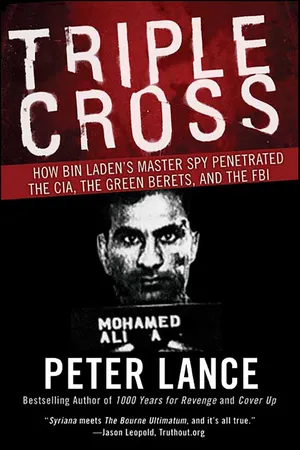
On October 20, 2000, after tricking the U.S. intelligence establishment for years, Ali Mohamed stood in handcuffs, leg irons, and a blue prison jumpsuit before Judge Leonard B. Sand in a Federal District courtroom in Lower Manhattan. Over the next thirty minutes he pleaded guilty five times, admitting to his involvement in plots to kill U.S. soldiers in Somalia and Saudi Arabia, U.S. ambassadors in Africa, and American civilians “anywhere in the world.” The goal of the al Qaeda terrorists he trained, he said, was to “kidnap, murder and maim.” His career in espionage had earned him a death sentence in an Egyptian trial the year before. But now, before the federal judge, Ali was seeking mercy.
In short but deliberate sentences, Mohamed peeled back the top layer of the secret life he’d led since 1981, when radical members of his Egyptian army unit gunned down Nobel Prize winner Anwar Sadat. A highly educated master spy, fluent in four languages, Mohamed told of how he had risen from a young recruit in the virulently anti-American Egyptian Islamic Jihad to become Osama bin Laden’s most trusted security adviser. He described how al Qaeda cell members from Kenya had infiltrated Mogadishu, Somalia, in the 1993 campaign that ultimately downed two U.S.
Black Hawk helicopters; how he had brokered a terror summit between al Qaeda and the hyper-violent Iranian Party of God known as Hezbollah; and how he had trained al Qaeda jihadis in Afghanistan and Sudan, teaching them improvised bomb building while schooling them in the creation of secret cells so that they could operate in the shadows. On this last bit of tradecraft, he’d literally written the book. If there was ever a shadow man in the dark reaches of al Qaeda, it was the triple spy born Ali Abdel Saoud Mohamed.
Because there is so little on the public record about him and because his career resulted in so much terror and death, we will reproduce his words from that plea session throughout this book, verbatim.
Perhaps Ali’s most telling admission came when Judge Sand asked his objectives. Mohamed answered by restating al Qaeda’s longstanding goal of driving the U.S. out of the Middle East—particularly Saudi Arabia, where troops had been stationed since August 7, 1990. What would make Mohamed’s leader, Osama bin Laden, think he could achieve that goal? At that point, without naming him, Mohamed cited the example of how President Ronald Reagan had withdrawn U.S. troops from Lebanon following the deadly Marine barracks bombing in 1983—an act of terror that some suspect Ali himself may have had a hand in:
But the most important aspect of that plea session was what was left un-said. In that Southern District Courtroom nearly two years before the attacks of September 11, Ali Mohamed uttered nothing on the record about his most stunning achievements: how he had slipped past a State Department Watch List and into America, seduced a Silicon Valley medical technician into marriage, joined the U.S. Army, and gotten himself posted to the highly secure base where the Green Berets and Delta Force train. He didn’t say a word about how he’d moved in and out of contract spy work for the CIA and fooled FBI agents for six years as he smuggled terrorists across U.S. borders, and guarded the tall Saudi billionaire who had personally declared war on America: Osama bin Laden.
“Those who know Ali Mohamed say he is regarded with fear and awe for his incredible self-confidence, his inability to be intimidated, [his] absolute ruthless determination to destroy the enemies of Islam and his zealous belief in the tenets of militant Islamic Fundamentalism.”
That’s how terrorism expert Steven Emerson described Mohamed after the FBI finally arrested him in 1998. Though the Bureau had been onto his terrorist connections since 1989, it took the simultaneous attacks on the embassies in Dar es Salaam and Nairobi to jolt them into the admission that the Justice Department had been conned; that whatever intelligence crumbs he’d thrown to the FBI, Mohamed had gotten back ten times more. Worse, he’d led a campaign of disinformation that lulled the Bureau into a vast underestimation of the al Qaeda threat.
Mohamed’s commanding officer at Fort Bragg, Lt. Col. Robert Anderson, was more specific: “Ali Mohamed is probably the most dangerous person that I ever met in my life.”
He wasn’t the devil himself, Anderson said, in an interview for this book. He was more like “The aide to the devil. He was a fanatic. He had an air about him; a stare, a very coldness that was pathological.” But Anderson noted that Ali “would shift into a very nice polite individual when it was to his advantage.”
Now, in the courtroom, as he stood cuffed and stooped over, feigning humility, Ali Mohamed played yet another role—that of the contrite and broken jihadi, a man willing to cooperate with the Feds. Finally, once and for all, the hope was that he would give up his secrets. But in the poker game between “asset” and FBI control agent, Mohamed held most of the face cards. He had stung the Bureau repeatedly over the years and he knew that in the end, they would want to hide the truth.
“Ali knew where the bodies were buried,” said one former FBI agent. “In fact, he dug most of the graves himself. There was just no way that [FBI] management wanted that story to come out.”
“With his connections to U.S. law enforcement and intelligence,” says Emerson, “I’ve never seen a terrorist with such a storied background.” As the man who had sat in a room with the “terror prince,” while bin Laden personally targeted the Nairobi embassy back in 1994, Mohamed should have been the star witness in the embassy bombing trial, which was just months away. Yet Patrick Fitzgerald, the lead prosecutor, never called him.
Why did the Feds let Ali Mohamed sit out that trial? Why did they make a secret plea agreement with him? Why didn’t he testify? The evidence I uncovered demonstrates that Mohamed wasn’t just the government’s best witness to al Qaeda’s successes, he was also the best witness to the failures of the FBI and the CIA to stop bin Laden’s terror campaign.
It was a string of attacks that stretched from the murder of Rabbi Meier Kahane in 1990 through the bombing of the World Trade Center in 1993, up through the assault on the U.S.S. Cole in 2000, and on to the second attack on the Twin Towers in 2001. Mohamed had been an FBI snitch for much of that decade and he’d been on the Bureau’s radar since 1989. What he knew about the FBI’s missteps could fill a metaphorical book, and the U.S. Justice Department seemed determined that it would never be published.
And yet even today, years after pleading guilty to crimes that would have ended any other terrorist’s life via lethal injection, Ali Mohamed remains a legal black hole. Minutes after that hearing he was locked away, hidden from public scrutiny. It’s been nearly nine years, and one of the discoveries made in this investigation is that, as late as November 2006, Judge Sands had yet to pronounce sentence.
Today Mohamed exists in a kind of legal no-man’s-land, a prisoner of the Feds whose name appears nowhere on the Bureau of Prisons inmates roster. His case file in the Southern District is heavily redacted or otherwise sealed. Only a handful of people in the Justice Department know the full details of his plea agreement.
His wife, Linda Sanchez, remains loyal to him and hopeful that some day the Feds will set him free. “He’s done a lot for the government,” she said in an exclusive interview for this book. “Someday you’ll know it all, but I can’t discuss it.”
Mohamed’s lawyers, James Roth and Lloyd Epstein, have steadfastly resisted any attempts by journalists to get the full story. But from interviews with those who knew him in North Carolina and Silicon Valley, the depth of Mohamed’s deception is becoming clearer. “It boggles the mind that anyone who lived this close here could possibly have anything to do with something this horrible,” said an old acquaintance from California. “It makes you wonder about anyone else we were so taken in by.” Another U.S. official who crossed Mohamed’s path had a different opinion. “You could sit and have lunch with him and he’d be as nice as pie. But if the call came to blow you up, there is no question in my mind that Ali would blow you up.”
Death of a Pharaoh
On October 6, 1981, Anwar Sadat, the Egyptian president who had won a Nobel Prize for making peace with Israel, sat in a reviewing stand near Cairo’s unknown soldier tomb. Surrounded by four layers of bodyguards during an annual troop review commemorating the Yom Kippur War, Sadat looked upward as an elite Egyptian Air Force squadron performed flybys overhead. Suddenly, one of the troop carriers passing the reviewing stand came to an abrupt stop. Five men jumped off, led by a radical army lieutenant named Khalid al-Islambouli. They rushed the reviewing stand, throwing grenades and firing bursts from automatic weapons. Thirty-five seconds later, a bullet ripped through an artery in Sadat’s chest. “Impossible,” he exclaimed, “impossible.” Then he fell dead.
On the day of the assassination, one of the shooters was gunned down immediately. A second escaped, but was captured shortly thereafter; three of the others were wounded. Still, the ringleader, al-Islambouli, was ecstatic. “I have slain Pharaoh,” he cried, “and I do not fear death.”
The murder of Sadat was a seminal event in what would become a decades-long jihad, or holy war, against the West. The assassination came a year after Sheikh Omar Abdel Rahman, the assassins’ spiritual leader, issued a fatwa—a religious order—condemning Sadat. Rahman was arrested, but later acquitted in the assassination plot. He would go on to make an indelible mark on the future of radical Islam.
The Blind Sheikh
Blinded shortly after birth, Omar Abdel Rahman had memorized the Koran by the age of eleven. He earned a degree in Koranic studies in 1972 from the Al Azhar University in Cairo, where he was influenced by the writings of Sayyid Qutb, an intellectual who was an early adherent of the Muslim Brotherhood.
The Brotherhood, or Ikhwan, was founded in 1928. It spawned two of Egypt’s most virulent terror sects: The al Gamma’a Islamayah (Islamic Group), run by Rahman, and the Egyptian Islamic Jihad (EIJ), led by Dr. Ayman al-Zawahiri, the scion of a prominent Cairo family. Begun as a student movement within the Brotherhood, the EIJ splintered o...