A true crime account of the historic 1920s case from the killers' point of view, detailing their explosive relationship that culminated in murder.
It was a crime that shocked the nation: the brutal murder in Chicago in 1924 of a child by two wealthy college students who killed solely for the thrill of the experience. Nathan Leopold and Richard Loeb were intellectuals—too smart, they believed, for the police to catch them. When they were apprehended, state's attorney Robert Crowe was certain that no defense could save the ruthless killers from the gallows. But the families of the confessed murderers hired Clarence Darrow, entrusting the lives of their sons to the most famous lawyer in America in what would be one of the most sensational criminal trials in the history of American justice.
Set against the backdrop of the 1920s—a time of prosperity, self-indulgence, and hedonistic excess in a lawless city on the brink of anarchy—
For the Thrill of It draws the reader into a world of speakeasies and flappers, of gangsters and gin parties, with a spellbinding narrative of Jazz Age murder and mystery.
Praise for
For the Thrill of It
"Baatz's comprehensive account of the case succeeds in identifying their peculiar personality traits as well as what it was in the nature of their relationship that made them believe in their infallibility in performing the ultimate crime. . . . [An] exhaustively researched and rivetingly presented account. . . . One of the best true-crime books of this or any other season." —
Booklist (starred review)
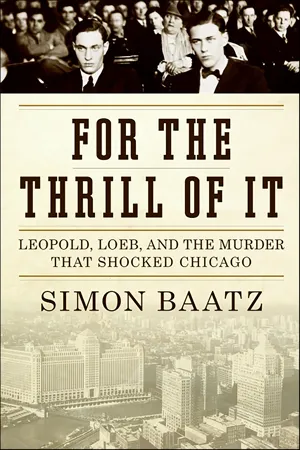
eBook - ePub
For the Thrill of It
Leopold, Loeb, and the Murder That Shocked Jazz Age Chicago
- 560 pages
- English
- ePUB (mobile friendly)
- Available on iOS & Android
eBook - ePub
About this book
Information
Print ISBN
9780060781026
Subtopic
Social Science BiographiesPART ONE
THE CRIME
1 THE KIDNAPPING
WEDNESDAY, 21 MAY 1924—THURSDAY, 29 MAY 1924
This cruel and vicious murder…this gruesome crime…this atrocious murder…the most cruel, cowardly, dastardly murder ever committed in the annals of American jurisprudence.1
Robert Crowe, state’s attorney of
Cook County, 23 July 1924
Cook County, 23 July 1924
Everybody knows that this was a most unfortunate homicide. That it is the cruelest, the worst, the most atrocious ever committed in the United States is pure imagination without a vestige of truth…. A death in any situation is horrible, but when it comes to the question of murder it is doubly horrible. But there are degrees…of atrocity, and as I say, instead of this being one of the worst…it is perhaps one of the least painful.2
Clarence Darrow,
defense attorney, 23 July 1924
defense attorney, 23 July 1924
FLORA FRANKS GLANCED AT THE CLOCK. Already past six o’clock and still no sign of Bobby! The cook had prepared dinner and the maids were waiting patiently for the family to move to the dining room. Normally she could rely on her eldest son, Jack, sixteen years old, to keep an eye on his younger brother, but Jack lay upstairs in bed, ill with chicken pox; he had not been to school all week. Her daughter, Josephine, seventeen years old, tried to calm Flora’s fears—Bobby always played baseball after school; perhaps he had gone to a friend’s home for supper after the game.3
Jacob Franks agreed with his daughter. Admittedly it was not like Bobby to be late for dinner; but nothing serious had happened to the boy. It was only three blocks from the Harvard School to their house and Bobby was now fourteen years old, old enough to know not to talk to strangers. The boy had probably fallen in with a classmate after the game and had forgotten the time. Still, he was annoyed that his son should be so thoughtless and forgetful, annoyed with Bobby for causing his mother to worry.
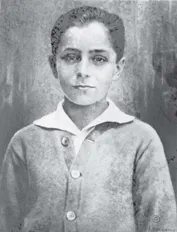
1. ROBERT (BOBBY) FRANKS. Bobby Franks was a pupil at the Harvard School for Boys. This photograph appeared as the frontispiece to a collection of poems published in his memory by his brother Jack.
Jacob Franks was proud of his four children: Josephine had been accepted at Wellesley College for the fall, and Jack, a junior at the Harvard School, was planning to attend Dartmouth College. Jacob Jr. was the youngest child, still a student in grade school, but already showing signs of academic promise. Bobby, the darling of the family, was a bit of a scamp who got into his share of scrapes at school, but he was, nevertheless, his mother’s favorite. She loved his assertiveness, his independent spirit, his ambition; he had already announced to the family that he too would go to Dartmouth and then would study for the law. No doubt he would keep his promise: the principal of the Harvard School, Charles Pence, had reported that Bobby was a precocious child. Only a freshman at the school, he was a member of the class debating team. He was a popular boy at school, a keen tennis player and an avid golfer; he had joined with some other boys in establishing a reading group, and only a few days earlier, he had won a debate on capital punishment, arguing for a link between criminality and mental illness—“most criminals have diseased minds”—and protesting against the right of the state “to take a man, weak and mentally depraved, and coldly deprive him of his life.”4
FOR FLORA AND JACOB FRANKS, their four children were the capstone of their lives. As a young boy, Jacob Franks had lost his own father. His mother had run a clothing store and then a pawnshop in Chicago, and in 1884 Jacob had set up in business for himself, opening a pawnshop on Clark Street south of Madison Street. It was a good location and an auspicious time—gambling was then unregulated in the city and there were at least a dozen gaming houses within a block of Jacob Franks’s pawnshop.
Jacob soon built up a loyal clientele—the gamblers could rely on Jacob to lend them as much as ninety percent of the value of the diamonds, watches, and rings that they pawned—and once their luck turned, they could easily redeem their property. Michael (Hinky Dink) Kenna, Democratic alderman of the First Ward and one of the most powerful politicians in Chicago, remembered Jacob Franks as an honest businessman who earned the loyalty of his customers: “He ran the business strictly on the square and he had the respect of every man who ever made a loan…. He knew who he was dealing with, and for that reason would take a chance.”5
Jacob Franks never ran for political office, yet he was well connected—“Franks,” according to one politician, “has for years been a big factor in the Democratic party”—and he used his connections to make his fortune. An opportunity to buy stock in the Ogden Gas Company was a lucky break for Franks and his business partner, Patrick Ryan; the two entrepreneurs sold the stock to the People’s Gas Light and Coke Company at an enormous profit estimated by one friend to be as much as $1 million. Franks bought land in the downtown district and watched its value soar when the city moved the grog shops, gambling dens, and brothels farther south, to the Levee between 18th and 22nd streets. By 1924, Jacob Franks was wealthy beyond his wildest dreams; he was worth, at a conservative estimate, more than $4 million.6
IT WAS NOW AFTER seven o’clock. The youngest son, Jacob Jr., had finished eating and was fidgeting, anxious to leave the table. His father let him go. Flora, Josephine, and Jacob remained at the table talking; they could no longer pretend that Bobby was delayed at a friend’s house.
Jacob went to the phone to call his lawyer, Samuel Ettelson. Jacob Franks had known Ettelson for many years—the two men were close friends. Ettelson, undoubtedly one of the most influential lawyers in Chicago, had served as corporation counsel during the mayoralty of William Hale Thompson from 1915 to 1923 and was now state senator for Cook County in the Illinois legislature. A prominent Republican, Ettelson still had considerable influence with the police department and with the state’s attorney, Robert Crowe. If anything had happened to Bobby, Jacob Franks could rely on Ettelson to help launch a massive police investigation.7
Ettelson arrived at the house on Ellis Avenue around nine o’clock that evening. The three adults talked briefly in the living room; both parents were now consumed with anxiety. Ettelson started calling the teachers at the Harvard School. Had they seen Bobby Franks that afternoon? Could they remember when he had left to go home? Only Richard Williams, the athletics instructor, could provide much information. Bobby had been the umpire at an impromptu baseball game between some schoolboys on a vacant lot at 57th Street and Ellis Avenue. Williams had seen Bobby leave the game to walk home around 5:15 p.m.8
Had Bobby returned to the Harvard School on his way home? Perhaps, Ettelson reasoned, he had popped into the school to retrieve something and had been locked inside by the janitor. The two men grabbed their coats and hats and made for the door—it was a five-minute walk to the school. When they reached the main entrance, the building was dark; there was no sign of the janitor. A window was open on the first floor. Ettelson helped Jacob Franks climb into the building and both men began hunting through the classrooms. They also searched the school grounds, but there was nothing—no clue, no trace of the boy’s whereabouts.9
At home, Flora Franks waited anxiously for her husband. It was now almost half past ten; Jacob had been gone for more than an hour. The children were asleep and the servants, except for one maid, had all retired to their quarters—the house suddenly seemed very quiet.
In the hallway, the phone rang. Flora could hear the maid pick up the receiver and answer the caller—she was bringing the telephone into the living room—had Bobby been found? It was a man’s voice—Flora Franks remembered later that it was “more of a cultured voice than a gruff voice.”10
The caller spoke rapidly yet clearly—Flora did not miss a word. “This is Mr. Johnson…your boy has been kidnaped. We have him and you need not worry: he is safe. But don’t try to trace this call…. We must have money. We will let you know tomorrow what we want. We are kidnapers and we mean business. If you refuse us what we want or try to report us to the police, we will kill the boy.”11
The receiver clicked—the caller had hung up. Flora stood motionless for a moment, still holding the phone in her hands; then she fainted and fell to the floor.
Six minutes later, Samuel Ettelson and Jacob Franks returned. The maid was still holding Flora in her arms—she had revived her mistress with spirits of ammonia, and at that moment Flora had regained consciousness.
At least they now knew what had happened to the boy—and, thank God, he was still alive. Perhaps Mr. Johnson would telephone again that night—Samuel Ettelson called the phone company to put a trace on incoming calls.12 Admittedly this was a risky maneuver—the kidnapper had explicitly warned against it. Ettelson was in a difficult situation: as a friend of the Franks family, he wanted Bobby returned home, alive and safe; yet as a public official, he was loath to truckle to blackmailers. From his years as corporation counsel, Ettelson had vast experience in managing the city’s affairs, and in negotiating contracts with labor unions, utility companies, building contractors, and streetcar companies, yet nothing had prepared him for this. He was uncertain how best to proceed. Should they inform the police? Or should they wait for another phone call? If they merely obeyed the kidnapper’s commands, were they nevertheless putting the boy’s life at risk? Perhaps it would be better to have the Chicago police out searching for the kidnapper. Perhaps the police had a list of likely suspects who could be rounded up.
At two o’clock in the morning, Ettelson decided they should go to the police. Jacob Franks could stand their inaction no longer; anything was better than waiting for the phone to ring. Ettelson was well connected with the Chicago police—he was a personal friend of the chief of detectives, Michael Hughes, and of the deputy captain of police, William (Shoes) Shoemacher. Why should he not use that influence to rescue Bobby?
The central police station was almost deserted. Ettelson had never previously met the young lieutenant, Robert Welling, in charge; could he trust Welling not to leak news of Bobby’s disappearance? And suppose Bobby was not in danger? Suppose that this was a juvenile hoax by some of his classmates? Unlikely, of course, but Ettelson was reluctant to mobilize the Chicago police department and find, the next morning, that Bobby was safe and sound, having spent the night with a friend. His reputation would be tarnished, and Ettelson, who always hoped for a revival of his political fortunes, could not afford to be made a laughingstock.
Robert Welling listened thoughtfully to Franks and Ettelson. He would, if they liked, send out detectives to search for the boy. Ettelson demurred; perhaps, he advised the lieutenant, it was all unnecessary; the boy might turn up in the morning. “We are not sure. Perhaps it is only some prank, some foolish joke. Perhaps—” Ettelson’s voice trailed off. What should they do? He spoke again: he did not himself believe it was a hoax. “If the boy really has been kidnapped, then we must be very, very careful. He may be in the hands of desperate men who would kill him.” Ettelson could not bear the risk that the kidnappers might kill Bobby. “Perhaps,” he decided finally, “we would better wait until morning before doing anything about it.”13
THE NEXT MORNING, AT EIGHT o’clock, a special delivery letter arrived. The envelope bore six two-cent stamps, was addressed to Jacob Franks at 5052 Ellis Avenue, and had a Chicago postmark; it had been mailed either the previous evening or earlier that morning.
In one sense the arrival of a ransom letter provided a measure of relief, however minor, for Bobby’s parents. It confirmed that he was still alive and provided instructions for his recovery. The writer of the letter, George Johnson, promised that Bobby was “at present well and safe. You need not fear any physical harm for him providing you live up carefully to the following instructions…. Make absolutely no attempt to communicate with either the police authorities nor any private agency. Should you already have communicated with the police, allow them to continue their investigations, but do not mention this letter.
“Secure before noon today $10,000. This money must be composed entirely of old bills of the following denominations: $2,000 in $20 bills, $8,000 in $50 bills. The money must be old. Any attempt to include new or marked bills will render the entire venture futile. The money should be placed in a large cigar box…and wrapped in white paper. The wrapping paper should be sealed…with sealing wax.
“Have the money thus prepared as directed above and remain home after one o’clock P.M. See that the telephone is not in use. You will receive a future communication instructing you as to your future course.
“As a final word of warning, this is a strictly commercial proposition, and we are prepared to put our threats into execution should we have reasonable ground to believe that you have committed an infraction of the above instructions. However, should you carefully follow out our instructions to the letter, we can assure you that your son will be safely returned to you within six hours of our receipt of the money.”14
The family felt a tremendous sense of relief. Here was assurance that Bobby was still alive. Merely for the payment of a trivial sum, a bagatelle, they would soon have Bobby back, safely home. Samuel Ettelson was sanguin...
Table of contents
- Cover
- Title Page
- Contents
- List of Illustrations
- Preface
- Part One
- Part Two
- Part Three
- Leopold and Loeb in Fiction
- Author's Note
- Sources
- Notes
- Searchable Terms
- Illustration Credits
- About the Author
- Other Books by Simon Baatz
- Copyright
- About the Publisher
Trusted by 375,005 students
Access to over 1.5 million titles for a fair monthly price.
Study more efficiently using our study tools.
Frequently asked questions
Yes, you can cancel anytime from the Subscription tab in your account settings on the Perlego website. Your subscription will stay active until the end of your current billing period. Learn how to cancel your subscription
No, books cannot be downloaded as external files, such as PDFs, for use outside of Perlego. However, you can download books within the Perlego app for offline reading on mobile or tablet. Learn how to download books offline
Perlego offers two plans: Essential and Complete
- Essential is ideal for learners and professionals who enjoy exploring a wide range of subjects. Access the Essential Library with 800,000+ trusted titles and best-sellers across business, personal growth, and the humanities. Includes unlimited reading time and Standard Read Aloud voice.
- Complete: Perfect for advanced learners and researchers needing full, unrestricted access. Unlock 1.5M+ books across hundreds of subjects, including academic and specialized titles. The Complete Plan also includes advanced features like Premium Read Aloud and Research Assistant.
We are an online textbook subscription service, where you can get access to an entire online library for less than the price of a single book per month. With over 1.5 million books across 990+ topics, we’ve got you covered! Learn about our mission
Look out for the read-aloud symbol on your next book to see if you can listen to it. The read-aloud tool reads text aloud for you, highlighting the text as it is being read. You can pause it, speed it up and slow it down. Learn more about Read Aloud
Yes! You can use the Perlego app on both iOS and Android devices to read anytime, anywhere — even offline. Perfect for commutes or when you’re on the go.
Please note we cannot support devices running on iOS 13 and Android 7 or earlier. Learn more about using the app
Please note we cannot support devices running on iOS 13 and Android 7 or earlier. Learn more about using the app
Yes, you can access For the Thrill of It by Simon Baatz in PDF and/or ePUB format. We have over 1.5 million books available in our catalogue for you to explore.