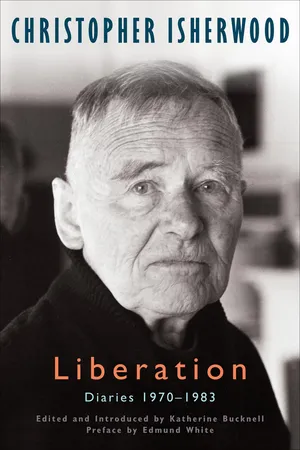
Candid and revealing, the final volume of Christopher Isherwood's diaries brings together his thoughts on life, love, and death. Beginning in the period of his life when he wrote Kathleen and Frank, his first intensely personal book, Liberation: Diaries 1970–1983 intimately and wittily records Isherwood's immersion in the 1970s art scene in Los Angeles, New York, and London—a world peopled by the likes of Robert Rauschenberg, Ed Ruscha, Andy Warhol, and David Hockney, as well as his Broadway writing career, which brought him in touch with John Huston, Merchant and Ivory, John Travolta, John Voight, Elton John, David Bowie, Joan Didion, and Armistead Maupin. With a preface by Edmund White, Liberation is a rich and engaging final memoir by one of the most celebrated writers of his generation.
- 928 pages
- English
- ePUB (mobile friendly)
- Available on iOS & Android
eBook - ePub
About this book
Information
Liberation
January 1, 1970—July 4, 1983
January 1–March 2, 1970
January 1. We got up very late and have been fussing around, chiefly engaged in destroying old manuscripts; the early Meeting by the River material for instance. Now we have to go out and see people, including Margaret Leighton whom I like and Marti Stevens who bores me.
Bill van Petten called to wish me a happy New Year and to tell me that the new (sixteen-year-old) generation calls itself the Jam Generation. It relates to its parents, whereas the previous generation (twenty-year-old) didn’t. It believes in pilgrimages; hence these huge gatherings as at Woodstock. Bill also says that the newsmen on the Los Angeles Times are very pessimistic about the seventies. They expect organized violence by the blacks.
Last night we saw the New Year in with Jack [Larson] and Jim [Bridges]. Several people connected with Jim’s film1 were there; he starts shooting on Monday. We both feel that the prospects of the film look dubious because Jim doesn’t seem to have really thought through the material and found out what it’s about. Surely it isn’t about this girl at all, but about the weird married couple who decide that the husband must father the baby? The girl is just a human appliance, but it looks as if Jim is going to sentimentalize her. However, Jim feels he has got a very good cast. Sam Groom,2 who plays the husband, was there last night. I liked him. We talked about Hemingway, on whom he’d written a thesis. He looks awfully young for the part, though, but Jim says he’s a marvellous partner for mad Collin Horne.3 One could see them as a wayout Macbeth and Lady. The girl who plays the girl (Barbara Hershey)4 and the boy who plays her boyfriend Tad (Scott somebody)5 and a boy who is a friend of his and a girl who is Scott’s girlfriend were also there, utterly ambushed in lank shoulder hair. I sure hope the Jam Generation will decree crew cuts. Don says that this is the most unflattering period for women in the whole of history. When Jim announced midnight and a toast in champagne, the young folk barely responded; it was too square for them.
Incidentally, Bill van Petten told me that, if you don’t have any particular plans, this is now called being “unstructured”; in the sixties it was called “hanging loose.” Bill is desperately in pursuit of all the very latest slang, the latest attitudes, the last “word.”
January 3. I saw Swami yesterday. He doesn’t seem sick, only tired. And of course there is a little bit of policy somewhere in it; for now Asaktananda has written a drastic appeal to Belur Math to send someone to be second assistant without delay!
Swami told me that when the palpitations, or whatever they were, came over him in Santa Barbara he felt quite detached, as if his body belonged to someone else. “I felt a flustering in my chest, and I was like an observer.” He also told me he had a dream that he was swimming in the Ganges. He wasn’t at all afraid of being drowned, he didn’t know if he had clothes on or not, he couldn’t see the banks of the river.
Yesterday we had lunch with Alan Searle. He is very red in the face (hinting at apoplexy) and very plump. He made big protestations of affection but the fact remains that he has been here eleven weeks and has only now made a move to see us, just before leaving! He says he’s thinking of coming to live here. He drinks a lot. He says that Willie [Maugham] told him never to write his life, and that Kanin’s book is made up of stories he told about Willie; that Kanin never really knew Willie as well as he makes out.6
1969 was actually a very happy year for me, mostly because of Don, and this despite the fact that it was a year of frustrations. We wrote the Cabaret treatment and got turned down by Tony Harvey and the Claudius screenplay and got turned down by Tony Richardson. Black Girl got very disappointing notices. Ray Henderson’s Dogskin production fizzled out after looking most promising, because Burgess Meredith deserted us. True, all these projects could easily be revived this year or later.7
I did quite a lot of work but not nearly enough. Only six chapters of Kathleen and Frank; that’s disgraceful. The other chores were all for the Vedanta Society except for a foreword to Hockney’s book of drawings, which I wrote with extraordinary difficulty, unwillingness and boredom, as a gesture of friendship, and for which I’ve never even been thanked, much less paid!8
The best event was Irving Blum’s decision to give Don this show. The most memorable days were the two on Tahiti and the day of our visit to Stevenson’s grave—but altogether, that trip was really the best of my whole life, I think.9 The chief disaster was the collapse of our hillside during the rains on February 25; this may well lead to much more serious slides nearer the house. The most boring thing that happened was John Lehmann’s visit. The most interesting new person I met was Jim Gates (with Peter Schneider a runner-up); the most intriguing celebrities, Michael York and Jeanne Moreau. Relations with friends haven’t been very intense; we have kept ourselves even more than usual to ourselves. When I ask myself who I’ve felt particularly drawn to, amongst people in this town, I’m rather surprised to find it’s Leslie Caron—although I still don’t dig her husband Michael [Laughlin]. I have been very regular in going to the gym but alas have gotten progressively heavier. I bulge with gas.
Never mind, it was a good year, with much beautiful quiet joy in it and loving snug closeness of Kitty and Dobbin.10
January 11. It’s dripping rain and I have a cold lurking which I’m trying to keep at the back of my throat with Coricidin D. How I hate my huge belly! A lot of it is gas and I can dislodge it if I do stationary trotting; haven’t been out today except up to the trash cans.
It now seems almost definite that we’ll go to London on February 2, after a stopover in New York, and that we’ll seriously consider Clifford Williams as director11 and, if okay, start casting and then rehearsals and then open, all being well, sometime in March or April. But Don’s show is still set for the beginning of March, so he’ll probably have to go back for it and then return for our opening. All this sounds as unreal to me at the moment as the plans to go with David Hockney and Peter [Schlesinger] on the trans-Siberian railway—except that Don and I have pretty well decided to back out of that.
We had supper with Jo [Lathwood] last night and yesterday afternoon I saw Elsa [Lanchester]. Much as Elsa would hate to admit it, she and Jo are now sisters in bereavement, because of Ray Henderson being about to get married.12 Yesterday Elsa was giving a party too and her attitude was just like Jo’s: all alone I’m doing it, poor little me, it seems so strange without him, etc. etc. Jo described to us how she had been given a surprise birthday celebration by “her” girls at the factory. Her slogan is, “They all love me.” And Elsa described how she had gone to some celebrity dinner the other night and been applauded for five minutes; she said that this “made me feel worthy of my friends.” Oh, the false pathos of these unhappy old girls! It doesn’t move you in the way they intend, but it is genuinely, heartbreakingly squalid.
January 30. It’s five fifteen a.m. and I’m up before dawn because today is the Vivekananda breakfast puja.13 Shall be off there in a short while. Peter Schneider and Jim Gates will meet me there and afterwards we’ll all drive to Claremont, where Jim will have the stitches taken out of his neck. He was operated on, messily, by a Dr. Joseph Griggs who is the brother of Phil who is now Buddha and a monk at the London center. The swelling is huge and looks nasty and Jim thinks it is maybe infected, but he seems serenely unworried. He told me that right after the operation, when it started to hemorrhage, and he really thought he was dying, he felt suddenly blissfully happy. Maybe he is Alyosha Karamazov—but oh wow man the pitfalls! Anyhow he is sort of dear to me and so is Peter. Peter is now coming up from behind, in racing parlance, I mean he had an interview with Swami, too, his second, yesterday and Swami told him to sit up straight and look after his body and Peter told Swami that his father had only told him to look after his mind and Swami had said but they are the same. (This from Swami himself, when I went to see him yesterday afternoon.) Anyhow, in a word, Peter isn’t going to be left out of the Atman race. He is keenly competitive and quite jealous lest Jim should somehow get a bigger slice of me than he does; not that he wants me, or even maybe the Atman, but that’s his character. And at his age it’s lovable. He is therefore coming along with us to Claremont.
This evening I take off for New York, leaving Jim to house-sit here. He is rather thrilled at the idea of being alone in this (to him) vast palace. It is funny and interesting that there is very little involvement between the boys, seemingly; conscious involvement, that is. They are involved of course. And their life in that little shack beside the canal with the ducks and the kitty and the meditation hut at the back in the grassy yard is so idyllic, hippie in the best way and far more genuine and unpretentious than most hippies’ lives are. I told them, they will look back and say they never had it so good, later on. People come to see them in droves and food is prepared and they eat, or else there is no one and they don’t. They wander off to college or their jobs at these restaurants and it all seems so simple.
From New York, Don and I are to go to London on the 4th and then find out if the play is really going to happen. About all this I feel at present only the dislike of leaving the nest and the hate of flying and of the impending icy weather, etc. I called Don this morning, just to say hello, but I guess he is spending the night out; no answer.
Gavin [Lambert] just got back from Europe, last night. He says he’s still ill and he looks it; he really seems quite fragile and his hands shake like an old lady’s. He seriously considers buying a house in Tangier, in the kasbah, and spending several months there every year, chiefly amongst the Arabs. When he talks of this he is Lesley Blanch. He’s also quite a wonderful person, so much style and courage. Style is a kind of courage, always, I suppose.
Am rambling to pass the time. Now I must call the boys and tell them the car will start ( just tried it) so they needn’t come around and pick me up.
8:07 p.m. A very quick goodbye. Charlie Locke called to say his wife is dying of terminal cancer and can I do something to arrange for them to spend her last weeks in Cornwall. But Jim Gates does not have anything serious the matter with him. So hurrah for that. Goodbye.
England, March 2–April 30, 1970
We arrived in England on February 5, 1970, from New York, where we had stayed since leaving Los Angeles on January 31.
All through the rest of February, Don was with me in London and we did a good deal of rewriting on our play, A Meeting by the River. On March 2, after Don had gone back to Los Angeles because of his show at the Irving Blum gallery, I decided to start this diary and try to keep it every day until he returned or I left England to rejoin him in California.1
March 2. I’ll try and write this entirely at odd moments. Am now waiting for Bob Holness of the BBC radio program “Late Night Extra.” (Long before that sentence was finished, he arrived, interviewed me—How is your play getting along? How do you feel about Cabaret?—and left within twenty minutes.)
Don left this morning for New York and Los Angeles. There was a nasty little snowstorm, then it cleared, then it snowed again. It’s horribly cold. I rushed out and bought books—as people rush into pubs to get drunk for the sake of getting drunk: the script of Lindsay Anderson’s If,2 Frederick Brown’s Cocteau biography,3 Aldous Huxley’s letters, The Divine Comedy of Pavel Tchelitchew,4 Richard Neville’s Play Power.
The heat is on and it’s still cold. Clement Scott Gilbert and his secretary have taken away the new pages we did since the reading of the play on Wednesday last; they’ll xerox them. Clement said that John Roberts and Clifford Williams have been “meaning” to ask me if I minded having all reference to the cubes removed from the version of the play which will be sent round to the actors when they start casting. I don’t like their attitude, it seems sneaky. Are they so scared of me and, if so, why? What is Clifford up to? We have heard nothing from him since the reading and apparently he has gone to New York to see Oh! Calcutta! which he is to work on before he directs our play. I said, it’s not that we’re wild about having the cubes in, but how can you explain to an art director that he must devise a substitute when you haven’t shown him what the substitute is a substitute for?
A BOAC plane with that terribly insecure-looking tail has just flown over...
Table of contents
- Contents
- Preface
- Introduction
- Textual Note
- Acknowledgements
- Liberation: January 1, 1970–July 4, 1983
- January 1–March 2, 1970
- England, March 2–April 30, 1970
- May 27, 1970–August 26, 1972
- September 2, 1972–December 14, 1974
- January 1, 1975–December 31, 1975
- Day-to-Day Diary, January 1–July 31, 1976
- August 1, 1976–June 9, 1980
- July 16, 1980–July 4, 1983
- Glossary
- Index
- About the Author
- Books by Christopher Isherwood
- Credits
- Copyright
- About the Publisher
Trusted by 375,005 students
Access to over 1.5 million titles for a fair monthly price.
Study more efficiently using our study tools.
Frequently asked questions
Yes, you can cancel anytime from the Subscription tab in your account settings on the Perlego website. Your subscription will stay active until the end of your current billing period. Learn how to cancel your subscription
No, books cannot be downloaded as external files, such as PDFs, for use outside of Perlego. However, you can download books within the Perlego app for offline reading on mobile or tablet. Learn how to download books offline
Perlego offers two plans: Essential and Complete
- Essential is ideal for learners and professionals who enjoy exploring a wide range of subjects. Access the Essential Library with 800,000+ trusted titles and best-sellers across business, personal growth, and the humanities. Includes unlimited reading time and Standard Read Aloud voice.
- Complete: Perfect for advanced learners and researchers needing full, unrestricted access. Unlock 1.5M+ books across hundreds of subjects, including academic and specialized titles. The Complete Plan also includes advanced features like Premium Read Aloud and Research Assistant.
We are an online textbook subscription service, where you can get access to an entire online library for less than the price of a single book per month. With over 1.5 million books across 990+ topics, we’ve got you covered! Learn about our mission
Look out for the read-aloud symbol on your next book to see if you can listen to it. The read-aloud tool reads text aloud for you, highlighting the text as it is being read. You can pause it, speed it up and slow it down. Learn more about Read Aloud
Yes! You can use the Perlego app on both iOS and Android devices to read anytime, anywhere — even offline. Perfect for commutes or when you’re on the go.
Please note we cannot support devices running on iOS 13 and Android 7 or earlier. Learn more about using the app
Please note we cannot support devices running on iOS 13 and Android 7 or earlier. Learn more about using the app
Yes, you can access Liberation by Christopher Isherwood, Katherine Bucknell in PDF and/or ePUB format, as well as other popular books in Literature & Literary Biographies. We have over 1.5 million books available in our catalogue for you to explore.