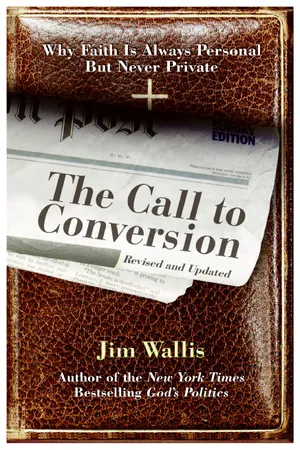
A leading voice at the crossroads of faith and politics offers a prophetic appeal for our times: faced with a growing gap between the rich and poor, bombarded by national security alerts that ratchet up our stress levels, taxed by a government that spends billions of dollars on war -- where do we find hope? In this revised and updated edition of his classic, Jim Wallis insightfully critiques contemporary culture and politics, inspiring us with stories to convert our way of thinking and point to a solution to our current social and political dilemmas.
- 224 pages
- English
- ePUB (mobile friendly)
- Available on iOS & Android
eBook - ePub
About this book
Put Your Faith into Action
Information
Topic
Theology & ReligionSubtopic
Peace & Global DevelopmentCHAPTER 1
The Call
The people who sat in darkness have seen a great light, and for those who sat in the region and shadow of death light has dawned. From that time Jesus began to preach, saying, “Repent, for the kingdom of heaven is at hand.”
Matthew 4:16–17
JUST AS LIGHT breaks into the darkness, the kingdom of God has arrived. That is how the prophet Isaiah, quoted here by Matthew, said it would be. The times into which Jesus came were dark indeed. Political domination at the hands of Rome, economic oppression by the rich, and human sinfulness on every side—these were the experiences of the common people. But where there was no light, God’s new order would shine for all to see in the person of Jesus Christ. No wonder the word gospel means “good news”! The people had been waiting a long time.
Jesus inaugurated a new age, heralded a new order, and called the people to conversion. “Repent!” he said. Why? Because the new order of the kingdom is breaking in upon you and, if you want to be a part of it, you will need to undergo a fundamental transformation. Jesus makes the need for conversion clear from the beginning. God’s new order is so radically different from everything we are accustomed to that we must be spiritually remade before we are ready and equipped to participate in it. In his Gospel, John would later refer to the change as a “new birth.” No aspect of human existence is safe from this sweeping change—neither the personal, nor the spiritual, social, economic, and political. The kingdom of God has come to change the world and us with it. Our choice is simply whether or not we will offer our allegiance to the kingdom.
As he walked by the Sea of Galilee, he saw two brothers, Simon who is called Peter and Andrew his brother, casting a net into the sea; for they were fishermen. And he said to them, “Follow me, and I will make you fishers of men.” Immediately they left their nets and followed him. And going on from there he saw two other brothers, James the son of Zebedee and John his brother, in the boat with Zebedee their father, mending their nets, and he called them. Immediately they left the boat and their father, and followed him. (Matt. 4:18–22)
Jesus called people to follow him. The first disciples took him quite literally. They were young Jewish men with established occupations and family responsibilities who nevertheless left everything to follow him. Jesus called them to himself, and he called them to a mission. “Follow me, and I will make you fishers of men.” Their calling was not just for their own sake. From the outset, Jesus’s disciples were—and are—called for a purpose.
To leave their nets was no light choice for these Galilean fishermen. Their fishing nets were their means of livelihood and the symbol of their identity. Now Peter and the others were leaving not only their most valued possessions; they were leaving their former way of life. That is what it meant to follow Jesus. Old ties were broken, former things left behind. Peter said, “Lo, we have left everything and followed you” (Matt. 19:27).
Four simple fishermen heard the call of Jesus. They were the first to obey and follow. They would not be the last. Others too would forsake all previous commitments to join Jesus’s band. They would become his disciples and share his life. From then on they were bound to Jesus and to his kingdom; nothing would ever be the same for them again. They had made a clear choice with very real consequences. Jesus told potential converts to count the cost:
As they were going along the road, a man said to him, “I will follow you wherever you go.” And Jesus said to him, “Foxes have holes, and birds of the air have nests; but the Son of man has nowhere to lay his head.” To another he said, “Follow me.” But he said, “Lord, let me first go and bury my father.” But he said to him, “Leave the dead to bury their own dead; but as for you, go and proclaim the kingdom of God.” Another said, “I will follow you, Lord; but first let me say farewell to those at my home.” Jesus said to him, “No one who puts his hand to the plow and looks back is fit for the kingdom of God.” (Luke 9:57–62)
In the Bible, conversion means “turning.” “To convert” in the King James Bible is translated “to turn” in the Revised Standard Version.
The Hebrew word for conversion (shub) means “to turn, return, bring back, restore.” It occurs more than one thousand times and always involves turning from evil and to the Lord.1 The prophets continually called Israel to turn from its sins and worship of idols and return to Yahweh, the true and living God. This call to conversion was both individual and corporate in the Old Testament. These people of God were much like us, always falling away from their Lord and getting themselves into trouble. Conversion meant to come back, to come home again, to wander no longer in sin, blindness, and idolatry. To convert meant to be again who you really were and to remember to whom you really belonged.
The Greek words for conversion (metanoein and epistrephein) mean “to turn around.”2 Turning around involves stopping and proceeding in a new direction. The New Testament stresses the necessity of a radical turnabout and invites us to pursue an entirely different course of life. Thus, fundamental change of direction is central to the meaning of the words. The assumption—from the preaching of John the Baptist through Jesus to the first apostles—is that we are on the wrong path, moving away from God. The Bible refers to our self-determined course as walking in sin, darkness, blindness, dullness, sleep, and hardness of heart. To convert is to make an about-face and take a new path.3
Correct intellectual belief was a major concern of the Greeks. The early Christians, in contrast, were more concerned with transformation. The first evangelists did not simply ask people what they believed about Jesus; they called upon their listeners to forsake all and to follow him. To embrace his kingdom meant a radical change not only in outlook but in posture, not only in mind but in heart, not only in worldview but in behavior, not only in thoughts but in actions. Conversion for them was more than a changed intellectual position. It was a whole new beginning.
Thus conversion is far more than an emotional release and much more than an intellectual adherence to correct doctrine. It is a basic change in life direction. If the key to conversion in the biblical stories is a turning from and a turning to, it is always appropriate to ask what is being turned from and what is being turned to in the account of any conversion.
Conversion begins with repentance, the Greek word for which is metanoia. Our word repentance conjures up feelings of being sorry or guilty for something. The biblical meaning is far deeper and richer. In the New Testament usage, repentance is the essential first step to conversion. In the larger rhythm of turning from and turning to, repentance is the turning away from. Repentance turns us from sin, selfishness, darkness, idols, habits, bondages, and demons, both private and public.4 We turn from all that binds and oppresses us and others, from all the violence and evil in which we are so complicit, from all the false worship that has controlled and corrupted us. Ultimately, repentance is turning from the powers of death. These ominous forces no longer hold us in their grip; they no longer have the last word.
Having begun with repentance, conversion proceeds to faith. The call to repentance is the invitation to freedom and the preparation for faith. Just as John the Baptist prepared the way of Jesus, so repentance makes us ready for faith in Christ. As repentance is the turning from, faith is the turning to. Repentance is seeing our sin and turning from it; faith is seeing Jesus and turning toward him. Together, repentance and faith form the two movements of conversion.5
Faith is turning to belief, hope, and trust. As repentance dealt with our past, faith opens up our future. Faith opens us to the future by restoring our sight, softening our hearts, bringing light into our darkness. We are converted to compassion, justice, and peace as we take our stand as citizens of Christ’s new order. We see, hear, and feel now as never before. We enter the process of being made sensitive to the values of the new age, the kingdom of God. The victory of Jesus Christ over the powers of death has now been appropriated to our own lives; we are enabled to live free of their bondage. Christ has vanquished the powers that once held us captive and fearful; we now stand in the radical freedom he bought for us with his own blood. “So if the Son makes you free, you will be free indeed” (John 8:36). Our freedom, like Jesus’s, will now become a threat to the existing order of things. It is no mere coincidence that immediately after Jesus says, “You will be free indeed,” he says, “Yet you seek to kill me” (John 8:37).
CONVERSION IN THE BIBLE is always firmly grounded in history; it is always addressed to the actual situation in which people find themselves. In other words, biblical conversion is historically specific. People are never called to conversion in a historical vacuum. They turn to God in the midst of concrete historical events, dilemmas, and choices. That turning is always deeply personal, but it is never private. It is never an abstract or theoretical concern; conversion is always a practical issue. Any idea of conversion that is removed from the social and political realities of the day is simply not biblical.
In the biblical narratives, the “from” and “to” of conversion are usually quite clear. Conversion is from sin to salvation, from idols to God, from slavery to freedom, from injustice to justice, from guilt to forgiveness, from lies to truth, from darkness to light, from self to others, from death to life, and much more.6 Conversion always means to turn to God. But what it means to turn to God is both universal and particular to each historical situation. We are called to respond to God always in the particulars of our own personal, social, and political circumstances. But conversion is also universal: it entails a reversal of the historical givens whatever they may be at any place and time—first-century Palestine, sixteenth-century Europe, or the United States in the twenty-first century. As such, conversion will be a scandal to accepted wisdoms, status quos, and oppressive arrangements. Looking back at biblical and saintly conversions, they can appear romantic. But in the present, conversion is more than a promise of all that might be; it is also a threat to all that is. To the guardians of the social order, genuine biblical conversion will seem dangerous.
In both the Old and New Testaments conversion involved a “change of lords.”7 Conversion from idolatry is a constant biblical theme: False gods enter the household of faith; alien deities command an allegiance that rightly belongs to God alone. The people, then as now, resisted the naming of their idols and stubbornly clung to them. What were the idols that lured the people of God? Which were the false gods that demanded service and fidelity? Our contemporary idols are not so different from those of biblical times: wealth, power, pride of self, pride of nation, sex, race, military might, etc. Conversion meant a turning away from the reigning idolatries and turning back to the true worship of the living God.
There are no neutral zones or areas of life left untouched by biblical conversion. It is never solely confined to the inner self, religious consciousness, personal morality, intellectual belief, or political opinion. Conversion in Scripture was not a self-improvement course or a set of guidelines to help people progress down the same road they were already traveling. Conversion was not just added to the life they were already living. The whole of life underwent conversion in the biblical accounts. There were no exceptions, limitations, or restrictions.
If we believe the Bible, every part of our lives belongs to the God who created us and intends to redeem us. No part of us stands apart from God’s boundless love; no aspect of our lives remains untouched by the conversion that is God’s call and God’s gift to us. Biblically, conversion means to surrender ourselves to God in every sphere of human existence: the personal and social, the spiritual and economic, the psychological and political.
Conversion is our fundamental decision in regard to God. It marks nothing less than the ending of the old and the emergence of the new. “When anyone is united to Christ, there is a new world; the old has gone, and a new order has already begun” (2 Cor. 5:17, New English Bible). Heart, mind, and soul, being, thinking, and doing—all are remade in the grace of God’s redeeming love. This decision to allow ourselves to be remade, this conversion, is neither a static nor a once-and-finished event. It is both a moment and a process of transformation that deepens and extends through the whole of our lives. Many think conversion is only for nonbelievers, but the Bible sees conversion as also necessary for the erring believer, the lukewarm community of faith, the people of God who have fallen into disobedience and idolatry.8
The people of God are those who have been converted to God and to God’s purposes in history. They define their lives by their relationship to the Lord. No longer are their lives organized around their own needs or the dictates of the ruling powers. They belong to the Lord and serve God alone. They have identified themselves with the kingdom of God in the world, and the measure of their existence is in doing God’s will. Transformed by God’s love, the converted experience a change in all their relationships: to God, to their neighbor, to the world, to their possessions, to the poor and dispossessed, to the violence around them, to the idols of their culture, to the false gods of the state, to their friends, and to their enemies. The early church was known for these things. In other words, the early Christians were known for the things their conversion wrought. Their conversion happened in history; and, in history, the fruits of their conversion were made evident.
Biblical conversion is never an ahistorical, metaphysical transaction affecting only God and the particular sinner involved. Conversion happens in individuals in history; it affects history and is affected by history. The biblical accounts of conversion demonstrate that conversion occurs within history; it is not something that occurs in a private realm apart from the world and is then applied to history.9
The goal of biblical conversion is not to save souls apart from history but to bring the kingdom of God into the world with explosive force; it begins with individuals but is for the sake of the world. The more strongly present that goal is, the more genuinely biblical a conversion is. Churches today are tragically split between those who stress conversion but have forgotten its goal, and those who emphasize Christian social action but have forgotten the necessity for conversion. Today’s converts need their eyes opened to history as much as today’s activists need their spirit opened to conversion. But first, both need to recover the original meaning of conversion to Jesus Christ and to his kingdom. Only then can our painful division be healed and the integrity of the church’s proclamation be restored. Only then can we be enabled to move beyond the impasse that has crippled and impoverished the churches for so long.
Conversion in the New Testament can be understood only from the perspective of the kingdom of God. The salvation of individuals and the fulfillment of the kingdom are intimately connected and are linked in the preaching of Jesus and the apostles. The powerful and com...
Table of contents
- Cover
- Title Page
- Contents
- Introduction
- Introduction to the 1981 Edition
- CHAPTER 1: The Call
- CHAPTER 2: The Betrayal
- CHAPTER 3: The Injustice
- CHAPTER 4: The Peril
- CHAPTER 5: The Vision
- CHAPTER 6: The Roots
- CHAPTER 7: The Victory
- Bibliography
- Notes
- Acknowledgments
- About the Author
- ALSO BY JIM WALLIS
- Copyright
- About the Publisher
Trusted by 375,005 students
Access to over 1.5 million titles for a fair monthly price.
Study more efficiently using our study tools.
Frequently asked questions
Yes, you can cancel anytime from the Subscription tab in your account settings on the Perlego website. Your subscription will stay active until the end of your current billing period. Learn how to cancel your subscription
No, books cannot be downloaded as external files, such as PDFs, for use outside of Perlego. However, you can download books within the Perlego app for offline reading on mobile or tablet. Learn how to download books offline
Perlego offers two plans: Essential and Complete
- Essential is ideal for learners and professionals who enjoy exploring a wide range of subjects. Access the Essential Library with 800,000+ trusted titles and best-sellers across business, personal growth, and the humanities. Includes unlimited reading time and Standard Read Aloud voice.
- Complete: Perfect for advanced learners and researchers needing full, unrestricted access. Unlock 1.5M+ books across hundreds of subjects, including academic and specialized titles. The Complete Plan also includes advanced features like Premium Read Aloud and Research Assistant.
We are an online textbook subscription service, where you can get access to an entire online library for less than the price of a single book per month. With over 1.5 million books across 990+ topics, we’ve got you covered! Learn about our mission
Look out for the read-aloud symbol on your next book to see if you can listen to it. The read-aloud tool reads text aloud for you, highlighting the text as it is being read. You can pause it, speed it up and slow it down. Learn more about Read Aloud
Yes! You can use the Perlego app on both iOS and Android devices to read anytime, anywhere — even offline. Perfect for commutes or when you’re on the go.
Please note we cannot support devices running on iOS 13 and Android 7 or earlier. Learn more about using the app
Please note we cannot support devices running on iOS 13 and Android 7 or earlier. Learn more about using the app
Yes, you can access The Call to Conversion by Jim Wallis in PDF and/or ePUB format, as well as other popular books in Theology & Religion & Peace & Global Development. We have over 1.5 million books available in our catalogue for you to explore.