From a seasoned advisor, "a meaty, fast-paced portrait of North Korean society, economy, politics and foreign policy" (
Foreign Affairs).
In
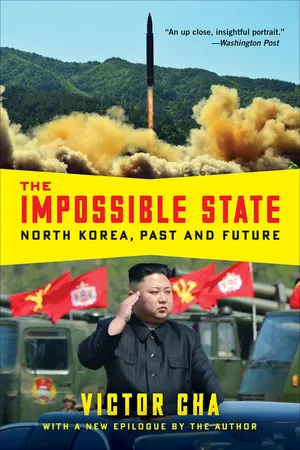
The Impossible State, international-policy expert and former Director for Asian Affairs at the National Security Council Victor Cha pulls back the curtain on this controversial and isolated country, providing the best look yet at North Korea's history, the rise of the Kim family dynasty, and the obsessive personality cult that empowers them. He illuminates the repressive regime's complex economy and culture, its appalling record of human-rights abuses, and its belligerent relationship with the United States, and analyzes the regime's major security issues—from the seemingly endless war with its southern neighbor to its frightening nuclear ambitions—all in light of the destabilizing effects of Kim Jong-il's death and the pivotal and disquieting transition of power from tyrannical father to inexperienced son.
How this enigmatic nation-state—one that regularly violates its own citizens' inalienable rights and has suffered famine, global economic sanctions, a collapsed economy, and near total isolation from the rest of the world—has continued to survive has long been a question that preoccupies the West. Cha reveals a land of contradictions, and delves into the ideology that leads an oppressed, starving populace to cling so fiercely to its failed leadership.
With rare personal anecdotes from the author's time in Pyongyang and his tenure as an adviser in the White House, this authoritative, accessible, "engrossing" history (
The Economist) offers much-needed understanding of the country's veiled past and uncertain future.
"An up-close, insightful portrait." —
The Washington Post
"An eye-opening view of the closed, repressive dictatorship of North Korea. . . . A useful, pertinent work for understanding the human story behind the headlines." —
Kirkus Reviews
- 560 pages
- English
- ePUB (mobile friendly)
- Available on iOS & Android
eBook - ePub
About this book
Information
Chapter One
Contradictions
Contradictions
We passed over barren and gray fields as the gulfstream vi touched down on the empty runway of the airport. As the plane taxied on the tarmac, there was no flight traffic to be seen. No baggage carts or fuel trucks shuttling about. It looked as though we were the only arrival or departure of the day. We cruised past two passenger planes with propeller engines, the kind you would see in a 1940s Humphrey Bogart movie. Then the plane turned right and the main terminal came into view, a small 1960s-era building about one-tenth the size of today’s international air terminals. Scrawled across the top of the edifice with large, red block letters was pyongyang, written in English and in Han’gŭl (Korean characters). Hanging atop the center of the Sunan international air terminal’s façade was an oversize portrait of the first leader of the Democratic People’s Republic of Korea (DPRK, North Korea), Kim Il-sung.
We prepared to deplane into the cool spring air, after the long flight from Elmendorf Air Base in Alaska. It was dusk with an orange glow to the sky, and it was eerily silent: no street sounds, no car horns, no birds. We disembarked one by one, following established security protocol, while two security officers, known as “ravens,” checked each of our names off the passenger manifest. The ravens then escorted us to a receiving party of North Korean airport staff and foreign ministry officials, who were standing on the tarmac in front of the Kim Il-sung portrait. It was at that point that our security detail turned around and headed back to the plane. I blurted out, “Hey, aren’t you guys coming with us?” The agent, looking puzzled at my naive question through his dark sunglasses, responded, “No sir, we stay with the plane. Too much sensitive comms equipment aboard to stay overnight in enemy territory. We will transport southbound to Osan [air base in South Korea]. See you on the other side in a few days, sir.” The Gulfstream VI was a military plane that the White House provided at the request of New Mexico’s then-governor Bill Richardson who had pressed the George W. Bush administration to allow him to visit North Korea. The plane was capable of confidential communications (and probably a whole host of other things I was unaware of). I then remembered that the ravens, who were fully armed, always checked us on and off the plane at our various stops along the way, but the only time they ever separated from the plane was when we overnighted at Elmendorf Air Force Base, a secure facility. I thought to myself, “U.S. military plane, invaluable; U.S. government officials, expendable.”
My job on this trip as National Security Council (NSC) staff was to accompany the governor and make sure he did not make any nuclear deals outside of the ones we were then trying to negotiate through the Six-Party Talks. Our specific mission was to negotiate the successful return of a set of POW/MIA (Prisoners of War/Missing in Action) remains from the Korean War that was held by the Korean People’s Army (KPA). Two experts from the Defense Department were detailed for the trip. One was a forensics expert. The other was a Central Asia policy expert, who also was a Ph.D. candidate at Georgetown University, and on whose dissertation committee I later served. Richardson, then about to announce his candidacy for president on the Democratic ticket, was the media highlight of the trip (he had brought with him Andrea Mitchell of NBC News and an Associated Press correspondent, to ensure adequate publicity), but this was the first time U.S. officials from the second term of the Bush administration had entered North Korea. The last time had been in 2002, when the United States confronted North Korea about a clandestine second nuclear program that was in violation of standing agreements. This sparked a major crisis that led to ballistic missile tests and, ultimately, a nuclear test by Pyongyang. So no one knew exactly what to expect.
As we walked up a small set of steps to meet the receiving party in front of the VIP entrance, the only recognizable face was that of Mats Foyer, the Swedish ambassador to Pyongyang, who I later found out had insisted on being at the airport to greet us, since Sweden was the protecting power for American interests in North Korea. This arrangement with Sweden exists because the United States has no embassy in Pyongyang, as it remains technically at war with the country. A cease-fire, not a peace treaty, ended hostilities in 1953. I looked over my shoulder to see our plane departing down the runway, and mumbled to the two Pentagon officials standing next to me, “The three of us should stay together, and not get separated during this trip.” Once inside the terminal, we were offered some refreshments and exchanged some diplomatic pleasantries. We were asked to pay an entry fee in cash. (Credit cards don’t work in North Korea.) We were given our schedules by the hosts, which under normal circumstances would be something handled by our embassy and for which every detail would have been painstakingly ironed out in advance of the trip. In this case, however, the North Koreans provided no details in advance, preferring to maintain total control of the itinerary; hence, we were literally flying blind into the country, unclear of what we would do.
As we headed out to the transportation vehicles, I looked at the departure board for flights. The long, black board had only one entry for the day, a flight to Beijing. The Sunan Airport parking lot was empty except for our awaiting convoy. The North Koreans directed Governor Richardson to one car, an old 1970s Cadillac sedan, and indicated for me to get into a separate car, a brand-new Volkswagen Passat. They told everyone else to get into the vans. The two Defense Department personnel immediately tried to rectify the situation, claiming that I needed to travel with the other members of the official detail, but we really did not have much choice in the matter unless we wanted to create a scene. I made eye contact with them saying that it was okay. I sat in the backseat of the car and watched as the rest of the traveling party filed onto the van. I peered over at the odometer and noticed that the car had less than one hundred kilometers (60 mi) on it. I induced that the Chinese must have provided a fleet of these new Passats in contravention of standing U.N. sanctions against the North. At that moment, the thought crossed my mind that I was alone in an enemy country with White House security clearances of the highest order, no diplomatic or security protection, and sitting in the back of a sedan with no idea where the driver and his companion in the front seat might be instructed to take me. I sat back and closed my eyes. Normally, one would use the car ride on official trips to work on the BlackBerry or field calls from Washington. But there was no BlackBerry service and no global cell service. I had no U.S. embassy control officer passing me cables and intelligence traffic to review. I could not even ask the driver what the score of the previous evening’s Yankees–Red Sox game was. (I was born in New York City.)
I dozed off and awoke thirty minutes later to see our convoy speeding down wide and empty thoroughfares as I got my first look at Pyongyang. As an academic, I had studied the country for decades, and as a U.S. official, I had negotiated with their diplomats, but I had never set foot in the country until this trip. We sped past what appeared to be a work unit of hundreds of school-age children walking twelve-wide and thirty-deep with the first student carrying a numbered placard. We whizzed past the gates of Kim Il-sung University, where book-toting college students were pouring onto the sidewalks after their day’s study. The car then slowed as we passed a large, white, gated structure on my right side. This used to be the official residence of Kim Il-sung, but after his death in 1994, it was turned into a mausoleum, an $8.9 billion, 115,000-square-foot structure surrounded by moats and complete with marble floors, kilometer-long (0.6 mi) halls, moving walkways, escalators, air-purification systems, and automatic shoe-cleaners, where the Great Leader’s embalmed body is housed in a clear sarcophagus.1 Our car then turned right down a secluded dirt road with barbed-wire fencing. I could see farmers in the distance tilling the land with an ox. (I saw only one tractor on the whole trip despite passing hundreds of acres of farmland.) We drove past a guarded checkpost and entered the Paekhwawŏn State Guesthouse, a lush green compound with a private lake and many pheasants wandering about. The manager greeted us and escorted us to our rooms.
The high-ceilinged, tastefully appointed European-style rooms had an inner door and an outer door with traditional keyholes, but no keys. I flipped on the television to see what service was available. A black screen came to life momentarily with the BBC logo in the bottom right corner, but then a graphic appeared, saying service not available. I turned to another channel, with the CNN logo at the bottom, but after a few seconds the same notice showed up. I flipped through all the channels to find only two that came through. One was a broadcast of the Supreme People’s Assembly—DPRK rubber-stamp legislature—hearing in progress. The other was a documentary about the exploits of Great Leader Kim Il-sung as an anti-Japanese guerrilla fighter. The only phone service available in the room was two white phones sitting atop the writing desk. Written on a thin strip of white paper underneath one of them was LOCAL CALLS, and the other INTERNATIONAL CALLS. I thought about dialing a random number on the local phone to see whom I would get, but then picked up the international phone, dialed 9 to get an outside line, and then called the White House Situation Room, knowing full well that there were probably about ten people listening in on the call from a room somewhere in the guesthouse. The Sit Room patched me through to Steve Hadley, the national security adviser. I said, “Mr. Hadley, I just wanted to let you know that the party has safely arrived in Pyongyang.” “Good,” he responded. I then said, “Mr. Hadley, we are staying at the Paekhwawŏn Guesthouse, where I am calling you from a phone designated for international calls in my room.” There was a brief pause on the other end of the line, after which Hadley, fully aware of the lack of any secure communications, responded, “Okay, got it.” Every call after that was a one-way conversation in which I would report on the day’s events, but the White House would be in receive mode only, not giving the North the benefit of any insights into our position.
I could not sleep very well that night, a combination of jet lag and restlessness at what the trip might have in store. As I stared at the ceiling in my room, I was thinking that I had never imagined myself to be in this position. As a professor of international relations at Georgetown University, I had written about U.S. policy in Asia, and was interested in studying policy, but did not intend to practice it. Friends in the Bush administration, such as Dr. Michael Green, had liked some of what I had written, and during two postdoctoral stints at Stanford University’s Hoover Institution (where I was the Edward Teller National Security Fellow) and the Center for International Security and Cooperation, I had gotten to know Dr. Condoleezza Rice, then a professor of political science and university provost. When they asked if I would be willing to serve on the NSC, it was hard to say no—both out of a sense of public duty and because of my substantive interests in the area. Three years later, another sleepless night was not unusual except that it was without the incessant humming of a BlackBerry, which was now basically an overpriced paperweight in service-absent North Korea.
At dawn, I walked downstairs and onto the grounds. There were no birds chirping, as the country suffered deforestation because of floods and energy shortages that forced the people to cut down trees for firewood. Distant military marching-band music could be heard piped from loudspeakers in the center of the city. Small pheasants ran about, making shrieking sounds I had never heard before. (I think they may have been served at dinner that night.) On the contained compound, there were no ubiquitous North Korean guides normally accompanying foreigners every minute, so I wandered around the grounds by a pond. I caught glimpses of armed soldiers quietly standing guard every two hundred yards or so on the other side of the fence. The contrast between this blissfully peaceful moment and the larger strategic context of the trip was stark. Here we were in the midst of a nuclear crisis with North Korea—the worst since 1994, when the United States contemplated a preemptive strike on the Yongbyon nuclear complex. The Kim regime had only months earlier carried out an unprecedented nuclear test, which led to the severest U.N. Security Council (UNSC) sanctions since the Korean War. Additional financial sanctions were targeting the leadership’s personal assets held in overseas bank accounts. Pyongyang threatened to turn the Republic of Korea (ROK, South Korea) into a “sea of fire,” and declared that it was unafraid of war with the United States. I returned to the guesthouse to see the manager standing outside the entrance puffing on a cigarette. He was a middle-age man with a friendly smile, wearing a gray overcoat, dark glasses, slippers, and the ubiquitous Kim Il-sung lapel badge. He asked if there was enough heat and hot water last night. I told him that there was more than enough. We chatted about the weather in Washington and Pyongyang, and I complimented him on the beauty of the Paekhwawŏn grounds. He then said quietly to me in Korean that I was the first White House official to stay in the guesthouse since former president Jimmy Carter in 1994. I laughed uncomfortably, since this fellow did not know that I was just a lowly NSC staff director of Asian affairs. Then, as he extinguished his cigarette and exhaled his last puff, he murmured quietly that he wished us well in trying to bring peace between our two countries. It was the last thing I had expected to hear, given the poor state of our relations.
NORTH KOREA IS the Impossible State. The regime, created in 1948 out of the division of the Korean Peninsula by U.S. and Soviet occupation forces at the beginning of the Cold War, has outlasted anyone’s expectations. Even after the mighty Soviet Union and other communist regimes collapsed some two decades ago, this enigmatic Asian nation continues to hang on. Today, we witness an Arab Spring, where dictators in Egypt, Tunisia, Yemen, and Libya, ensconced in power much longer than North Korea’s leadership, have been ousted, and yet the Dear Leader Kim Jong-il (as he is referred to within the DPRK), until his death in late 2011, and his son, Kim Jong-un (the so-called Great Successor), sit happily in Pyongyang declaring 2012 as the year of a “powerful and prosperous nation” (kangsŏng tae’guk). The regime remains intact despite famine, global economic sanctions, a collapsed economy, and almost complete isolation from the rest of the world. By any metric, this poor, backward, and isolated place should have been relegated to history’s graveyard. It is a hermetically sealed Cold War anachronism.
North Korea is a land of contradictions. North Korean schoolchildren learn grammatical conjugations of past, present, and future by reciting “We killed Americans,” “We are killing Americans,” “We will kill Americans.” They learn elementary school math with word problems that subtract or divide the number of dead American soldiers to get the solution. Yet, at the same time, since 1994 the school curriculum has made English, not Russian, the mandatory foreign language of study. In terms of economics, the facts are even more bewildering. North Korea sits at the heart of the most vibrant economic region of the world. It has the globe’s second largest economy on its border (China), the third largest economy across the sea (Japan), and the fifteenth largest economy contiguous to it, with which it shares a common language (South Korea). It has a young, literate, and inexpensive labor force. The U.S. Geological Survey assesses North Korea to have some of the world’s largest untapped reserves of coal, iron ore, limestone, magnesite, and other minerals akin to rare earth reserves (tungsten, molybdenum, and niobium-tantalum). A Goldman Sachs report estimated the value of North Korea’s mineral deposits at 140 times the country’s GDP.2 Yet the economy has been in freefall for the past two decades. Per capita gross national income has contracted from $1,160 in 1990 to $960 in 2009. Life expectancy rates are 67.4 years, down from 70.2 years in 1990. Rather than engage in commerce with the world, the North Korean regime engages in self-sustaining illicit activities. It is one of the world’s biggest counterfeiters of U.S. currency. North Korea’s fake $100 bill is so authentic-looking that U.S. law enforcement agencies refer to it as the “supernote,” because it is based on printing technology and a specialized ink that is better than the original bills produced by the U.S. government. North Korea is also one of the world’s biggest producers of counterfeit cigarettes and medications, including Viagra.
Along with this colossal economic mismanagement, the people of North Korea endure some of the worst human rights abuses in the world. North Korea ranks seventh out of seven (lowest possible) on Freedom House’s Freedom in the World index, and is therefore one of just nine countries to be given the ignominious title “the Worst of the Worst.”3 It is in the 0th percentile for the World Bank’s Voice and Accountability index and ranks dead-last in the Freedom of the Press index. In North Korea, you can get thrown into a gulag for six months of hard labor for watching a DVD of Jackie Chan’s Twin Dragons4 or for humming South Korean pop songs. If the portraits of Kim Il-sung and Kim Jong-il in your home or office are not properly dusted or are hung off-center, you could be sent to jail. Even if you do everything right, one evening the secret police can knock on your door, strip you and your entire family of your worldly possessions, and throw you into a gulag because it was discovered that someone in your family from a previous generation was a collaborator with Japanese colonial authorities.
A recent CNN report with Wolf Blitzer and Alina Cho showed North Koreans in Pyongyang using cell phones and enjoying themselves at amusement parks. The impression given was that the world knows very little about what happens behind Kim’s iron curtain (this is true) but that when we peer behind it, things are not all that bad (this is false). A few neatly dressed elites playing games on their cell phones, which do not have cell service outside the country, does not represent North Korea. Public executions more than tripled in the past year. The numbers of prisoners in North Korea’s infamous kwalliso (prison camps)—a system as bad as Stalin’s gulags—is reportedly on the rise. Shoot-to-kill orders are in effect for North Korean refugees seeking to cross the Yalu or Tumen Rivers into China. When international news reporters broadcast that cell phones are a sign of the North’s willingness to reform, they must have missed the public bulletin boards in Korean, which forbid the use of Chinese-made mobile phones (which, with a prepaid SIM card, can dial outside of the country) and the use of foreign currency as a crime punishable by death. Three North Koreans in ninety thousand today own their own car. About ten out of a hundred own a refrigerator in their apartments. The DPRK is one of the few industrialized societies in the history of the modern nation-state system to have suffered a famine that killed as much as 10 percent of the population. Most everyone is a vegetarian, but not by choice. The average meal is a small bowl of boiled corn with a sprinkling of pickles. Beef is so scarce that for the average North Korean, it is a delicacy eaten only once per year. NGO groups that visited rural areas in February 2011 had a question on their nutritional surveys that asked, “When was the last time you had protein?” Virtually every respondent could remember the exact date when they last had an egg or a piece of meat, revealing the state of undernourishment. The government’s public distribution system (PDS) provides about 1,500 calories per day, which is less than the U.N. requirement for minimum need. The effects of this systemic malnourishment will be evident for generations: the average seven-year-old boy in North Korea is twenty centimeters (8 in) shorter and ten kilograms (22 lb) lighter than in South Korea. In spite of all this, when the world tries to help the people of North Korea with food, the regime blatantly violates the four basic norms of humanitarian aid: access, transparency, nondiscrimination, and a focus on the most vulnerable.
Yet the North Korean people, despite all of their hardship, believe that they are the chosen people. They consider themselves fortunate to have been born of the purest race, and in the most innocent, virginal, and virtuo...
Table of contents
- Dedication
- Contents
- A Note on the Korean Text
- Glossary of Acronyms and Abbreviations
- Chapter One - Contradictions
- Chapter Two - The Best Days
- Chapter Three - All in the Family
- Chapter Four - Five Bad Decisions
- Chapter Five - The Worst Place on Earth
- Chapter Six - The Logic of Deterrence
- Chapter Seven - Complete, Verifiable, and Irreversible Dismantlement (CVID)
- Chapter Eight - Neighbors
- Chapter Nine - Approaching Unification
- Chapter Ten - The End Is Near
- Acknowledgments
- Notes
- Index
- Photo Section
- About the Author
- Also by Victor Cha
- Credits
- Copyright
- About the Publisher
Trusted by 375,005 students
Access to over 1.5 million titles for a fair monthly price.
Study more efficiently using our study tools.
Frequently asked questions
Yes, you can cancel anytime from the Subscription tab in your account settings on the Perlego website. Your subscription will stay active until the end of your current billing period. Learn how to cancel your subscription
No, books cannot be downloaded as external files, such as PDFs, for use outside of Perlego. However, you can download books within the Perlego app for offline reading on mobile or tablet. Learn how to download books offline
Perlego offers two plans: Essential and Complete
- Essential is ideal for learners and professionals who enjoy exploring a wide range of subjects. Access the Essential Library with 800,000+ trusted titles and best-sellers across business, personal growth, and the humanities. Includes unlimited reading time and Standard Read Aloud voice.
- Complete: Perfect for advanced learners and researchers needing full, unrestricted access. Unlock 1.5M+ books across hundreds of subjects, including academic and specialized titles. The Complete Plan also includes advanced features like Premium Read Aloud and Research Assistant.
We are an online textbook subscription service, where you can get access to an entire online library for less than the price of a single book per month. With over 1.5 million books across 990+ topics, we’ve got you covered! Learn about our mission
Look out for the read-aloud symbol on your next book to see if you can listen to it. The read-aloud tool reads text aloud for you, highlighting the text as it is being read. You can pause it, speed it up and slow it down. Learn more about Read Aloud
Yes! You can use the Perlego app on both iOS and Android devices to read anytime, anywhere — even offline. Perfect for commutes or when you’re on the go.
Please note we cannot support devices running on iOS 13 and Android 7 or earlier. Learn more about using the app
Please note we cannot support devices running on iOS 13 and Android 7 or earlier. Learn more about using the app
Yes, you can access The Impossible State by Victor Cha in PDF and/or ePUB format, as well as other popular books in History & 21st Century History. We have over 1.5 million books available in our catalogue for you to explore.