- 240 pages
- English
- ePUB (mobile friendly)
- Available on iOS & Android
eBook - ePub
About this book
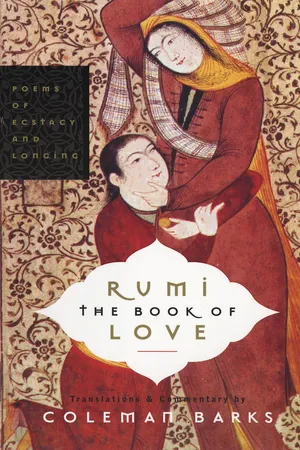
Rumi: The Book of Love is a collection of astonishing poems for lovers from the mystic Rumi, by the translator who made him sing anew, Coleman Barks.
Poetry and Rumi fans will want to own this gorgeously packaged compilation of love poems by the thirteenth-century Sufi mystic. Rumi is best known and most cherished as the poet of love in all its forms, and renowned poet and Rumi interpretor Coleman Barks has gathered the best of these poems in delightful and wise renderings that will open your heart and soul to the lover inside and out.
Frequently asked questions
Yes, you can cancel anytime from the Subscription tab in your account settings on the Perlego website. Your subscription will stay active until the end of your current billing period. Learn how to cancel your subscription.
At the moment all of our mobile-responsive ePub books are available to download via the app. Most of our PDFs are also available to download and we're working on making the final remaining ones downloadable now. Learn more here.
Perlego offers two plans: Essential and Complete
- Essential is ideal for learners and professionals who enjoy exploring a wide range of subjects. Access the Essential Library with 800,000+ trusted titles and best-sellers across business, personal growth, and the humanities. Includes unlimited reading time and Standard Read Aloud voice.
- Complete: Perfect for advanced learners and researchers needing full, unrestricted access. Unlock 1.4M+ books across hundreds of subjects, including academic and specialized titles. The Complete Plan also includes advanced features like Premium Read Aloud and Research Assistant.
We are an online textbook subscription service, where you can get access to an entire online library for less than the price of a single book per month. With over 1 million books across 1000+ topics, we’ve got you covered! Learn more here.
Look out for the read-aloud symbol on your next book to see if you can listen to it. The read-aloud tool reads text aloud for you, highlighting the text as it is being read. You can pause it, speed it up and slow it down. Learn more here.
Yes! You can use the Perlego app on both iOS or Android devices to read anytime, anywhere — even offline. Perfect for commutes or when you’re on the go.
Please note we cannot support devices running on iOS 13 and Android 7 or earlier. Learn more about using the app.
Yes, you can access Rumi: The Book of Love by Coleman Barks in PDF and/or ePUB format, as well as other popular books in Literature & Ancient Poetry. We have over one million books available in our catalogue for you to explore.
Information
1. Spontaneous Wandering
I take down my King James to look up the passage about love (charity) in 1 Corinthians 13. There is a tiny red ant living in Corinth. It walks to the top and along the gold edges. Spontaneous wandering is a favorite region of the heart. It may look like mindless drift, but it isn’t. More the good Don and Sancho out for their inspired adventures, quixotic and panzaic.5 The ant is my teacher.
We see through a glass darkly, then face-to-face. A more polished mirror shows us who we truly are. The wandering of Rumi’s poetry is a model for the soul’s lovely motions. When thirst begins to look for water, water has already started out with a canteen, looking for thirst. Love feels like sliding along the eddies and currents of the tao.
Pir Vilayat Khan6 recently commented to me, “Your first Rumi volumes seemed very sexual.” He’s right. There is too much of that energy in the first work with Rumi I did, especially in some of the quatrains. I was very wet with such water at the time myself. I was thirty-nine. Now I’m sixty-five. Things change; nothing wrong with that. What’s truly alive is always changing.
Gay lovers hear Rumi’s poetry as gay. I don’t agree, though I’m certainly guilty of previously loading Rumi’s poetry with erotic fruit. I don’t do that now. Rumi is way happier than sex and orgasms, his wandering more conscious and free. See “Imra’u ‘l-Qays” in the next section. Rumi and Shams wander in that country.
Perhaps the purest wanderer of our time is Nanao, like Basho in his. Gary Snyder says about him,
This subtropical East China Sea carpenter and spear fisherman finds himself equally at home in the desert. So much so that on one occasion when an eminent traditional Buddhist priest boasted of his lineage, Nanao responded, “I need no lineage. I am desert rat.” But for all his independence Nanao Sakaki carries the karma of Chungtzu, En-no-gyoja, Saigyo, Ikkyu, Basho, and Issa in his bindle. His work or play in the world is to pull out nails, free seized nuts, break loose the rusted, open up the shutters. You can put these poems in your shoes and walk a thousand miles.
GO WITH MUDDY FEET
When you hear dirty story
wash your ears.
When you see ugly stuff
wash your eyes.
When you get bad thoughts
wash your mind.
and
and
Keep your feet muddy.7
—Nanao Sakaki
Excuse my wandering.
How can one be orderly with this?
It’s like counting leaves in a garden,
along with the song notes of partridges,
and crows. Sometimes organization
and computation become absurd.
FIVE THINGS
I have five things to say,
five fingers to give into your grace.
First, when I was apart from you,
this world did not exist, nor any other.
Second, whatever I was looking for was always you.
Third, why did I ever learn to count to three?
Fourth, my cornfield is burning!
Fifth, this finger stands for Rabia,8
and this is for someone else.
Is there a difference?
Are these words or tears?
Is weeping speech?
What shall I do, my love?
So the lover speaks, and everyone around
begins to cry with him, laughing crazily,
moaning in the spreading union
of lover and beloved.
This is ...
Table of contents
- Dedication
- Contents
- Preface
- Introduction: The Magnificent Regions of the Heart
- A Brief Account of Rumi's Life
- Chapter 1
- Chapter 2
- Chapter 3
- Chapter 4
- Chapter 5
- Chapter 6
- Chapter 7
- Chapter 8
- Chapter 9
- Chapter 10
- Chapter 11
- Chapter 12
- Chapter 13
- Chapter 14
- Chapter 15
- Chapter 16
- Chapter 17
- Chapter 18
- Chapter 19
- Chapter 20
- Chapter 21
- Chapter 22
- A Note on Translation
- Notes
- Index of Titles and First Lines
- About the Author
- Books by Coleman Barks
- Credits
- Copyright
- About the Publisher