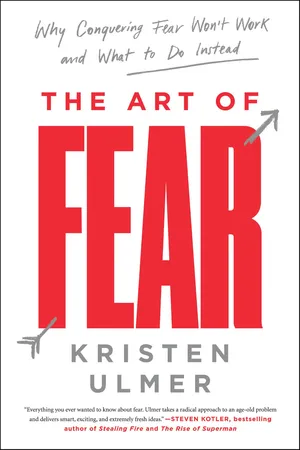
The former professional extreme skier "unpacks this misunderstood emotion and lays out strategies for experiencing fear in an empowering way" (Parade).
We all feel fear. Yet we are often taught to ignore it, overcome it, push past it. But to what benefit? This is the essential question that guides Kristen Ulmer's remarkable exploration of our most misunderstood emotion in
The Art of Fear.
Once recognized as the best extreme skier in the world (an honor she held for twelve years), Ulmer knows fear well. In this conversation-changing book, she argues that fear is not here to cause us problems—and that in fact, the only true issue we face with fear is our misguided reaction to it (not the fear itself).
Rebuilding our experience with fear from the ground up, Ulmer starts by exploring why we've come to view it as a negative. From here, she unpacks fear and shows it to be just one of 10,000 voices that make up our reality, here to help us come alive alongside joy, love, and gratitude. Introducing a mindfulness tool called "Shift," Ulmer teaches readers how to experience fear in a simpler, more authentic way, transforming our relationship with this emotion from that of a draining battle into one that's in line with our true nature.
Influenced by Ulmer's own complicated relationship with fear and her over fifty years as a mindset facilitator,
The Art of Fear will reconstruct the way we react to and experience fear—empowering us to easily and permanently address the underlying cause of our fear-based problems, and setting us on course to live a happier, more expansive future.
Do you ask yourself such big questions? If you do, it’s probably not for very long, because these big questions are hard to answer. The quality of your life, however, is determined by the bigness of your questions. And so, in order for us to get started and move ahead, I’ll offer you simple answers that we can work with. For the duration of this book, who and what you are is this: You are a corporation made up of 10,000 individual employees. This concept is going to be on every page of this book, so drink it in now.
Your corporation has a name. Mine is Kristen. Yours is Susan or Biff or Wang or whatever’s on your birth certificate. Just like those of other corporations, such as Apple or Honda, your name is simply a chosen title or brand name and lacks any substance. The substance lies entirely in the activities and functions of the many employees running the corporation, of which there are 10,000.
Now imagine that in this corporation called (Your Name), none of the 10,000 employees know their job title, their job description, who’s boss, or even what they’re manufacturing. How well would that corporation run?
Insert a buzzer noise here.
That’s what it’s like to be a human being: you’re a poorly run, chaotic entity where only five or so exhausted employees are actually working. Half of the others are being ignored or abused by these five. The abused ones are upset and covertly running the show in mutiny, and have been for decades. And no one, certainly not you, knows who’s really in charge. HR has completely lost control. In fact, who even knows what’s being manufactured?
This is not a recipe for a successful corporation. And yet this is your life.
Fear is one of the 10,000 employees in your personal corporation. And while Fear is just one voice among 10,000—I also like to call the employees “voices”—Fear is a big deal, because it’s usually the ringleader of the mutiny faction. As a result, it makes a stink in every moment of your life.
ORIGINS OF FEAR: THE LIZARD BRAIN
Why did the chicken cross the road? Because her lizard brain told her to.
—SETH GODIN
Do you know that a single-cell amoeba, if exposed to fire, will move away in order to save itself? It has no arms or legs, no spinal column, not even a brain to be aware of its own existence . . . but it still knows how to survive.
This is where Fear—or your “safe versus not safe” mechanism—first appeared. Such innate physical intelligence is the basis from which all creatures have had a chance to survive, evolve, and now excel.
Then, 500 million years ago, a part of your future brain—the amygdala—first showed up (in fish). Two to three million years ago, along came us, and the amygdala began its human reign. Seth Godin likes to call it the Lizard Brain, and so do I.
Two almond-size nuggets located at the top of your spinal cord, the Lizard Brain is the smallest, most deeply buried part of our brain—tiny compared with the outermost layer, the enormous neocortex (also two to three million years old). Yet it remains by far the most powerful. As it should be: The Lizard Brain is responsible for an organism’s survival and subsequent evolution, from the very first amoeba to fish to lizards to cavemen to now, of course, you. Without it, you wouldn’t even exist.
Today, the Lizard Brain not only is responsible for sending emotional messages but remains on the lookout for anything that might kill you. Which is certainly handy—except it doesn’t distinguish between major threats and minor inconveniences. It sees imminent life-ending danger everywhere: A job interview is perceived as a public execution. A casual comment by a co-worker is seen as vicious criticism. Falling in love feels like falling off a cliff. It remembers when you made a fool out of yourself in public and warns you not to do that again . . . or you may die.
If someone makes a suggestion, the Lizard Brain immediately says no, because it’s change, it’s new. It might threaten whatever the Lizard Brain has set up for you already, which, so far, has worked—after all, you’re still alive.
The Lizard Brain hates risk, hates the unknown, says, Don’t do it! Watch out! Don’t trust this person. Don’t leave this relationship. Don’t start that business. Sit down, shut up, and don’t take breaks or someone will steal your job—which will result in death. And always, always move away from the fire. According to the Lizard Brain, everything is a fire.
When the Lizard Brain speaks, things become black-and-white. You may take everything very seriously. You may become critical of others, blame them for everything, and allow nothing to be your fault. You may procrastinate, make excuses, obsess about details, incessantly struggle to figure things out, try to fit in, to be nice to everyone, even people who are jerks, and on and on.
In short, everything you do is to appease the Lizard Brain. Yet, prevalent as it is, you likely have no idea this is even happening. The Lizard Brain isn’t operating from some penthouse suite in your corporate headquarters but instead unconsciously, in the duct system, oozing like vapor into every behavior.
To you, this is likely unacceptable. The fact that you read books like this is an indicator that you’re interested in experiences beyond the Lizard Brain. Like, say, the neocortex. What’s not to like about the neocortex? It’s new. It’s expansive. It’s found only in higher species. The neocortex offers intellect, reasoning, imagination, creativity, and higher states of awareness. It’s concerned with happiness, not survival. Beat it, amygdala, you think. There’s no more dinosaurs. I’m not a fish. You believe that this newer, sexier part of your brain is more aligned with your true self and who you want to be.
But the Lizard Brain isn’t giving up that easily.
Which leads us to our first interview with one of your employees. I’m sure it has something it wants to say about this, yes?
ME: Hey, LB. What’s going on?
LIZARD BRAIN: You want to replace me? Only a fool would do such a thing as get rid of its basic survival intelligence. Without me, you do understand you’d do stupid things like jump out of an airplane without a parachute or fall in love with just anyone? Do you know that rats with damaged amygdalae will walk right up to cats without a care in the world? Cats! Wanting to put the neocortex in charge further proves how stupid humans are and how much they need my help.
ME: They are pretty insistent, though, that they want a higher experience.
L.B.: The more insistent they are, the more I consider this an emergency. And in an emergency, I take over. The more you try to get rid of me, in fact, the bigger the emergency. You could die! So when you ignore me, the louder and louder I will have to speak, obligated to immerse myself until this crisis is over.
ME: Which is why we find you so problematic. Many of us have even given you new nicknames: Doomsday Brain, or Crazy Brain.
L.B.: After all I’ve done for you, that’s just insulting, and also terrifying and further confirmation that you need me now more than ever.
Can you see, then, that despite your best efforts to take three breaths and will it away or become more “spiritual,” you’re not smarter or more powerful than the Lizard Brain? It’s half a billion years old. How old are you?
The Lizard Brain remains firmly in place as your oldest and most established employee.
Like it or not, my friend, this is probably your CEO.
WHAT HAPPENS NEXT?
For all its talking, the Lizard Brain messages don’t need thought or analysis—you’re in danger, you need to move!—so it communicates instead with physical sensations of discomfort, otherwise known as Fear. It manufactures Fear, and sends its shot directly to your Body. The Body is an employee that lives in the moment and has no opinions. Its only job is to feel the feeling, much like it feels the sensation of wind or cotton against skin, and then carry out immediate action, fight or flight (flee) being the most obvious. The equation, then, is:
LIZARD BRAIN
EMOTION
ACTION
It’s a simple system easily witnessed in animals: On a dirt road at night, a rabbit suddenly jumps out and then runs like a maniac away from your truck fender. Once, I flopped onto a black couch in a dark room. The moment before impact, an equally black cat shot off like a rocket from underneath my butt. It turns out the cat had been sleeping before I came along and nearly flattened it. How, from the comfort of her own home, in a deep sleep, was she able to instantly, abruptly save her own life from being crushed by my bony butt? Apparently the Lizard Brain is hard at work even as we sleep.
But wait, you argue, is it that simple for humans? We’re not cats. We experience “fearful thoughts,” too. Good catch. For us, there’s a whole extra step involved, called the Thinking Mind. We’ll learn about this vital employee next.
THE THINKING MIND
The Thinking Mind is a fascinating part of the human experience. So what, exactly, is the Thinking Mind?
A mystery, that’s what—one of the great mysteries of life, right up there with outer space and the depths of the ...
Table of contents
Cover
Title Page
Dedication
Contents
Introduction: Everything You Know About Fear is Wrong
Part I: Clarity
Part II: Dropping the Stick
Part III: Shift: The Game of 10,000 Wisdoms
Part IV: Honoring Fear
Afterword: One Last Conversation with Fear
Acknowledgments
About the Author
Credits
Copyright
About the Publisher
Trusted by 375,005 students
Access to over 1.5 million titles for a fair monthly price.
Study more efficiently using our study tools.
Frequently asked questions
Yes, you can cancel anytime from the Subscription tab in your account settings on the Perlego website. Your subscription will stay active until the end of your current billing period. Learn how to cancel your subscription
No, books cannot be downloaded as external files, such as PDFs, for use outside of Perlego. However, you can download books within the Perlego app for offline reading on mobile or tablet. Learn how to download books offline
Perlego offers two plans: Essential and Complete
Essential is ideal for learners and professionals who enjoy exploring a wide range of subjects. Access the Essential Library with 800,000+ trusted titles and best-sellers across business, personal growth, and the humanities. Includes unlimited reading time and Standard Read Aloud voice.
Complete: Perfect for advanced learners and researchers needing full, unrestricted access. Unlock 1.5M+ books across hundreds of subjects, including academic and specialized titles. The Complete Plan also includes advanced features like Premium Read Aloud and Research Assistant.
Both plans are available with monthly, semester, or annual billing cycles.
We are an online textbook subscription service, where you can get access to an entire online library for less than the price of a single book per month. With over 1.5 million books across 990+ topics, we’ve got you covered! Learn about our mission
Look out for the read-aloud symbol on your next book to see if you can listen to it. The read-aloud tool reads text aloud for you, highlighting the text as it is being read. You can pause it, speed it up and slow it down. Learn more about Read Aloud
Yes! You can use the Perlego app on both iOS and Android devices to read anytime, anywhere — even offline. Perfect for commutes or when you’re on the go. Please note we cannot support devices running on iOS 13 and Android 7 or earlier. Learn more about using the app
Yes, you can access The Art of Fear by Kristen Ulmer in PDF and/or ePUB format, as well as other popular books in Personal Development & Emotions in Psychology. We have over 1.5 million books available in our catalogue for you to explore.