There is only one way to defeat Obama’s misguided and dangerous socialist agenda for America, and that is to resoundingly and categorically defeat Barack Obama.
It’s that simple: He and his fanatical policies have got to go.
We know that. We’ve already started the process by taking over the House of Representatives. With the leadership of courageous Tea Party members and other activists across the country, along with the support of so many disgusted and alienated voters, we threw out a large number of arrogant and self-serving congressmen, who deserved exactly what they got. We also sent Obama a message about our plans for him.
In case there’s any doubt about it, we’re planning to send him back to Illinois. For good.
Accomplishing this will require a disciplined twofold strategy: First we have to block him in Congress by repealing his most offensive programs and impeding any new catastrophic legislation. Then we need to rout him in the voting booth.
And we can—and must—do both.
Let’s start with Congress first. During the next two years, we have to capitalize on our control of the House in order to systematically undo the damage that Obama and his naive policies have already done. That includes using the budget to defund health care “reform” and his other extravagant follies, and doing whatever else it takes to reject and repeal his colossal blunders.
At the same time, we have to thwart any fresh attempts by Obama to further devastate our fragile economy. There’s no doubt about it, he’ll be back with more and more outlandish legislative schemes to implement his radical dreams. That’s why we have to be both vigilant in recognizing what he is up to and rigorous in stopping him. Each and every time one of his wacky and expensive programs comes up for a vote, we need to beat him.
But it won’t be enough just to thrash his initiatives and reverse his mistakes. We also need to trounce him in the voting booth and get him out of the White House. So, our next step, on November 6, 2012, is to vote him out of office.
We’ll gladly give him a one-way ticket back home.
Let’s face it. Defeating an incumbent president, even an unpopular one, is not an easy task. A sitting president has an amazing arsenal of tools available to woo the voters that a challenger can never match. And, in fact, most presidents are reelected. Of the ten presidents since World War II, seven were reelected: Harry Truman, Dwight Eisenhower, Lyndon Johnson, Richard Nixon, Ronald Reagan, Bill Clinton, and George Bush 43. Only Gerald Ford, Jimmy Carter, and George Bush 41 were not.
But when a president loses badly in the Congressional elections after only two years in office, it becomes a lot harder for him to bounce back. Only Eisenhower and Clinton won a second term after losing control of Congress during their first midterm election. And, in Ike’s case, the magnitude of the swing in opposition seats was not very great and he personally remained a very popular and likable figure. In Bill Clinton’s case, he moved deliberately and significantly to the center and enthusiastically embraced conservative policies that attracted swing voters.
That’s not likely to happen with Obama. After the cataclysmic Congressional elections, he did not seem to have even considered a voluntary change in his political direction. And he won’t. When he finally realized that he did not have the support in Congress to limit the extension of the Bush tax cuts, he surrendered, while petulantly lashing out at the Republicans.
Obama is vulnerable and we can defeat him. To borrow his own words, “Yes, we can!”
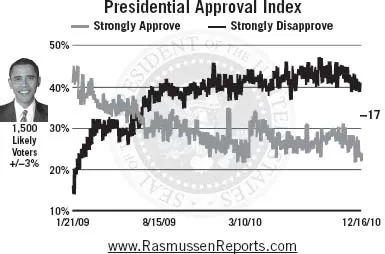
Consider how far and how fast he has fallen. When he took office, he was riding high. His favorability and job approval were stratospheric. Now they have plunged sharply; each week seems to bring him to a new low!1
The Zogby poll shows Obama even lower with his approval dipping below 40%!2
What happened?
- Obama reached the height of his surge in popularity after his victories in the early caucuses and primaries. In the later primaries, he mostly lost the large, industrial states like Michigan, Pennsylvania, and Ohio to Hillary, in part due to the Rev. Wright tapes. He won the nomination anyway because his early victories, many in sparsely populated caucus states, had given him enough delegates to prevail.
- McCain had surged to a lead over Obama after the conventions, and the Democrat only moved ahead because of the sudden economic collapse and McCain’s inability to seize the moment by opposing TARP. So Obama was fading at the finish line.
- Doubts about Obama surfaced right before the election in the Joe the Plumber flap, where he explicitly embraced income redistribution.
- On taking office, he overpromised on what his stimulus package could deliver, claiming it would stop the recession and lower unemployment.
- His health care bill was a vast overreach. And when he failed to sell it to the people, he pushed it anyway. Even when the most liberal state in the nation—Massachusetts—voted for a Republican senator, Scott Brown, to protest the proposal, he used parliamentary tricks to push it through anyway.
- As unemployment soared up to nearly 10% and stayed there for his entire first two years as president, public patience wore thinner and thinner. More and more people began to realize that, at best, Obama had no clue as to what to do and that, at worst, his policies were causing things to get worse.
- Obama’s takeover of GM and Chrysler illustrated the lengths he will go to socialize our economy. His vast expansion of federal regulatory powers over banks and his huge financial bailouts of the states underscored that he was a big-spending, big-government man, out of control.
- The British Petroleum oil spill began to create an image of incompetence. As the facts of his late and tepid response came out, we began to suspect that he would rather spend his time using the spill to stick it to the oil companies than figuring out how to mitigate the environmental damage. As BP scrambled to contain the spill and Obama looked on passively, he seemed like a president out of touch and out of answers.
- Terror attacks began again after a seven-year hiatus under Bush after 9/11. At Fort Hood, a gunman massacred our troops, and a terrorist was only seconds away from detonating a bomb in a plane over Detroit before alert passengers wrestled him to the ground. Mayhem was only narrowly averted in Times Square in the heart of New York City when a terrorist failed to set off his bomb amid a crowded street.
- The war in Afghanistan grew hotter and seems to have no end in sight. This peace candidate has failed to end the war and has only escalated it.
Then came his “shellacking”3 at the polls on November 2, 2010. His losses showed the country how weak he was and how much his citizens disapproved of his presidency. When he caved in and backed the Republicans on extending the Bush tax cuts, voters gave him credit for compromise, but the affair reinforced his image of weakness.
Now it is up to us to finish the job.
FIRST ORDER OF BUSINESS: BARACK OBAMA
How do we defeat Obama?
There’s only one way: by running front and center against his deplorable policies and programs. Our message is very simple: Obama’s big picture for our country will bankrupt us and transform the America that we love into a superbureaucracy that controls every aspect of our lives and businesses. That’s his plan; that’s his passion; that’s his ideal.
It’s not ours. That’s why we have to stop him. It’s not too late. But we can’t waste any time. Starting today, we have a burning mission: to incessantly remind our fellow voters that Obama is the archetype of a zealous tax and spend liberal. That’s truly what he is. That’s truly what he believes in.
This is not simply a call to obstruct everything that Obama proposes. If, by chance, he suddenly introduces initiatives that make sense, we should support them. This is not a call for a knee-jerk opposition to everything he calls for.
It is, however, a call to systematically reverse his calamitous signature achievements, such as health care and deficit spending, and to stop him from any further disasters.
It’s important not to forget just how dangerous his ideas are. We need to remind voters about the real Obama. To do that, we need to repeatedly call attention to his history: the genuinely frightening implications of his health care “reform,” his commitment to class warfare and the redistribution of wealth, his nonstop plans to raise more and more taxes, his utter failure to create jobs, and his over-the-top spending. In short, we need to use his dismal record and his frightening delusions to beat him.
To do otherwise and run a campaign that attacks him personally would only help him win reelection. It might be tempting to some, but that kind of strategy would take us down a dangerous and futile road. We have to take the high road. Voters like Obama, even if they don’t believe that he is particularly competent. So personal attacks just won’t work.
Pollsters routinely rate presidents according to two different measures: personal favorability and job approval. The former measures the public’s opinion of the politician as a person, while the latter gauges how people feel he is doing his job as president.
Most modern presidents score better on personal favorability than on job approval. Americans like their presidents. So, at times, even though our economy may be falling apart or casualties in a foreign war may be mounting so high that we express disapproval of a president’s policies, we still like the guy.
Here’s an average of post–World War II presidents and their ratings compiled by Gallup. Notice how their personal favorability is usually higher than their job approval.
COMPARISON OF FAVORABLE PERSONAL RATINGS AND JOB APPROVAL RATINGS OF PRESIDENTS: EISENHOWER TO BUSH
President: Eisenhower
Average Favorable Personal Rating: 84%
Average Favorable Job Approval Rating: 65%
President: Kennedy
Average Favorable Personal Rating: 88%
Average Favorable Job Approval Rating: 70%
President: Johnson
Average Favorable Personal Rating: 77%
Average Favorable Job Approval Rating: 55%
President: Nixon
Average Favorable Personal Rating: 80%
Average Favorable Job Approval Rating: 49%
President: Ford
Average Favorable Personal Rating: 73%
Average Favorable Job Approval Rating: 47%
President: Carter
Average Favorable Personal Rating: 70%
Average Favorable Job Approval Rating: 45%
President: Reagan
Average Favorable Personal Rating: 70%
Average Favorable Job Approval Rating: 53%
President: George H. W. Bush
Average Favorable Personal Rating: 73%
Average Favorable Job Approval Rating: 61%
President: Clinton
Average Favorable Personal Rating: 56%
Average Favorable Job Approval Rating: 55%
President: George W. Bush
Average Favorable Personal Rating: 67%
Average Favorable Job Approval Rating: 68%
Source: Gallup, http://www.gallup.com/poll/8938/historical-favorability-ratings-presidents.aspx4
Recently Bill Clinton and George W. Bush have had favorability and job approval ratings that were more equal. Clinton’s scandal with Monica Lewinsky and his impeachment diminished his popularity, while unhappiness about President Bush’s handling of Iraq and the failure to find weapons of mass destruction in Iraq slashed Bush 43rd’s previously high favorability ratings.
But Obama has picked up the old pattern of higher personal favorability than job approval. Because Americans genuinely admire Obama’s personal journey and because of what his election as president represents for America, Obama’s personal favorability has run much higher than his job approval. Pollster John Zogby says that the gap between them has averaged 7 to 8 points during his first two years in office.5
This means that in working to defeat Obama, we must be especially careful to take on the president, not the man. Our attacks must never go to his motivations, character, veracity, integrity, personal life, middle name, or intellect. That won’t work. Americans may wonder if Obama knows how to handle the economy, and most think his ideas about health care are cockeyed, but they still admire him personally. It’s important not to forget that.
Some may have come to feel that he is a liar and a faker. Even in that case, it would be best for those who do to keep their opinions to themselves and their eyes on the ball. We want to defeat him! It might feel temporarily good to criticize him personally, but those who do so are helping him. Those who criticize what he has done in office, his initiatives and his programs, are hurting him.
HOW TO BEAT OBAMA
To understand how to defeat Obama in 2012, it’s important to examine what brought his party down in 2010. There are three theories:
The first is the Gospel According to Obama, which claims that the Democrats lost because he failed to end the bitter partisan tone in Washington.
The president is fond of saying that he simply did not communicate his message well and that he was so intent on getting the policy right that he neglected to explain it adequately. “I neglected some things that matter a lot to people, and rightly so: maintaining a bipartisan tone in Washington…I’m going to redouble my efforts to go back to some of those first principles.”6
Of course, this apologia for the election defeat is pure self-serving nonsense. There’s no evidence that Obama didn’t tell us enough about health care or the bank bailouts. He did. The problem isn’t that we didn’t understand him, it’s that Americans fundamentally disagree with him. His tone or communications style is not the issue. In fact, most of us like his coolness, his calm and dispassionate reason. We find his speaking style attractive (even if he does have to drag a teleprompter everywhere he goes). And, when he gets going, we sometimes even forget how much we disagree with him and find ourselves attracted to his enthusiasm. Although MSNBC anchor Chris Matthews seems to be the only one who feels a tingle going up his leg when the president speaks.
But it’s not like we don’t understand him. We do.
We get it. But we don’t like it.
We don’t like partisan rancor, but if the alternative is to follow Obama’s misguided policies, w...