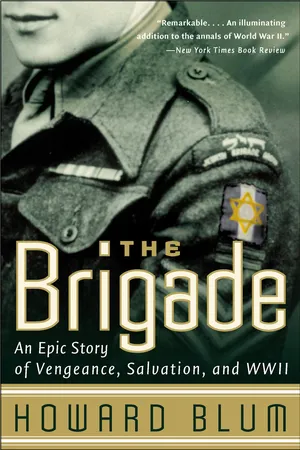
November 1944. The British government finally agrees to send a brigade of 5,000 Jewish volunteers from Palestine to Europe to fight the German army. But when the war ends and the soldiers witness firsthand the horrors their people have suffered in the concentration camps, the men launch a brutal and calculating campaign of vengeance, forming secret squads to identify, locate, and kill Nazi officers in hiding. Their own ferocity threatens to overwhelm them until a fortuitous encounter with an orphaned girl sets the men on a course of action—rescuing Jewish war orphans and transporting them to Palestine—that will not only change their lives but also help create a nation and forever alter the course of world history.
eBook - ePub
The Brigade
An Epic Story of Vengeance, Salvation, and WWII
- 336 pages
- English
- ePUB (mobile friendly)
- Available on iOS & Android
eBook - ePub
The Brigade
An Epic Story of Vengeance, Salvation, and WWII
About this book
Information
PART I
AT SEA
November 1944
ONE
The troops were singing. The Hebrew songs had broken out spontaneously when the trucks approached the docks in Alexandria and the men saw the cargo ships that would take them across the Mediterranean to Italy. As they marched up the gangplanks, their voices grew louder and more spirited. It was a bright Tuesday morning, the final day of October 1944, and at last the Jews from Palestine were going to war.
For the past three years, the volunteers in the three battalions that made up the British Palestine Infantry Regiment had spent their days doing monotonous guard duty in North Africa, chasing after goats stolen by mischievous Arab youths, and training in the hills north of Tel Aviv with outdated weapons. A world away the war in Europe had raged on. But just five weeks ago the three battalions had been ordered to Burg-el-Arab, a flat brushless stretch of desert between El Alamein and Alexandria, and had been swiftly re-formed and outfitted into the combat-ready Jewish Brigade Group.
The historical significance of these soldiers preparing to go off to Europe with a golden Star of David on their blue shoulder patches was appreciated by the Brigade’s new British commander. Brig. Ernest Frank Benjamin announced to his officers that “this is the first official Jewish fighting force since the fall of Judea to the Roman legions.”
But as the boats left the harbor, the men standing on the quarterdeck watched the Egyptian shore disappear and were excited by another knowledge. An army of Jews was finally on its way to confront an enemy that had set out to annihilate their people.
Sgt. Israel Carmi did not go on deck with the others as the SS Stafford went to sea. He remained on guard by the bunks.
He had been ordered by the Haganah to smuggle two men to Europe along with the troops. Days ago he had stolen two uniforms, and his wife had tailored them at the kibbutz so that the impostors could march up the gangplank unnoticed with the rest of the soldiers.
But Carmi knew the two would never be able to fool a British officer. So he stayed with them as they lay on their bunks. He would try to intervene before anyone could become suspicious. He was prepared, though, to do whatever was necessary to ensure that the two stowaways arrived in Europe. Carmi was a sergeant in the British army, but his allegiance was to the Haganah and the land, the eretz, he was leaving behind.
That night, Capt. Johanan Peltz could not sleep. He went up to the deck and walked over to the rail. The moon was high in the sky and illuminated the sea with a silver sheen. The shoreline had receded from sight, and he was full of anticipation. He had spent seven years in this primitive, overbearingly hot part of the world, and he was glad to be leaving.
It felt blasphemous to be happy in these grim times, but he could not help being filled with a sense of joy as he imagined returning to Zabiec, his family’s estate in Poland, once the war was over. In his mind it was all very clear. He would ride in a carriage through the allée of chestnut trees to the front door of the big brick house. It would be the dinner hour, everyone certain to be home. He would walk up the wide stone steps and when the maid answered the door he would tell her not to announce him. Then he would stride across the checkerboard floor of the main hall, tall and erect in his British officer’s uniform, and into the dining room, while his parents and grandfather, proud and elated, rushed from the table to greet the returning hero.
Lt. Arie Pinchuk was in the radio room playing bridge. He, too, could not sleep. His stomach bubbled nervously. He was an officer in the Jewish Brigade, but he was traveling to Europe on his own private, and very vital, mission.
He could not concentrate on the cards, either. He was thinking about what he would need to do, all the obstacles he would face. And from the depths of his own internal hell, he was silently demanding, Mama, Papa, Leah, what has become of you?
It was nearly three A.M. when Pinchuk returned to his bunk, and by then the Stafford was rolling violently. The ship had headed into a storm. Waves crashed against the bow, and the swells surged over the deck. The winds were shearing. Yet the convoy continued on. All the men could do was hope the rough weather would soon improve.
TWO
The storm grew worse. Rain poured down throughout the morning, and the wind continued to blow hard. The Stafford bounced on high, dark waves, its stern lifting up in the water as its bow dropped. Swells slammed against the boat, and the big sea swept over the deck. Across from the pilot house, crests of water surged repeatedly over a hill of wooden crates and the ropes that bound them finally gave way. The boxes slid about the deck, smashing into one another and careening into the rough, rolling sea.
The men below were tossed about helplessly, too. Nevertheless, when his relief came to assume the watch over the two stowaways, Carmi was eager to try to move about. He wanted to escape the stuffy, crowded hold deck with its tiers of bunks, and the engines vibrating ominously beneath him as the ship struggled forward.
He worked his way along a narrow, heaving corridor to the bulkhead door and started to the top. But guards were posted to prevent any reckless soldiers from going on deck. Instead, Carmi was directed to the mess.
He was in no mood for food and, apparently, neither were many of the men. The mess was nearly empty. But just as he was about to leave, he noticed an officer sitting alone, on a bench attached to a long gray table across the room. The man’s back was rigidly straight, his blue eyes staring ahead as though fixed on a distant object, his hands clasped together on the tabletop.
Nearly six years had passed since they had served together in the Palestinian Police, but Carmi recognized the soldier immediately. Of course, he had heard the stories. He knew the man had been declared one of the porshim, judged unreliable by the Haganah. The commanders of the underground had even tried to prevent him from becoming an officer in the British army. But this was of little significance to Carmi. When he saw Johanan Peltz sitting across the room, he felt only a rush of affection for an old friend.
The men had first met in the winter of 1937, in the riding ring of the Police School near Mount Scopus in Jerusalem. The new recruits were choosing mounts. Peltz was inspecting a tall sturdy chestnut, at least eighteen hands, with a white star on its forehead and a matching white sock on its right foreleg. The horse had a disagreeable disposition, snarling menacingly as Peltz moved to pat its flank.
When the Haganah had begun looking for riders to serve in the colonial force, Carmi had matter-of-factly volunteered, mounting a horse for the first time. Despite his diligence, a year later he was still a bouncing thick-bodied horseman. “Lot of horse,” Carmi warned, trying to be helpful.
Peltz interpreted the veteran’s remark as a challenge. “I’m a lot of rider,” he said, and quickly climbed on the horse. Once he was in the ring, he put on a calculated and masterful performance. It ended with his reaching down to the ground while on a full gallop to grab one of the blue kolpaks the Palestinian Police wore as hats.
“She’ll do,” he said as he jumped off.
But there was a problem. The British cavalry sergeant insisted that if Peltz wanted this animal as his regular mount, he would have to name it. Peltz studied the horse, but nothing came to mind. The sergeant watched him, and grew impatient.
“Something the matter with you, boy? Don’t have a brain?”
Peltz bristled.
“If you can’t think of a name,” Carmi said, “call her ‘Anonymous.’”
Peltz immediately agreed. That night the two men ate dinner together, and, as they stayed up late talking afterward, a friendship was begun. Carmi appreciated Peltz’s swaggering confidence, his eagerness to accept a challenge. Peltz respected the Haganah veteran’s uncompromising determination to fight for what he believed in. They spent a lot of time in each other’s company that cold winter in Jerusalem. But in the spring Carmi was stationed in the north and Peltz was given command of an isolated police post on the southern end of the Dead Sea.
They had not seen each other since then. Yet as Carmi leaned on a bulkhead to steady himself against the roll of the ship, he looked across the mess and reconsidered disturbing his old friend. Peltz seemed in a trance. Perhaps their reunion should wait for another day. What, Carmi wondered, could Peltz be thinking? He decided there was only one way to find out.
“How’s Anonynous?”
Surprised, Peltz looked up and saw Israel Carmi standing above him.
“Sold,” said Peltz. “Made a good profit. Besides, I can’t ride anymore. I took an Arab bullet in the knee and now the whole leg’s no good. Can’t get a grip on a horse.”
“I heard,” said Carmi, letting Peltz know that he had heard everything: the ambush at Sdom, as well as the dispute with the underground commanders that had followed. And that while Carmi was Haganah, he was also still his friend.
“Sit, Israelik,” Peltz said gratefully.
Carmi sat down across the table, and told Peltz that he had been watching him. “I almost walked away. You looked deep in your own world.”
“I was.”
“Well?”
Peltz thought for a moment, and then decided to share what had been going through his mind. When Peltz was six, a new riding instructor came to live at Zabiec. His name was Tony Power and he was an Oxford-educated English army captain who had originally been sent to Poland as a liaison to the cavalry. Power taught Johanan until the boy went to high school, and Peltz idolized him. In their years together Peltz not only learned to speak a clipped and precise King’s English, but he also tried to mimic the casual, yet confident superiority that was the essence of Power’s Englishness. And now Peltz told Carmi a story he had first heard from Power.
The king of England, Power had reprimanded the young, restless Peltz, was able despite the demands of nature to sit rigidly in the saddle while the troops passed in endless parade. “‘Know how His Majesty managed to combat the urge to pee?’” Peltz quoted. “‘He made up his mind he didn’t need to.’”
“And you were thinking about this for a reason, Johanan?” Carmi asked.
“Seasickness,” Peltz said. “Everyone’s sick to their stomachs. But not me. I make up my mind not to be sick, I’m not sick.”
Carmi considered this, then he said, “I can last as long as you can.”
“We’ll see,” said Peltz.
As the boat surfed high and crashed down with each new wave, the two men sat opposite one another and talked. They did not discuss the war. They spoke about other matters. A sly acquaintance from their police days who furtively juggled two girlfriends, both waitresses at the same café in Jerusalem. A raid Peltz had led on Madame Muneira’s infamous “Kilo Seven,” the brothel named for its location directly opposite the “kilometer seven” stone road marker on the road to Motza. How Carmi and his wife were trying to teach Shlomit, their infant daughter, to walk. They talked and talked, hoping to keep their minds occupied with easy, comfortable conversation, rather than on the unsettled feeling that was starting to rise up in the pits of their stomachs.
It was only a small contest, but each man was determined to win.
Down below, Arie Pinchuk was sick. Violently sick. He had spent most of the afternoon running from his bunk to the latrine. But now he got up and forced himself to tour the pitching ship. He hoped that the exercise would be a palliative. It had to be better than the agony of lying on his bouncing bunk surrounded by the raw odor of engine fuel and clammy sweat.
Yet after wandering around the ship for just a brief time, he needed to sit. He made his way uneasily to the mess. Entering, he saw Peltz across the room and immediately decided to leave.
As a newly commissioned lieutenant, Pinchuk had been put in charge of a platoon that was assigned to Peltz for training. Peltz had been relentless. Even the British at the Sarafand camp outside Tel Aviv had noticed; a Scottish sergeant nicknamed Peltz “Skinner” because he “skinned his lads to the bone.” Endless bayonet drills, rifle practice until calluses rose on many of the men’s trigger fingers, and arduous field marches, the men in full kit and pounding at a breathless pace through the solid dunes of Rishon Le Zion under an unforgiving sun—Peltz kept his troops busy with a strict, almost cruel diligence. Pinchuk had found it unbearable. Lying down on his hard cot at night, he was aching and totally spent. He grew to detest the autocratic Peltz.
And now when Pinchuk saw his old tormentor, his first instinct was to find some other place to sit. But then he saw the husky man on the bench across from Peltz, and he hesitated.
He had never met Israel Carmi, but he knew about him. He had heard stories about what Carmi had done in the Haganah. And like many of the soldiers, Pinchuk believed that if it had not been for the mutiny Carmi had led when the Second Battalion was stationed in Benghazi, the Brigade might never have been sent to Europe. If the British had not been forced to confront the anger and resolve of the Jewish soldiers, they might very well have kept them permanently out of the war. He was convinced that Carmi was an authentic Jewish hero; and without Carmi’s actions, his own mission never woul...
Table of contents
- Cover
- Title Page
- Dedication
- Epigraph
- Contents
- A Note to the Reader
- Prologue
- Part I
- Part II
- Part III
- Part IV
- Part V
- Part VI
- A Note on Sources
- Acknowledgments
- About the Author
- Praise
- Books by Howard Blum
- Copyright
- About the Publisher
Trusted by 375,005 students
Access to over 1.5 million titles for a fair monthly price.
Study more efficiently using our study tools.
Frequently asked questions
Yes, you can cancel anytime from the Subscription tab in your account settings on the Perlego website. Your subscription will stay active until the end of your current billing period. Learn how to cancel your subscription
No, books cannot be downloaded as external files, such as PDFs, for use outside of Perlego. However, you can download books within the Perlego app for offline reading on mobile or tablet. Learn how to download books offline
Perlego offers two plans: Essential and Complete
- Essential is ideal for learners and professionals who enjoy exploring a wide range of subjects. Access the Essential Library with 800,000+ trusted titles and best-sellers across business, personal growth, and the humanities. Includes unlimited reading time and Standard Read Aloud voice.
- Complete: Perfect for advanced learners and researchers needing full, unrestricted access. Unlock 1.5M+ books across hundreds of subjects, including academic and specialized titles. The Complete Plan also includes advanced features like Premium Read Aloud and Research Assistant.
We are an online textbook subscription service, where you can get access to an entire online library for less than the price of a single book per month. With over 1.5 million books across 990+ topics, we’ve got you covered! Learn about our mission
Look out for the read-aloud symbol on your next book to see if you can listen to it. The read-aloud tool reads text aloud for you, highlighting the text as it is being read. You can pause it, speed it up and slow it down. Learn more about Read Aloud
Yes! You can use the Perlego app on both iOS and Android devices to read anytime, anywhere — even offline. Perfect for commutes or when you’re on the go.
Please note we cannot support devices running on iOS 13 and Android 7 or earlier. Learn more about using the app
Please note we cannot support devices running on iOS 13 and Android 7 or earlier. Learn more about using the app
Yes, you can access The Brigade by Howard Blum,Hardscrabble Entertainment, Inc. in PDF and/or ePUB format, as well as other popular books in History & Historical Biographies. We have over 1.5 million books available in our catalogue for you to explore.