A gripping saga of race and retribution in the Deep South. "Like a real-life
To Kill a Mockingbird, but with even more subtlety and complexity." —Walter Isaacson,
New York Times-bestselling author
In 1945, Willie McGee, a young African-American man from Laurel, Mississippi, was sentenced to death for allegedly raping Willette Hawkins, a white housewife. At first, McGee's case was barely noticed, until Bella Abzug, a young New York labor lawyer, was hired to oversee McGee's defense. Together with William Patterson, the son of a slave and a devout believer in the need for revolutionary change, Abzug and a group of white Mississippi lawyers risked their lives to plead McGee's case. After years of court battles, McGee's supporters flooded President Harry S. Truman and the U.S. Supreme Court with clemency pleas, and famous Americans—including William Faulkner, Albert Einstein, Jessica Mitford, Paul Robeson, Norman Mailer, and Josephine Baker—spoke out on McGee's behalf.
By the time the case ended in 1951 with McGee's public execution in Mississippi's infamous traveling electric chair, their movement had succeeded in convincing millions of people worldwide that McGee had been framed and that the real story involved a consensual love affair between him and Mrs. Hawkins—one that she had instigated and controlled. As Heard discovered, this controversial theory is a doorway to a tangle of secrets that spawned a legacy of confusion, misinformation, and pain that still resonates today.
Based on exhaustive documentary research—court transcripts, newspaper reports, archived papers, letters, FBI documents, and the recollections of family members on both sides—Mississippi native Alex Heard tells a moving and unforgettable story that evokes the bitter conflicts between black and white, North and South, in America.
eBook - ePub
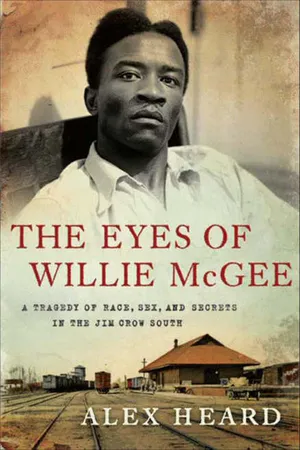
The Eyes of Willie McGee
A Tragedy of Race, Sex, and Secrets in the Jim Crow South
- 432 pages
- English
- ePUB (mobile friendly)
- Available on iOS & Android
eBook - ePub
About this book
Information
Print ISBN
9780061284151
Subtopic
African American HistoryNotes
ABBREVIATIONS
CL: Jackson Clarion-Ledger
Compass: The New York Compass
CRC: Civil Rights Congress
DW: The Daily Worker
JDN: Jackson Daily News
LLC: Laurel Leader-Call
LOC: Library of Congress
MDAH: Mississippi Department of Archives and History
NAACP: National Association for the Advancement of Colored People
Rogers: Lauren Rogers Museum of Art Library
SRC: Southern Regional Council
NYT: The New York Times
WaPo: The Washington Post
EPIGRAPH
sorrow night: Hansberry, Masses and Mainstream, July 1951, 19–20.
ONE: THE HOT SEAT
F. Aegerter: “Mrs. Roosevelt Calls McGee ‘Bad Character,’” CRC press release, June 1, 1951. CRC papers.
from obscurity to fame: See Rowan, South of Freedom, “Run! The Red Vampire!,” 174–92; Zaim, “Trial by Ordeal: The Willie McGee Case,” Journal of Mississippi History, Fall 2003, 215–47.
The story began: State of Mississippi v. Willie McGee, December 1945 Special
Term, Jones County Courthouse, Laurel, Mississippi; CL, JDN, LLC, December 6–7, 1945.
Hinds County jail: CL, December 14, 1930.
thousands of individuals: see “15,000 ‘Free McGee’ Pleas Swamp Wright,” Compass, July 29, 1950.
“Dear Mr. President”: Willie McGee letters, April 30, 1951, CRC papers.
Faulkner: Meriwether, Essays, Speeches & Public Letters by William Faulkner, 211–12; Blotner, Faulkner, 539.
Einstein: “A Letter from Albert Einstein,” NYT display ad, May 4, 1951.
State Department: JDN, April 25, 1951.
Combat: Rowan, South of Freedom, 191.
Mayella Ewell, Tom Robinson: Lee, To Kill a Mockingbird, 172–77, 190–242, 269–70.
love affair: Willie McGee’s initial account of his alleged relationship with Willette Hawkins appeared in an autobiographical statement he wrote for his first appeals lawyer, Forrest Jackson, which he and others expanded on later. See Dixon Pyles’s interview with a Daily Worker investigator, CRC papers, 1952; Willie McGee’s affidavit, February 3, 1951, Hinds County Courthouse, Jackson, Mississippi, CRC papers; and Rosalee McGee’s affidavit, July 25, 1950, MDAH.
“depraved, enslaved, adulterous woman”: References to Mrs. Hawkins were cut from “A Black Woman Speaks” when Beah Richards published a collection of her poetry in 1974. The original version, which she read at a civil rights meeting in 1951, is widely available on the Web. See www.thumperscorer.com/discus/messages/11222/8608.html.
Carol Cutrere: Williams, Orpheus Descending, 27–28.
Roosevelt was no coward: Cook, Eleanor Roosevelt: Volume Two, 1933–1938, 153–54, 177–81; Janken, White, 209–11.
China, Soviet Union: NYT, July 27, 1950; see “Execution of M’Gee Blasted by Moscow,” Toler Papers, Mississippi State University.
Julius Rosenberg: Meeropol, The Rosenberg Letters, 98.
CRC origins: “Congress on Civil Rights” invitation; Walter White memo, May 1, 1946; Marian Wynn Perry memo, May 7, 1946, NAACP papers.
“the Communists persuaded”: Eleanor Roosevelt to Roy Wilkins, July 18, 1950; Walter White to Eleanor Roosevelt, July 24, 1950, NAACP papers.
“added suspicions”: Eleanor Roosevelt to Aubrey Grossman, March 14, 1951, CRC papers.
radio broadcast: “Willie McGee Execution,” Jim Leeson audio recording, May 7–8, 1950, University of Southern Mississippi oral history collections.
execution scene: CL, JDN, LLC, NYT, May 8, 1951.
Dray seemed convinced: Dray, At the Hands of Persons Unknown, 397–405.
as did Mitford: Mitford, A Fine Old Conflict, 160–94.
not proven fact: Brownmiller, Against Our Will, 239–45.
Carl Rowan in Laurel: Rowan, South of Freedom, 174–92; Rowan, “McGee was Going to Die,” Stag, March 1953.
Adolphus and Marjorie McGee: In Tales of Wo-Chi-Ca: Blacks, Whites and Reds at Camp, authors June Levine and Gene Gordon recall these as the names of two McGee children who attended a leftist summer camp in the late 1940s.
Mary Mostert: author interview, September 2004; Mostert, “Death for Association,” The Nation, May 5, 1951; Mostert, “Internet Journalism—the Guerilla Warfare Wing in the Media and Propaganda War,” July 26, 2003, http://w...
Table of contents
- Cover
- Title Page
- Dedication
- Epigraph
- Contents
- One
- Two
- Three
- Four
- Five
- Six
- Seven
- Eight
- Nine
- Ten
- Eleven
- Twelve
- Thirteen
- Epilogue
- Bibliography
- Notes
- Searchable Terms
- Acknowledgments
- About the Author
- Credits
- Copyright
- About the Publisher
Trusted by 375,005 students
Access to over 1.5 million titles for a fair monthly price.
Study more efficiently using our study tools.
Frequently asked questions
Yes, you can cancel anytime from the Subscription tab in your account settings on the Perlego website. Your subscription will stay active until the end of your current billing period. Learn how to cancel your subscription
No, books cannot be downloaded as external files, such as PDFs, for use outside of Perlego. However, you can download books within the Perlego app for offline reading on mobile or tablet. Learn how to download books offline
Perlego offers two plans: Essential and Complete
- Essential is ideal for learners and professionals who enjoy exploring a wide range of subjects. Access the Essential Library with 800,000+ trusted titles and best-sellers across business, personal growth, and the humanities. Includes unlimited reading time and Standard Read Aloud voice.
- Complete: Perfect for advanced learners and researchers needing full, unrestricted access. Unlock 1.5M+ books across hundreds of subjects, including academic and specialized titles. The Complete Plan also includes advanced features like Premium Read Aloud and Research Assistant.
We are an online textbook subscription service, where you can get access to an entire online library for less than the price of a single book per month. With over 1.5 million books across 990+ topics, we’ve got you covered! Learn about our mission
Look out for the read-aloud symbol on your next book to see if you can listen to it. The read-aloud tool reads text aloud for you, highlighting the text as it is being read. You can pause it, speed it up and slow it down. Learn more about Read Aloud
Yes! You can use the Perlego app on both iOS and Android devices to read anytime, anywhere — even offline. Perfect for commutes or when you’re on the go.
Please note we cannot support devices running on iOS 13 and Android 7 or earlier. Learn more about using the app
Please note we cannot support devices running on iOS 13 and Android 7 or earlier. Learn more about using the app
Yes, you can access The Eyes of Willie McGee by Alex Heard in PDF and/or ePUB format. We have over 1.5 million books available in our catalogue for you to explore.