From a bestselling author with intimate knowledge of CIA tradecraft comes an electrifying novel of terrifying possibilities –– a story of betrayal and secrets that could implode America's war on terrorism ... and a nightmarish conspiracy firmly rooted in the very highest levels of our nation's government.
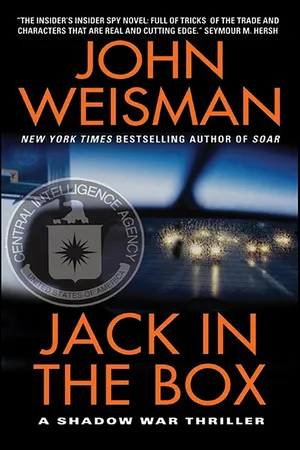
- 448 pages
- English
- ePUB (mobile friendly)
- Available on iOS & Android
eBook - ePub
About this book
Information
Publisher
HarperCollins e-bookseBook ISBN
9780062040190
Year
2011MOSCOW
CHAPTER 1
FRIDAY, OCTOBER 23, 1998
SAM WATERMAN spent the morning of his forty-fifth birthday a hostage to his profession, stuffed rudely onto the rear floorboard of one of the consulate’s 1985-vintage four-door Zil sedans, the driveshaft hump wedged uncomfortably against his kidneys, his long legs tucked fetal, his body hidden under a damp blanket. Even though he knew he couldn’t be seen through the dark-tinted windows, he still held his breath as the car clunked over the antiterrorist barriers just prior to passing the Russian police checkpoint outside the garage gate. He exhaled slowly when the driveshaft under his side whined as the car merged into the late-morning traffic.
“Keep going, keep going,” Sam instructed tersely from under musty cover. “Don’t check your mirrors. Just drive. Nice and easy.”
“Don’t have a cow, man.” That was Consular Officer Tom Kennedy, imitating Bart Simpson. Tom, who’d been recruited to do the driving, could impersonate Bart perfectly. He was still working on his Homer, though, running and rerunning the videotapes his sister sent him through the mail pouch, night after night after night. Which kind of told you what Moscow’s social life had to offer a reasonably good-looking African-American junior-grade diplomat, even in these post-Soviet days.
Sam grunted and shifted his position slightly, trying to reduce the pressure on his kidneys as the car turned left, heading west.
“We’re on Kutuzovsky Prospekt,” Homer told him. “Doh. Crossroads of the world.”
“Tom, put a cork in it.” Christ, he’d warned the kid this was serious business, and the youngster still wanted to talk. Not good. Because they weren’t safe. Not by a long shot. FSB,1 the Russian internal security agency, had inherited the KGB’s elaborate passive surveillance system. Vizirs they were called—long-range, high-power telescopes mounted on sturdy tripods, positioned in buildings along Moscow’s major thoroughfares. The watchers would scan for diplomatic plates, and peer inside the cars. If they saw your lips moving, they’d take note. Were you talking to someone hidden in the car? Were you operating a burst transmitter in the open briefcase on the passenger seat? Were you broadcasting? If they thought you were up to no good, they’d dispatch one of the static counterintelligence teams that were all over the city to do a traffic stop—dip plates or no.
And Sam couldn’t afford a traffic stop. Not today.
Today he had to meet General Pavel Baranov at precisely five past one, and failure wasn’t a viable option. The rendezvous was critical. Baranov had used his emergency call-out signal, an inconspicuous broken chalk line on a weatherworn lamppost sixty yards from the entrance to the Arbatskaya metro stop. Sam had seen the long-short-short Morse code signal last night on his regular evening jog—a five-mile run that began outside the embassy’s faded mustard-colored walls and took a long, meandering, but unfailingly consistent route that brought him all the way to the western boundary of the Kremlin, and thence back toward the embassy.
The Arbatskaya signal site and the letter D were to be used by Baranov only under crisis conditions. Still in his running gear, Sam sent Langley a code-word-secret “criticoni,” an urgent cable alerting his division chief to Baranov’s emergency signal (in the cable Sam referred to Baranov not by his true name, but by his CIA cryptonym, GTLADLE; Sam’s CIA inhouse pseudonym, which he used to sign the cable, was Cyrus N. PRINGLE)2. In it, he enumerated all the operational details for the emergency PMP3 and requested comment. Today he was awake by five, running and rerunning the operation in his mind. By six he was in the office, checking for response from Langley—there was none, which was typical—and removing gear from the duffel he kept in walk-in safe.
The next step was to shanghai young Tom Kennedy, one of three greenhorn consular officers Sam had identified as potential decoys. The decoy factor was critical. As CIA’s Moscow chief, Sam was “declared” to the Russians. He even held regular meetings with his counterparts at SVR, the Russian foreign intelligence service. And thanks to an American defector, a CIA turncoat named Edward Lee Howard who’d been transferred into FSB, Russia’s internal security and counterintelligence service by Vladimir Putin, the Kremlin’s aggressive new director of counterintelligence, FSB pretty much knew who was Agency and who wasn’t.
Ed Howard and Sam Waterman had history. In fact, sometimes Sam felt as if the traitor was shadowing him. He and Howard had been members of the same basic Russian-language studies class at Georgetown University. Subsequently, Howard sat next to Sam at the CIA’s language institute in Rosslyn during the two-year, advanced Russian course. They’d even shared a room at, the Agency’s case-officer training facility near Williamsburg also known as the Farm, for the six-week class in advanced tradecraft procedures required of all case officers assigned behind the Iron Curtain.
But that’s where the relationship stopped. As he readied himself for his first Warsaw Pact tour, Sam was already an experienced case officer with a successful tour in Germany. He’d run an agent network and worked against a KGB Rezident. Howard was a greenhorn trainee who had never handled an agent or worked in the pressure cooker atmosphere of a real-world op.
Despite that lack of experience, Howard had been selected to go to Moscow under deep State Department cover. But then, in the spring of 1983, Ed Howard flunked four separate polygraph tests—and his career was abruptly terminated.
On May 2, 1983, Howard was told to report to the personnel office. Sam had even seen him in the corridor. The distraught young case officer was flanked by two armed CIA security agents. Later, Sam heard that when Howard got to personnel, he was given papers to sign, fired on the spot, and escorted from the building. Although Howard and his wife Mary moved back to their home in New Mexico almost immediately, he was kept on CIA payroll through the end of June. Sam never saw him again.
Then Howard started acting strangely. From New Mexico, a distraught-sounding Howard made open-line telephone calls to the U.S. embassy in Moscow that let KGB eavesdroppers know that he was a disgruntled CIA employee who’d just been fired. After half a dozen similar provocations, including two trips to Vienna, where CIA countersurveillance teams had spotted the former case officer meeting with known KGB officers, the FBI was called in. Howard was interrogated half a dozen times but denied any collusion with the Soviets. The FBI didn’t believe him and assigned twenty-four-hour surveillance to the fired CIA operative. His arrest seemed imminent.
But the FBI blew the case. The surveillance crew assigned to Howard were New Mexico locals who never factored into their operations that Howard had been trained to evade KGB surveillance. It didn’t take the former CIA trainee long to note their below-average performance. And so, Ed Howard used basic CIA tradecraft to evade the G-men. Late in September 1985, he and his then-wife fabricated a jack-in-the-box device for their car, then went for a drive along a route he had carefully worked out. Once she’d put sufficient distance between their vehicle and the FBI agents to open a GAP, she slowed down. Howard jumped out and hid in some bushes. His wife activated the JIB, sped away, returned home, drove straight into the garage, and dropped the door. It took the FBI almost twenty-four hours to realize Howard had skipped.
In the meanwhile, Howard flew from Albuquerque through Tucson to New York, where he caught a plane for London. At Heathrow, he connected to a flight for Copenhagen, and thence to Helsinki, where he went straight to the Soviet embassy and asked for political asylum. Six days later, using reports from an MI6 source in Helsinki, British counterintelligence cabled Langley’s CI4 gumshoes that Howard had handed the KGB a foot-thick pile of documents. The double-crossing son of a bitch even betrayed (among many other jewels) all the Agency tradecraft he’d learned during the “Denied Area Operations” course required of all case officers assigned to Moscow, Prague, Warsaw, Paris, Bonn, Delhi, and other stations where local counterintelligence capabilities were exceptional and the opposition was active.
Howard presented the DAO course syllabus to his new masters at Moscow Center as evidence of his bona fides. He’d immediately been put to work at the KGB’s Second Chief Directorate-counterintelligence, followed by a long tour in the First Chief Directorate, where he trolled much of Western Europe for American agents. And now the rotten son of a bitch spent his days working for Vlad Putin at the FSB, using everything he’d learned at Langley against his former colleagues.
Which meant whenever one of Sam’s people drove, surveillance was virtually guaranteed. So Sam went outside the box and used an outsider, a junior consular officer Vlad Putin’s FSB understood to be totally uninvolved in intelligence gathering.
At 9:06A.M., Sam strode unannounced into the expansive office of Sandra Wheeler, the consul general. At 9:12 he returned to his own secure. Seven minutes after that, there was a tentative knock on Sam’s thick door. Enter Thomas Jefferson Kennedy; Foreign Service Officer Grade Four, stage left. Twelve minutes later, a wide-eyed Thomas J. Kennedy headed for the garage, having received his first inculcation into the shadowy Wilderness of Mirrors in which Samuel Elbridge Waterman had lived and worked for almost nineteen years.
10:38 A.M. The drivetrain had developed a nasty vibration.
Sam could feel it shudder through the floorboard. He was sweating even though the Zil’s heater didn’t work. He lay silent, eyes closed, counting the seconds off, timing the route he’d painstakingly devised, as Tom drove in blessed silence. They’d be heading northwest now, less than a kilometer from the Ring Road that encircled the city. At the Volokolamskoe on-ramp they’d turn north, toward the MIO and Moscow’s Sheremetevo airport.
But they wouldn’t go to Sheremetevo. Instead, the youngster would exit south, onto Leningradskoe, and divert to a narrow, deserted strip of parkland where Sam would roll out. Then Tom would drive like hell to the airport, where he’d wait in the no-parking zone—in vain—for a consular official scheduled to arrive from Berlin. And, yes, tickets had been bought. There was even a Russian visa stamped in the nonar-rival’s diplomatic passport just in case the Russians ever checked. Sam had thought of everything, right down to the smallest detail. “Plausible” and “denial,” after all, were the two foremost watchwords of his particular faith.
Sam squinted at the dim luminous dial on his cheap Bulgarian wristwatch. Thirty-nine minutes had elapsed since the car passed through the embassy gates. The Zil banked hard right. In his head, Sam saw the exit and the industrial zone. He felt Tom brake, accelerate, then brake again. Showtime. Sam pulled the blanket off, reached up, opened the rear door, and scrambled out next to the pockmarked brick wall of a narrow alley. He rapped the Zil’s door. “Go-go-go!”
Alone, he made his way southwest toward a narrow swath of green parkland. He checked the watch. He was two minutes behind schedule.
10:52A.M. Sam caught the sparsely passengered ferry with seventy-five seconds to spare, paid for his ticket, and found a hardwood bench in the rear of the smoky passenger cabin for the six-minute voyage to Zaharkovo. Halfway across, he went to the men’s toilet. Even unheated, the cramped compartment stank of urine. He stepped across a puddle under the tin trough that served as a pissoir, entered the single stall, shut the door, and quickly shed his long black nylon overcoat. Underneath, he wore a thigh-length brown patchwork leather jacket. He stuffed the coat behind the toilet. He extracted a false mustache from its envelope, exposed the adhesive, and affixed the disguise to his upper lip. He ripped up the envelope and flushed it. Finally, he pulled a short-brimmed, green wool cap from the jacket pocket and jammed it on his head.
He left the men’s room just in time to feel the engines reverse as the boat pulled alongside the quay. Without reentering the cabin, he elbowed his way to the rail, nudged up the gangway, walked up the dock and across the street. There he climbed aboard a waiting No. 96 bus, which he rode to the Tušinskaja metro stop. Sixty-nine minutes and three train changes later he emerged from Textilshchiki station, crossed the road, and stepped gingerly over a single, rusting set of railroad tracks into a huge, deserted industrial park where, in the old days, they’d assembled Moskvich automobiles as part of Joe Stalin’s workers’ paradise.
What Sam had performed since leaving the Zil was an SDR, or Surveillance Detection Route. It was a planned, timed course during which he’d had half a dozen opportunities to spot a hostile tail. Not to shake it, however, simply to identify it. Only in Hollywood did CIA officers shake a tail. In real life, you spotted the opposition. Under normal circumstances you did nothing to alert them, because if the other side realized they’d been tagged, they’d change surveillance methods, and the cycle would have to begin all over. Today’s SDR was different. If he’d been spotted, he’d have had to go provocative—escape surveillance by using aggressive, evasive tradecraft. That was why Sam had spent six weeks crafting each segment of this particular SDR, even though he’d use it only once.
Six weeks, because he had to provide himself with a number of rabbit holes in case he had to disappear. Six weeks, because he had to make sure that no matter where he might be pinged, he could still go black—vanish in plain sight—without alerting the opposition. Most important, six weeks, because Vlad Putin’s counterintelligence people were good. They did...
Table of contents
- Cover
- Title Page
- Dedication
- Contents
- PART I MOSCOW
- PART II WASHINGTON, D.C.
- PART III MOSCOW
- PART IV PARIS
- PART V WASHINGTON, D.C.
- Direct Action
- Praise
- Books by John Weisman
- Jack-in-the-Box
- Copyright
- About the Publisher
- Footnotes
Trusted by 375,005 students
Access to over 1.5 million titles for a fair monthly price.
Study more efficiently using our study tools.