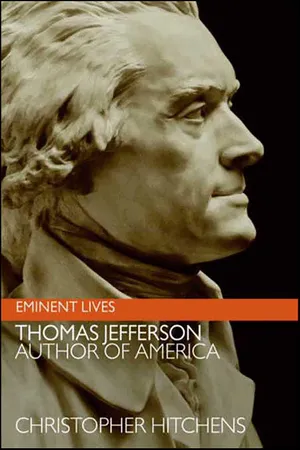
BORN ON APRIL 13, 1743 (April 2 until the adoption of the Gregorian calendar in 1758), Thomas Jefferson was the offspring of stable planter stock in the native aristocracy of Virginia. His father, Peter Jefferson, was a surveyor and cartographer whose immigrant parents were said to have come from the Snowdonia district of northern Wales. Peter’s marriage to Jane Randolph, whose own family was one of the “names” of traditional Virginia society, can only have improved his standing. Perhaps it was young Jefferson’s evident contempt and dislike for his mother—to whom he almost never alluded—or his apparent indifference to aristocracy, but when he came to write his own very brief Autobiography in 1821, he spoke of these matters of bloodline and provenance and “pedigree,” especially in his mother’s case, with an affected indifference. “Let everyone,” he wrote, “ascribe the faith and merit he chooses,” to such trifling questions. Since Jefferson always founded American claims of right upon the ancient Saxon autonomy supposedly established by the near-mythical English kings Hengist and Horsa, who had left Saxony and established a form of self-rule in southern England (he even wished to see their imagined likeness on the first Great Seal of the United States), we are confronted at once with his fondness for, if not indeed his need for, the negation of one of his positions by another.
We cannot hope to peer very far past the opaque curtain that is always in evidence (and also not in evidence) when a young man seemingly reveres his father and is indifferent to his mother. However, the nature of individual humans is not radically different and it’s no great surprise to discover that the adolescent Thomas felt himself liable at one point to go to seed and to waste his time on loose company. We find, also, an excruciating account of a “bad date” at the Apollo Room of the Raleigh Tavern when, nerving himself to make advances to the much sought-after Rebecca Burwell, he made an utter hash of the approach and a more or less complete fool of himself. (“Good God!” he wrote to a friend the following morning. Later, news that Miss Burwell—the sister of a classmate and the daughter of a family estate in York County—was betrothed to another man was to give young Thomas the first of the many migraine attacks that plagued him intermittently through life.) That this initial reverse was a sting is not to be doubted. Nor is it to be doubted that it was followed by still another fiasco, when he made a crass and unsuccessful attempt to seduce the wife of his friend John Walker. I mention this because it demonstrates that Jefferson was ardent by nature when it came to females, and also made reticent and cautious by experience. This is worth knowing from the start, and would scarcely need to be observed at all if it were not for the generations of historians who have written, until the present day, as if he were not a male mammal at all.
He recovered from his early instability in three principal ways: by adopting the study of the classics, by pursuing the practice of law, and by making an excellent marriage. These avenues converged on a single spot, still revered by Americans and also made part of the small change of their experience by featuring in image on the reverse of the humble nickel, or five-cent coin. A Palladian house named Monticello, on a mountaintop in the Virginia wilderness (and built with its front facing the untamed West), emerged as the centerpiece of a life which could well, were it not for some accidents of history, have been devoted to uxoriousness, agricultural husbandry, hunting, bibliophilia, and the ingenious prolongation of chattel slavery.
The difference was made by Jefferson’s attendance, between 1760 and 1762, at William and Mary College in Williamsburg. Here, he had the best luck that a young man can have, in that he was fortunate with his tutors. In particular, he fell in with Dr. William Small, a Scots-born teacher of the scientific method, and with the great George Wythe, who taught the law as an aspect of history and logic and humanism and who seems to have adopted the young man as a personal protégé. Once aroused, the thirst for learning was unslakeable in Jefferson for the rest of his life; as unappeasable, in fact, as his longing for the possession of books and the acquisition of their contents. Among the authors whose work he assimilated at this time was Lord Bolingbroke, a pioneer critic of organized Christianity. For anyone even reasonably attuned, the air was full of Enlightenment thinking at the time, and blowing from England and Scotland as well as from France. (It was to waft Thomas Paine across the Atlantic, among other things, bearing a letter of introduction from the learned Dr. Benjamin Franklin.) Private in this as in so many things, Jefferson never made any ostentatious renunciation of religion, but his early detachment from its mystical or “revealed” elements was to manifest itself throughout his mature life.
To have a proper photograph of Shakespeare, Susan Sontag once wrote, would be the modern equivalent of possessing a splinter from the True Cross. We naturally do not possess a photograph of Thomas Jefferson, but we have a number of portraits of him at numerous stages of his life, and a wealth of eyewitness descriptions. By the time he came to Williamsburg, he was very tall for his age and indeed very tall for his times, standing two inches above six feet. He was neither clumsy nor particularly graceful, having long but somewhat loose limbs. Reddish of hair and freckled of complexion, he possessed hazel eyes, thin lips, and a rather prominent nose and chin. If one plays the parlor game—“If he were to be an animal, which animal would he be?”—we are almost compelled to think of a large and rather resourceful fox.
The exigencies of family and position required a good marriage of this vulpine fellow, and Jefferson made one in 1772 with Martha Wayles Skelton, who was five years his junior. She became the mistress of Monticello, sharing her husband’s fondness for music (he had learned the violin at the age of nine). An ominous note intrudes itself here: a few months before his wedding he had written to one of his in-laws, Robert Skipwith, recommending Locke, Montesquieu, Hume, and other authors of the Enlightenment to him but also strongly approving Lawrence Sterne. This endorsement occurs even more forcefully in a 1787 letter to his cousin Peter Carr, where Jefferson describes Sterne’s work as “the best course of morality that ever was written.” We know, furthermore, that Thomas and Martha took an early mutual delight in Sterne’s Tristram Shandy, even reading it aloud to one another during those long evenings. We must thus, from the first, appreciate what becomes ever clearer as the story proceeds: we are studying a man with very little sense of humor.
As the young Jefferson was growing to manhood and acquiring the habits and lineaments of an educated gentleman, a historic power struggle was developing on the northern border of British North America. The Seven Years’ War between Britain and France, known in American history books as the French and Indian War, prefigured the later Napoleonic conflict by fighting itself out on several continents. British and French forces clashed in Europe, on the high seas, and in India and the Caribbean. Employing local tribes as surrogates and proxies, they also fought bitterly over Canada and especially Quebec. General James Wolfe’s capture of the latter in late 1759 can well be described as a turning point in history: it decided that the future world language would be English and it indirectly precipitated the American Revolution, which in turn caused the British Empire to establish Australia as an alternative destination for convicts and malcontent laborers.
In London, an immense argument broke out concerning the future of victorious British policy. The Indian sub-continent had been wrested from France for good: the eventual Treaty of Paris in 1763 would allow Britain to take command of at least one more French possession. The choices narrowed themselves to two: Guadeloupe or Canada. One faction urged the claims of Guadeloupe, an island rich in sugar and spices and slaves, the addition of which would almost complete British control of the Caribbean basin. Another party spoke up for the acquisition of Canada: a vast space for settlement, potentially abundant in furs and timber and minerals, and a grand future market for British manufactured goods. The second case—more forward-looking and commercial—seemed in many respects the stronger and more persuasive one. It did, however, contain an overlooked flaw. If the British Crown took possession of Canada, the thirteen American colonies would no longer need to depend on London’s military protection against France. Once out from under that “umbrella,” what thoughts of self-determination might start to infiltrate their consciousness? This argument was made, with considerable force, in a pamphlet by William Burke (a close colleague, but not a kinsman, of the more celebrated Edmund). He wrote:
William Burke was unusually prescient. The British did take Canada. They also decided to recoup the heavy expenses of the Seven Years’ War, which had partly been fought to protect the thirteen colonies, by raising taxes on their supposedly grateful American subjects. This provoked a rebellion and ultimately a political separation in 1776, in which the military balance was tipped against Britain by a France that sought revenge for the humiliation of 1763. And the cost of this expedition to the depleted French treasury, in the opinion of many historians, precipitated the crisis of insolvency that compelled King Louis to summon the Estates General and begin the unraveling of the ancien régime that culminated in the revolution of 1789.
Thus, almost all of Jefferson’s long political life is foreshadowed in Burke’s analysis. An independent America was achievable, first by means of a skillful manipulation of the rivalries between the two former principal colonial powers, France and Britain, and second by playing a long hand with the ramshackle empire that had first conquered the Americas: the once-magnificent but now fast-declining Spain. Yet it could not be forgotten that America had less than five million inhabitants (nearly one-fifth of them African slaves) while France had twenty-seven million and Britain perhaps fifteen million people. Thus, the young republic had always to look to the vast interior on the edge of which it was so tenuously established. Within this quadrilateral of forces, Jefferson was to emerge as the republican equivalent of a philosopher king, who was coldly willing to sacrifice all principles and all allegiances to the one great aim of making America permanent.
It took some little time before Jefferson’s own life became caught up to the same pace and rhythm as these parallel events were to dictate. In 1768, at the age of twenty-five, he had become a member of Virginia’s House of Burgesses: a part-time local parliament made up largely of his own class, and without much fatiguing exertion about the matter of election. Nonetheless, Jefferson took his duties with seriousness and embarked—in the literal sense—upon a project that seems to show how early the pattern of his life was set. He set off in a canoe to discover the reasons why the Rivanna River could not be open to navigation. Later listing the obstacles and finding them superable, he initiated a plan for the clearing of the waterway and thus reduced the onerousness with which tobacco and other crops had hitherto been conveyed by land to the larger but more distant James River. This venture in practical science anticipates his later and grander dreams of a transcontinental “portage” by water, and his relentless concentration on the importance of the Mississippi. By 1773 he had become the Albermarle County surveyor—a profession in which George Washington had also distinguished himself—and may well have felt that, even if his father had held the same post, he had earned it in his own right.
That same year, his father-in-law John Wayles died. He left to his daughter (which in law at the time meant that he left to his son-in-law) an estate that doubled Jefferson’s holding. He also bequeathed the slaves with whom to work the land, among them an illegitimate child of his—and thus Martha Jefferson’s half sister—named Sally Hemings. The young Jefferson couple, meanwhile, were beginning to produce children of their own, of whom only two out of six were to outlive infancy. The acquisition of this new fortune in real estate and human property was, in radically different ways, to haunt Jefferson for the rest of his life, because it brought with it more debts and responsibilities than he was capable of managing. Still, at the time he could have congratulated himself on having a fine house, a growing family, the respect of his peers, and the chance of professional advancement.
In another epoch, he might have become locally famous as an autodidact and inventor, winning a bucolic reputation as a stern but kindly slave-master, and celebrated for the generosity of his table, the excellence of his wines, and the range of his library and conversation. But there was evidently something in him that caused impatience, and impelled him to seek a larger compass for his energy. Indeed, this was a time when the crisis of the British Empire in North America made it difficult for all but the most obtuse to be content with the merely private life.
In 1773, however, Jefferson was still able to keep an equilibrium between that private life and his public responsibilities. He was also able to imagine a balance—which proved to be illusory—between the political claims of Virginia in particular, the thirteen colonies in general, and the continuation of Crown rule in North America. A few dress rehearsals of rebellion had taken place: in May of 1769 the normally placid House of Burgesses in Virginia had been dissolved by the British governor in consequence of its insubordination in the matter of taxes, but the members, including Jefferson, strolled coolly down the street to the Apollo Room of the Raleigh Tavern—scene of his rejection on the dance floor by the maddening Miss Burwell—and there reconstituted themselves as an “Association” pledged to boycott goods taxed by Parliament. (A monograph should be written on the role of the tavern in the American Revolution.) This was all good sport by the standards of the day, and the rebellion politely fizzled out within a year. It remains noteworthy for our purposes, however, and for two reasons. The first of these is that the testy if dexterous governor, Norborne Berkeley, Baron de Botetourt, was by his name and title a perfect emblem of that “Norman yoke” on ancient English liberty which Paine, Jefferson, and many others were beginning to revive as an article of propaganda. The second is that the idea of economic warfare—of sanctions, boycotts, and embargoes—had taken root in Jefferson’s receptive mind.
Tame as the Virginia House of Burgesses might be, at least when compared with what was to come, it did furnish Jefferson with the opportunity to hear some full-dress revolutionary oratory from Patrick Henry and to persuade himself that his own talent lay in the opposite direction. Never an accomplished speaker (this is to say the very least, if we rely on contemporary accounts), he discovered a talent for the careful drafting of bills and measures, for the fusion of legal with political arguments, and for the intelligible synthesis of complicated ideas. Allied to his voracious talent as a reader, these gifts caused him to be in constant request as the quarrel with King George III mounted to a crisis. Thus in 1773 he was a founding and useful member of Virginia’s “Committee of Correspondence,” a legal means of establishing contact between opposition forces in all the disparate colonies and the germ of the Continental Congress. The resolution to establish such a committee (which has an echo of the radical “London Corresponding Society” across the water) was written by Jefferson. The next year, after the British imposition of collective punishment on Boston, and the famous row over the fate of the East India Company’s ill-conceived plan to dump its tea—which was then dumped in revenge—he helped to propose a Virginia resolution for a day of solidarity with the people of Massachusetts. This resolution having been adopted, the new British governor Lord Dunmore dissolved the House of Burgesses again, and once more Jefferson and his companions walked down to the Raleigh Tavern to refresh themselves and reconvene. Later in 1774, he adopted the pen name of “Virginian” to compose A Summary View of the Rights of British America. This polemical treatise was a morally and legally necessary exercise, a sort of “last chance” warning to King George that the patience of his colonial subjects was not inexhaustible. Reprinted as a pamphlet in London, it had considerable influence on the debate then proceeding at Westminster, and it’s surely worthy of mention that Edmund Burke himself—then a lobbyist for the colony of New York—helped to prepare it for the press as part of his own efforts at conciliation.
A Summary View shows that Jefferson was a loss to the law and the bar, and that a client who wished for an attorney who could plead on either side of a case would have done well to engage him. Strangely, perhaps, for one who was shortly going to be celebrated for proclaiming universal principles, Jefferson grounded his fundamental case upon an essentially tribal appeal. The ancient Saxon settlers in England, he said, had voluntarily removed themselves from the European continent to an island. And the American settlers in North America had voluntarily removed themselves in turn from that island to another continent. Both had established self-ruling and autonomous communities. No loss of rights was involved in either instance: the inborn and inherent freedom of the Saxon could no more be forfeited to ...