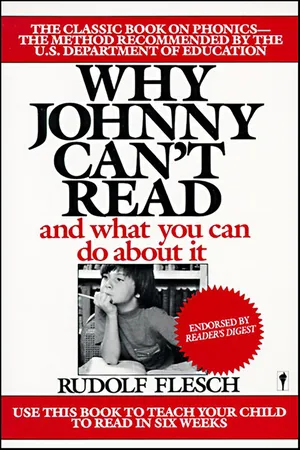
The classic bestseller on phonics—the method that can teach children to read in six weeks.
In 1955, Dr. Rudolf Flesch published
Why Johnny Can't Read, a sharp criticism of teaching methods being used in American schools—methods, he argued, that were failing children and lowering the nation's literacy rates in comparison to other countries. He championed a return to phonics, which emphasized learning letters and their sounds rather than trying to memorize whole words and recognize them on sight.
Time magazine reported that the book would "shock many a US parent and educator"—and indeed, it remained a bestseller for thirty-seven weeks and changed the way reading was taught.
Today, this method of teaching is recommended by the U.S. Department of Education, and for parents who want to teach their child to read—whether in a homeschooling setting, in the preschool years, or as a supplement to classroom lessons—
Why Johnny Can't Read contains complete materials and instructions.
"Forthright, clear, and persuasive." —
Language
"For use by parents who will be able to help their children at home, with the primer contained in the book." —
Kirkus Reviews
- 240 pages
- English
- ePUB (mobile friendly)
- Available on iOS & Android
eBook - ePub
About this book
Information
Topic
EducationSubtopic
Inclusive EducationChapter I
A LETTER TO JOHNNY’S MOTHER
Dear Mary:
I have decided to start this book with a letter to you. You know that the idea came to me when I offered to help Johnny with his reading. It’s really his book—or yours. So the only proper way to start it is with the words “Dear Mary.”
You remember when I began to work with Johnny half a year ago. That was when he was twelve and they put him back into sixth grade because he was unable to read and couldn’t possibly keep up with the work in junior high. So I told you that I knew of a way to teach reading that was altogether different from what they do in schools or in remedial reading courses or anywhere else. Well, you trusted me, and you know what has happened since. Today Johnny can read—not perfectly, to be sure, but anyone can see that in a few more months he will have caught up with other boys of his age. And he is happy again: You and I and everyone else can see that he is a changed person.
I think Johnny will go to college. He has a very good mind, as you know, and I don’t see why he shouldn’t become a doctor or a lawyer or an engineer. There is a lot in Johnny that has never come to the surface because of this reading trouble.
Since I started to work with Johnny, I have looked into this whole reading business. I worked my way through a mountain of books and articles on the subject, I talked to dozens of people, and I spent many hours in classrooms, watching what was going on.
What I found is absolutely fantastic. The teaching of reading—all over the United States, in all the schools, in all the textbooks—is totally wrong and flies in the face of all logic and common sense. Johnny couldn’t read until half a year ago for the simple reason that nobody ever showed him how. Johnny’s only problem was that he was unfortunately exposed to an ordinary American school.
You know that I was born and raised in Austria. Do you know that there are no remedial reading cases in Austrian schools? Do you know that there are no remedial reading cases in Germany, in France, in Italy, in Norway, in Spain—practically anywhere in the world except in the United States? Do you know that there was no such thing as remedial reading in this country either until about thirty years ago? Do you know that the teaching of reading never was a problem anywhere in the world until the United States switched to the present method around about 1925?
This sounds incredible, but it is true. One of the articles on reading that I found was by a Dr. Ralph C. Preston, of the University of Pennsylvania, who reported on his experiences on a trip through Western Germany in the April, 1953, Elementary School Journal. Dr. Preston visited a number of classrooms in Hamburg and Munich. “After the experience of hearing these German children read aloud,” he says, “I began to attach some credence to a generally expressed opinion of German teachers that before the end of Grade 2 almost any child can read orally (without regard to degree of comprehension) almost anything in print!”
Of course, Dr. Preston, being an American educator, didn’t draw the obvious conclusion from what he saw. The explanation is simply that the method used over there works, and the method used in our schools does not. We too could have perfect readers in all schools at the end of second grade if we taught our children by the system used in Germany.
Now, what is this system? It’s very simple. Reading means getting meaning from certain combinations of letters. Teach the child what each letter stands for and he can read.
Ah no, you say, it can’t be that simple. But it is. Let me give you an illustration.
I don’t know whether you know any shorthand. Let’s suppose you don’t. Let’s suppose you decide to learn how to read English shorthand.
Right away you say that nobody learns how to read shorthand. People who want to know shorthand learn how to write it; the reading of it comes by the way.
Exactly. That’s why shorthand is such a good illustration of this whole thing. It’s just a system of getting words on paper. Ordinary writing is another such system. Morse code is a third. Braille is a fourth. And so it goes. There are all sorts of systems of translating spoken words into a series of symbols so that they can be written down and read back.
Now the way to learn any such system is to learn to write and to read it at the same time. And how do you do that? The obvious answer is, By taking up one symbol after another and learning how to write it and how to recognize it. Once you are through the whole list of symbols, you can read and write; the rest is simply practice—learning to do it more and more automatically.
Since the dawn of time people have learned mechanical means of communication in this way—smoke signals and drums in the jungle and flag language and I don’t know what all. You take up one item after another, learn what it stands for, learn how to reproduce it and how to recognize it, and there you are.
Shorthand, as I said, is an excellent example. I don’t know any English shorthand myself, but I went to a library and looked up the most widely used manual of the Gregg system, the Functional Method by L. A. Leslie. Sure enough, it tells you about the symbols one after the other, starting out with the loop that stands for the long a in ache, make, and cake. After a few lessons, you are supposed to know the shape of all the shorthand “letters,” and from there on it’s just a matter of practice and picking up speed.
Our system of writing—the alphabet—was invented by the Egyptians and the Phoenicians somewhere around 1500 b.c. Before the invention of the alphabet there was only picture writing—a picture of an ox meant “ox,” a picture of a house meant “house,” and so on. (The Chinese to this day have a system of writing with symbols that stand for whole words.) As soon as people had an alphabet, the job of reading and writing was tremendously simplified. Before that, you had to have a symbol for every word in the language—10,000, 20,000 or whatever the vocabulary range was. Now, with the alphabet, all you had to learn was the letters. Each letter stood for a certain sound, and that was that. To write a word—any word—all you had to do was break it down into its sounds and put the corresponding letters on paper.
So, ever since 1500 b.c. people all over the world—wherever an alphabetic system of writing was used—learned how to read and write by the simple process of memorizing the sound of each letter in the alphabet. When a schoolboy in ancient Rome learned to read, he didn’t learn that the written word mensa meant a table, that is, a certain piece of furniture with a flat top and legs. Instead, he began by learning that the letter m stands for the sound you make when you put your lips together, that e means the sound that comes out when you open your mouth about halfway, that n is like m but with the lips open and the teeth together, that s has a hissing sound, and that a means the sound made by opening your mouth wide. Therefore, when he saw the written word mensa for the first time, he could read it right off and learn, with a feeling of happy discovery, that this collection of letters meant a table. Not only that, he could also write the word down from dictation without ever having seen it before. And not only that, he could do this with practically every word in the language.
This is not miraculous, it’s the only natural system of learning how to read. As I said, the ancient Egyptians learned that way, and the Greeks and the Romans, and the French and the Germans, and the Dutch and the Portuguese, and the Turks and the Bulgarians and the Esthonians and the Icelanders and the Abyssinians—every single nation throughout history that used an alphabetic system of writing.
Except, as I said before, twentieth-century Americans—and other nations in so far as they have followed our example. And what do we use instead? Why, the only other possible system of course—the system that was in use before the invention of the alphabet in 1500 b.c. We have decided to forget that we write with letters and learn to read English as if it were Chinese. One word after another after another after another. If we want to read materials with a vocabulary of 10,000 words, then we have to memorize 10,000 words; if we want to go to the 20,000 word range, we have to learn, one by one, 20,000 words; and so on. We have thrown 3,500 years of civilization out the window and have gone back to the Age of Hammurabi.
You don’t believe me? I assure you what I am saying is literally true. Go to your school tomorrow morning—or if Johnny has brought home one of his readers, look at it. You will immediately see that all the words in it are learned by endless repetition. Not a sign anywhere that letters correspond to sounds and that words can be worked out by pronouncing the letters. No. The child is told what each word means and then they are mechanically, brutally hammered into his brain. Like this:
“We will look,” said Susan.
“Yes, yes,” said all the children.
“We will look and find it.”
So all the boys and girls looked.
They looked and looked for it.
But they did not find it.
“Yes, yes,” said all the children.
“We will look and find it.”
So all the boys and girls looked.
They looked and looked for it.
But they did not find it.
Or this:
“Quack, quack,” said the duck.
He wanted something.
He did not want to get out.
He did not want to go to the farm.
He did not want to eat.
He sat and sat and sat.
He wanted something.
He did not want to get out.
He did not want to go to the farm.
He did not want to eat.
He sat and sat and sat.
All the reading books used in all our schools, up through fourth and fifth and sixth grade, are collections of stuff like that. Our children learn the word sat by reading over and over again about a duck or a pig or a goat that sat and sat and sat. And so with every word in the language.
Every word in the language! You know what that means? It means that if you teach reading by this system, you can’t use ordinary reading matter for practice. Instead, all children for three, four, five, six years have to work their way up through a battery of carefully designed readers, each one containing all the words used in the previous one plus a strictly limited number of new ones, used with the exactly “right” amount of repetition. Our children don’t read Andersen’s Fairy Tales any more or The Arabian Nights or Mark Twain or Louisa May Alcott or the Mary Poppins books or the Dr. Doolittle books or anything interesting and worth while, because they can’t. It so happens that the writers of these classic children’s books wrote without being aware of our Chinese system of teaching reading. So Little Women contains words like grieving and serene, and Tom Sawyer has ague and inwardly, and Bulfinch’s Age of Fable has nymph and deity and incantations. If a child that has gone to any of our schools faces the word nymph for the first time, he is absolutely helpless because nobody has ever told him how to sound out n and y and m and ph and read the word off the page.
So what does he get instead? He gets those series of horrible, stupid, emasculated, pointless, tasteless little readers, the stuff and guff about Dick and Jane or Alice and Jerry visiting the farm and having birthday parties and seeing animals in the zoo and going through dozens and dozens of totally unexciting middle-class, middle-income, middle-I.Q. children’s activities that offer opportunities for reading “Look, look” or “Yes, yes” or “Come, come” or “See the funny, funny animal.” During the past half year I read a good deal of this material and I don’t wish that experience on anyone.
Who writes these books? Let me explain this to you in detail, because there is the nub of the whole problem.
There are one or two dozen textbook houses in America. By far the most lucrative part of their business is the publication of readers for elementary schools. There are millions of dollars of profit in these little books. Naturally, the competition is tremendous. So is the investment; so is the sales effort; so is the effort that goes into writing, editing, and illustrating these books.
Now, with our Chinese word-learning system you can’t produce a series of readers by printing nice, interesting collections of stuff children of a certain age might like to read. Oh no. Every single story, every single sentence that goes into these books has to be carefully prepared and carefully checked to make sure that each word is one of the 637 that the poor child is supposed to have memorized up to that point—or if it’s the 638th word, that it appears in just the right context for optimum guesswork and is then repeated seventeen times at carefully worked-out intervals.
Naturally, the stupendous and frighteningly idiotic work of concocting this stuff can only be done by tireless teamwork of many educational drudges. But if the textbook house put only the drudges on the title page, that wouldn’t look impressive enough to beat the competition. So there has to be a “senior author”—someone with a national reputation who teaches how to teach reading at one of the major universities.
And that’s why each and every one of the so-called authorities in this field is tied up with a series of readers based on the Chinese word-learning method. As long as you used that method, you have to buy some $30 worth per child of Dr. So-and-so’s readers; as soon as you switch to the common-sense method of teaching the sounds of the letters, you can give them a little primer and then proceed immediately to anything from the Reader’s Digest to Treasure Island.
I have personally met some of the leading authorities in the field of reading. They are all very nice ladies and gentlemen, and obviously sincere and well meaning. But they are firmly committed to the application of the word method, and it would be inhuman to expect from them an objective point of view.
Consequently it’s utterly impossible to find anyone inside the official family of the educators saying anything even slightly favorable to the natural method of teaching reading. Mention the alphabetic method or phonetics or “phonics” and you immediately arouse derision, furious hostility, or icy silence.
For instance, in the May 1952 Catholic Educator, Monsignor Clarence E. Elwell published an article “Reading: The Alphabet and Phonics.” Monsignor Elwell is Superintendent of Schools of the Diocese of Cleveland and knows what he is talking about. He says: “In a language based on an alphabetic (that is, phonetic) method of coding the spoken word, the only sensible way to teach how to decode the written symbols is (1) by teaching the phonetic code, that is, the alphabet, and (2) the manner of coding—letter by letter, left to right. It is as nonsensical to use a whole word method for beginning reading as it would be to teach the Morse code on a whole word basis…. A child who has been taught the code and how to use it … gains a confident habit in attacking words. Instead of guessing when he comes to a new word, as he did when taught by the sight word method, he now works through a word and to the surprise of the teachers usually comes up with the right answer…. After four years’ experiment with the introduction of a strong program of phonics at the very beginning of grade one, the experimenter finds teachers convinced and children apparently happier in their success.”
What do you think happened when Monsignor Elwell said publicly that our whole...
Table of contents
- Cover
- Title Page
- Dedication
- Contents
- Foreword
- Preface
- Chapter I: A LETTER TO JOHNNY’S MOTHER
- Chapter II: WHAT IS PHONICS?
- Chapter III: WHY JOHNNY CAN’T SPELL
- Chapter IV: A COW AND CONSEQUENCES
- Chapter V: PHONICS vs. NO PHONICS
- Chapter VI: TWO YEARS WASTED
- Chapter VII: “OH, OH! COME, COME! LOOK, LOOK!”
- Chapter VIII: HOW NOT TO TEACH READING
- Chapter IX: EYEWITNESS REPORT
- Chapter X: WORD GUESSING—ITS CAUSE AND CURE
- Chapter XI: A LETTER TO JOHNNY’S TEACHER
- EXERCISES
- INSTRUCTIONS
- By the same author
- Copyright
- About the Publisher
Trusted by 375,005 students
Access to over 1.5 million titles for a fair monthly price.
Study more efficiently using our study tools.
Frequently asked questions
Yes, you can cancel anytime from the Subscription tab in your account settings on the Perlego website. Your subscription will stay active until the end of your current billing period. Learn how to cancel your subscription
No, books cannot be downloaded as external files, such as PDFs, for use outside of Perlego. However, you can download books within the Perlego app for offline reading on mobile or tablet. Learn how to download books offline
Perlego offers two plans: Essential and Complete
- Essential is ideal for learners and professionals who enjoy exploring a wide range of subjects. Access the Essential Library with 800,000+ trusted titles and best-sellers across business, personal growth, and the humanities. Includes unlimited reading time and Standard Read Aloud voice.
- Complete: Perfect for advanced learners and researchers needing full, unrestricted access. Unlock 1.5M+ books across hundreds of subjects, including academic and specialized titles. The Complete Plan also includes advanced features like Premium Read Aloud and Research Assistant.
We are an online textbook subscription service, where you can get access to an entire online library for less than the price of a single book per month. With over 1.5 million books across 990+ topics, we’ve got you covered! Learn about our mission
Look out for the read-aloud symbol on your next book to see if you can listen to it. The read-aloud tool reads text aloud for you, highlighting the text as it is being read. You can pause it, speed it up and slow it down. Learn more about Read Aloud
Yes! You can use the Perlego app on both iOS and Android devices to read anytime, anywhere — even offline. Perfect for commutes or when you’re on the go.
Please note we cannot support devices running on iOS 13 and Android 7 or earlier. Learn more about using the app
Please note we cannot support devices running on iOS 13 and Android 7 or earlier. Learn more about using the app
Yes, you can access Why Johnny Can't Read by Rudolf Flesch in PDF and/or ePUB format, as well as other popular books in Education & Inclusive Education. We have over 1.5 million books available in our catalogue for you to explore.