![]()
Chapter 1
Photo credit: Jason Reposar
THE POETIC RAPTURE THAT IS SURFING
Sometime in the mid-1900s, an adventurous surfer by the name of Greg Noll was on a pioneering mission down in Mazatl$aAn. Surfing had yet to hit the Mexican shores at this time, and the sight of man riding wave was a new phenomenon. One afternoon Noll came in from a session at a long, rolling point break. He was greeted at the shoreline by an old man who’d been watching him surf. The old man’s eyes were bulging. He bowed his head and made the sign of the cross, whimpering something in Spanish. Noll didn’t know what the hell was going on. It wasn’t until later that he found out the old guy suffered from bad eyesight and mistook Noll standing on a board as Jesus walking on water.
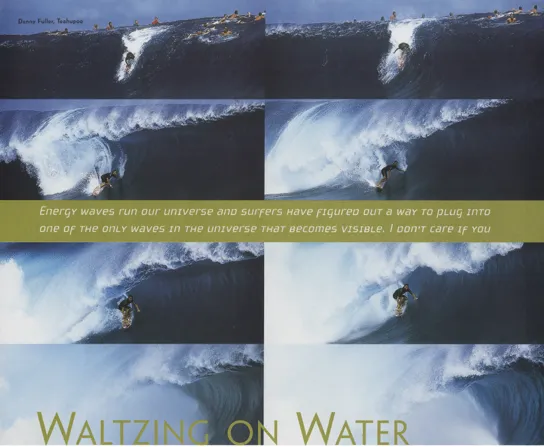
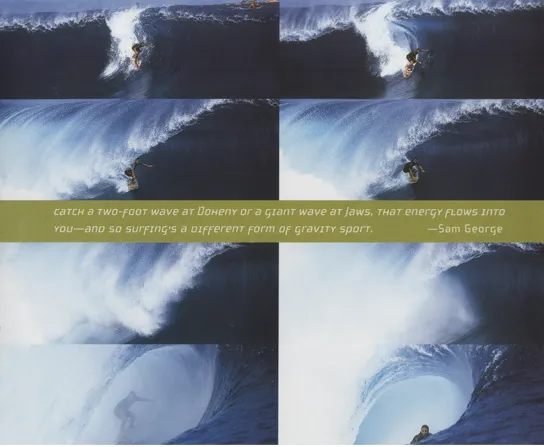
At its best, surfing is a spiritual pursuit that enriches and enlarges the individual, creating a kinship with nature that’s unlike any other sport. Wind, weather, and tide all have a hand in creating its playing field. That playing field is ever changing; hence no two waves are exactly the same. Waves are pulses of energy—aquatic metaphors for the bigger picture that is the cosmos. Surfers catch these waves and ride them for no particular reason other than fun. There is an extreme case of adaptability going on here. Imagine trying to toss a ball into a hoop, but the hoop is ducking and weaving and in flux. This is the kind of dance partner with which surfers have to deal. And there is no permanence in the act of wave riding, nothing to show for one’s efforts. As quickly as the wave breaks it dissipates back into the giant vastness of the sea, the cycles of the universe mirrored perfectly, the dance of surfing a dress rehearsal for all of life’s lessons.
Photo credit: Jason Reposar
![]()
Chapter 2
Photo credit: Randy Hild Collection
IN THE BEGINNING
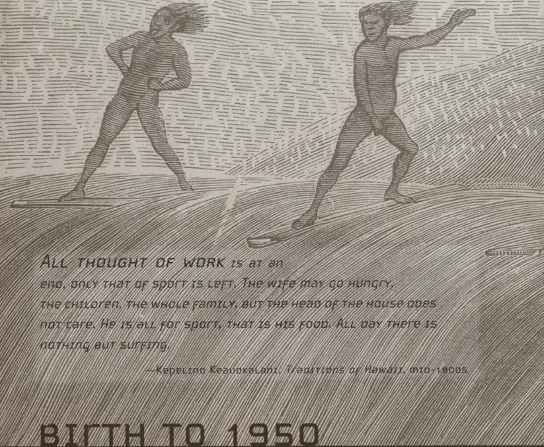
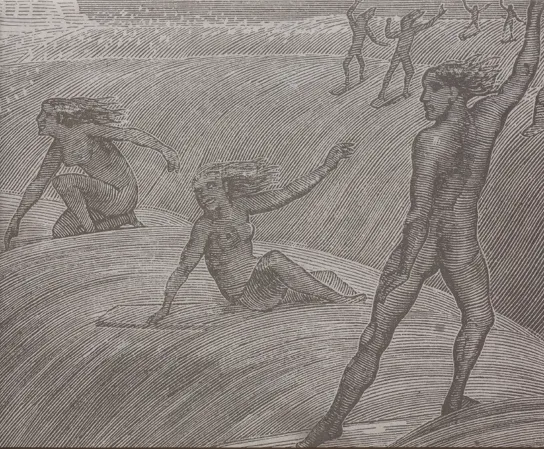
Exactly when and where surfing began is all a bit gray. Some say it started in Peru in the fifteenth century when fishermen stood up in their canoes while waves pushed them shoreward. Others tell the same story, placing it in West Africa, There’s the whacky theory that back in biblical times, when Moses was put in the reed basket and sent down the river, he became the world’s first surfer. We’re pretty sure Polynesians brought surfing from the Society Islands to Hawaii around A.D. 500 and we’re almost positive that by A.D. 1000 be’e nalu—also known as surfboard riding—was in full effect. The best recorded history we have starts with Captain Cook’s diaries when he sailed to Hawaii in 1778. As the story goes, the early Polynesians migrated to Hawaii and brought their oceanic lifestyle with them. Everything revolved around the sea—from work to food to recreation. When the surf was up they did what surfers do today—drop everything and paddle out. Hawaii sits right smack in the middle of the Pacific Ocean. There was no shortage of waves. You may have heard of surfing referred to as "the Sport of Kings." Well, back then it truly was. Surfers came from royal families. They’d paddle their oversized wili wili wood boards out to Waikiki, catch the sloping swells that seemed to go forever, and ride them shoreward with stiff, hood ornament-like styles. Back then boards were sacred. Surfers would find just the right tree, chop it down, carve it into shape with sharp stones or coral, stain it with ti root, and then lug it down to the beach. Upwards of twenty feet and weighing in over 100 pounds, they were a nightmare to drag around. Early surfers wore loincloths or nothing at all, frolicking in the fun and celebration of it all, enjoying surfing for its playfulness and sense of freedom. But when Christian missionaries arrived on the scene in the early 1800s, they decided these demonstrations of liberation threatened their still and upright ideals. They declared it impure and unethical, and consequently, surfing’s popularity diminished throughout the century.
Photo credit: Randy Hild Collection
Photo credit: Randy Hild Collection
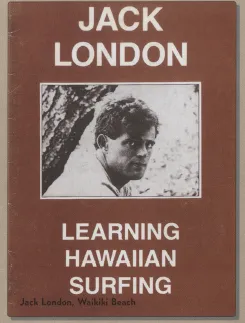
WHERE BUT THE moment before was only the wide desolation and invincible roar, is now a man, erect, full-statured, not struggling frantically in that wild movement, not buried and crushed and buffeted by those mighty monsters, but standing above them all, calm and superb, poised on the giddy summit, his feet burieo in the churning foam, the salt smoke rising to his knees, and all the rest of him the free air and flashing sunlight, and he is flying through the air, flying forward, flying fast as the surge on which he stands.
—Jack London, Learning Hawaiian Surfing, 1907
GREAT LITERATURE AS GREAT PR
In 1907, thirty-one-year-old Jack London showed Lip in Hawaii with his wife and wave-lust in tow. Not only was London curious about surfing, but he also happened to he Americas most famous writer. His plan was to perch himself in the heart of Waikiki, immerse himself in the "beach boy" lifestyle, and scribe his findings for all America to read. Under the tutelage of two local surfers—-Alexander Hume Ford and George Freeth—London ended up falling in love with surfing, which he wrote about both eloquently and enthusiastically in a beautiful book called Learning Hawaiian Surfing, as well as a few well-circulated magazine articles. Hume Ford went on to start the Waikiki Outrigger Canoe and Surfboard Club, Freeth became famous for introducing wave-riding to California, and London’s surf stoke was broadcast throughout the country, letting the entire nation in on the magic of waltzing on water.
Photo credit: Randy Hild Collection
Photo credit: Randy Hild Collection
Photo credit: Randy Hild Collection
THE MAN WHO WALKED ON CALIFORNIA WATER
George Freeth was dubbed "the Man Who Can Walk on Water" when he showcased surfing for the-First time at Redondo Beach in the summer of 1907. Freeth was regarded as the best surfer at Waikiki, and he’d been invited to California to help promote the new railway line that brought inlanders to the beach. Thousands of spectators huddled about the shore, amazed and astonished, as Freeth cut left, cut right, and essentially cut the ribbon on surfing in the mainland United States.
BEACH BOYS APLENTY
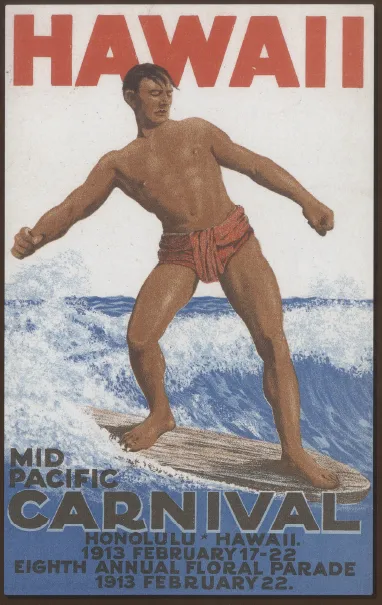
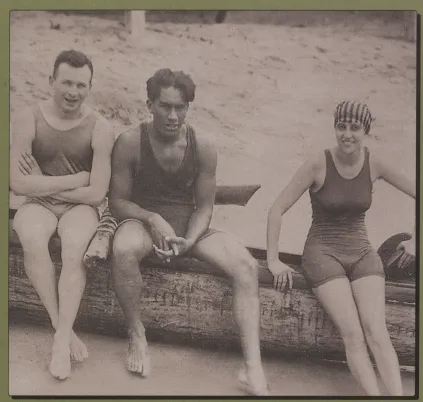
By 1915, Waikiki’s Outrigger Club had over a thousand surf-stoked members. And they weren’t the only game in town—the Hui Nalu Club was also up and running, with a more local, Hawaiian roots membership. Waikiki was booming with new hotels and restaurants, boatloads of tourists, and surfers aplenty. The local beach boys shared their lifestyle with the traveling haoles (mainlanders) and taught them how to surf, Hawaiians had a holistic view of the water—surfing was not just something you did, it was something you lived They fished, they paddled, they dove, they rode waves, and they loved women like water monkeys, legend has it, one beach boy took a young lass out for a night surf instructional and ended up teaching her the joys of making love while standing on a surfboard—-a glorious image. Beach boys also swam like Olympian athletes, and sure enough, an Olympic gold medalist emerged from the bunch.
Photo credit: Randy Hild Collection
Photo credit: Randy Hild Collection
THE DUKE
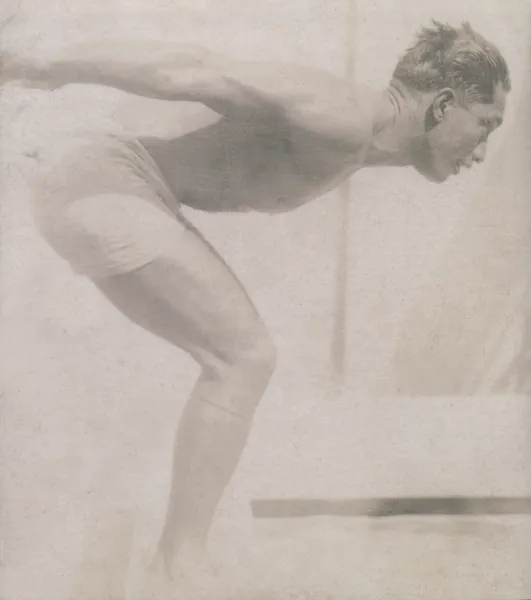
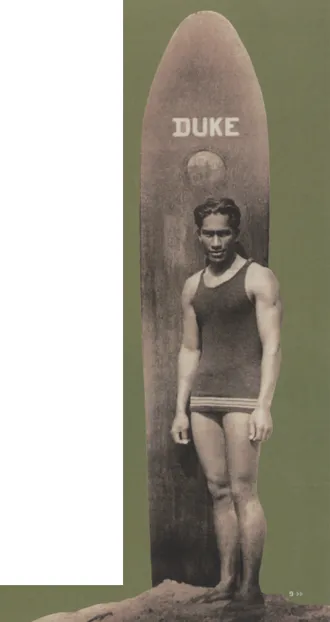
Duke Kahanamoku is regarded as the rather of modern surfing, and for good reason. He was baptized in the waters of Waikiki, was rumored to be the fastest swimmer in the world, and went on to win a couple of Olympic gold medals in the 100-meter freestyle. His achievements elevated him to celebrity status, and he toured throughout the United States, Europe, and Australia giving swim demos and showcasing surfing wherever possible. His 1914 demo at Freshwater Beach in Sydney is the stuff of legend. He walked the length of the hoard like a bronzed Jesus, did handstands and headstands with grace and glory, took a young girl out for a wave and scattered the seeds for what would later become Australia’s second most popular sport Dukes godliness attracted the showbiz set. He went to Hollywood wooed women, and appeared in a few Minis. In his later years he acted as Hawaiian ambassador, shaking hands spreading aloha and sharing surfing.
Photo credit: Randy Hild Collection
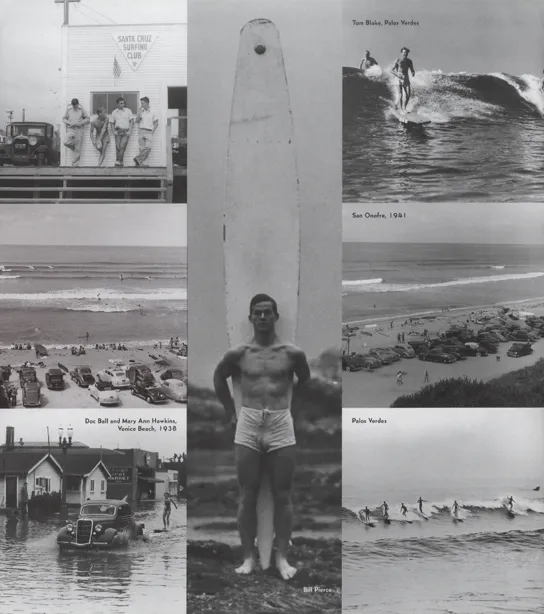
Photo credit: Doc Ball, Bob Johnson, Leroy Grannis
ENTER TOM BLAKE
In 1920, on his way home from winning his second 100-meter freestyle Olympic gold medal, this time in Antwerp, Belgium, Duke Kahanamoku stopped off in Detroit, Michigan, where he met Tom Blake, a Wisconsoner who was so taken by the Duke that he decided right then and there he’d devote the rest of his life to Hawaiian watersports. Blake relocated to Hawaii, where he proceeded to paddle, swim, and surf with mad fervor. He became obsessed with board design and took on the role of craftsman. Borrowing the plan shape of the ancient olo boards, Blake dug hundreds of small holes in the wooden plank,...