"Takes readers on illuminating scientific adventure, beginning sixty-six million years ago, that connects dinosaurs, comets, DNA, and the future of the planet." —
Huffington Post
In this brilliant exploration of our cosmic environment, the renowned particle physicist and
New York Times–bestselling author of
Warped Passages and
Knocking on Heaven's Door uses her research into dark matter to illuminate the startling connections between the furthest reaches of space and life here on Earth.
Sixty-six million years ago, an object the size of a city descended from space to crash into Earth, creating a devastating cataclysm that killed off the dinosaurs, along with three-quarters of the other species on the planet. What was its origin? In
Dark Matter and the Dinosaurs, Lisa Randall proposes it was a comet that was dislodged from its orbit as the Solar System passed through a disk of dark matter embedded in the Milky Way. In a sense, it might have been dark matter that killed the dinosaurs.
Working through the background and consequences of this proposal, Randall shares with us the latest findings—established and speculative—regarding the nature and role of dark matter and the origin of the Universe, our galaxy, our Solar System, and life, along with the process by which scientists explore new concepts. In
Dark Matter and the Dinosaurs, Randall tells a breathtaking story that weaves together the cosmos' history and our own, illuminating the deep relationships that are critical to our world and the astonishing beauty inherent in the most familiar things.
"Randall has woven a beautiful account of how life on Earth is intimately connected to the cosmos." —
The Daily Telegraph (UK)
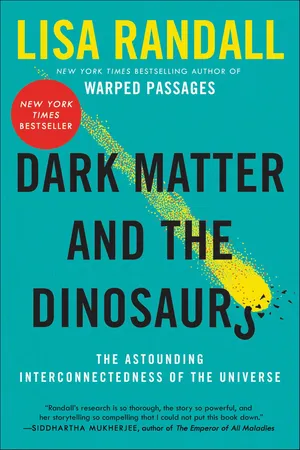
eBook - ePub
Dark Matter and the Dinosaurs
The Astounding Interconnectedness of the Universe
- 432 pages
- English
- ePUB (mobile friendly)
- Available on iOS & Android
eBook - ePub
About this book
Information
Topic
Physical SciencesSubtopic
Astronomy & AstrophysicsPART I
THE DEVELOPMENT OF THE UNIVERSE
1
THE CLANDESTINE DARK MATTER SOCIETY
We often fail to notice things that we are not expecting. Meteors flash across the sky on a moonless night, unfamiliar animals shadow us when we hike through the woods, magnificent architectural details surround us as we walk through a town. Yet we often overlook these remarkable sights—even when they are directly in our field of view. Our very bodies host colonies of bacteria. Ten times more bacterial cells than human cells live inside us and help with our survival. Yet we are barely aware of these microscopic creatures that live in us, consume nutrients, and aid our digestive systems. Only when bacteria misbehave and make us ill do most of us even acknowledge their existence.
To view things, you have to look. And you have to know how to look. But at least the phenomena I just mentioned can in principle be seen. Imagine the further challenges in understanding something that you literally cannot see. That would be dark matter, the elusive stuff in the Universe that has only minuscule interactions with the matter we understand. In the chapter that follows, I’ll explain the many measurements with which astronomers and physicists have established dark matter’s existence. In this one, I’ll introduce this elusive matter: what it is, why it might seem so perplexing, and why—from some important perspectives—it is not.
THE UNSEEN IN OUR MIDST
Although the Internet is a single giant network in which billions of people engage online, most of those who are communicating on social networks don’t interact directly—or even indirectly—with each other. Participants tend to friend like-minded people, follow others with similar interests, and turn to news sources that represent their own particular worldview. With such restricted interactions, the many people engaged on-line fragment into distinct, non-interacting populations within which they rarely encounter an objectionable point of view. Even people’s friends’ friends don’t generally confront the contradictory opinions of unaffiliated groups, so most of the Internet’s participants are oblivious to the existence of unfamiliar communities with different, incompatible ideas.
We’re not all so closed to worlds outside our own. But when it comes to dark matter, we’re all guilty as charged. Dark matter just isn’t part of ordinary matter’s social network. It lives in an Internet chat room that we don’t yet know how to enter. It’s in the same Universe and even occupies the same regions of space as visible matter. But dark matter particles interact only imperceptibly with the ordinary matter that we know. As with Internet communities to which we are oblivious—unless we are told about dark matter, in our daily lives we would be unaware it exists.
Like the bacteria within us, dark matter is one of many other “universes” right under our noses. And like those microscopic creatures, it is all around us too. Dark matter passes right through our bodies—and resides in the outside world as well. Yet we don’t notice any of its consequences because it interacts so feebly—so much so that it forms a distinct population. It is a society totally separate from the matter that we know.
But it’s an important one. Whereas bacterial cells—though numerous—account for only about one or two percent of our weight, dark matter—though an insignificant fraction of our bodies—accounts for about 85 percent of the matter in the Universe. Every cubic centimeter around you contains about a proton’s mass worth of matter. That might sound like a lot or a little depending on how you view it. But it means that if dark matter is composed of particles whose mass is comparable to those we know of and if those particles travel at the velocity we expect based on well-understood dynamics, billions of dark matter particles pass through each of us every second. Yet no one notices that they are there. The effect of even billions of dark matter particles on us is minuscule.
That’s because we can’t sense dark matter. Dark matter doesn’t interact with light—at least to the extent that people have been able to probe so far. Dark matter is not made out of the same material as ordinary matter—it’s not composed of atoms or the familiar elementary particles that do interact with light, which is essential to everything we can see. The mystery that my colleagues and I hope to solve is what precisely dark matter is composed of. Does it consist of a new type of particle? If so, what are its properties? Aside from its gravitational interactions, does it have any interactions at all? If we are lucky with current experiments, particles of dark matter might turn out to experience some minuscule electromagnetic interactions that have so far been too small to detect. Dedicated probes are searching—I’ll explain how in the third part of the book. But so far dark matter remains invisible. Its effects haven’t influenced detectors at their current level of sensitivity.
However, when large amounts of dark matter aggregate into concentrated regions, its net gravitational influence is substantial, leading to measurable influences on stars and on nearby galaxies. Dark matter affects the expansion of the Universe, the path of light rays passing to us from distant objects, the orbits of stars around the centers of galaxies, and many other measurable phenomena in ways that convince us of its existence. We know about dark matter—and indeed it does exist—because of these measurable gravitational effects.
Furthermore, even though it is unseen and unfelt, dark matter played a pivotal role in forming the Universe’s structure. Dark matter can be compared to the under-appreciated rank and file of society. Even when invisible to the elite decision makers, the many workers who built pyramids or highways or assembled electronics were crucial to the development of their civilizations. Like other unnoticed populations in our midst, dark matter was essential to our world.
We wouldn’t even be around to comment on any of this, let alone put together a coherent picture of the Universe’s evolution, if dark matter hadn’t been present in the early Universe. Without dark matter, there wouldn’t have been enough time to form the structure that we now observe. Clumps of dark matter seeded the Milky Way galaxy—as well as other galaxies and galaxy clusters. Had galaxies not formed, neither would have the stars, nor the Solar System, nor life as we know it. Even today, the collective action of dark matter keeps galaxies and galaxy clusters intact. Dark matter might even be relevant to the trajectory of the Solar System if the dark disk alluded to in the introduction exists.
Yet we don’t observe dark matter directly. Scientists have studied many forms of matter but all of them whose composition we know have been observed with some form of light—or more generally, electromagnetic radiation. Electromagnetic radiation appears as light at visible frequencies, but can also appear as radio waves or ultraviolet radiation, for example, when outside the limited range of frequencies that we can see. The effects might be observed under a microscope, with a radar device, or in optical images on a photograph. But electromagnetic influences are always involved. Not all of the interactions are direct—charged elements interact with light most directly. But the elements of the Standard Model of particle physics—the most basic elements of the matter we know about—interact with each other enough that light, if not directly a friend, is at least a friend of a friend of all the forms of matter we can see.
Not only our vision, but our other senses—touch, smell, taste, and sound—rely on atomic interactions, which rely in turn on the interactions of electrically charged particles. Touch too, though for more subtle reasons, relies on electromagnetic vibrations and interactions. Since human senses are all based in electromagnetic interactions of some sort, we can’t directly detect dark matter in the usual ways. Although dark matter is all around us, we can’t see or feel it. When light shines on dark matter, it doesn’t do anything. The light just passes through.
Given that they’ve never seen (or felt or smelled) it, many people I’ve spoken to are surprised at the existence of dark matter and find it quite mysterious—or even wonder if it’s some sort of mistake. People ask how it can possibly be that most matter—about five times the amount of ordinary matter—cannot be detected with conventional telescopes. Personally, I would expect quite the opposite (though admittedly not everyone sees it this way). It would be even more mysterious to me if the matter we can see with our eyes is all the matter that exists. Why should we have perfect senses that can directly perceive everything? The big lesson of physics over the centuries is how much is hidden from our view. From this perspective, the question is really why the stuff we do know about should constitute as much of the energy density of the Universe as it does.
Dark matter might sound like an exotic suggestion to some, but proposing its existence is far less rash than revising the laws of gravity—as dark matter skeptics might prefer. Dark matter—although indeed unfamiliar—is likely to have a more or less conventional explanation that is completely consistent with all known physical laws. After all, why should all matter that acts in accordance with known laws of gravity behave exactly like familiar matter? To put it succinctly, why should all matter interact with light? Dark matter can simply be matter that has different or no fundamental charges. Without electric charge or interactions with charged particles, dark matter simply can’t absorb or emit light.
However, I do have a slight problem with one aspect of dark matter, which is its name. I don’t take issue with the “matter” part. Dark matter is indeed a form of matter—meaning that it is stuff that clumps and exerts its own gravitational influence, interacting with gravity like all other matter. Physicists and astronomers detect its presence in diverse ways that rely on this interaction.
It is the “dark” in the name that is unfortunate—both because we see dark things, which absorb light, and because the ominous-sounding label makes it sound more potent and negative than it actually is. Dark matter is not dark—it is transparent. Dark stuff absorbs light. Transparent things, on the other hand, are oblivious to it. Light can hit dark matter, but neither the matter nor the light will change as a result.
At a recent conference bringing together people from many disciplines, I met Massimo, a marketing professional who specializes in branding. When I told him about my research, he looked at me incredulously and asked, “Why is this called dark matter?” His objection was not to the science, but to the name’s needlessly negative connotations. It’s not exclusively true that every brand associates negative qualities with “dark.” The “Dark Knight” was a good guy—if complicated. But compared to its use in Dark Shadows, His Dark Materials, Transformers: Dark of the Moon, Darth Vader’s “dark side of the Force”—not to mention the hilarious dark song from the Lego movie—the “dark” in “dark matter” is pretty tame. Despite our evident fascination with things dark, dark matter doesn’t really live up to the name’s reputation.
Dark matter does, however, share one quality with the evil stuff: it is hidden from view. Dark matter is aptly named in the sense that no matter how much you heat it up, it won’t emit light. In that sense it is truly dark—not in the sense of being opaque but in the sense of being the opposite of light-emitting or even light-reflecting. No one sees dark matter directly—even with a microscope or a telescope. As with the many malevolent spirits in movies and literature, its invisibility serves as its shield.
Massimo agreed that “transparent matter” would have been a better name—or at least less scary. Although true from a physics perspective, I’m not certain that he’s right. “Dark matter,” even if not my favorite term, seems to attract a fair amount of attention. Nonetheless, dark matter is neither ominous nor powerful—at least without a huge amount of it. It interacts so feebly with normal matter that it’s extremely challenging to find. That’s part of what makes it so interesting.
BLACK HOLES AND DARK ENERGY
The name “dark matter” gives rise to other confusions too—even beyond the ominous-sounding implications referred to above. For example, a lot of the people I talk to about my research fail to distinguish dark matter from black holes. To clarify the distinction, I’ll take a brief detour to discuss black holes, which are objects that form when too much matter gets within too small a region of space. Nothing—including light—escapes from their powerful gravitational influence.
Black holes and dark matter are no more the same than black ink and film noir. Dark matter doesn’t interact with light. Black holes absorb light—and anything else that comes too close. Black holes are black because all light that goes in remains in. It is not radiated and it is not reflected back. Dark matter might have been relevant to the formation of black holes* since any form of matter can collapse to form one. But black holes and dark matter are certainly not the same thing. They should in no way be confused.
One further misunderstanding is triggered by dark matter’s infelicitous name. Because another component of the Universe is named “dark energy”—also a problematic choice—people often confuse it too with dark matter. Although also a diversion from our main topic, dark energy is an essential part of cosmology today. So I’ll now clarify this other term to ensure that you—my enlightened reader—will always know the difference.
Dark energy is not matter—it is just energy. Dark energy exists even if no actual particle or other form of stuff is around. It permeates the Universe, but doesn’t clump like ordinary matter. The density of dark energy is the same everywhere—it can be no denser in one region than another. It is very different from dark matter, which collects into objects and will be denser in some places than in others. Dark matter acts like familiar matter, which gets bound into objects such as stars, galaxies, and galaxy clusters. The dark energy distribution, on the other hand, is always smooth.
Dark energy also remains constant over time. Unlike matter or radiation, dark energy does not become more dilute when the Universe expands. This is in some respects its defining property. The dark energy density—energy not carried by particles or matter—remains the same over time. For this reason, physicists often refer to this type of energy as a cosmological constant.
Early in the Universe’s evolution, most of the energy was carried by radiation. But radiation dilutes more quickly than matter so matter took over eventually as the largest energy contribution. Much later in the Universe’s evolution, dark energy—which never diluted whereas both radiation and matter did—came to dominate and now constitutes about 70 percent of the Universe’s energy density.
Before Einstein proposed his theory of relativity, people thought only about relative energy—the difference in energy between one setup and another. But equipped with Einstein’s theory, we learned that the absolute amount of energy is itself meaningful and produces a gravitational force that can contract or expand the Universe. The big mystery about dark energy is not why it exists—quantum mechanics and the theory of gravity suggest it should be present and Einstein’s theory tells us it has physical consequences—but why its density is so low. Given its dominance, this might not seem to be an issue. But although dark energy makes up most of the Universe’s energy today, it is only recently—after matter and radiation were diluted enormously by the Universe’s expansion—that the influence of dark energy began to compete with that of the other types of energy. Earlier on, the dark energy density was minuscule compared to the other much larger radiation and matter contributions. Without knowing the answer in advance, physicists would have estimated that the dark energy density should be an astounding 120 orders of magnitude bigger. The question of the small size of the cosmological constant has flummoxed physicists for years.
Many astronomers say that we now live in a renaissance era of cosmology, in which theories and observations have advanced to the stage where precisely calibrated tests will help pin down which ideas are realized in the Universe. However, given the dominance of dark energy and dark matter, and even the mystery of why so much ordinary matter has survived to today, physicists also joke that we live in the dark ages.
But these mysteries are precisely what make this an exciting time for anyone investigating the cosmos. Scientists have made a great deal of progress in understanding the dark sector, yet big questions remain for which we are poised to make progress. For a researcher like me, this is the optimal situation.
Perhaps one can say that physicists studying “the dark” are participating in a Copernican revolution in a more abstract form. Not only is the Earth not physically the center of the Universe, but our physical makeup is not central to its energy budget—or even to most of its matter. And, just as the first object in the cosmos that people studied was the Earth—the object with which they were most familiar—physicists focused first on the matter of which we are made, which is the most readily...
Table of contents
- Contents
- Introduction
- Part I: The Development of The Universe
- Part II: An Active Solar System
- Part III: Deciphering Dark Matter’s Identity
- Conclusion: Looking Up
- Acknowledgments
- List of Illustrations
- Supplementary Reading
- Index
- About the Author
- Also by Lisa Randall
- Credits
- Copyright
- About the Publisher
Trusted by 375,005 students
Access to over 1.5 million titles for a fair monthly price.
Study more efficiently using our study tools.
Frequently asked questions
Yes, you can cancel anytime from the Subscription tab in your account settings on the Perlego website. Your subscription will stay active until the end of your current billing period. Learn how to cancel your subscription
No, books cannot be downloaded as external files, such as PDFs, for use outside of Perlego. However, you can download books within the Perlego app for offline reading on mobile or tablet. Learn how to download books offline
Perlego offers two plans: Essential and Complete
- Essential is ideal for learners and professionals who enjoy exploring a wide range of subjects. Access the Essential Library with 800,000+ trusted titles and best-sellers across business, personal growth, and the humanities. Includes unlimited reading time and Standard Read Aloud voice.
- Complete: Perfect for advanced learners and researchers needing full, unrestricted access. Unlock 1.5M+ books across hundreds of subjects, including academic and specialized titles. The Complete Plan also includes advanced features like Premium Read Aloud and Research Assistant.
We are an online textbook subscription service, where you can get access to an entire online library for less than the price of a single book per month. With over 1.5 million books across 990+ topics, we’ve got you covered! Learn about our mission
Look out for the read-aloud symbol on your next book to see if you can listen to it. The read-aloud tool reads text aloud for you, highlighting the text as it is being read. You can pause it, speed it up and slow it down. Learn more about Read Aloud
Yes! You can use the Perlego app on both iOS and Android devices to read anytime, anywhere — even offline. Perfect for commutes or when you’re on the go.
Please note we cannot support devices running on iOS 13 and Android 7 or earlier. Learn more about using the app
Please note we cannot support devices running on iOS 13 and Android 7 or earlier. Learn more about using the app
Yes, you can access Dark Matter and the Dinosaurs by Lisa Randall in PDF and/or ePUB format, as well as other popular books in Physical Sciences & Astronomy & Astrophysics. We have over 1.5 million books available in our catalogue for you to explore.