An account of the USSR's defeat in Afghanistan drawing on many interviews with Soviet veterans: "Fascinating. . . . A highly readable history of the conflict." —
The New York Times Book Review
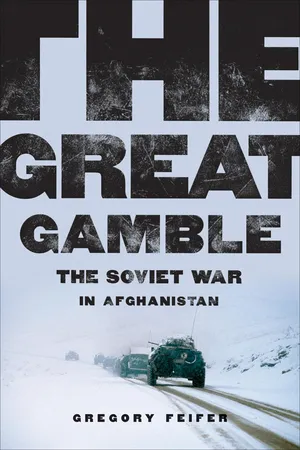
In this groundbreaking account of the Soviet invasion of Afghanistan, former NPR Moscow correspondent Gregory Feifer vividly depicts the war that contributed greatly to the demise of the USSR, and that offers striking lessons for the twenty-first century as well. Told primarily from the perspective of the Russians who fought it,
The Great Gamble offers valuable insight into the history of Afghanistan's troubled government and the rise of the mujahideen and Al-Qaeda.
"Feifer has done truly extraordinary research . . . For all its heft, [
The Great Gamble] is an effortless read—an unusual and gratifying combination." —
Minneapolis Star Tribune
"A provocative and important book, telling us what the Soviet military was thinking and feeling as it lost its war in Afghanistan. Gregory Feifer vividly shows that their campaigns there amounted to a manual of how not to do it." —Thomas Ricks, author of
Fiasco
"Thoughtful, deliberative use of eyewitness testimony gives an intensely close-up sense of what the war was like for those who fought it." —
Kirkus Reviews
"Brings to life in spirited detail the bloody, eight-year struggle that killed a million Afghans and tens of thousands of Russians and broke the back of the Soviet Union, which disappeared within two years of the war's end. You think it can't happen to us? Read Feifer." —Thomas Powers, Pulitzer Prize-winner and author of
Heisenberg's War
- 336 pages
- English
- ePUB (mobile friendly)
- Available on iOS & Android
eBook - ePub
About this book
Information
Print ISBN
9780061143199
Subtopic
Storia dell'Asia centraleCHAPTER 1
INVASION CONSIDERED
A Short, Victorious War
I
Dusk had already fallen in the late afternoon of December 12, 1979, when select members of the Soviet Union’s top leadership gathered in a Kremlin conference room. They were there for a brief discussion of an issue that had given them much trouble during the better part of the outgoing year: political crisis in the USSR’s southern neighbor Afghanistan. The informal assemblage of mostly white-haired gerontocrats wasn’t an official meeting of the state’s top governing body, the Politburo of the Communist Party’s Central Committee. They formed a much smaller group of oligarchs who held the state’s real political power, making decisions secretly among themselves. The elders ran the Soviet Union collegially, arriving at resolutions by the consensus that enabled them to share responsibility and absolve individual blame. What exactly happened during their secret midwinter meeting remains the subject of debate.
General Secretary Leonid Brezhnev presided. He had less than two years to live. Television appearances of the ailing leader had made him a public laughingstock. Propped between the shoulders of fellow Politburo members, the bloated, bushy-browed bear of a man made supreme efforts to mumble through euphemistic texts written by his advisers. (Slurring the frequently used bureaucratic word “systematically” was among his most mocked gaffes. It emerged from his lips sounding much like a juvenile term for women’s breasts.) During important Politburo meetings, the master of tedium went through the motions of approving decisions already made by members of his immediate entourage, who even wrote his responses for him. One reason for his longevity in office was that the rest of the Soviet leadership—some of whose members were far from incompetent—worried that the West would interpret any changes in its makeup as a sign of the Party’s instability.
Brezhnev had come to power in October 1964, promising to do away with Nikita Khrushchev’s anti-Stalinist campaigns and boat-rocking reforms. Supported by vast cadres of Party functionaries, the new general secretary put an end to embarrassing and potentially ruinous questions about past activities. He provided stability for the Communist nomenklatura—the politically dependable men who occupied senior positions in the bureaucracy and lived much better than others on the patronage. Dissidents were once again put on public trial. After the Czechoslovakian reform movement known as “socialism with a human face” was crushed along with the Prague Spring in 1968, Brezhnev’s tenure developed into what became known as zastoi—the stagnation. The economy, beset by massive inefficiencies from central planning and institutions such as Stalin’s agricultural collectivization, declined more or less consistently, and was further dragged down by a ballooning military-industrial complex overseen by Defense Minister Dmitri Ustinov. Prevented from making significant improvements by the nature of his rule and no doubt his own nature too, Brezhnev presided over a system that managed to hobble ahead only because the fruit of corruption spread from the Party elite to the rest of society. The economy’s raw materials and articles of production were largely—maybe even chiefly—distributed by thievery, bribery, and black marketeering.
Chief Party ideologue Mikhail Suslov, KGB Chairman Yuri Andropov, Foreign Minister Andrei Gromyko, and Defense Minister Ustinov also attended the December 12 meeting. Some claim—although people close to the Soviet leadership deny—that Prime Minister Alexei Kosygin was there as well. If he wasn’t, it may have been because Kosygin, as is widely believed, opposed the idea of invading Afghanistan—or because he was ill.
Although the imposing, six-foot-tall Suslov was generally regarded as Brezhnev’s likely successor, most Politburo decisions were made by a triumvirate composed of Andropov, Gromyko, and Ustinov. They simplified and prettified the issues in their reports to Brezhnev. Using good old ideological terms such as “the interests of the proletariat” and “the spread of the world socialist revolution,” they also usually told the Soviet leader what they believed he wanted to hear. Possibly in the hope of succeeding him, Ustinov was particularly sycophantic, singing Brezhnev’s praises in official pronouncements and refusing to say anything that would prompt his ire.
The defense minister had no monopoly on kowtowing or backslapping, however. Frequent awards ceremonies were venues for fierce jockeying to secure places closest to the general secretary so that the following day’s newspaper photographs would display the “winners.” When Brezhnev pinned on Kosygin the latest of the prime minister’s countless medals—that one for the Order of the October Revolution—he commented that the award looked pretty, then turned to fellow Politburo member Konstantin Chernenko. “Kostya,” the general secretary said, “I don’t have one of those.” Several days later—probably the time it took for the Politburo to find an excuse to make the award—a place was found on Brezhnev’s bulging chestful of decorations for a new Order of the October Revolution.
Shortly before the December Kremlin meeting, Andropov had sent Brezhnev a personal memorandum that had heavily influenced the debate over how Moscow should respond to a series of worrying developments in Afghanistan. A new communist government in Kabul was asking Moscow to send Red Army troops to quell increasing social unrest. The Soviet leadership had been turning down the requests for almost a year. Public opposition had especially spiked after Afghanistan’s president, Nur Mohammed Taraki, was ousted by his deputy, Prime Minister Hafizullah Amin, in September, a situation KGB chairman Andropov now characterized as “an undesirable turn for us.” Andropov criticized Amin’s mass repressions and the “alarming information” that Amin was conducting secret activities that might lead to a “possible political shift to the West.”
Andropov too is believed to have earlier opposed the idea of invading Afghanistan, but Vladimir Kryuchkov, his hawkish and secretive deputy, prevailed upon him to change his mind. In his memorandum, Andropov went on to say that Afghans living outside the country were supporting Amin’s rival Babrak Karmal—whom Taraki had exiled to Prague as Afghanistan’s ambassador to Czechoslovakia—and they were developing a plan to oust the new leader. Andropov suggested moving Soviet military units close to the Afghanistan border to provide “assistance” for such an event. The Soviet ambassador to the United States, Anatoly Dobrynin—from whose notes Andropov’s text survives—believed the memorandum was central to convincing Brezhnev of the need to invade Afghanistan.
Defense Minister Ustinov, another prime advocate of increased Soviet military involvement in Afghanistan, probably also pushed for invasion at the December 12 meeting. Ustinov was disliked by most of his subordinates, who regarded him as a technocrat with scant combat experience. Although the Red Army’s top generals had warned of the dangers of invading Afghanistan, Marshal Ustinov was more concerned about countering possible American military plans in the region. The 1979 Iranian Revolution had much eroded Washington’s authority in the Middle East. Ustinov wanted to prevent any restoration of that influence.
Deputy Foreign Minister Georgy Kornienko believed Andropov may have played the key role on December 12. He would later write that his boss, Foreign Minister Gromyko, spoke against invasion until October, when he apparently bent to growing pressure from Ustinov and Andropov following Taraki’s assassination. But Leonid Shebarshin, who was then the KGB’s Tehran station chief, told me the pressure came from another Politburo member, Mikhail Suslov. Shebarshin was one of the service’s top Afghanistan experts, who would rise to KGB chairmanship—for a day—after the attempted putsch in 1991. Sitting in the Moscow offices of his private security company, he said Suslov, not Andropov, played the main role on December 12. The Party’s stalwart ideologue, Suslov was said to have insisted that Moscow protect Afghanistan’s socialist regime by removing the threat posed by Amin, who was thought to have ties to the CIA.
However, what Suslov and the others actually said during their meeting—or exactly how the group reached its consensus that day—will almost certainly never be known. The conduct and substance of that fateful conference remains one of the Cold War’s greatest mysteries. None of the participants, now all dead, recorded their versions of what took place, or even related them to others. Debate continues to this day—even among the most knowledgeable people, who personally knew the Politburo members—about who influenced whom and with what arguments. What is clear, however, is that when the de facto Soviet leadership emerged from its discussion, it had made the decision to invade.
The only document recording at least a summary of the critical meeting is a cryptic note handwritten by Chernenko, who later became Soviet leader. Kept in a special Central Committee safe, the paper that remained “super top secret” for many years was signed by Brezhnev and later seconded with the signatures of most members of the full Politburo: Andropov, Ustinov, Gromyko, Suslov, Chernenko, Arvid Pelshe, Victor Grishin, Nikolai Tikhonov, Andrei Kirilenko, and Vladimir Shcherbitsky.
Written in the Soviet bureaucratese that hid evidence of the decision-making process, the note speaks of the secrecy in which the plan to invade was approved. For extra protection against any charge of illegal maneuvering or unauthorized activity, the signers took the additional precaution of having the entire Politburo also approve it. The note titled “Concerning the Situation in ‘A,’” as Afghanistan was referred to, made no mention of military action, saying only that “measures” were to be executed by “Andropov Y. V., Ustinov D. F., and Gromyko A. A.”

“On the Situation in ‘A’,” the Politburo note that resulted from the December 12, 1979, meeting authorizing Amin’s overthrow. (Alexander Liakhovskii archive)
Fifteen days later, on December 27, the so-called Limited Contingent of Armed Forces of the Soviet Union—including special forces, motorized rifle, paratroop, and other divisions—launched their invasion. Some of the Soviet leaders would soon be dead of old age or illness. It’s unlikely that they realized the gravity or full ramifications of their decision. It would start a war that would last nine years and cost tens of thousands of Soviet lives.
II
Eleven months before the December 12 meeting, in January 1979, Valery Kurilov was serving as a KGB counterintelligence officer. The English-speaking twenty-nine-year-old was drafted into a training program for a group of elite special forces, spetsnaz (short for “special purpose”), under the KGB’s foreign intelligence wing, the flagship First Chief Directorate. Members of the Zenit, or Zenith, unit were used as so-called diversionary brigades outside Soviet borders. Only officers of superior mental and physical soundness were selected. Graduates were enlisted in reserve units for later formation into spetsnaz groups that would be inserted behind enemy lines or used for other covert activities.
Kurilov received the recruitment call on one of the blurry days following the prolonged celebration of the New Year, the atheist Soviet Union’s main holiday, analogous to Western Christmas. Work all but ceased for up to two weeks while most citizens gave themselves to private or collective drinking. Kurilov left his wife and daughter for Balashikha, a suburban town northeast of Moscow, where a “saboteurs” course was conducted, with lessons in how to parachute, lay mines, fire sniper rifles, use radio communications, draw maps, and cope with hard physical tasks.
Conditions were spartan in the old log barracks at the spetsnaz group’s headquarters in a dense stretch of woods. The snow was deep and temperatures low. In the cold, the recruits were taught to stage attacks, conduct ambushes, and free hostages. They learned to fight with newly distributed Finnish combat knives. They were also taught to throw scissors and nails, and to strangle with shoelaces. They became skilled in using plastic explosives and digging ditches with their hands for laying bombs that would go unnoticed by guards patrolling train tracks. They practiced building secret shelters for hiding during the day. Fierce competition among the men accelerated their transformation into expert warriors. They shed weight, their faces became craggy, and they were told they were the best of the best.
The commander of Kurilov’s group was KGB Colonel Grigory Boyarinov, head of the First Directorate’s Department Eight, for special operations. The highly decorated officer had cut his teeth in the deadly Soviet-Finnish War that preceded World War II. Boyarinov was a demanding commander, but his clear concern for his subordinates helped earn him their respect and devotion.
Spring brought a measure of relief and the course abruptly ended in May, just as the officers were preparing to travel to the south of Russia for mountain training. They were informed they’d be going to Afghanistan instead, where, they were told, enemies of that country’s 1978 communist revolution were still active. The Soviet embassy and its advisers needed protection from possible threat.
Along with new summer and winter-white uniforms, the officers were given false documents describing them as engineers, meteorologists, and other specialists. The group was driven to the Chkalov military airport near Moscow, where fifty-odd men boarded a military plane with Aeroflot markings bound for the Uzbek capital, Tashkent. The following day, the men flew on to Kabul, accompanied by a plane loaded with supplies.
Zenit’s transport was part of a large transfer of Soviet equipment and troops to Afghanistan that swelled with Moscow’s increasing concern about the country’s growing instability. The officers were to help evacuate Soviet embassy staff and advisers in the event of a crisis. Two months earlier, in March, eight Mi-8 transport helicopters, a squadron of An-12 turboprop cargo planes, a signal center, and a paratroop battalion had been sent to the Bagram air base on the sun-baked, dusty flats forty-five miles north of Kabul. The aircraft crews wore Afghan uniforms, the paratroops were disguised as advisers, the helicopters and planes bore Afghan markings. A month later, in April, General Alexei Yepishev, head of the General Staff’s Main Political Directorate (called GLAVPUR), led a delegation of top military officials to assess the situation in Afghanistan. In August, General Ivan Pavlovskii, the well-respected chief of Soviet ground forces, followed with a group of sixty officers on a training and reconnaissance tour that lasted several weeks.
A new battalion of paratroops and spetsnaz troops from Central Asian republics was also formed in May. Based in neighboring Uzbekistan and organized to serve as guard troops for the beleaguered Afghan president Taraki, the men were never dispatched for that purpose. Instead, they would form a so-called Muslim battalion, part of a scheme to soften the impact of the Soviet presence in Afghanistan by including Tajiks, Uzbeks, Turkmen, and members of other ethnic groups that also lived in Afghanistan.
Also in the spring of 1979, Yuri Andropov ordered Oleg Kalugin—the KGB general who headed counterintelligence for the First Chief Directorate—to draft a report for the Politburo detailing recommendations for Soviet activity in Afghanistan. Kalugin stressed the need to win the propaganda war. He suggested publicly accusing Pakistan of aggressively threatening the Afghan revolution. He also proposed calling Afghan rebels American and Zionist agents. The young KGB general also suggested creating local committees to support the revolution, forming several strike units of loyal troops outfitted with the most advanced technology, and readying Soviet military forces on the border with Afghanistan to parachute into the country to protect or evacuate Soviet citizens under threat—and then guard important Afghan government installations. The last recommendation was a step toward advising a full invasion.
The Kremlin assembled four representatives to inform the Politburo about the situation in Afghanistan and implement decisions on the ground. The group included KGB chief liaison Boris Ivanov, who was a respected intelligence veteran; Soviet Ambassador Alexander Puzanov, a bland Party apparatchik; top military envoy and World War II hero General Ivan Pavlovskii; and bull-necked former paratrooper Leonid Gorelov, chief Soviet military adviser to the Afghan government. Each of the four had his own line of communication to Moscow, which began receiving conflicting reports about the deepening political crisis.
From Moscow, Kryuchkov ordered the four men to combine the channels of information by jointly drafting one report, chiefly to avoid upsetting Brezhnev with bad news. Pressure to muzzle the representatives came from Andropov and Ustinov, who were especially eager to please the ailing leader. The decision helped create the effect of a vicious circle. The top Soviet apparatchiks were too concerned with their own careers to want to be caught on the wrong side of the general secretary’s decisions: most opinions in the Politburo swayed with Brezhnev’s. Now the growing information vacuum meant the Kremlin would essentially stop receiving any objective evaluations about Afghanistan’s fast-worsening developments. The rosy reports would serve to diminish opposition by Prime Minister Kosygin to the opinions of Politburo hawks like Suslov and his associate, Central Committee member Boris Ponomaryov, that Afghanistan was staging breakthroughs in the world revolutionary process and needed help shoring them up.
In May, the KGB’s Zenit group—sent to protect Soviet embassy staff—set up in the embassy’s school, which had just let out for summer. The complex stood in a northwestern suburb of Kabul; a number of Soviets lived in the surrounding houses. The first task was to examine the compound’s security and locate possible places where attacks against it could be mounted. The officers installed an alarm system and worked out defensive positions on the embassy’s flat roofs, which they protected with sandbags. Then they scouted the neighborhood, learning, with the help of Afghan cou...
Table of contents
- Cover
- Title Page
- Dedication
- Contents
- Introduction
- Chapter 1
- Chapter 2
- Chapter 3
- Chapter 4
- Chapter 5
- Chapter 6
- Chapter 7
- Chapter 8
- Epiologue
- Acknowledgments
- Glossary of Names
- Notes
- Bibliography
- Searchable Terms
- About the Author
- Credits
- Copyright
- About the Publisher
Trusted by 375,005 students
Access to over 1.5 million titles for a fair monthly price.
Study more efficiently using our study tools.
Frequently asked questions
Yes, you can cancel anytime from the Subscription tab in your account settings on the Perlego website. Your subscription will stay active until the end of your current billing period. Learn how to cancel your subscription
No, books cannot be downloaded as external files, such as PDFs, for use outside of Perlego. However, you can download books within the Perlego app for offline reading on mobile or tablet. Learn how to download books offline
Perlego offers two plans: Essential and Complete
- Essential is ideal for learners and professionals who enjoy exploring a wide range of subjects. Access the Essential Library with 800,000+ trusted titles and best-sellers across business, personal growth, and the humanities. Includes unlimited reading time and Standard Read Aloud voice.
- Complete: Perfect for advanced learners and researchers needing full, unrestricted access. Unlock 1.5M+ books across hundreds of subjects, including academic and specialized titles. The Complete Plan also includes advanced features like Premium Read Aloud and Research Assistant.
We are an online textbook subscription service, where you can get access to an entire online library for less than the price of a single book per month. With over 1.5 million books across 990+ topics, we’ve got you covered! Learn about our mission
Look out for the read-aloud symbol on your next book to see if you can listen to it. The read-aloud tool reads text aloud for you, highlighting the text as it is being read. You can pause it, speed it up and slow it down. Learn more about Read Aloud
Yes! You can use the Perlego app on both iOS and Android devices to read anytime, anywhere — even offline. Perfect for commutes or when you’re on the go.
Please note we cannot support devices running on iOS 13 and Android 7 or earlier. Learn more about using the app
Please note we cannot support devices running on iOS 13 and Android 7 or earlier. Learn more about using the app
Yes, you can access The Great Gamble by Gregory Feifer in PDF and/or ePUB format. We have over 1.5 million books available in our catalogue for you to explore.