The treatment and management of cardiovascular disease has seen rapid advances in recent years; as a trainee or practitioner of cardiovascular medicine, it can be difficult to find the time to stay abreast of recent updates in information. Unlike standard exhaustive text and reference titles, Essential Facts in Cardiovascular Medicine provides the most critical facts and clinical pearls of cardiovascular medicine, in a high-yield, concise, bulleted format that can fit in your pocket. Essential Facts in Cardiovascular Medicine is the perfect guide to enhance your cardiovascular knowledge, prepare for board examinations, and improve clinical practice. Essential Facts in Cardiovascular Medicine covers numerous important topics from the basics of Statistics, to factoids in General Cardiology, Physical Exam, EKG, Congenital Heart Disease, Valvular Heart Disease, Heart Failure/Transplant, Acute Coronary Syndromes, Pericardial Diseases, Electrophysiology, Pharmacology, Pregnancy, Pulmonary Hypertension, Peripheral Vascular Disease, Echocardiography, Formulas, Interventional Cardiology and Cardiac Tumors.
- 184 pages
- English
- ePUB (mobile friendly)
- Available on iOS & Android
eBook - ePub
Essential Facts in Cardiovascular Medicine
About this book
Information
Topic
MedicineSubtopic
Cardiology1 Statistics
- Sensitivity: “true positive”; calculate per Figure 1.1: (A)/(A + C)
- Specificity: “true negative”; calculate per Figure 1.1: (D)/(B + D)
- Positive predictive value: calculate per Figure 1.1: (A)/(A + B)
- Negative predictive value: calculate per Figure 1.1: (D)/(C + D)
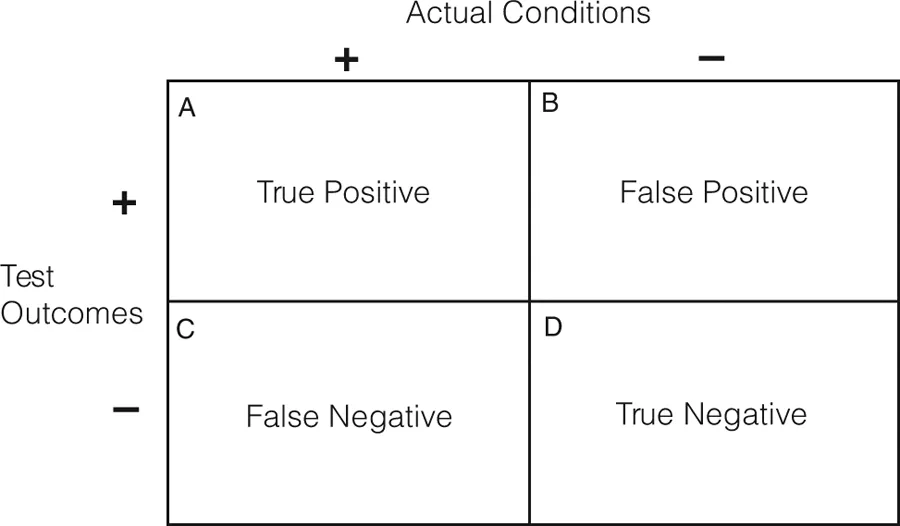
Figure 1.1 Sensitivity, specificity, positive and negative predictive value calculation.
- Type I error (α): reporting a difference when no difference exists (“false positive”)
- Type II error (β): reporting no difference when a difference exists (“false negative”)
- Power = 1 − type II error (β)
- Likelihood ratio positive (LR+) = sensitivity/(1 − specificity)
- Likelihood ratio negative (LR−) = (1 − sensitivity)/specificity
- Prevalence = actual condition / total population
- Odds ratio = LR+/LR−
- Posttest odds of disease = pretest odds of disease × LR
- Number needed to treat (NNT) = 1/(absolute risk reduction or risk difference)
- Absolute risk reduction (ARR): difference between event rates in the experimental and control groups
- Propensity score matching: method to adjust for observed characteristics of patients randomly assigned differing treatments
- Relative risk (RR): ratio of the probability of an event occurring in an exposed group over a comparison, nonexposed group
- Odds ratio (OR): measure of association between an exposure and an outcome. The OR represents the odds that an outcome will occur given a particular exposure compared to the odds of the outcome occurring in the absence of that exposure.
2 General Cardiology
- Framingham Risk Score includes (Ridker, Buring, Rifai, et al. 2007):
- Age
- Sex
- Total cholesterol
- High-density lipoprotein (HDL) cholesterol
- Systolic blood pressure (SBP)
- Smoking (Wilson, D’Agostino, Levy, et al. 1998)
- Reynolds Risk Score (for healthy patients without diabetes) includes:
- Age
- Total cholesterol (mg/dL)
- HDL cholesterol (mg/dL)
- SBP (mm Hg)
- Current smoking (yes or no)
- Parental history of myocardial infarction (MI) before age 60 years (yes or...
Table of contents
- Cover
- Title Page
- Copyright
- Contents
- Abbreviations
- Preface
- Acknowledgments
- 1. Statistics
- 2. General Cardiology
- 3. Physical Exam
- 4. EKG
- 5. Congenital Heart Disease
- 6. Valvular Heart Disease
- 7. Heart Failure/Transplant
- 8. Acute Coronary Syndromes
- 9. Pericardial Disease
- 10. Electrophysiology
- 11. Pharmacology
- 12. Pregnancy
- 13. Pulmonary Hypertension
- 14. Peripheral Vascular Disease
- 15. Echocardiography
- 16. Interventional Cardiology
- 17. Cardiac Tumors
- 18. Formulas
- References
- Index
- About the Author
Trusted by 375,005 students
Access to over 1.5 million titles for a fair monthly price.
Study more efficiently using our study tools.
Frequently asked questions
Yes, you can cancel anytime from the Subscription tab in your account settings on the Perlego website. Your subscription will stay active until the end of your current billing period. Learn how to cancel your subscription
No, books cannot be downloaded as external files, such as PDFs, for use outside of Perlego. However, you can download books within the Perlego app for offline reading on mobile or tablet. Learn how to download books offline
Perlego offers two plans: Essential and Complete
- Essential is ideal for learners and professionals who enjoy exploring a wide range of subjects. Access the Essential Library with 800,000+ trusted titles and best-sellers across business, personal growth, and the humanities. Includes unlimited reading time and Standard Read Aloud voice.
- Complete: Perfect for advanced learners and researchers needing full, unrestricted access. Unlock 1.5M+ books across hundreds of subjects, including academic and specialized titles. The Complete Plan also includes advanced features like Premium Read Aloud and Research Assistant.
We are an online textbook subscription service, where you can get access to an entire online library for less than the price of a single book per month. With over 1.5 million books across 990+ topics, we’ve got you covered! Learn about our mission
Look out for the read-aloud symbol on your next book to see if you can listen to it. The read-aloud tool reads text aloud for you, highlighting the text as it is being read. You can pause it, speed it up and slow it down. Learn more about Read Aloud
Yes! You can use the Perlego app on both iOS and Android devices to read anytime, anywhere — even offline. Perfect for commutes or when you’re on the go.
Please note we cannot support devices running on iOS 13 and Android 7 or earlier. Learn more about using the app
Please note we cannot support devices running on iOS 13 and Android 7 or earlier. Learn more about using the app
Yes, you can access Essential Facts in Cardiovascular Medicine by Yerem Yeghiazarians in PDF and/or ePUB format, as well as other popular books in Medicine & Cardiology. We have over 1.5 million books available in our catalogue for you to explore.