The Trafalgar Chronicle, the yearbook of The 1805 Club, has established itself as a prime source of information and the publication of choice for new research about the Georgian navy, sometimes also loosely called Nelson's navy. Successive editors have widened the scope to include all sailing navies of the period, while a recurring theme is the Trafalgar campaign and the epic battle of 21 October 1805. Contributors toTheTrafalgar Chroniclehave included leading experts in their field, whether they are Professor John Hattendorf from the US Naval War College in Newport, RI, Professor Andrew Lambert from Kings College, London, or antiquarians and enthusiasts. Each volume is themed and this new edition looks in detail at the Royal Marines and the United States Marine Corps. The RM were founded in 1664, but their 'royal' title was only granted to them on 29 April 1802. The USMC traces its roots to the Continental Marines of the American Revolutionary War (or American War of Independence), when two battalions were formed by Captain Samuel Nicholas after a resolution of the Second Continental Congress on 10 November 1775. Both corps have similar duties, then and now, and in this volume there are newly researched articles about their common roles in the age of sail. The main piece has been written by Major General Julian Thompson, and there are leading articles by American and British scholars including Dr Charles P Neimeyer, the Director and Chief of Marine Corps History at Marine Corps University, Quantico, Virginia. There is also a unique autobiography by a marine who took part in the battle of Trafalgar, the War of 1812, the bombardment of Algiers and the First Ashanti War. Other issues are investigated, including Victory's true colours in which Andrew Baines, ?Head of Historic Ships at the National Museum of the Royal Navy, describes the research which went into revealing how Nelson's flagship looked in 1805. Scholars and students, experts and enthusiasts fascinated by the era of the sailing navy will be absorbed by this handsomely illustrated journal.
eBook - ePub
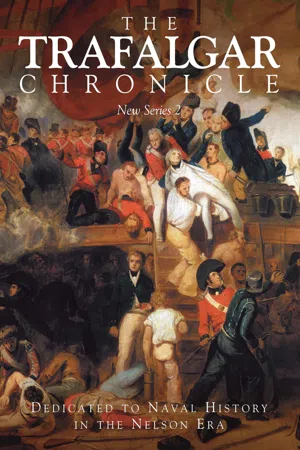
The Trafalgar Chronicle: New Series 2
Dedicated to Naval History in the Nelson Era
- 248 pages
- English
- ePUB (mobile friendly)
- Available on iOS & Android
eBook - ePub
About this book
Information
Subtopic
Military & Maritime HistoryIndex
HistoryNotes
The Marines: The Early Days
1 Britt Zerbe, The Birth of the Royal Marines, 1664–1802 (The Boydell Press, 2013), p22.
2 Ibid, p25.
3 Seymour’s 4th Foot, Saunderson’s 30th Foot, Villiers’s 31st Foot, and Fox’s 32nd Foot. A succession of amalgamations, name changes, and cuts in the years between 1714 and the present day have seen these regiments becoming: 4th Foot – part of The Duke of Lancaster’s Regiment; 30th Foot – part of The Duke of Lancaster’s Regiment; 31st Foot – part of The Princess of Wales’s Royal Regiment; 32nd Foot – part of The Rifles.
4 A Spanish coastguard cut off the ear of one Captain Jenkins, or so the captain claimed. Jenkins was brought before the House of Commons to exhibit his ear in a bottle. Winston Churchill wrote: ‘whether it was in fact his own ear or whether he had lost it in a seaport brawl remains uncertain, but the power of this shrivelled object was immense’. Winston Churchill, History of the English Speaking Peoples, Purnell, vol 5, chapter 2, p2104.
5 Zerbe, p44.
6 Ibid, p45.
7 Despite the imposition of a tariff on the price of commissions imposed by George I, who disapproved of purchase, there was a wide variation in the price of commissions. See Alan J Guy, Colonel Samuel Bagshawe and the Army of George II (Army Records Society, 1990), pp13–14 and 38 for a résumé of the system.
8 See also orders for the Officers of Marines on Board HMS Mars, 31 May 1799, in Brian Lavery (ed), Shipboard Life and Organisation, 1751–1815 (Navy Records Society), pp227–33.
9 See Andrew Lambert, The Challenge: Britain Against America in the Naval War of 1812 (Faber & Faber, 2012).
10 Admiral Carden in early 1915, at the start of the Dardanelles campaign.
11 Richard Brooks, The Royal Marines: 1664 to the Present (London: Constable, 2002), p10.
The Marines in Boston, 1774–75
1 Britt Zerbe, The Birth of the Royal Marines 1664–1802 (Woodbridge: Boydell Press, 2013), p229. See also Thomas Boas, “ For the glory of the Marines”. The organisation, training, uniforms, and combat role of the British Marines during the American revolution (Devon, Pennsylvania: Dockyard Press, 1993).
2 John Montagu, Earl of Sandwich, The private papers of John, Earl of Sandwich: First Lord of the Admiralty, 1771–1782, ed George R Barnes and John Owen (London: Navy Records Society, 1932), vol I, p55.
3 General Thomas Gage to Vice-Admiral Samuel Graves, 17 February 1774, in Naval documents of the American Revolution (NDAR), (Washington, DC: Government Printing Office, 1964), vol I, p31.
4 Major John Pitcairn to Lord Sandwich, 14 February 1775, in John Montagu, Earl of Sandwich, vol I, p58.
5 Major John Pitcairn to Lord Sandwich, 4 March 1775, in John Montagu, Earl of Sandwich, vol I, p60.
6 Ibid, p61.
7 Allen French, ‘The British expedition to Concord, Massachusetts, in 1775’, The Journal of the American Military Foundation, I (1937), pp1–17; Major John Pitcairn’s Report to General Gage, 26 April 1775: www.digitalhistory.uh.edu/active_learning/explorations/revolution/account3_lexington.cfm.
8 ‘A circumstantial Account of an attack that happened, on the 19th April, 1775, on his Majesty’s Troops by a number of the people of the Province of the Massachusetts-Bay’, in NDAR, vol I, p195. See also david H Fischer, Paul Revere’s ride (New York: Oxford University Press, 1994).
9 Nathaniel Philbrick, Bunker Hill. A city, a siege, a revolution (London: doubleday, 2013), p128.
10 John Barker, The British in Boston being the diary of Lieutenant John Barker of the King’s Own Regiment from November 15, 1774 to May 31, 1776, ed Elizabeth E dana (Cambridge, Massachusetts: Harvard University Press, 1924), p35.
11 Cyril Field, Britain’s sea-soldiers. A history of the Royal Marines and their predecessors (Liverpool: The Lyceum Press, 1924), vol I, p151.
12 Ibid.
13 ‘Narrative of Vice Admiral Samuel Graves’, 19 April 1775, in NDAR, vol I, p193.
14 Craig J Brown, Victor T Mastone and Christopher V Maio, ‘The revolutionary war battle America forgot: Chelsea Creek, 27–28 May 1775’, The New England Quarterly, 86:3 (2013), pp398–432.
15 Vice Admiral Samuel Graves to General Thomas Graves, 25 May 1775, in NDAR, vol I, pp523–4.
16 General J Burgoyne to Lord Stanley, 25 June 1775, in C Field, vol I, pp154–6.
17 Ibid, p155.
18 Richard M Ketchum, The battle for Bunker Hill (London: Cresset Press, 1963), p121. See also Richard Frothingham, History of the siege of Boston and the battles of Lexington, Concord, and Bunker Hill (Boston: Charles C Little and James Brown, 1896).
19 Samuel Gillespie, An historical review of the Royal Marine Corps, from its original institut...
Table of contents
- Cover
- Title
- Copyright
- CONTENTS
- President’s Foreword – Admiral Sir Jonathon Band
- Editor’s Foreword – Peter Hore
- The Marines: The Early days – Julian Thompson
- The Marines in Boston, 1774–75 – Anthony Bruce
- Leathernecks: The US Marine Corps in the Age of the Barbary Pirates – Charles Neimeyer
- ‘Against the Common Enemies’: American Allies and Partners in the First Barbary War – Benjamin Armstrong
- Captain Ingram, the Sea Fencibles, the Signal Stations and the defence of dorset – david Clammer
- That Matchless Victory: Trafalgar, the Royal Marines and Sea Battle in the Age of Nelson – Britt Zerbe
- Loyal Au Mort: The Adairs at the Battle of Trafalgar – Allan Adair
- Marine Stephen Humphries 1786–1865 – By Himself
- The Royal Marines Battalions in the War of 1812 – Alexander Craig
- The First Royal Marine Battalion’s Peninsular War 1810–1812 – Robert k Sutcliffe
- The ‘Blue Colonels’ of Marines: Sinecure and Shaping the Royal Marine Identity – John d Bolt
- The Royal Marine Uniform Sword by Blake, London, Provenanced to Captain Richard Welchman, Royal Marines – Sim Comfort
- Captain Philip Gidley king, Royal Navy, Third Governor of New South Wales – Tom Fremantle
- Captain James Cottell: The Pictorial Life of a Trafalgar Veteran – John Rawlinson
- The Rise and Fall of the Bourbon Armada, 1744–1805: From Toulon to Trafalgar – Larrie d Ferreiro
- Smuggling and Blockade-Running during the Anglo-danish War of 1807–14 – Jann M Witt
- Contributors’ Biographies
- Notes
- Plate section
Trusted by 375,005 students
Access to over 1.5 million titles for a fair monthly price.
Study more efficiently using our study tools.
Frequently asked questions
Yes, you can cancel anytime from the Subscription tab in your account settings on the Perlego website. Your subscription will stay active until the end of your current billing period. Learn how to cancel your subscription
No, books cannot be downloaded as external files, such as PDFs, for use outside of Perlego. However, you can download books within the Perlego app for offline reading on mobile or tablet. Learn how to download books offline
Perlego offers two plans: Essential and Complete
- Essential is ideal for learners and professionals who enjoy exploring a wide range of subjects. Access the Essential Library with 800,000+ trusted titles and best-sellers across business, personal growth, and the humanities. Includes unlimited reading time and Standard Read Aloud voice.
- Complete: Perfect for advanced learners and researchers needing full, unrestricted access. Unlock 1.5M+ books across hundreds of subjects, including academic and specialized titles. The Complete Plan also includes advanced features like Premium Read Aloud and Research Assistant.
We are an online textbook subscription service, where you can get access to an entire online library for less than the price of a single book per month. With over 1.5 million books across 990+ topics, we’ve got you covered! Learn about our mission
Look out for the read-aloud symbol on your next book to see if you can listen to it. The read-aloud tool reads text aloud for you, highlighting the text as it is being read. You can pause it, speed it up and slow it down. Learn more about Read Aloud
Yes! You can use the Perlego app on both iOS and Android devices to read anytime, anywhere — even offline. Perfect for commutes or when you’re on the go.
Please note we cannot support devices running on iOS 13 and Android 7 or earlier. Learn more about using the app
Please note we cannot support devices running on iOS 13 and Android 7 or earlier. Learn more about using the app
Yes, you can access The Trafalgar Chronicle: New Series 2 by Peter Hore in PDF and/or ePUB format, as well as other popular books in History & Military & Maritime History. We have over 1.5 million books available in our catalogue for you to explore.