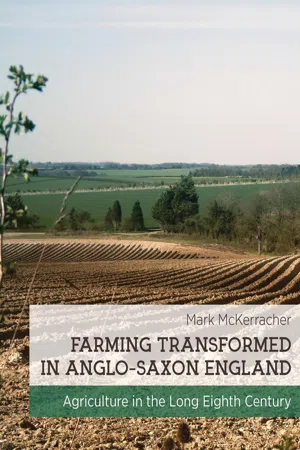
Anglo-Saxon farming has traditionally been seen as the wellspring of English agriculture, setting the pattern for 1000 years to come – but it was more important than that. A rich harvest of archaeological data is now revealing the untold story of agricultural innovation, the beginnings of a revolution, in the age of Bede. Armed with a powerful new dataset, Farming Transformed explores fundamental questions about the minutiae of early medieval farming and its wider relevance. How old were sheep left to grow, for example, and what pathologies did cattle sustain? What does wheat chaff have to do with lordship and the market economy? What connects ovens in Roman Germany with barley maltings in early medieval Northamptonshire? And just how interested were Saxon nuns in cultivating the opium poppy? Farming Transformed is the first book to draw together the variegated evidence of pollen, sediments, charred seeds, animal bones, watermills, corn-drying ovens, granaries and stockyards on an extensive, regional scale. The result is an inter-disciplinary dataset of unprecedented scope and size, which reveals how cereal cultivation boomed, and new watermills, granaries and ovens were erected to cope with – and flaunt – the fat of the land. As arable farming grew at the expense of pasture, sheep and cattle came under closer management and lived longer lives, yielding more wool, dairy goods, and traction power for plowing. These and other innovations are found to be concentrated at royal, aristocratic and monastic centers, placing lordship at the forefront of agricultural innovation, and farming as the force behind kingdom-formation and economic resurgence in the seventh and eighth centuries.
- 144 pages
- English
- ePUB (mobile friendly)
- Available on iOS & Android
eBook - ePub
Farming Transformed in Anglo-Saxon England
About this book
Information
Subtopic
British HistoryIndex
Social SciencesCHAPTER 1
The lie of the land
Farming defined the Anglo-Saxon world. For the most part, its settlements were rural, its labours agricultural. Agrarian matters pervaded law-codes, riddles, miracle stories, educational texts and the reckoning of time. Land was measured less by physical extent than by agricultural capacity. Farming fed the wealth, war, craft and culture of Anglo-Saxon society; its heart beat to agrarian rhythms.
Despite being so central to the lives of Anglo-Saxon communities, agriculture has long been peripheral to Anglo-Saxon studies. A persistent dearth of evidence has rendered farming something of a poor relation, merely an assumed backdrop to greater social, political and economic themes. In particular, the scant evidence from written sources has long failed to provide any real narrative of agricultural change across the Anglo-Saxon period, between the fifth and eleventh centuries AD. It seems improbable that so long a span could have witnessed no development in farming practices but, until recently, any such processes have remained thoroughly obscure, as Hunter Blair observed:
‘Wherever we look – to livestock, to cereals, to root crops, to the orchard or to the kitchen garden, it is difficult to find any evidence, at least from the earlier part of the Anglo-Saxon period, suggesting any notable innovations in comparison with the Romano-British period.’ (Hunter Blair 1977, 272–273)
Over the last 40 years, however, and especially since 1990, the situation has been radically improved by an abundant harvest of new data. These decades have witnessed an extraordinary growth in Anglo-Saxon settlement archaeology, coupled with the increasingly systematic recovery and analysis of animal bones and plant remains. The study of Anglo-Saxon agriculture no longer lies outside the realm of the archaeologist, as it did for much of the twentieth century. On the contrary, a substantial, variegated dataset is now available to the agricultural archaeologist of this period. Already these developments are bearing fruit, and recent scholarship heralds an exciting new phase of research into the early medieval countryside, with landscape and settlement research by Hamerow, Rippon and Blair; seminal work on field systems by Oosthuizen, Williamson and Hall; landmark animal bone studies by Crabtree and Holmes; and the first book-length, overarching survey of the whole topic by Banham and Faith (Hamerow 2012; Oosthuizen 2013a; Williamson 2013; Hall 2014; Crabtree 2012; Holmes 2014; Banham & Faith 2014; Rippon et al. 2015; Blair 2013b).
Nonetheless, to date only a very few studies have closely interrogated the wide-ranging and diffuse archaeological datasets that are now available, each focusing upon a specific category of evidence such as animal bones or field systems. This book is the first systematically to draw together the evidence of pollen, sediments, charred seeds, animal bones, watermills, corn-drying ovens, granaries and stockyards on an extensive, regional scale, weaving together multiple strands of evidence in a view of agricultural development as a whole process. It utilises and integrates a diverse body of archaeological data for the first time, in order to tell a new story of farming transformed in Anglo-Saxon England.
Traditionally, Anglo-Saxon farming has been seen as the wellspring of English agriculture, setting the pattern for a thousand years to come – but it was more important than that. This book argues that the fields, ploughs, crops and livestock of Anglo-Saxon England were important not simply as the forerunners of later rural traditions, but as vital parts of the economies, cultures and societies of early medieval Britain. It focuses in particular on changes in farming practices between the seventh and ninth centuries. This period is already well known among historians and archaeologists as the time when Anglo-Saxon kingdoms and lordship became consolidated; when towns returned to the landscape for the first time since the Roman period, accompanied by an escalation in long-distance trade and craft production; and when monasteries proliferated, made wealthy by huge grants of land. This book argues that all of these momentous trends were underpinned and powered by fundamental transformations in farming. Anglo-Saxon England first came of age in its pastures and ploughland.
Previous studies have seen in this period the foundations of medieval English wool production and wheat cultivation. This book proposes a more complex picture of regional variation and specialisation. Cereal cultivation expanded massively as crop-choices were increasingly fine-tuned to local environmental conditions. New watermills, granaries and ovens were erected to cope with, and flaunt, the fat of the land. As arable farming grew at the expense of pasture, sheep and cattle came under closer management and lived longer lives, yielding more wool, dairy goods, and traction power for ploughing. These and other innovations were concentrated at royal, aristocratic and monastic centres, placing lordship at the forefront of agricultural innovation, and farming as the force behind kingdom-formation and economic resurgence in the age of Bede.
England in the ‘long eighth century’
My focus upon the seventh to ninth centuries follows current trends in Anglo-Saxon scholarship, recognising this as a time of major social and economic change, in agriculture as in other spheres. Historians of early medieval Europe now write of the ‘long eighth century’ – encompassing the later seventh to earlier ninth centuries – as the first recognisable period when Europe emerged from its post-Roman chrysalis in a coherent new form, newly mindful of its classical heritage but following different, post-classical trajectories (Wickham 2000, ix). North-western Europe in this period was dominated – culturally, intellectually and, in some ways, politically – by Carolingian Francia which, under Charlemagne, underwent something of a classical revival in learning and law-giving. Monastic scriptoria pursued the study and copying of ancient texts, including agronomic works, while Charlemagne’s legislation included what has been described as ‘an explicit agrarian policy’ (Butzer 1993, 558–573).
Between the seventh and ninth centuries, Anglo-Saxon England was drawn into this world: integration into European Christendom, with its rich ecclesiastical culture and fertile intellectual climate, gave rise to monastic schools of spectacular artwork and scholarship, not to mention expanding political and mercantile horizons (Webster 2012, 69–115). Later history confirms the cultural and economic impact of these centuries upon the Anglo-Saxon kingdoms. Certainly by the ninth and tenth centuries, for instance, the wealth of England – founded ultimately in agriculture – was sufficient to attract Viking raiders and then invaders, to buy peace from the same at hefty prices, and to support a network of fortified towns (burhs) to defend the imperilled realms (Higham & Ryan 2013, 232–322). When viewed from this perspective, it is difficult to imagine English agriculture not developing through the long eighth century.
And yet, in some ways, this is a comparatively recent view. In the later nineteenth and earlier twentieth centuries, there arose a general consensus among historians that the earlier part of the Anglo-Saxon period – the fifth and sixth centuries AD – had witnessed the most significant innovations in early medieval farming: namely, the introduction of heavy ploughing and open field systems, as part of an integrated Germanic package which ultimately foreshadowed medieval English farming (Whitelock 1952, 14; Hoskins 1955, 55). Such a view was consistent with the prevailing culture-historical paradigms of the time, in which the spread of ideas was correlated directly with the spread of peoples. In this model, the fifth and sixth centuries were seen as a period of major population flux, with Anglo-Saxon settlers widely – sometimes violently – displacing native Britons, and transforming the empty, wilding wastes of the post-Roman countryside into something more regular, more Germanised and, eventually, English. Largely circumstantial evidence, including the distribution of Old English place-names, was cited in support of this view. Compact ‘Anglo-Saxon’ villages and open fields were contrasted with ‘Celtic’ patterns of dispersed settlement and irregular fields (Green 1885, 138, 154; Maitland 1897, 15; Gray 1915, 409–418).
Such traditional narratives have long since been disputed, for several reasons. Not least among these reasons is the decoupling of migration from innovation in archaeological theory. The movement of ideas is no longer so readily ascribed to the spread of peoples. Besides this paradigm shift, various arguments have since been made against the traditional models of utter Germanisation in post-Roman Britain, whether genetic, cultural or agrarian (Hamerow 1997). Farming between the fifth and seventh centuries is now more commonly perceived as having undergone contraction and simplification, not wholesale innovation or restructuring. By contrast, the history and archaeology of the seventh to ninth centuries – spanning the long eighth century and sometimes known to archaeologists as the Mid- or Middle Saxon period – are increasingly being deemed more consistent with a model of agricultural development (Faith 2009; Rippon 2010).
It is a key premise of this book that the seventh to ninth centuries witnessed a profound change in the relationship between people and landscape in Anglo-Saxon England. This claim can be supported even before one considers specifically the evidence for farming. First, there is the political narrative, strikingly illustrated by the archaeology of the period. The later sixth and seventh centuries encompassed the crystallisation and consolidation of the kingdoms and aristocracies which came to dominate later Saxon England. New élite identities found emphatic expression in lavishly furnished burials such as those at Sutton Hoo (Suffolk), now known as ‘princely graves’, and settlement complexes with great halls, such as at Cowdery’s Down (Hampshire). Both are vivid testimony to lordly command of wealth, labour and natural resources in this period (Wickham 2009, 157–158; Welch 2011, 269–275; Hamerow 2012, 102).
There are important implications here for agricultural history. Not only could the greater political stability thus represented have been conducive to developments in farming, but also, more specifically, these emergent élites seem to have been closely concerned and connected with agriculture. Despite its popular image as a turbulent warrior society, Anglo-Saxon England was fundamentally and necessarily an agricultural society, whose lords depended on farmers more than fighters. Kingly concern for the productive landscape was enshrined in law-codes. The late seventh-century laws of Ine of Wessex clearly demonstrate the importance of farmland in the mind-set of Anglo-Saxon royalty, dealing with issues from the fencing or hedging of shared land, to the hiring of oxen and the shearing of sheep (EHD no. 32, §§40–69). The agrarian foundations of élite wealth are even more directly attested by extant food-rents, detailing the goods to be extracted by itinerant kings and royal retinues as they traversed their subject territories. Again, Ine’s Laws include a famous example (EHD no. 32, §70.1). Such concerns are also evident in charters which recorded royal land-grants from the late seventh century onwards, first for ecclesiastical beneficiaries and then, from the later eight...
Table of contents
- Front Cover
- Title Page
- Copyright Page
- Contents
- List of figures
- List of tables
- Abbreviations
- Acknowledgements
- 1. The lie of the land
- 2. Farm and field
- 3. Beast and bone
- 4. The growth of arable
- 5. The changing harvest
- 6. Farming transformed
- Appendix: gazetteer of sites
- Bibliography
Trusted by 375,005 students
Access to over 1.5 million titles for a fair monthly price.
Study more efficiently using our study tools.
Frequently asked questions
Yes, you can cancel anytime from the Subscription tab in your account settings on the Perlego website. Your subscription will stay active until the end of your current billing period. Learn how to cancel your subscription
No, books cannot be downloaded as external files, such as PDFs, for use outside of Perlego. However, you can download books within the Perlego app for offline reading on mobile or tablet. Learn how to download books offline
Perlego offers two plans: Essential and Complete
- Essential is ideal for learners and professionals who enjoy exploring a wide range of subjects. Access the Essential Library with 800,000+ trusted titles and best-sellers across business, personal growth, and the humanities. Includes unlimited reading time and Standard Read Aloud voice.
- Complete: Perfect for advanced learners and researchers needing full, unrestricted access. Unlock 1.5M+ books across hundreds of subjects, including academic and specialized titles. The Complete Plan also includes advanced features like Premium Read Aloud and Research Assistant.
We are an online textbook subscription service, where you can get access to an entire online library for less than the price of a single book per month. With over 1.5 million books across 990+ topics, we’ve got you covered! Learn about our mission
Look out for the read-aloud symbol on your next book to see if you can listen to it. The read-aloud tool reads text aloud for you, highlighting the text as it is being read. You can pause it, speed it up and slow it down. Learn more about Read Aloud
Yes! You can use the Perlego app on both iOS and Android devices to read anytime, anywhere — even offline. Perfect for commutes or when you’re on the go.
Please note we cannot support devices running on iOS 13 and Android 7 or earlier. Learn more about using the app
Please note we cannot support devices running on iOS 13 and Android 7 or earlier. Learn more about using the app
Yes, you can access Farming Transformed in Anglo-Saxon England by Mark McKerracher in PDF and/or ePUB format, as well as other popular books in Social Sciences & British History. We have over 1.5 million books available in our catalogue for you to explore.