eBook - ePub
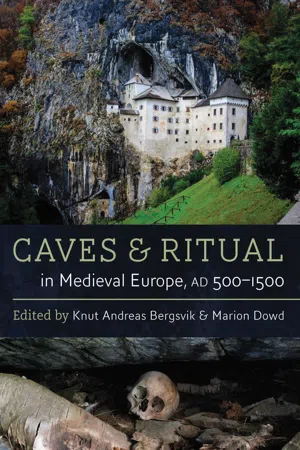
Caves and Ritual in Medieval Europe, AD 500-1500
- 376 pages
- English
- ePUB (mobile friendly)
- Available on iOS & Android
eBook - ePub
Caves and Ritual in Medieval Europe, AD 500-1500
About this book
Caves and rockshelters in Europe have traditionally been associated with prehistory, and in some regions cave archaeology has become synonymous with the Palaeolithic. However, there is abundant evidence that caves and rockshelters were important foci for activities in historic times. During the medieval period (here taken as AD 500–1500) caves were used for short-term shelter, habitation, specialised craft activities, storage, as hideaways and for tending animals. Caves were also used for religious purposes. Caves and ritual in medieval Europe, AD 500–1500 focuses on this neglected field of research – the ritual and religious use of caves. It draws together interdisciplinary studies by leading specialists from across Europe: from Iberia to Crimea, and from Malta to northern Norway. The different religions and rituals in this vast area are unified by the use of caves and rockshelters, indicating that the beliefs in these natural places – and in the power of the underworld – were deeply embedded in many different religious practices. Christianity was widespread and firmly established in most of Europe at this time, and many of the contributions deal with different types of Christian practices, such as the use of rock-cut churches, unmodified caves for spiritual retreat, caves reputedly visited by saints, and caves as places for burials. But parallel to this, some caves were associated with localised popular religious practices, which sometimes had pre-Christian origins. Muslims in Iberia used caves for spiritual retreat, and outside the Christian domain in northern Europe, caves and rockshelters were places for carving symbols among Pictish groups, places for human burial, for bear burials amongst the Sámi, and places for crafting and votive deposition for Norse populations.
Information
Subtopic
European HistoryIndex
Social SciencesChapter 1
Caves and rockshelters in medieval Europe: religious and secular use
Knut Andreas Bergsvik and Marion Dowd
Caves have fascinated humans from the earliest times. Though natural geological features, caves can feel supernatural, unpredictable, animated, dangerous but also inviting. From the birth of the discipline of archaeology in the mid-1800s, caves have attracted the attention of antiquarians and archaeologists. Traditionally, caves were targeted in the search for Palaeolithic deposits, not least because the stable underground environment favours the preservation and survival of organic material. The most important early hominid and Palaeolithic finds from around the world, for instance, have come from caves and the subterranean world continues to produce the most scientifically ground-breaking archaeological discoveries (e.g. the Sterkfontein and Rising Star caves of the so-called Cradle of Humankind in South Africa). Not surprisingly, therefore, cave archaeology has become synonymous with the Palaeolithic. Caves and rockshelters, however, are multi-period sites but because of their long use-histories, many Palaeolithic cave excavations involved digging through (and frequently discarding) deep cultural layers from later prehistoric and historic periods. When archaeological material of later date was retrieved from early excavations, it was usually a by-product of Palaeolithic research.
Things have started to change in recent years and younger stratigraphy from caves has begun to attract greater attention. The number of archaeological excavations focussed on later periods of cave activities is increasing, as is the publication of such assemblages and sites (e.g. Dowd 2015, and contributions in edited volumes such as Branigan and Dearne 1992; Tolan-Smith and Bonsall 1997; Kornfeld et al. 2007; Bergsvik and Skeates 2012; Moyes 2012; Mavridis and Jensen 2013; Dowd 2016). Overall, studies from across Europe demonstrate a remarkable variation in terms of how caves and rockshelters were used in all archaeological periods, from the Palaeolithic through to recent centuries. The evidence can vary from sites utilised briefly during hunting and fishing expeditions, to caves that were greatly modified and intensively used for ritual activities – and in both instances examples can be found from every archaeological period. Such diversity is also found during the Middle Ages in Europe.
Of all archaeological periods, it could be argued that the medieval usage of caves has been the most overlooked. There are at least two reasons that can partially explain this neglect. Firstly, stratigraphically, the upper layers in cave sediments are more vulnerable to natural or cultural formation processes, disturbance and destruction than deeper, older strata. Frequently antiquarians and archaeologists were to blame for the removal, destruction and/or disposal of medieval cultural layers without any analysis, as de Vingo notes for Italy and southern France (chapter 10). The situation in Poland and the Czech Republic is similar where publications on Palaeolithic material might refer to the discovery of medieval artefacts in caves, but these never made their way into museum collections; at some Polish sites, organic material from upper historic strata was even used for the production of guano (see Wojenka, chapter 14; Peša, chapter 15; and Golec, chapter 16). Prijatelj reports that the medieval use of caves has been almost totally overlooked in Slovenian scholarship (chapter 17), and Hommedal discusses the consequences of the less than ideal excavations of the Selja caves that took place in the mid-1800s (chapter 4). There are also problems with artificial rock-cut ‘caves’. As Schulze-Dörrlamm (chapter 13) highlights, the subsequent use of medieval cave churches and monasteries left little for archaeologists to study apart from architectural details, inscriptions and wall paintings.
The second reason which partially explains the scholarly neglect of medieval cave use is that medieval archaeology has had a particular research history distinct from that of earlier periods. The above-ground register of medieval monuments and buildings meant that antiquarian scholars focussed primarily on architecture and art history. Modern scholarship has inherited the antiquarian bias towards medieval monuments erected by the political and clerical élite. When medieval archaeology began to develop as a discipline in the 1950s and 1960s, caves once again fell outside of mainstream research in favour of medieval towns and the extensive cultural layers and excellent preservation often encountered in urban environments (e.g. Graham-Campbell and Valor 2007; Carver and Klápště 2011). Although the focus gradually shifted towards the archaeology of the ‘ordinary people’ of the Middle Ages and their material culture, it tended to be populations who lived in urban rather than rural areas. Rural communities and the areas where most caves and rockshelters are situated were rarely if ever studied. In later years, contract/commercial (or ‘rescue’) archaeology did involve archaeological excavations in rural districts across Europe, but caves and rockshelters again passed under the radar as most large-scale projects involved the construction of infrastructure or industries in open agricultural landscapes where caves and rockshelters did not exist as they are a largely karst phenomenon. In summary, up to the present day, caves have scarcely ever featured in medieval research and they play a minor role in overviews and reference works devoted to the period. A quick search for the words ‘cave’ or ‘rockshelter’ in the indices of texts on medieval history and archaeology demonstrate this point.
The aim of this collection, then, is to cast some light on what has been an entirely neglected field of research. With contributions from different parts of Europe, the broad range of religious, ritual and secular roles that caves and rockshelters assumed in the lives of medieval people soon becomes apparent. Below we touch upon some of the main themes explored by the various authors, but in the first instance it is necessary to discuss some issues of terminology.
The difference between a cave, rockshelter and artificial ‘cave’
For the purposes of this book, and in line with most cave archaeology research, a cave can be defined as any natural underground cavity in rock that is formed by the solvent and erosive action of surface water as it slowly travels downwards through joints, bedding planes and fissures (Coleman 1965, 84; Fogg and Fogg 2001, 149). Caves occur in permeable and soluble rock types with poor porosity – which in Europe consist primarily of limestone. Composed chiefly of calcite, limestone is dissolved by the slightly acidic carbon dioxide contained in surface water, particularly rainwater and tannic acid from upland bogs. Over millennia, the continuous flow of erosive water combined with gradual chemical erosion cause underground fissures and joints to slowly enlarge, eventually developing into cave chambers and passages (Mitchell and Ryan 2001, 14–15). Caves vary enormously in size and, technically, can include passages just a few metres to many kilometres in length. One of the defining characteristics is the level of natural light. Small caves and the outer parts of large systems are bathed in sunlight by day, giving rise to the term ‘daylight zone’. Artificial light is optional for most activities in the daylight zone of caves, hence their attractiveness to humans over millennia for habitation, shelter and craft activities. The ‘twilight zone’ of a cave occurs deeper inside large cave systems – an area where low light dominates and the levels change (often imperceptibly) according to the time of day or season. The ‘dark zone’ only occurs in very deep caves where absolutely no natural daylight penetrates. These spaces are permanently shrouded in impenetrable darkness, yet have also attracted human activities – primarily of a ritual nature but also as hideaways. The dark zone is not conducive to habitation because of the need for artificial lightning, low temperatures and dampness. Despite the modern pervasive cliché of prehistoric (and sometimes historic) ‘cave-men’, archaeology provides little evidence – from any period – that people actually lived in the deepest, darkest extremities of caves. Traces of dwelling and settlement activities (when identified) are typically found in the daylight zone at cave entrances or within rockshelters.
Caves can also develop in coastal areas that are exposed to relentless wave action which, together with large stones, serves to erode and enlarge natural rock fissures and clefts. Sea caves are usually shallower than karst caves, but some are deep and can have twilight zones and occasionally even dark zones (e.g. Bjerck 2012). Rockshelters, as the name suggests, comprise spaces that receive protection from overhanging rock, generally a consequence of the natural erosion of a soft rock face leaving a harder ‘lip’ of rock jutting out overhead. Yet another site type is the boulder chamber, occurring in isolation or in scree. These natural tumbles of boulders sometimes enclose chambers or shelters. Rockshelters and boulder chambers tend to be fully or partially exposed to daylight but afford some shelter from the elements, and thus have long been utilised for short-term occupation, as animal shelters and occasionally for rituals. Artificial ‘caves’ include artificially rock-cut subterranean chambers that share similar features to natural caves. Such sites typically occur in regions where natural caves are absent or in hot countries where there is an abundance of soft rock that can be easily dug out. Some artificial caves may originally have been natural caverns that were modified and enlarged beyond recognition, such as certain cave churches or catacombs. Artificial ‘caves’ also include chambers that were constructed of stone or similar building materials with the intention of mimicking a natural cave.
It has been convincingly argued that caves and rockshelters should not be considered a single category in terms of understanding ritual activities. In Mesoamerican archaeology, for instance, the distinction between caves and rockshelters is based on the presence or absence of a dark zone which significantly influences the nature of ritual activities and also determines whether a site is suitable for ritual or secular purposes (Clottes 2012; Moyes and Brady 2012). The dark zones of caves are particularly wellsuited to ritual because of the affordances of seclusion and privacy, and the frequent perception of the subterranean as an otherworldly and timeless environment (see articles in Dowd and Hensey 2016). In this book, Arias et al. (chapter 8) deal with funerary rites that took place in the darkness of La Garma cave in northern Spain, and Prijatelj (chapter 17) discusses several examples of sites in Slovenia where darkness played an important role in Late Antique funerary customs.
As darkness is a central requirement for rituals at many cave sites, it is essential to distinguish between caves with a dark zone and sites which at best provide semidark environments, such as shallow caves, rockshelters, boulder chambers and some variants of rock-cut ‘caves’. Unfortunately, the quality and quantity of light is seldom specified in site reports and publications (Taçon et al. 2012, 136), and rarely in this publication – which means that further work is required of archaeologists in considering this vital aspect of caves. Darkness is, however, not the only element of the subterranean that enhances or accommodates ritual activity. Factors such the stable and unchanging character of sites, the protection offered by caves and rockshelters, and occasionally restricted accessibility are considered important by many scholars (e.g. Bradley 2000; Dowd 2015). Numerous studies from around the world illustrate that rituals have taken place in the daylight zones of caves and rockshelters (e.g. Lewis-Williams and Dowson 1990; Layton 1992; Baird et al. 2011; Prufer and Prufer 2012), and this book provides even more examples, particularly from northern Europe.
Chronology and the Middle Ages
Depending on different regional circumstances, there is great variety as to when the Middle Ages began depending on historic events and processes across Europe (Høiris and Ingesman 2010). Similarly, the end of the Middle Ages has been set as early as the mid-thirteenth century and as late as the early sixteenth century (Hoyt 1966, 1). This book covers various cultural regions in Europe where different date ranges are relevant. In Crimea many scholars argue for a commencement date in the 5th century. In Ireland, for instance, the ‘early medieval’ period commences with the introduction of Christianity about AD 400 and ends with the Anglo-Normal invasion of 1169, while in much of southern, western and central Europe the collapse of the Western Roman Empire in AD 476 is regarded as a key event in defining the origins of the Middle Ages. In some of the countries discussed in this book – such as Spain, Italy, France, Germany, the Czech Republic and Poland – AD 500 is conveniently set as a start date for the Middle Ages, while c. AD 600 is relevant to Malta, Great Britain and Slovenia. Further north, the conversion to Christianity is again considered a defining milestone and approximately AD 1000 marks the beginning of the Middle Ages in Norway and Iceland.
Because the medieval period is thus considered by archaeologists and historians to begin and end at different times in different countries, in this book we have adopted the most inclusive chronological timeframe possible of AD 500–1500. We have sought not to standardise the terms used for this chronological period, thus in some countries the timeframe in question incorporates both the ‘early medieval’ and ‘high medieval’ periods (e.g. Ireland), while elsewhere scholars would use the term ‘Middle Ages’ (e.g. Czech Republic). The majority of the papers here consider activities at caves and rockshelters within the timeframe of AD 500–1500 (often more restricted than this broad timeframe); however, some chapters also expand into preceding and succeeding periods as some of the patterns that occur during the Middle Ages originated before this period or extended beyond it. Thus, de Vingo (chapter 10), M. Buhagiar (chapter 11) and Prijatelj (chapter 17) all consider Antique (Roman) use of caves in Italy/France, Malta and Slovenia respectively, while Prijatelj (chapter 17) and Dowd (chapter 7) explore aspects of post-medieval cave use. Svestad adopts a long durée approach covering the period c. 900 BC–AD 1700.
One of our primary aims has been to demonstrate the widespread and persistent phenomenon of religious/ritual cave use in medieval times across widely disparate regions of Europe, addressing Christian activities but also how caves and rockshelters were perceived and used by peo...
Table of contents
- Cover
- Title
- Copyright
- Contents
- Preface
- List of contributors
- Chapter 1: Caves and rockshelters in medieval Europe: religious and secular use - Knut Andreas Bergsvik and Marion Dowd
- PART I: NORTHWESTERN EUROPE
- PART II: IBERIA AND THE MEDITERRANEAN
- PART III: CENTRAL AND EASTERN EUROPE
Trusted by 375,005 students
Access to over 1.5 million titles for a fair monthly price.
Study more efficiently using our study tools.
Frequently asked questions
Yes, you can cancel anytime from the Subscription tab in your account settings on the Perlego website. Your subscription will stay active until the end of your current billing period. Learn how to cancel your subscription
No, books cannot be downloaded as external files, such as PDFs, for use outside of Perlego. However, you can download books within the Perlego app for offline reading on mobile or tablet. Learn how to download books offline
Perlego offers two plans: Essential and Complete
- Essential is ideal for learners and professionals who enjoy exploring a wide range of subjects. Access the Essential Library with 800,000+ trusted titles and best-sellers across business, personal growth, and the humanities. Includes unlimited reading time and Standard Read Aloud voice.
- Complete: Perfect for advanced learners and researchers needing full, unrestricted access. Unlock 1.5M+ books across hundreds of subjects, including academic and specialized titles. The Complete Plan also includes advanced features like Premium Read Aloud and Research Assistant.
We are an online textbook subscription service, where you can get access to an entire online library for less than the price of a single book per month. With over 1.5 million books across 990+ topics, we’ve got you covered! Learn about our mission
Look out for the read-aloud symbol on your next book to see if you can listen to it. The read-aloud tool reads text aloud for you, highlighting the text as it is being read. You can pause it, speed it up and slow it down. Learn more about Read Aloud
Yes! You can use the Perlego app on both iOS and Android devices to read anytime, anywhere — even offline. Perfect for commutes or when you’re on the go.
Please note we cannot support devices running on iOS 13 and Android 7 or earlier. Learn more about using the app
Please note we cannot support devices running on iOS 13 and Android 7 or earlier. Learn more about using the app
Yes, you can access Caves and Ritual in Medieval Europe, AD 500-1500 by Knut Andreas Bergsvik, Marion Dowd, Knut Andreas Bergsvik,Marion Dowd, Knut Bergsvik, Marion Dowd in PDF and/or ePUB format, as well as other popular books in Social Sciences & European History. We have over 1.5 million books available in our catalogue for you to explore.