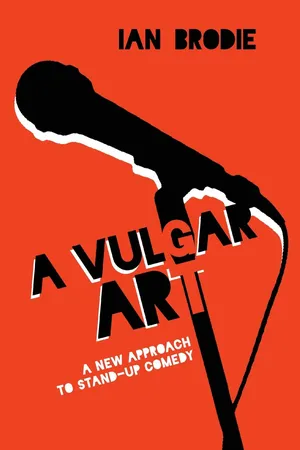
In A Vulgar Art, Ian Brodie uses a folkloristic approach to stand-up comedy, engaging the discipline's central method of studying interpersonal, artistic communication and performance. Because stand-up comedy is a rather broad category, people who study it often begin by relating it to something they recognize—"literature" or "theatre"; "editorial" or "morality"—and analyze it accordingly. A Vulgar Art begins with a more fundamental observation: someone is standing in front of a group of people, talking to them directly, and trying to make them laugh. So, this book takes the moment of performance as its focus, that stand-up comedy is a collaborative act between the comedian and the audience. Although the form of talk on the stage resembles talk among friends and intimates in social settings, stand-up comedy remains a profession. As such, it requires performance outside of the comedian's own community to gain larger and larger audiences. How do comedians recreate that atmosphere of intimacy in a roomful of strangers? This book regards everything from microphones to clothing and LPs to Twitter as strategies for bridging the spatial, temporal, and sociocultural distances between the performer and the audience.
- 240 pages
- English
- ePUB (mobile friendly)
- Available on iOS & Android
eBook - ePub
About this book
Trusted by 375,005 students
Access to over 1.5 million titles for a fair monthly price.
Study more efficiently using our study tools.
Information
Subtopic
TelevisionPART 1
The Opener: From Folk Talk to Stand-Up
Okay [L]
good evening ladies and gentlemen thank you for uh coming out tonight to the Lakeshore Theater to see me uh talk [W]
that’s what I’m going to be doing
this is going to be . . .
I don’t know how much stand-up comedy you’ve seen in your life but uh . . .
it’s pretty talky
—Paul F. Tompkins, Freak Wharf
This is the opener: order your drinks, show up halfway through, skip it all together. It’s not what you came for, unless it’s your friend up there and you’re just being supportive. It’ll be over soon enough. But, since your expectations are low, maybe you’ll be surprised.
In this section, I begin to make the argument for why a folkloristic approach is best suited for an analysis of stand-up comedy: as a discipline both interdisciplinary and disciplinarily distinct, it has throughout its history synthesized a variety of approaches and applied them to the performances of vernacular culture. My aim is to demonstrate how its insights can be applied to the cultural performances that bestride vernacular and popular. This also looks at folklore genres and genre theory and how, while loosely framing the materials of stand-up comedy along genre lines helps locate the comedian as engaged in a process of interpersonal communication, stand-up comedians switch between “genres” so effortlessly that one must look to the entire performance as an integral unit.
CHAPTER 1
Stand-Up Comedy and a Folkloristic Approach
When I think of a storyteller, I think of an old folkie, over by a puppet theatre at a folk festival. I don’t think a storyteller would have been able to get three 90-minute specials on major Canadian networks.
—Ron James
“The Sickniks” was the title of an article in the July 13, 1959, issue of Time. A polemic against the rise of a new form of comedy, it identified Mort Sahl, Jonathan Winters, and Shelley Berman as key players but reserved much of its venom for Lenny Bruce.
What the sickniks dispense is partly social criticism liberally laced with cyanide, partly a Charles Addams kind of jolly ghoulishness, and partly a personal and highly disturbing hostility toward all the world. No one’s flesh crawled when Jack Benny carried on a running gag about a bear named Carmichael that he kept in the cellar and that had eaten the gasman when he came to read the meter. The novelty and jolt of the sickniks is that their gags (“I hit one of those things in the street—what do you call it, a kid?”) come so close to real horror and brutality that audiences wince even as they laugh. (Time 1959)
By 1960, Sahl was a major cultural force, providing material for John Kennedy’s appearance at the Al Smith dinner during the presidential campaign and earning over $300,000 a year. He even appeared on the cover of Time that August (Time 1960b). Outside of his influence, most notable was his style, so different from what had preceded him.
Holding a rolled newspaper in his right hand, flashing baby-blue eyes and a wolfish grin, he states his theme and takes off like a jazz musician on a flight of improvisation—or seeming improvisation. He does not tell jokes one by one, but carefully builds deceptively miscellaneous structures of jokes that are like verbal mobiles. He begins with the spine of a subject, then hooks thought onto thought; joke onto dangling joke, many of them totally unrelated to the main theme, till the whole structure spins but somehow balances. All the time he is building toward a final statement, which is too much part of the whole to be called a punch line, but puts that particular theme away forever. (Time 1960b)
Partly in response, Playboy convened a panel of comedians for its March 1961 issue: included were Sahl, Bruce, and Winters; Bill Dana, best known for his José Jimenez character; Mike Nichols, of the improvisational-sketch comedy team Nichols and May; Village Voice cartoonist Jules Feiffer; and Steve Allen, former host of the Tonight Show and an early supporter of these comedians. Those involved in this “new,” “hip,” and, occasionally, “sick” school were consistent only in identifying themselves as different from forebears. Sahl pointed out the comedian as specialist, noting, “There is no new school of humor. Here are just a lot of guys working now who can’t sing or dance” (qtd. in Time 1960b, 35). Winters saw that the “gimmick . . . was to get away from jokes per se. . . . I pray to God we’re past the pie throwing phase” (qtd. in Time 1960b, 35). Allen located it in the upsurge of youth, proved by the election of John F. Kennedy, while Dana thought it inherently cyclic. But Nichols saw them as “all peddling a kind of inside humor, which gives an audience the impression that they’re the only ones who really understand it” (qtd. in Time 1960b, 35). It is perhaps Nichols who was the most prescient, as the premise of a performer and an audience working in collusion opposite an indeterminate “outsider” or “other” has been the dominant theme in the scholarship of the intervening fifty years.
The Playboy panel appears as a line in the sand, one of the first opportunities to reflect on the burgeoning “new comedy,” if only within a vernacular theory approach. Playboy, the Village Voice, and, later, Rolling Stone—vanguards of “new journalism”—continued to examine it; but, despite the commercial successes of Bill Cosby, Richard Pryor, George Carlin, and Steve Martin, stand-up comedy, as it became known, was largely considered a countercultural phenomenon.
As with many popular art forms, the academy was slow to recognize stand-up comedy. Outside of a few passing references—which would posit stand-up comedians as modern examples of the phenomenon of their immediate interests but would rarely follow up on that point—few paid it much scholarly attention until its sudden growth in the late 1970s, coincident with the emergence of cable television, particularly HBO. Scholars concerned themselves with stand-up comedy as a more-or-less homogeneous entity, a sphere of human activity that could be differentiated on the basis of professional and amateur, original and derivative, good and bad. They all note, implicitly or not, that a variety of performance strategies are required for the different audiences the comedian might face. But by making general statements about what stand-up comedy is, there was a tendency to conceive of it as an ideal, a pseudo-Platonic form against which all actual occurrences are contrasted. Some researchers will look at a specific adjectival group of stand-up comedians (categorized by nationality, by ethnicity, by gender, by sexuality) and contrast their work with a presumed homogenous mainstream. Others will establish a role for the comedian—moral spokesperson, jester, anthropologist—focus on one or two performers who fit their model, and then again contrast it with their unexamined “mainstream,” “typical,” or “regular” stand-up comedy. All implicitly present what “stand-up comedy” is and who “the stand-up comedian” is.
Within the scholarship, definitions of stand-up—and, as a consequence, the data pool from which scholars draw their observations—vary wildly. However, a set of interrelated themes emerges. The contemporary stand-up comedian does something more than tell jokes, but they must still “be funny.” The something they do is observational, by the comedian grounding it in an experiential, proto-ethnographic act; reflective, by endeavoring to interpret that experience; perspectival, by taking a particular position for interpretation; critical, by privileging that position; and, above all, vernacular, by locating it in the local rather than the universal. This locality is both figurative, the assumed or anticipated shared experience of the audience and performer, and, as the performance progresses, literal: informed by the audience’s reactions, the experienced comedian customizes the performance.
Whereas many do not bother articulating a definition for stand-up comedy, seeing it as self-evident, others make bold attempts.
A strict, limiting definition of stand-up comedy would describe an encounter between a single standing performer behaving comically and/or saying funny things directly to an audience, unsupported by very much in the way of costume, props, setting, or dramatic vehicle. (Mintz 1998, 194)
Stand-up comedy . . . is a rather strange and precarious line of work in which to succeed one must routinely win the attention, approval and laughter of a large assembly of people. (McIlvenny, Mettovaara, and Tapio 1993, 225)
[Stand-up comedy] is a single performer standing in front of an audience talking to them with the specific intention of making them laugh. (Double 1997, 4)In standup comedy individual performers stand on stage and say funny things directly to an audience to make them laugh. How they convey their self-identities in their routines is an integral aspect of their stage persona. (Price 1998, 256)
Stand-up comedy is verbal entertainment presented by one person to others. It is a monologue spoken to and for the audience, and its purpose is not to inform but to invoke the audience’s response. It is a speech that always presupposes a reply. Applause and laughter are the audience’s answers to the address of the comedian. (Lo 1998, 160)
[Stand-up] is a form of public address—one speaker speaking directly to a live audience with a variety of intents and purposes. It is both serious and not serious, because . . . stand-ups range in their talk from the most trivial details of everyday life . . . to the most potent political and social issues of the larger culture. . . . (French 1998, 57)
[Stand-up] may best be described as a humorous monologue (although the comedian usually starts his show with an attempt to engage the audience in a dialogue), presented to an audience in a seemingly spontaneous and conversational manner. (Misje 2002, 87)
Narrative [i.e., stand-up] comedians are, in a sense, like modern day jesters, publicly smashing assumptions that underlie attitudes and behaviors that exist in society. Where comedians are socially conscious, the assumptions that explode are often ideological ones. But the fact that they keep audiences laughing gives the comedians licence to provide incisive and sometimes biting social commentary. (Rahman 2004, 1)
Stand-up comedy, apparently, is difficult to circumscribe but, nevertheless, seems recognizable when encountered. Patterns of features emerge. Stand-up comedy is typically
1. a spoken, verbal performance by a sole individual;
2. in front of, to, and in collaboration with an audience;
3. with a clear demarcation between performer and audience;
4. without conspicuous staging, costuming, or props;
5. in prose and without musical accompaniment;
6. with minimal characterization;
7. seemingly extemporaneous;
8. largely autobiographical or observational;
9. presented as emerging from a particular worldview (place, perspective, values, experience, etc.);
10. claiming shared, complementary, or overlapping worldviews between performer and audience;
11. esoteric;
12. ostensibly counter-hegemonic;
13. deliberately aimed at evoking laughter from the audience to whom it is being performed;
14. taking place within an exchange economy and thus with attendant expectations of value for money; and
15. often recorded, broadcast, and disseminated as a tangible product for sale and/or for purposes of reputation cultivation.
For each feature one could easily find a comedian who would prove the exception, but most of these features would be present most of the time to virtually every performer who either identifies him- or herself or is identified by others as a “stand-up comedian.” It is a skeletal description that is deliberately avoiding both functionalist approaches and necessary historical antecedents. This point is taken up again in chapter 3, where the social identity of stand-up comedian is further qualified through the lens of vernacular theory. It is a workable definition and a starting point for the work that follows.
This work is built on the argument that stand-up comedy is a complex transposition of vernacular forms of talk into a more formal, mediated context and that this more formal, mediated context introduces a distance between audience and performer that needs reconciliation. The discipline best suited for stand-up comedy’s analysis is the discipline that studies vernacular expression: the discipline of folklore. Despite this, very little has been written by folklorists on stand-up comedy.1
In general, the assumption that underlies what few references there are to stand-up comedy by folklorists is that there is something analogous to vernacular talk going forward, whether that be in terms of the function of stand-up comedy or in the appearance of folk texts within popular performance or in the “storytelling” process. These claims to analogue are rarely tested: they remain the product of “common sense.” In part, I would imagine, this is due to the concern of stand-up comedy being “not folklore,” the same question I raise in the introduction. However, the claims are by no means untenable: much of the present work is concerned with demonstrating the very real connection between vernacular talk and stand-up comedy and, thus, the applicability and importance of folklore to its study.
All communicative acts presume a group of people present to the act, as performer and receiver of the message. Stand-up comedy is an explicit example of this, demonstrated by how broadcasts and recordings are—without exception—of the comedian’s routine as performed in front of an audience. The comedian and the live audience constitute a group, as do, implicitly, the comedian, the live audience, and the audience at home.
Contemporary folklore is rooted in the concept of the group. At its minimum, a group has one communicator and one receiver; they are in contact with each other through the medium of communication itself, whether that be in immediate face-to-face communication, over space via some transmitting medium, or over time via some recording medium, and they have in common a shared referent required to encode and decode the communication.
For the most part folklorists study groups that are more recognizably assemblies of similar persons. There are certain broad social categories, like “American” or “children,” which identify groups whose named common factors are recognized as culturally significant keywords, even to the purported members themselves, but are simultaneously contestable given the numerous interpretations of how to define that common factor. In practice, identifying a large-scale group by its common factor can be most fruitful, as the delineation of immediately consequent additional common factors by the folklorist is likely to coincide with a general cons...
Table of contents
- Cover
- Title Page
- Copyright Page
- Dedication
- Contents
- Acknowledgments
- A Note on Transcriptions
- Let’s Go Out: Stand-Up Comedy, “Folklore” or “Not Folklore”?
- Welcome to the Show: A Vulgar Art
- PART 1
- PART 2
- PART 3
- Tip Your Servers: The Validation of Laughter
- Notes
- References
- Discography and Videography
- Index
Frequently asked questions
Yes, you can cancel anytime from the Subscription tab in your account settings on the Perlego website. Your subscription will stay active until the end of your current billing period. Learn how to cancel your subscription
No, books cannot be downloaded as external files, such as PDFs, for use outside of Perlego. However, you can download books within the Perlego app for offline reading on mobile or tablet. Learn how to download books offline
Perlego offers two plans: Essential and Complete
- Essential is ideal for learners and professionals who enjoy exploring a wide range of subjects. Access the Essential Library with 800,000+ trusted titles and best-sellers across business, personal growth, and the humanities. Includes unlimited reading time and Standard Read Aloud voice.
- Complete: Perfect for advanced learners and researchers needing full, unrestricted access. Unlock 1.5M+ books across hundreds of subjects, including academic and specialized titles. The Complete Plan also includes advanced features like Premium Read Aloud and Research Assistant.
We are an online textbook subscription service, where you can get access to an entire online library for less than the price of a single book per month. With over 1.5 million books across 990+ topics, we’ve got you covered! Learn about our mission
Look out for the read-aloud symbol on your next book to see if you can listen to it. The read-aloud tool reads text aloud for you, highlighting the text as it is being read. You can pause it, speed it up and slow it down. Learn more about Read Aloud
Yes! You can use the Perlego app on both iOS and Android devices to read anytime, anywhere — even offline. Perfect for commutes or when you’re on the go.
Please note we cannot support devices running on iOS 13 and Android 7 or earlier. Learn more about using the app
Please note we cannot support devices running on iOS 13 and Android 7 or earlier. Learn more about using the app
Yes, you can access A Vulgar Art by Ian Brodie in PDF and/or ePUB format, as well as other popular books in Media & Performing Arts & Television. We have over 1.5 million books available in our catalogue for you to explore.