- 214 pages
- English
- ePUB (mobile friendly)
- Available on iOS & Android
eBook - ePub
About this book
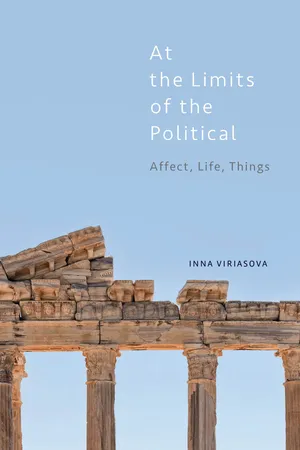
The question of the limits of the political permeates the history of western political thought and has been at the forefront of debates in contemporary political philosophy, especially in French and Italian contexts. This book argues that the question of radical political exteriority fell into neglect despite post-War critiques of totalitarian political ontology. The notion of 'the political' developed into a new form of totality, one which admits the impossibility of closure and yet refuses to let go of its totalizing ambition. Viriasova addresses this problem by offering a critical introduction to the debate on the concept of the political in contemporary continental philosophy, and develops an innovative perspective that allows us to rethink the limits of the political in affirmative and realist terms. The book explores such recent developments as Roberto Esposito's notion of the impolitical, Giorgio Agamben's concept of bare life, Michel Henry's radical phenomenology of life, the speculative realist philosophy of Quentin Meillassoux, as well as Buddhist political thought. The book makes a vital contribution to an emerging body of literature in contemporary philosophy that renews the fundamental questions of political ontology in response to the multiplying crises of inclusion that challenge democratic communities today.
Information
Part I
The Totality of the Political and Its Limits
Politics is a terrible force: If one only knows about it, one has already succumbed to it. One has lost one’s innocence.
—Thomas Mann
Chapter 1
Carl Schmitt: The General Economy of the Political
Carl Schmitt’s The Concept of the Political (1932) is widely regarded as the first major instance of theorizing “the political” (das Politische), and is also an early example of conceptualizing this political as a totality.1 In modern times, politics has been primarily understood in conjunction with the notion of the state: institutions operating for the sake of mediating human relations in the process of attaining a good life. Schmitt’s concept of the political is no longer attached to the state; on the contrary, the concept of the state now presupposes the concept of the political (2007, 19). The political is marked by the autonomy and specificity of the friend-enemy distinction, which underlies the multiplicity of human endeavours as their ultimate possibility. Within Schmitt’s work, the political evolves into a potentially all-encompassing phenomenon that leaves no space for “the absolutely unpolitical”—the reality that cannot be politicized and persists in the relationship of indifference to, rather than withdrawal from, the political.
The political is among the most studied aspects of Carl Schmitt’s thought, appropriated by contemporary, typically leftist, scholarship for its critique of liberal democracy (see, e.g., Mouffe 1999, 2005; Dyrberg 2009; Marchart 2007), but also critiqued for its totalization, particularly in conjunction with Schmitt’s affiliation with Nazism in 1933–1936. Despite the attention to “the political,” Schmitt’s notion of “the unpolitical” has received little consideration, even though it plays a crucial role in revealing the political totalization at hand. On most occasions, Schmitt presents the unpolitical as a merely “fictitious” reality, as nothing more than a product of a political decision. However, when we read The Concept of the Political (1932) and Political Theology (1922) more closely, we can see that even though Schmitt acknowledges the unpolitical only as a “fiction” and avoids any lengthy discussion of “the absolutely unpolitical,” his political totalization essentially relies on obscuring this radical exteriority. Contemporary political theory inherits this obscuration and so by examining Schmitt’s thought we gain a better understanding of the mechanism of the “forgetting” of the unpolitical.
In Schmitt, this mechanism is present in a doubling of the moment of sovereign decision: first is an originary decision on the unpolitical “as such,” and second is a political decision on the friend-enemy distinction. Schmitt prioritizes the latter decision and dedicates most of his time to discussing how we may identify and distinguish the political from other spheres of human activity. However, what is masked by this prioritization is the fact of the essential limitation of the political to humanity, insofar as what remains absolutely unpolitical for Schmitt consists in heterogeneous non-human forms of life. In the end, even as Schmitt’s concept of the political announces the end of the modern separation between “the state of nature” (the state of conflict, war, misery) and “politics” (the state of peace, security, culture), and establishes the political as a totality that permeates human life as a whole, he does not ultimately overcome the modern distinction between the non-human and politics. It speaks volumes that even as his totalizing vision of the political relies on the elimination of the absolutely unpolitical, the very fact of this philosophical elimination remains unthought by Schmitt. It is crucial, then, to examine in detail not only how the political becomes the total but also how the absolutely unpolitical is brushed aside by the desire for the affirmation of the political, of its primacy and valorization as the measure of all human relations.
Historical-Intellectual Background
The historical-intellectual context of the beginning of the twentieth century contributed greatly to Schmitt’s rethinking of the political in terms of the conflictual reality of human life, epitomized in the criterion of the friend-enemy distinction. First, the political embraces the spirit of that conflict-ridden age. The horrors of World War I, the struggles of the Weimar Republic and the failure of its democracy, all of these events find their way into Schmitt’s legal-political theory in the form of a confession of anthropological pessimism. Second, Schmitt establishes his affirmation of the conflictual reality of the political primarily as a polemic against the ideals of liberal democracy, which he sees as a movement of “neutralization and depoliticization” (Schmitt 1993). He explains that in the seventeenth century a shift takes place in Europe from Christian theology to natural science, at the core of which lies “an elemental impulse that has been decisive for centuries, i.e. the striving for a neutral sphere” (137), a sphere without conflict, where common agreement would be reached through the exchange of opinions. Such a trajectory toward neutralization or even deliberate depoliticization of reality appears within the liberal narrative of transition from the conflictual state of nature to the neutral sphere of the political state. In its essence, liberalism is a repression of the conflictual essence of the political. Against such a liberal, consensus-driven view of human nature, Schmitt embraces and affirms a belief in “a problematic human nature” defined by its conflictual drive (2007, 61). In opposition to the traditional interpretation of the Hobbesian transition from the state of nature to politics, Schmitt suggests that the commencement of the political way of life merely orders and contains but does not do away with conflictuality. Humanity undergoes a transformation only in its form of life and not in its essential quality. Liberal political thought, however, is in denial of this fact and ends up repressing the “genuine” essence of the political, replacing it with the neutral, depoliticized sphere of the state and law. Schmitt’s concept of the political is an attempt at lifting this repression: emerging as a reaction to liberalism, the political indexes the return of the repressed of liberal politics, since it gives a conceptual presence to and expresses the inexhaustible possibility of the interruption of order by the dynamic principle of intensive life.
Furthermore, two other, seemingly opposing, tendencies of the early twentieth century contributed to the totalizing extension of the political beyond the old framework of politics-as-state. First, the emergence of effective, non-state political actors and processes as well as the progress of democracy and the politicization of civil society contributed to diminishing the role of the state in defining “proper” political spaces (cf. Arditi 1996, 15). Second, “the closure of the map” (Bey 1991, 102), which marks humanity’s entrance into the new century, the disappearance of no-man’s land, terra incognita or the frontier, of the factual outside of the international system of nation-states, contributed greatly to the immanentisation of the political. Thinking the political beyond the state commences as a mechanism of compensation for a lost “transcendence” in politics. This transcendence is lost in both ideal and material sense as a result of the processes of secularization as well as appropriation of the material space of the globe by the community of states. The “death of God” and the occupation of terra incognita thus present a similar challenge for political thought: in light of the loss of transcendence, the outside of politics is being rethought in terms of immanence. An outside that can no longer be identified with an external reality, either material or divine, must be now located on the inside.
Importantly, the reality of conflicts, crises, and the loss of transcendence have also resulted in the disappearance of any certainty in human existence except for the certainty of death. As Richard Wolin puts it, such “existentialism” meant that “human existence, in its brute factivity, became a value in and of itself” (1990, 394). In a world without foundation, the primary certainty of life becomes death. It is not surprising that Schmitt will embrace the threat of violent, real death as the indicator of the “genuine” quality of the political. In sum, Schmitt’s concept of the political emerges as a self-referential reflection on the history and prominent tendencies of late-modern politics, but at the same time it itself represents an instance of a new historical-political consciousness, defined by a lack of a foundational principle. The affirmation of the political, performed in the face of liberal depoliticization and the displacement of the state’s primacy, is deemed possible only if it overcomes the limitations of its own sphere and merges with life itself, becoming total in a new sense. Schmitt realizes this necessity and so proclaims: “We have come to recognize that the political is the total, and as a result we know that any decision about whether something is unpolitical [Unpolitische] is always a political decision, irrespective of who decides and what reasons are advanced” (2005, 2). This proclamation rests on the elimination of the absolutely unpolitical and on the permanent relocation of the outside of politics (e.g., the state of nature and biological life) to the inside.
The Political as the Total: The Friend-Enemy Distinction
To diagnose the political as totalizing requires an elaboration of a concrete symptomology. In the first place, the political as the total results, counter-intuitively, from Schmitt’s desire to affirm the autonomy of the political based on the friend-enemy distinction. He famously proposes:
The specific political distinction to which political actions and motives can be reduced is that between friend and enemy. This provides a definition in the sense of a criterion and not as an exhaustive definition or one indicative of substantial content…. It is independent, not in the sense of a distinct new domain, but in that it can neither be based on any one antithesis or any combination of other antitheses, nor can it be traced to these…. Thereby the inherently objective nature and autonomy of the political becomes evident by virtue of its being able to treat, distinguish, and comprehend the friend-enemy antithesis independently of other antitheses. (2007, 26, 27; emphasis added)
Schmitt is determined to show that the political is not limited to a specific sphere, and to distance it from the common “negative” definitions that rely on a contrast with other domains, such as economy, law and morality (2007, 20). The political has been long subordinated to other spheres and has thus been viewed as a mere extension of other human activities. In opposition to these widespread attitudes of his time, Schmitt presents a positive view of the political, meaning that it proceeds from its own criterion, and so introduces into the discourse of political philosophy a distinction (friend-enemy) that lays the ground for the autonomy of the political. However, as long as the political discovers its autonomy in an always potentially multiple “criterion” and not an “essence,” it avoids any “substantial” limitation. As such, it is the specificity of the political criterion rather than the autonomy of the political sphere that is at stake for Schmitt (cf. Szabo 2006, 32; Arditi 1996, 17).
Its inessentiality provides the concept of the political with an unprecedented plasticity and the possibility for mobility across other social fields. The political becomes neither dependent on other spheres nor limited to its own sphere. Quite the opposite, it is capable of investing all human relations and endeavours with its intense principle of differentiation. Schmitt writes:
The distinction of friend and enemy denotes the utmost degree of intensity of a union or separation, of an association or dissociation…. [However,] every distinction, most of all the political, as the strongest and most intense of the distinctions and categorizations, draws upon other distinctions for support. (2007, 26, 27; emphasis added)
The political distinction stands out among all other distinctions due to its degree of intensity, ultimately implying that any distinction may be politicized. As the intensity of a certain opposition grows, it will eventually reach its highest level, and, when it reaches this level, it will no longer be an ethical, religious or any other opposition but a political distinction, transforming into an opposition between a friend and an enemy (62). The quantitative augmentation of the intensity of an opposition thus results in its qualitative transformation—politicization. By focusing on the quantity of the energetic charge of the political distinction, Schmitt introduces omnipresent potentiality as a defining factor of the political (Marder 2005, 16). That is, since any opposition may become political, the political is the total potential inherent in all other spheres of human life. It determines them in the last instance.
Furthermore, the concept of the political is “parasitic” (Shapiro 2003, 107) inasmuch as it feeds off or derives “its energy from the most varied human endeavours” (Schmitt 2007, 38). This parasitism results, again, from the absence of the “proper” place of the political. As the political is marked only by the criteria of differentiation and intensity, it can potentially consume any relational antithesis; it does not have a place of its own, it does not belong to a limited field. As Marton Szabo points out, the political has an infinite character: it can refer to anything by “touching” its subject. The political is a total contact, “an infinite substance that penetrates life as a whole” (2006, 33). At the same time, the ability of the political to thrive off heterogeneous relations is indicative of the political as a principle of displacement, as apparently non-political spheres become infected and ultimately displaced by the political. Consequently, the latter is a principle of both infinite contact and displacement, total unity and the erasure of difference. Due to the displacement of the state’s “monopoly on politics” (Schmitt 2007, 22), there is no longer an objective structure to mark the line between the political and the non-political. As a result, no endeavours are non-political as such; they are merely not-yet-politicized, and are only relatively unpolitical. As Schmitt concurs, “the total reality of the political” is thus revealed because concepts that at first glance had appeared non-political “turn into political ones” (38). In sum, the combination of the criteria of intensity, differentiation, and potentiality results in the emergence of the political as a totality. All living relations can potentially reach the level of intensity necessary for the political to emerge, and so the political is nothing less than “intensive life [intensives Leben]” (Schmitt in Wolin 1990, 406).
Life charged with conflictual energy, life that struggles with life and with death is what ultimately defines the political for Schmitt. More specifically, it is the possibility of physical demise that determines the reality of conflict at the heart of the political. “The friend, enemy, and combat concepts receive their real meaning precisely because they refer to the real possibility of physical killing” (Schmitt 2007, 33). In the age of violent conflicts, loss of transcendence, and absence of the firm ground of existence, death appears to be the only measure that offers a “foundation” for new politics. Schmitt embraces this pessimistic diagnosis of modernity and builds his theory of the political on this quasi-foundation. His discourse, in this regard, is not unique, as modern science also comes to define life through its conflict with death. As Xavier Bichat writes, for example, life is “the sum of the functions, by which death is resisted…. The measure … of life in general, is the difference which exists between the effort of exterior power, and that of interior resistance” (1815, 21, 22). Life is a perpetual struggle between a unity, an ensemble of functions, and its real, “negated other”—disintegration and death. Since no life is free from the imminent possibility of death, it is unavoidably charged with political energy, with actual war between human groups being its most intense manifestation. The political is a constitutive part of living insofar as life is marked by a degree of intensity in its struggle with death.
Schmitt may object that a “life which has only death as its antithesis is no longer life but powerlessness and helplessness.” Thus, the “natural” movement of life toward death is not in itself political because it lacks power. What makes life political and an act of power is the fact that life struggles not with death but with life (1993, 142). The political quality of life consists in killing (not mere dying), in a violent form of death, bodily destruction at the hands of another life. Life murders life, splits against itself and devours itself. Thus the political essence of life consists in struggle with death, but this possibility of death now takes the form of another life. The general underlying condition of this tendency of life toward politicization is finitude, where the figure of an enemy, in its very living nature, manifests a looming possibility of violent termination of life (i.e., of physical death) and not just a threat to our “way of life” (2007, 27). As a result, death is not opposed to life but is a function of life, a conclusion that scientific thought of the nineteenth century also readily embraces. As Michel Foucault has shown, modern physiology, for instance, begins to view the animal organism (including humans) as a bearer of death, containing “a perpetual devouring of life by life” (1994, 277). Life is a “wild,” “inexhaustible force,” “mute and invisible violence” that devours beings from within their inner darkness (278). Life gains its political charge by facing death in and as itself, by dividing and violently destroying itself.
The intimate connection between specifically human life and the political is epitomized in Sc...
Table of contents
- Acknowledgments
- Introduction: Beyond Politics
- Part I: The Totality of the Political and Its Limits
- Part II: Mapping the Unpolitical
- Conclusion
- References
- Index
- Author Biography
Trusted by 375,005 students
Access to over 1.5 million titles for a fair monthly price.
Study more efficiently using our study tools.
Frequently asked questions
Yes, you can cancel anytime from the Subscription tab in your account settings on the Perlego website. Your subscription will stay active until the end of your current billing period. Learn how to cancel your subscription
No, books cannot be downloaded as external files, such as PDFs, for use outside of Perlego. However, you can download books within the Perlego app for offline reading on mobile or tablet. Learn how to download books offline
Perlego offers two plans: Essential and Complete
- Essential is ideal for learners and professionals who enjoy exploring a wide range of subjects. Access the Essential Library with 800,000+ trusted titles and best-sellers across business, personal growth, and the humanities. Includes unlimited reading time and Standard Read Aloud voice.
- Complete: Perfect for advanced learners and researchers needing full, unrestricted access. Unlock 1.5M+ books across hundreds of subjects, including academic and specialized titles. The Complete Plan also includes advanced features like Premium Read Aloud and Research Assistant.
We are an online textbook subscription service, where you can get access to an entire online library for less than the price of a single book per month. With over 1.5 million books across 990+ topics, we’ve got you covered! Learn about our mission
Look out for the read-aloud symbol on your next book to see if you can listen to it. The read-aloud tool reads text aloud for you, highlighting the text as it is being read. You can pause it, speed it up and slow it down. Learn more about Read Aloud
Yes! You can use the Perlego app on both iOS and Android devices to read anytime, anywhere — even offline. Perfect for commutes or when you’re on the go.
Please note we cannot support devices running on iOS 13 and Android 7 or earlier. Learn more about using the app
Please note we cannot support devices running on iOS 13 and Android 7 or earlier. Learn more about using the app
Yes, you can access At the Limits of the Political by Inna Viriasova in PDF and/or ePUB format, as well as other popular books in Philosophy & Critical Theory. We have over 1.5 million books available in our catalogue for you to explore.