Why did France spawn the radical poststructuralist rejection of the humanist concept of 'man' as a rational, knowing subject? In this innovative cultural history, Carolyn J. Dean sheds light on the origins of poststructuralist thought, paying particular attention to the reinterpretation of the self by Jacques Lacan, Georges Bataille, and other French thinkers. Arguing that the widely shared belief that the boundaries between self and other had disappeared during the Great War helps explain the genesis of the new concept of the self, Dean examines an array of evidence from medical texts and literary works alike. The Self and Its Pleasures offers a pathbreaking understanding of the boundaries between theory and history.
eBook - ePub
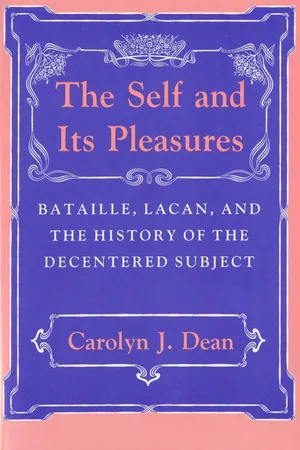
The Self and Its Pleasures
Bataille, Lacan, and the History of the Decentered Subject
- 288 pages
- English
- ePUB (mobile friendly)
- Available on iOS & Android
eBook - ePub
The Self and Its Pleasures
Bataille, Lacan, and the History of the Decentered Subject
About this book
Information
PART ONE
PSYCHOANALYSIS
AND THE SELF
In a most annoying manner, M. Lacan says “the constitution of reality” instead of simply “reality.”—Edouard Pichon,
“La Famille devant M. Lacan,” 1939
The reception of psychoanalysis in France is usually said to have been rather inhospitable. Freud’s version of the unconscious was allowed in only through the back door—by way of the literary avant-garde.1 Although at least one medical periodical, l’Encéphale, was receptive to psychoanalysis, in general the discipline had no official embodiment in France until 1926, when twelve men and women—Marie Bonaparte, René Laforgue, Edouard Pichon, Adrien Borel, Angelo Hesnard, Raymond de Saussure, Charles Odier, René Allendy, Georges Parcheminey, Rudolph Loewenstein, Eugénie Sokolnicka, and Henri Codet—formed the Société Psychanalytique de Paris.
At the time, Freud’s theories were so controversial that the society’s members debated whether to place his name on the cover of the new Revue Française de Psychanalyse. Most French commentary on Freud and translations of his work were inadequate at best and erroneous at worst, and thus helped mar his reputation. In 1913 the great psychiatrist Pierre Janet offered a critique of Freud filled with what the scholar C. M. Prévost calls “the most narrow and vulgar clichés that have circulated about psychoanalysis for the last half-century.”2 Janet believed incorrectly that Freud’s theories about dreams were archaic, in part because they neglected interpretative techniques drawn from French psychopathology, especially Janet’s own teachings.3 Furthermore, the first important medical article to appear on Freud in L’Encéphale, “Le Doctrine de Freud et son école” by Emmanuel Régis and Angelo Hesnard, represented an entirely adulterated version of his thought.
Sherry Turkle believes that psychoanalysis was received with skepticism in France because professional establishments, and psychiatry in particular, were wedded to a strong Cartesian tradition intrinsically hostile to Freudian assumptions about human irrationality. Moreover, France had its own hero in Janet, often touted by the French as the “real” father of psychoanalysis. Finally, Germanophobia and anti-Semitism led to the rejection of psychoanalysis as a foreign and “Jewish” theory incompatible with “le génie latin.”4
In France, nevertheless, as in most European countries and in the United States after World War I, the increasing recognition of the psychological origin of pathological symptoms was linked to psychoanalytic insights into unconscious motivation. Yet whereas elsewhere psychoanalysis rescued the rational subject, the self, from the domination of the unconscious,5 in France it was tied in with the dissolution of the self, a dissolution that the psychoanalyst Jacques Lacan made the organizing principle of his work.
How and why, then, did French psychoanalysis contribute to the dissolution of the self? Here I concentrate primarily on texts Lacan wrote before the advent of Lacanian analysis in 1953.6 I analyze how Lacan’s work both reflected and recast in new, psychoanalytic terms the dissolution of conventional boundaries between normality and pathology after the Great War. Of course that dissolution was itself the product of and a response to cultural perceptions, in particular the psychiatric perceptions of criminals, the New Woman, and other “deviants” who threatened the return to normalcy after the unprecedented upheaval of that “great” war. I focus on the relationship between those perceptions and three aspects of Lacan’s work: his analyses of criminality, the patriarchal family, and schizophrenia, which are connected, if freely, to the categories Lacan later termed the imaginary, the symboic, and the real, respectively. This triad loosely corresponds to Freud’s ego, superego, and id, though Lacan’s concept of the role of these psychic agencies is by no means equivalent to Freud’s.
The content of Lacan’s categories shifted between the 1950S and the 1970S as they were developing, and a full elaboration of these shifts is outside the scope of this book. Instead, I use them as a sort of retrospective frame to give coherence to my argument. It seems necessary to employ them in this way if I am to preserve a clear focus and a clearly defined context, and permissible to do so as long as I do not project a “final state”—an ahistorical, idealized conception of his corpus—onto Lacan’s early writing.7 Thus, I recognize that his earlier work anticipated such shifts (and I often refer to them), but I focus on a specific historical context before 1950. (I make an exception in Chapter 3, which I hope the reader will deem justifiable). No doubt Lacan scholars will find my focus too narrow and reductive and historians will find my focus too general, but such are the perils of interdisciplinary scholarship.
Lacan rejected the post-1920 Freudian topography outlined in The Ego and the Id, wherein Freud conceived the ego as an agent of adaptation, integration, and synthesis—of reality—and theorized sexual identity more generally as constituted by the normative regulation of unconscious drives through oral, anal, and genital stages. Lacan rejected both the ego’s adaptive role and Freud’s model of sexual maturation. Instead, he used Freud’s earlier writing on narcissism—one’s desire to be recognized and, ultimately, to be desired—as a model for ego formation. He believed that sexual identity was dependent not on innate or instinctual structures but on the mediation of others. That is, as Fredric Jameson has put it, “a previously biological instinct must undergo an alienation to a fundamentally communicational or linguistic relationship—that of the demand for recognition by the Other—in order to find satisfaction.”8 While the psychic agencies perform the same analytic work for Lacan as for Freud, Lacan sees identity as constituted through the mediation of others, through, paradoxically, a process of self-alienation, so that the psychic agencies’ operations are determined by, conceal or reveal a lack, an other (as Lacan called it) at the very heart of the self.
In his discussion of the imaginary, the symbolic, and the real, Lacan theorized the different ways in which this other constitutes the self. But what precisely is the other? In Lacan, it refers to the forces that shape the unconscious (on both primary and secondary levels) and is defined in so many ways that it seems infinitely “convertible” and difficult to pin down. For example, the imaginary other may be the mother with whom the child first identifies. The symbolic other is the father, who represents the language that organizes unconscious (imaginary) perceptions. The real other, however, according to Lacan, is impossible to symbolize.9
In the chapters that follow, I attempt to pin down the other in its various incarnations by reconstructing the process through which, it came both to symbolize and structure the unconscious, the locus of the Other, our “real” self. Yet my emphasis is not exclusively on theory but on history: How are these “others” constructed as other and how, then, does the self come to be constructed as an-other?10 How did interwar culture generate the structures of the unconscious? Chapter 1 focuses on Lacan’s reconstruction of the criminal other, Chapter 2 on the female other, and Chapter 3 on the psychotic, the other side of reason. The story, however, does not begin with Lacan.
1 See Pamela Tytell, La Plume sur le divan (Paris: Aubier, 1982); and Roudineseo, Lacan and Co., pp. 22–25. Here, I address only the advent of psychoanalysis in France as it relates to French psychiatry and certain of Lacan’s texts. I omit a discussion of Gaston Bachelard and Georges Canguilhem, who were instrumental in dissolving the distinction between normality and pathology. But as Roudinesco has pointed out, they had little relation to French psychoanalysis (Lacan and Co., p. xx). For general histories of the movement, see, above all, Roudinesco, La Bataille, vols. 1 and 2; Mordier; Victor N. Smirnoff, “De Vienne á Paris: Sur les origines d’une psychanalyse á la française,“ Nouvelle Revue de Psychanalyse 20 (Autumn 1979), 13-58; Marcel Scheidhauer, Le Rêve freudien en France, 1920-1926 (Paris: Navarin, 1985).
2C. M. Prévost, quoted in Scheidhauer, p. 71. Janet had developed a model of the psyche in which a hierarchy of different levels maintained a dynamic equilibrium of psychic “forces,” conceived of as physiological. Pathology, in this view, resulted from a “lack of psychological force,” which could be remedied by regulating psychic energy. He used hypnotism for this purpose and suggested that the neurotic individual modify his or her environment–work patterns, food and alcohol intake–or transform mental agitation by engaging in “useful” activity. Janet was, therefore, a functionalist. For an excellent overview of Janet’s work, see Henri Ellenberger, The Diseovery of the Unconseious: The Evolution of Dynamie Psychiatry (New York: Basic Books, 1970), pp. 331-417.
3Paul Bercherie has noted that “Freud’s first model was constructed with conceptual instruments which seemed archaic compared to the modernity of Janet or [Henri] Bergson. For a long time, associationism . . . was dominant in Germany; . . . [German psychiatry] was not influenced by the evolutionism and functionalism which marked the development of both the French and the Anglo-American currents” at the turn of the century and defined their sophistication. Bercherie, p. 67n.
4Sherry Turkle, Psychoanalytie Politics (Cambridge: Harvard University Press, 1981), p. 39.
5 American ego psychology is a case in point. It was “founded” by Heinz Hartmann in 1958. He based his own work, Ego Psychology and the Problem of Adaptation, on Anna Freud’s 1936 book The Ego and the Mechanisms of Defense. As Bercherie has remarked, ego psychology easily infiltrated the American analytic community because of its compatibility with functionalism, even though its origins were Viennese. Many proponents of ego psychology were Austrian analysts who emigrated to America before and during the Second World War. Bercherie, pp. 46-47,67n.
6This was the year Lacan gave his famous talk ‘The Function and Field of Speech and Language in Psychoanalysis,” often known as the Rome Discourse. The talk was given at the Rome Congress of the French Psychoanalytic Society, which had split from the Société Psychanalytique de Paris in 1952 and been expelled from the International Psychoanalytic Association.
7The term “final state” is Macey’s, pp. 1-25. Macey demonstrates to what extent Lacan’s admirers (and even his critics) present all his work as if it were always already in its “final state.” He argues that in so doing they dehistoricize his writing.
8Fredric Jameson, “Imaginary and Symbolic in Lacan: Marxism, Psychoanalytic Criticism, and the Problem of the Subject,” in Shoshana Felman, ed., Literature and Psychoanalysis: The Question of Reading: Otherwise (Baltimore: Johns Hopkins University Press, 1977), p. 367.
9 Anthony Wilden argues that “it is not possible . . . to define the Other in any definite way, since for Lacan it has a functional value.”Later he suggests that “one is led to suspect that the substitution of the words ‘the unconscious’ for ‘the Other’ in many of Lacan’s formulations will produce an adequate translation.” Anthony Wild-en, in Jacques Lacan, The Language of the Self: The Function of Language in Psycho-ana1ysis, ed. and trans. Wilden (Baltimore: Johns Hopkins University Press, 1968), pp. 264-66. Lacan also introduced a “small other object” (object a) that represents the cause of desire displaced onto a substitute object (e.g., the phallus).
10Theory has been admirably emphasized by Juliet Mitchell and Jacqueline Rose in their introductions to Jacques Lacan, Feminine Sexuality, trans. Rose (New York: Norton, 1985) pp. 1-57; and in Bowie, “Jacques Lacan,” pp. 116-53. See also Bice Benvenuto and Roger Kennedy, The Work of Jacques Lacan: An Introduction (New York: St. Martin’s Press, 1986); Elizabeth Grosz, Jacques Lacan: A Feminist Introduction (New York: Routledge, 1990); and Lemaire. One of the best theoretical accounts of Lacanian analysis is Ellie Ragland-Sullivan, Jacques Lacan and the Philosophy of Psychoanalysis (Chicago: University of Illinois Press, 1987). The only limitation of the book is the author’s virtually uncritical assessment of Lacan.
Chapter One
The Legal Status
of the Irrational
After about 1860, the criminal body came to be taken as evidence of deviance, and the function of law was to survey and repress...
Table of contents
- Acknowledgments
- Introduction
- PART ONE Psychoanalysis and the Self
- PART TWO Sade’s Selflessness
- PART THREE Headlessness
- Conclusion
- Selected Bibliography
- Index
Trusted by 375,005 students
Access to over 1.5 million titles for a fair monthly price.
Study more efficiently using our study tools.
Frequently asked questions
Yes, you can cancel anytime from the Subscription tab in your account settings on the Perlego website. Your subscription will stay active until the end of your current billing period. Learn how to cancel your subscription
No, books cannot be downloaded as external files, such as PDFs, for use outside of Perlego. However, you can download books within the Perlego app for offline reading on mobile or tablet. Learn how to download books offline
Perlego offers two plans: Essential and Complete
- Essential is ideal for learners and professionals who enjoy exploring a wide range of subjects. Access the Essential Library with 800,000+ trusted titles and best-sellers across business, personal growth, and the humanities. Includes unlimited reading time and Standard Read Aloud voice.
- Complete: Perfect for advanced learners and researchers needing full, unrestricted access. Unlock 1.5M+ books across hundreds of subjects, including academic and specialized titles. The Complete Plan also includes advanced features like Premium Read Aloud and Research Assistant.
We are an online textbook subscription service, where you can get access to an entire online library for less than the price of a single book per month. With over 1.5 million books across 990+ topics, we’ve got you covered! Learn about our mission
Look out for the read-aloud symbol on your next book to see if you can listen to it. The read-aloud tool reads text aloud for you, highlighting the text as it is being read. You can pause it, speed it up and slow it down. Learn more about Read Aloud
Yes! You can use the Perlego app on both iOS and Android devices to read anytime, anywhere — even offline. Perfect for commutes or when you’re on the go.
Please note we cannot support devices running on iOS 13 and Android 7 or earlier. Learn more about using the app
Please note we cannot support devices running on iOS 13 and Android 7 or earlier. Learn more about using the app
Yes, you can access The Self and Its Pleasures by Carolyn J. Dean in PDF and/or ePUB format, as well as other popular books in Literature & Literary Criticism Theory. We have over 1.5 million books available in our catalogue for you to explore.