Seductive Reasoning takes a provocative look at contemporary Anglo-American literary theory, calling into question the critical consensus on pluralism's nature and its status in literary studies. Drawing on the insights of Marxist and feminist critical theory and on the works of Althusser, Derrida, and Foucault, Rooney reads the pluralist's invitation to join in a "dialogue" as a seductive gesture. Critics who respond find that they must seek to persuade all of their potential readers. Rooney examines pluralism as a form of logic in the work of E. D. Hirsch, as a form of ethics for Wayne Booth, as a rhetoric of persuasion in the books of Stanley Fish. For Paul de Man, Rooney argues, pluralism was a rhetoric of tropes just as it was, for Fredric Jameson, a form of politics.
eBook - ePub
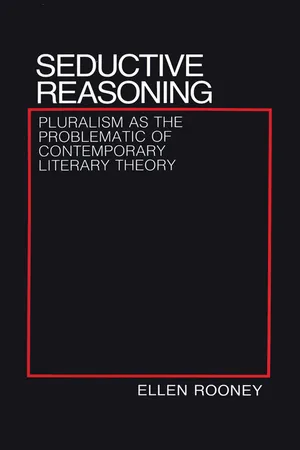
Seductive Reasoning
Pluralism as the Problematic of Contemporary Literary Theory
- 256 pages
- English
- ePUB (mobile friendly)
- Available on iOS & Android
eBook - ePub
About this book
Information
1 READING PLURALISM SYMPTOMATICALLY
The age of pluralism is upon us. It does not matter any longer what you do, which is what pluralism is.
—Arthur C. Danto, “The End of Art”
I
The colloquial meaning of the term “pluralist” shadows all our theories of pluralism. Paradoxically, those very critical discourses that set themselves the task of explicating the pluralist project in literary studies have most successfully eluded recognition of this fact. The resulting elision has the quality of an eloquent absence, a necessary silence, which enables pluralism to persist and develop even while thwarting efforts to break with its problematic. To attend to this silence is to begin to trace the limits of pluralism, to mark the colloquial as figuring that which literary critical pluralism cannot contain.1
In the American idiom, pluralism is an ordinary word, a nontechnical term, an integral part of ordinary language and popular consciousness. Despite its current appeal to some literary theorists, it is most characteristic of the quotidian cultural and social discourses of the mass media. Americans commonly speak of ethnic and religious pluralism, pluralist economies, and the virtues of their own pluralistic society. In all these uses, “pluralist” is an honorific. The very notion of pluralistic society is often identified with the United States as such, and, simultaneously, it is consistently associated with U.S. foreign policy. One can gloss this colloquial usage in a personal inflection as: “This is a free country. I can do (or say or believe) whatever I please.” But the idiom also appears in presidential speeches on the need for “political pluralism” in Central America and in New York Times articles describing the National Endowment for Democracy with headlines that announce: “Missionaries for Democracy: U.S. Aid for Global Pluralism” and “U.S. Pays for Pluralism.”2
I begin with the colloquial both in order to introduce the question of exclusion and to signal a certain historical conjuncture as the place of the analysis to follow. The exclusion of the colloquial from both celebratory elaborations and critical evaluations of pluralism is in fact only the first in a series of strategic exclusions or repressions: of the political, and of marxism in particular, of discontinuity, of resistance, of the possibility of exclusion itself, which together constitute the problematic of pluralist discourse in American literary studies. These elisions and the subsequent collapse of pluralism’s theoretical project actually promote the pluralist agenda; these are essential oversights, the enabling conditions of pluralism’s persistent ideological power. The practical and theoretical consequences of these silences, the determinate manner in which what is absent or not said structures what is or can be said, occupy a pivotal position in the argument that follows.
The difficulties that trouble any effort to discuss pluralism in literary theory can be glimpsed in the following exchange. In a 1980 interview, Ken Newton put this question to Derrida:
It might be argued that deconstruction inevitably leads to pluralist interpretation and ultimately to the view that any interpretation is as good as any other. Do you believe this and how do you select some interpretations as being better than others?
Derrida replied:
I am not a pluralist, and I would never say that every interpretation is equal, but I [JD] do not select. The interpretations select themselves. I am a Nietzschean in that sense. You know that Nietzsche insisted on the fact that the principle of differentiation was in itself selective. The eternal return of the same was not repetition, it was a selection of the more powerful forces. So I would not say that some interpretations are truer than others. I would say that some are more powerful than others. The hierarchy is between forces and not between true and false.3
The ironies of this particular dialogue are certainly not lost on those literary theorists who call themselves pluralists. It would come as no surprise to Wayne Booth, for example, that Derrida declines to join his company. In fact, contemporary pluralists frequently accuse others—Derrida prominent among them—of championing just the brand of interpretative irresponsibility Newton’s question identifies with pluralism itself.
Indeed, it would be difficult to exaggerate the number of selfdescribed pluralists who seem to view Derrida as the chief representative of that critical practice which is the antithesis of pluralism.4 Their most energetic polemics are directed against him and his epigones, as they are called, and against everything that can be made to answer to the name he let loose into critical discourse: deconstruction.5 To cite only a few examples: Booth, though openly reluctant to post “the limits of pluralism,” readily informs us that “pluralism is not … Derridaesque glasisme” (B 407). In a similar gesture, M. H. Abrams opposes his historicist’s pluralism to Derrida’s and Nietzsche’s “deconstructionist principles.” He names deconstruction as “one limit to what, according to [his] pluralist views, [he] would accept as a sound alternative history to [his] own,” insisting, “I would not accept a history genuinely written according to radically deconstructionist principles of interpretation.” E. D. Hirsch derides the “decadence,” “anti-rationalism,” “extreme relativism,” and “cognitive atheism” he associates with the names Derrida and Foucault. These instances are typical, and the list might be extended almost indefinitely. To cite only one second generation commentator: Paul Armstrong argues that pluralism must “chart a middle way between the anarchists and the absolutists,” but anarchism and (what Armstrong sees as) nihilism are unquestionably his main concerns. He vigorously opposes the view he paraphrases as “all interpretations are necessarily misinterpretations—that no criteria exist, within the text or outside, for judging any reading the ‘right’ one.” He adds: “I have in mind, obviously, the Yale deconstructionists and their mentor, Jacques Derrida, but Norman Holland and Stanley Fish hold similar views.”6
Given the evidence of these pluralist readings, one could conclude that Newton’s suggestion that “deconstruction” might lead to pluralism, may in fact be a form of pluralism, is simply absurd, an index of his unfamiliarity with the current critical use of the terms. But Derrida answers “I am not a pluralist” without questioning Newton’s premise. In fact, the breezy gloss of pluralism as “the view that any interpretation is as good as any other” is bound to seem plausible to large numbers of readers for whom the word denotes only a generalized tolerance of diversity, the view that any opinion (or individual) is “as good as any other.” Thus, in contemporary literary theory, a self-conscious pluralism has positioned itself, in part, through its polemical opposition to deconstruction; and yet it remains possible to consider the proposition that Derrida may be a pluralist. We enter here a terrain wherein it is not unusual to discover that some critics apply the term “pluralist” to figures and practices that others—critics in the “same” field—regard as the incarnation of the evil pluralism resists. The discrepancy between these two perspectives discloses a critical question: what are the limits of pluralism? Where—and how well guarded—is the border that separates the pluralist from his others? This is not a strictly empirical problem to be settled by means of a survey of the content of pluralist discourses. What is at stake is the principle of exclusion, and, not surprisingly, exclusion is both a practical and a theoretical problem for pluralism.
Pluralists, that is, self-described pluralists, have of course attempted to define their position, to correct this discrepancy. The most widely disseminated definition of pluralism within literary theory foregrounds a commitment to methodological eclecticism and an ethic of tolerance and intellectual openness. This view is drawn to a surprising extent from the work of one critic: Wayne Booth. Among those figures consciously elaborating a pluralist theory, Booth emerges as its most eloquent advocate. He conceives of pluralism as the generous and ultimately pragmatic pursuit of “critical understanding” and resolutely opposes “the view that any interpretation is as good as any other,” or, as Arthur Danto puts it, that it “does not matter any longer what you do.” According to Booth, the literary critic, working as she does with texts that can manifestly bear the burden of more than one “correct” interpretation, must avoid the fanatical and dogmatic rigidity of “monism,” without falling into the anarchic free-play of “relativism.”7 Pluralism, in Booth’s texts, is a compromising reaction formation; it endorses a plurality of interpretations and methods, but stops well short of infinite textual dissemination. This “limit” is never, however, conceptualized as a monism. On the contrary, in Booth’s view, “the limits of pluralism are plural” (B 423). (It is worth noting here that Booth’s vision is informed by a political metaphor. He sees the critical field as a “commonwealth” in which “my continued vitality as a critic depends finally on yours, and yours on mine” [B 420]. This commonwealth bears a striking formal resemblance to the classic liberal polity, and this should alert us to the discursive register Booth shares with U.S. newspaper editorialists and politicians, the register of the colloquial.)
Booth’s sustained polemic against lapses in critical understanding (reductive “monisms” such as “glasisme”) and in favor of a diverse and inclusive pluralism has led many to identify pluralist literary theory wholly with his work or with the work of critics who acknowledge his influence. My argument is directed to unsettling this identification. At the same time, the fact that Derrida can be asked to dissociate himself from something called pluralism (and that he complies) is symptomatic of the profound confusion surrounding the use of the term in literary critical discourse. The “misreading” of pluralism that construes it as mere relativism, the absence of principled constraints, is pervasive, and pluralists are compelled to defend themselves against it regularly; it is thus very frequently acknowledged, even if only to be rejected. As I suggest above, these misreadings are an irreducible element of pluralist discourse; the impossibility of overcoming the ambiguity of the concept seems to define pluralist theory as such.
Given this apparently fundamental ambiguity, the theoretical usefulness of the concept of pluralism cannot be taken for granted. This formulaic warning is itself very nearly a cliche of contemporary criticism, which finds its quintessential gesture in the claim that no theoretical position can simply be assumed, taken for granted. Obviously, I do not want to shield my observation from its resonances with the larger difficulties confronting literary theory, even supposing such a thing were possible. But in the case of pluralism, this remark has a double meaning. Before we can consider the significance of the uncertainties engendered by any theoretical effort whatsoever, we must address a problem that appears to be entirely practical.
When I suggest that the theoretical usefulness of the concept of pluralism cannot be taken for granted, I have a mundane, even banal, reference in mind: pluralism means so many things. I have already observed that this heterogeneity of usage may threaten or derail theoretical projects. The word echoes across enormous discontinuities in the public discourse of the United States, and this resonance inevitably suggests a practical alibi for the frustration pluralists meet as they attempt to refute or correct commentators like Newton, Derrida, and Danto, theorists who take pluralism to sanction the absence of principled (we might say, theoretical) restraints.
The sheer volume of material possibly relevant to an inquiry into pluralism is undeniably dizzying; anyone not inclined to produce an encyclopedic anatomy must make some deliberate exclusions, thus confronting the astonishing range of references, if only by negation. Booth, for example, explains in the opening pages of Critical Understanding: The Powers and Limits of Pluralism: “But I have had to resist, for obvious reasons, the temptation to complicate matters with illustrations (which of course I have ‘in my files’) from the fields of sociology, psychology, linguistics, political science, anthropology, law, history, philosophy, or rhetoric” (xii). This is a fairly exhaustive catalog of that which is not to be touched upon. But conspicuous by its absence from Booth’s list is any reference to the pervasive colloquial use of the word “pluralism” in its political sense, which, as I have observed, in the United States is not confined to the disciplinary discourse of political science. Booth’s remarks do not reveal whether or not he maintains files illustrating these more colloquial, essentially honorific uses of the term, but his text obscures what we might call the ordinary politics of pluralism by making no reference to this colloquialism.
Considerations of the vicissitudes of ordinary language, of efforts to include or exclude the shades of colloquial meaning, may seem remote from the theoretical matters with which we should immediately be concerned. After all, the opposition between the colloquial and the technical, the (allegedly) vulgar and the elite, is essential to the conventional practice of scholarship. The work of the academic critic is skewed toward isolating the conceptual force of such terms as “pluralist” and “critical pluralism.” To give these terms the kind of precision we demand of theory is inevitably to set certain rigorous limits on their use, to discipline them, by fixing them as elements in a technical vocabulary. This scholarly project can typically be distinguished by the rigor with which even (or especially) the most pervasive “ordinary language” sense of pluralism—the colloquial meaning operative in the discourse of presidential speeches or the editorial pages of our newspapers—is excluded or fo...
Table of contents
- Acknowledgments
- Abbreviations of Frequently Cited Texts
- Introduction
- 1 Reading Pluralism Symptomatically
- 2 Persuasion and the Production of Knowledge
- 3 The Limits of Pluralism Are Not Plural
- 4 “Not to Worry”: The Therapeutic Rhetoric of Stanley Fish
- 5 Not Taking Sides: Reading the Rhetoric of Persuasion
- 6 This Politics Which Is Not One
- Epilogue
- Index
Trusted by 375,005 students
Access to over 1.5 million titles for a fair monthly price.
Study more efficiently using our study tools.
Frequently asked questions
Yes, you can cancel anytime from the Subscription tab in your account settings on the Perlego website. Your subscription will stay active until the end of your current billing period. Learn how to cancel your subscription
No, books cannot be downloaded as external files, such as PDFs, for use outside of Perlego. However, you can download books within the Perlego app for offline reading on mobile or tablet. Learn how to download books offline
Perlego offers two plans: Essential and Complete
- Essential is ideal for learners and professionals who enjoy exploring a wide range of subjects. Access the Essential Library with 800,000+ trusted titles and best-sellers across business, personal growth, and the humanities. Includes unlimited reading time and Standard Read Aloud voice.
- Complete: Perfect for advanced learners and researchers needing full, unrestricted access. Unlock 1.5M+ books across hundreds of subjects, including academic and specialized titles. The Complete Plan also includes advanced features like Premium Read Aloud and Research Assistant.
We are an online textbook subscription service, where you can get access to an entire online library for less than the price of a single book per month. With over 1.5 million books across 990+ topics, we’ve got you covered! Learn about our mission
Look out for the read-aloud symbol on your next book to see if you can listen to it. The read-aloud tool reads text aloud for you, highlighting the text as it is being read. You can pause it, speed it up and slow it down. Learn more about Read Aloud
Yes! You can use the Perlego app on both iOS and Android devices to read anytime, anywhere — even offline. Perfect for commutes or when you’re on the go.
Please note we cannot support devices running on iOS 13 and Android 7 or earlier. Learn more about using the app
Please note we cannot support devices running on iOS 13 and Android 7 or earlier. Learn more about using the app
Yes, you can access Seductive Reasoning by Ellen Rooney in PDF and/or ePUB format, as well as other popular books in Literature & Feminist Literary Criticism. We have over 1.5 million books available in our catalogue for you to explore.