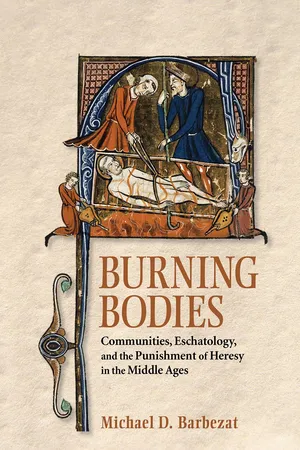
Burning Bodies interrogates the ideas that the authors of historical and theological texts in the medieval West associated with the burning alive of Christian heretics. Michael Barbezat traces these instances from the eleventh century until the advent of the internal crusades of the thirteenth century, depicting the exclusionary fires of hell and judicial execution, the purifying fire of post-mortem purgation, and the unifying fire of God's love that medieval authors used to describe processes of social inclusion and exclusion.
Burning Bodies analyses how the accounts of burning heretics alive referenced, affirmed, and elaborated upon wider discourses of community and eschatology. Descriptions of burning supposed heretics alive were profoundly related to ideas of a redemptive Christian community based upon a divine, unifying love, and medieval understandings of what these burnings could have meant to contemporaries cannot be fully appreciated outside of this discourse of communal love. For them, human communities were bodies on fire. Medieval theologians and academics often described the corporate identity of the Christian world as a body joined together by the love of God. This love was like a fire, melting individuals together into one whole. Those who did not spiritually burn with God's love were destined to burn literally in the fires of Hell or Purgatory, and the fires of execution were often described as an earthly extension of these fires. Through this analysis, Barbezat demonstrates how presentations of heresy, and to some extent actual responses to perceived heretics, were shaped by long-standing images of biblical commentary and exegesis. He finds that this imagery is more than a literary curiosity; it is, in fact, a formative historical agent.
It is written regarding the Creator of everything Himself: Our God is a consuming fire (Deut. 4:24; Heb. 12:29). God is called a fire because with the flames of His love he ignites the minds which He fills. For this reason, the Seraphim are called a raging fire, because the powers closest to Him in Heaven are set aflame by the unimaginable fire of His love. On earth, the hearts of the just burn, set on fire by this flame.1
—Gregory the Great, Homilies on the Prophet Ezekiel, 1.8.28
For Gregory the Great, and Christian writers who followed in the same tradition, fire was a tool to both describe the creation of community and enact exclusion from it. This chapter explores some of the linked imagery and concepts that medieval theologians employed to imagine Christian community as a body on fire. It also explains how these concepts of fiery unity relied on enduring divisions. This pairing is crucial and deliberate. The very promises of radical love and social cohesion that I examine hold within them their opposites. These promises of an ardent unity in love are also threats, and the tension created between these two poles propels much of the discussion in not only this but also the following chapters. The fiery images used to elaborate on and explain the ideology of Christian unity had violent consequences.
In the work of many medieval authors, the presentation of heresy is intimately related to conceptions of orthodox community and how that community came about and grew. For these writers, heresy was part of a vast complex of hostile forces that existed in opposition to orthodoxy. The members of this vast opposition were everything that faithful Christians were not, and Christian community arose from the rejection of the foundational attributes, motivations, and limitations of this opposition. In order to explain how medieval authors often presented heresy as an inverted image of orthodoxy, one must begin with an exploration of what these authors believed Christian community was, and a central image they used to describe the unity and nature of the Christian community was a body on fire.
Rather than offering a complete history of fire as a way to describe God’s nature or the experience of otherworldly punishment, this chapter aims to provide a sketch of the central symbols and ideas regarding fire and community present by the twelfth and thirteenth centuries. I have chosen this period as a focus and as a terminus because of its relation to the specific instances of execution for heresy I examine in later chapters. This sketch will by necessity draw heavily from the Fathers, as later authors and scholars found continued inspiration in their works, but the emphasis will be on introducing concepts that will enliven and inspire specific engagements with fire and community in the later chapters. In particular, the discussion to follow sets the stage for how and in what ways eschatologically charged invocations of fire and violence were also explorations of fundamental notions of positive community and Christian identity.
While it is a quickly drawn picture, this chapter does tell a unified story. It regards three fires. One fire is spiritual, unifying, and divine. Another is material, divisive, and infernal. The third fire is somehow both spiritual and material, divine and infernal. As the work of theologians progressed into the twelfth century, these three fires worked together as thematically linked pieces of an increasingly systematized economy of salvation and human relationships.
As an image of unity, fire was like God. God’s love, like His nature, could be spoken of as a fire, and this fire spread from believer to believer, uniting all in God’s fiery love and fiery nature. This spiritual fire bound Christians together into one burning body with their God. God’s love as caritas, or charity, was the foundation of community, and it set the parameters for both inclusion and exclusion from that body. Outside of the Christian body, there was only lack, and those without the fire of charity would burn another way.
While there was a fire of unity, there was also a fire of division. The fires of Hell existed to burn those human beings who remained outside the fiery ambit of God’s love. These fires are likely more familiar to many modern readers and popular conceptions of the Middle Ages than the fires of love, but they can only be completely understood in the context of their divine counterparts. While God’s flame was transformative, hellfire was not. It was a sterile, prisonlike thing in which the damned burned forever without any true change or consumption.
Finally, there was a third type of fire that functioned conceptually as a mixture of the other two. The fire of purgation burned those Christians who at their death bore with them minor sins. While this was a fire of punishment like that of Hell, this fire aimed to reform the less than perfect Christian, eventually opening the door to Heaven and the immediate presence of God. This fiery God could be reached through this avenue of fire, but the very passage was enabled, and in a sense made out of, His fiery nature. To burn in the purifying flames of Purgatory after death a Christian needed to also burn with the fire of God’s love. Only with the two put together was postmortem reformation possible, and in this otherworldly flame, the threat and horror of Hell hybridized with the hope and spirit of God’s unifying love.
The Fires of Love: Christian Community as a Body Burning with Love
In the theology of medieval Catholicism, there are two basic communities to which all rational creatures—human beings and angels—ultimately belong: the community of God and the community estranged from Him. As explained by Augustine of Hippo, these communities are founded on and directed toward opposed loves: “Two cities, then, have been created by two loves: that is, the earthly by the love of self extending even to the contempt of God, and the heavenly by love of God extending to contempt of self.”2 The earthly city is the community of people who loved themselves and the things of this world. The love that led this city was a small and selfish thing, the kind of desire that lay at the root of all suffering and cruelty.3 In the earthly city, wealth and power made men great, and each was a unit by himself, seeking what was good to him and for him.4 The politics of the earthly city remained clearly assigned “to the sphere of the appetites,” rather than the love of God.5
In contrast to the desire at the base of the earthly city, there was another love. This love promised, beyond all else, to make many into one. This promise of unity between all people was divine, made out of God at the same time that it led human beings to Him. It was an impartial love without limit that not only transcended the bias of appearances but also existed, in a fashion, to reveal the falsity of divisive appearances. In contrast to the worldly desire to dominate and to victimize others, this love would lead the believer to feel that his neighbor was a part of him, and that we are all a part of each other. This love was a maker of community that promised to take what is worst in us and turn it into what is best, to build on the common resemblance between human beings while melting away the divisiveness at the heart of all violence, prejudice, and pain. The common resemblance between human beings, on which a union of all humanity can be built, was God’s image. The image of the divine in man was distorted in the current world, and that deformation lay at the root of all vices and the suffering they caused. It followed logically that a harmonious human society could only be realized through the reparation of God’s likeness in each individual through the transformative power of a unifying love.
This great unity could only come about if the object of love shifted to God away from the things of His creation. God had provided a method for this change in orientation through the Incarnation of Christ. Joined together in love of Christ, believers became united to their God and to each other in a shared body, as the Apostle Paul explains:
For as the body is one, and hath many members; and all the members of the body, whereas they are many, yet are one body, so also is Christ. For in one Spirit were we all baptized into one body, whether Jews or Gentiles, whether bond or free; and in one Spirit we have all been made to drink. For the body is not one member but many. If the foot should say, because I am not the hand, I am not of the body; is it therefore not of the body? And if the ear should say, because I am not the eye, I am not of the body; is it therefore not of the body? If the whole body were the eye, where would be the hearing? If the whole were hearing, where would be the smelling? But God hath set the members every one of them in the body as it hath pleased Him.6
The unity of believers in God promised to dissolve the importance of many worldly differences: “There is neither Jew nor Greek: there is neither slave nor free: there is neither male nor female. For you are all one in Christ Jesus.”7 The corporate identity of the Christian community, imagined through the image of a united body, came about through the action of the Holy Spirit and the rest of the Trinity.8 God created the love in each believer that brought about Christian community and Christian unity. Just as the way was the destination, this love that unites was the very object of that love.9
Medieval theologians imagined the unity of love through many images. They saw it in the body of Christ into which all Christians joined as limbs. They found it in the ark of Noah, which would carry its passengers through the destruction of the world into the future.10 They described it as a city, a heavenly Jerusalem, where humanity would dwell with its creator in peace.11 All of these images are coterminous with the Church on earth, and medieval authors used the linked images of city, ark, institutional Church on earth, and common body to refer to the same fundamental society that they viewed as their own.12
All of these images of redemptive unity coexisted with things outside this union, led on by a fallen love opposed to the love that created redemptive unity. Augustine had termed the fallen love of creation cupiditas, or worldly desire.13 While God’s community promised unity in one body composed by many members, fallen humanity had by its basic nature a unifying emptiness and shared doom. At birth, a person was not a member of the Church, but rather a sharer in the fallen nature of humanity.14 This fallen nature was inherited from Adam and Eve, and all those who remained outside the Church belonged to it.15 This fallen nature had within it the destructive love of self in contempt of God, which was the root of suffering and cruelty. In contrast to the fallen unity of humanity, membership in the Church must be acquired. One had to join, or be joined to, the body of Christ. The ark had to be boarded, and everything outside it would perish in the Flood. The City of God was like a pilgrim in the current world, surrounded by the earthly city and its citizens. The unity of God was in process, always growing but never in the current world complete, and the instrument of this reparative and expanding unity was a perfect love.
This love that united creator and creation was caritas, and this love in fact was God.16 Often translated in the modern idiom as “love,” caritas meant a specific kind of divine love.17 While it was often used interchangeably with amor, in these cases the difference between this divine love and more earthly and physical loves was still clear.18 Caritas is the virtue by which human beings love God and become united to Him.19 It is a special, spiritualized kind of love, distinct from carnal affection. Union with God through caritas entailed a unity of believers with each other. As each Christian became united to God, they also became one with all other Christians, who were ...
Table of contents
List of Illustrations
Acknowledgments
Introduction
1. Our God Is Like a Consuming Fire
2. Fields and Bodies
3. The Beginning at Orleans in 1022
4. Likeness in Difference
5. Like Rejoices in Like
6. Witches and Orgiastic Rituals
7. Leaping from the Flames
Conclusion
Notes
Works Cited
Index
Trusted by 375,005 students
Access to over 1.5 million titles for a fair monthly price.
Study more efficiently using our study tools.
Frequently asked questions
Yes, you can cancel anytime from the Subscription tab in your account settings on the Perlego website. Your subscription will stay active until the end of your current billing period. Learn how to cancel your subscription
No, books cannot be downloaded as external files, such as PDFs, for use outside of Perlego. However, you can download books within the Perlego app for offline reading on mobile or tablet. Learn how to download books offline
Perlego offers two plans: Essential and Complete
Essential is ideal for learners and professionals who enjoy exploring a wide range of subjects. Access the Essential Library with 800,000+ trusted titles and best-sellers across business, personal growth, and the humanities. Includes unlimited reading time and Standard Read Aloud voice.
Complete: Perfect for advanced learners and researchers needing full, unrestricted access. Unlock 1.5M+ books across hundreds of subjects, including academic and specialized titles. The Complete Plan also includes advanced features like Premium Read Aloud and Research Assistant.
Both plans are available with monthly, semester, or annual billing cycles.
We are an online textbook subscription service, where you can get access to an entire online library for less than the price of a single book per month. With over 1.5 million books across 990+ topics, we’ve got you covered! Learn about our mission
Look out for the read-aloud symbol on your next book to see if you can listen to it. The read-aloud tool reads text aloud for you, highlighting the text as it is being read. You can pause it, speed it up and slow it down. Learn more about Read Aloud
Yes! You can use the Perlego app on both iOS and Android devices to read anytime, anywhere — even offline. Perfect for commutes or when you’re on the go. Please note we cannot support devices running on iOS 13 and Android 7 or earlier. Learn more about using the app
Yes, you can access Burning Bodies by Michael D. Barbezat in PDF and/or ePUB format, as well as other popular books in History & European Medieval History. We have over 1.5 million books available in our catalogue for you to explore.