- 544 pages
- English
- ePUB (mobile friendly)
- Available on iOS & Android
eBook - ePub
About this book
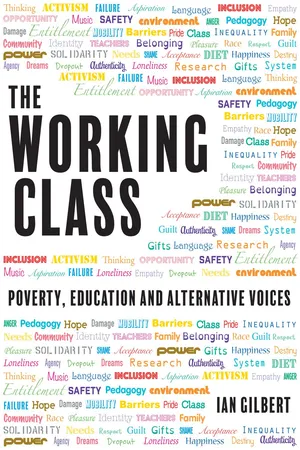
In The Working Class: Poverty, education and alternative voices, Ian Gilbert unites educators from across the UK and further afield to call on all those working in schools to adopt a more enlightened and empathetic approach to supporting children in challenging circumstances. One of the most intractable problems in modern education is how to close the widening gap in attainment between the haves and the have-nots. Unfortunately, successive governments both in the UK and abroad have gone about solving it the wrong way. Independent Thinking founder Ian Gilbert's increasing frustration with educational policies that favour 'no excuses' and 'compliance', and that ignore the broader issues of poverty and inequality, is shared by many others across the sphere of education - and this widespread disaffection has led to the assembly of a diverse cast of teachers, school leaders, academics and poets who unite in this book to challenge the status quo. Their thought-provoking commentary, ideas and impassioned anecdotal insights are presented in the form of essays, think pieces and poems that draw together a wealth of research on the issue and probe and discredit the current view on what is best for children from poorer socio-economic backgrounds. Exploring themes such as inclusion, aspiration, pedagogy and opportunity, the contributions collectively lift the veil of feigned 'equality of opportunity for all' to reveal the bigger picture of poverty and to articulate the hidden truth that there is always another way. This book is not about giving you all the answers, however. The contributors are not telling teachers or schools leaders how to run their schools, their classroom or their relationships - the field is too massive, too complex, too open to debate and to discussion to propose 'off-the-shelf' solutions. Furthermore, the research referred to in this book is not presented in order to tell educators what to think, but rather to inform their own thinking and to challenge some of the dominant narratives about educating the 'feckless poor'. This book is about helping educators to ask the right questions, and its starting question is quite simple: how can we approach the education of young people from disadvantaged backgrounds in a way that actually makes a difference for all concerned? Written for policy makers and activists as well as school leaders and educators, The Working Class is both a timely survey of the impact of current policies and an invaluable source of practical advice on what can be done to better support disadvantaged children in the school system. Edited by Ian Gilbert with contributions from Nina Jackson, Tim Taylor, Dr Steven Watson, Rhythmical Mike, Dr Ceri Brown, Dr Brian Male, Julia Hancock, Paul Dix, Chris Kilkenny, Daryn Egan-Simon, Paul Bateson, Sarah Pavey, Dr Matthew McFall, Jamie Thrasivoulou, Hywel Roberts, Dr Kevin Ming, Leah Stewart, (Real) David Cameron, Sir Al Aynsley-Green, Shona Crichton, Floyd Woodrow, Jonathan Lear, Dr Debra Kidd, Will Ryan, Andrew Morrish, Phil Beadle, Jaz Ampaw-Farr, Darren Chetty, Sameena Choudry, Tait Coles, Professor Terry Wrigley, Brian Walton, Dave Whitaker, Gill Kelly, Roy Leighton, Jane Hewitt, Jarlath O'Brien, Crista Hazell, Louise Riley, Mark Creasy, Martin Illingworth, Ian Loynd, David Rogers, Professor Mick Waters and Professor Paul Clarke.
Information
Topic
EducationSubtopic
Education GeneralChapter 1
Failure
Kids Like Jim
There was once a boy in my class, let’s call him Jim, who nearly made me give up teaching. He was the most irritating, disruptive, combustible and exacerbating child I had ever met. He could make you bite down on your knuckles in frustration, scream in the darkness of your cupboard and sob in the staffroom in front of your colleagues. I remember walking out of the school one lunchtime, ramming a cigarette in my mouth and heading straight for the pub with no intention of coming back. It took two pints of strong lager and the intervention of a supportive deputy head to make me change my mind.
Why was he so terrible? Because his life was in ruins. He was seven years old and already more awful, life-changing catastrophes had happened to him than I hope will ever happen to you or me in a lifetime.
By the age of three his father had been taken away and locked up without much hope of parole. I’ll leave it to you to imagine what he had done to deserve such a sentence, suffice to say toddler Jim didn’t go unscarred. His mother blamed him for losing her husband, and got pregnant again almost immediately.
If things had been bad for Jim before his brother was born, they got a whole lot worse after he arrived. His mother, now self-medicating with whatever she could lay her hands on from the local dealers, started to blame Jim for every misfortune that befell her. Starting with losing her partner, then her flat (after the neighbours complained) and then his brother’s father, who left quickly after the birth taking her dole money and drug supply with him.
Never what you might call a loving mother, she took to giving him scraps of food from her plate and locking him away for hours in his bedroom until he screamed himself into an exhausted sleep. One police report described a filthy flat with dirty nappies piled in a corner, broken windows covered in cardboard and discarded bottles and cigarette ends everywhere.
Respite from this hellhole came when Jim was six and a social worker asked why he wasn’t at school. His mum, it turned out, had forgotten his age and hadn’t realised he had already missed more than a year. Delighted, she packed him off to the local primary.
Which is when he turned up in my class.
From the start he was almost unmanageable. He walked into the room like a caged animal, his eyes flitting from one potential enemy to another, and refused to join the rest of the children on the carpet. I carried on while a kindly teaching assistant talked to him about what was going on and explained that he had no need to worry. Thinking it might help she brought him a cup of water. Jim panicked (I’ve no idea why), threw the cup onto the floor, spraying the other children with water, and ran out of the room and down the corridor. If the front door of the school hadn’t recently been fitted with a childproof lock I’m sure he would have been out, across the street and gone before anyone could catch him. The teaching assistant caught up with him in the front lobby as he was desperately pulling on the handle and screaming. She took his hand with the intention of gently guiding him back inside and received a sharp kick in the shin for her troubles. Despite his years of impoverishment, Jim was a big unit and when he used violence, which was often, he didn’t hold back. Consequently the poor teaching assistant, caught off guard, felt the full force of the blow and crumpled to the floor.
Luckily the head teacher, who had heard the commotion from her office and had come out to investigate, saw the whole thing unfold and was quick to intervene. Manoeuvring herself between Jim and the unfortunate teaching assistant, she engulfed him in a warm (and completely incapacitating) hug. Jim’s anger continued for a minute or more, his screams muffled by the head’s pink woolly jumper, until he eventually began to calm down. At this point his body went completely limp, his knees buckled and he began to sob. The head, noticing the change, gently lowered him down to the floor, where Jim spent the next ten minutes, head buried, weeping uncontrollably.
I’m telling you this story because there is a narrative becoming popular in education (especially among politicians) that society’s ills and inequalities can be solved, not by something substantial such as a redistribution of wealth, but by giving children a solid dose of traditional education.
This education will provide them with the cultural capital they need to rise up out of deprivation and transcend the many barriers and disadvantages that block their path to financial security and a happy and successful life.
This narrative is particularly popular among those who wish to maintain the status quo, those who are quite comfortable as things are (thank you very much) and who wish, at all costs, to avoid sharing their wealth.
It works particularly well for these people because it puts the emphasis on schools to make the difference and on students to work hard and take advantage of the wonderful legacy of ‘the best that has been thought and said’.13 All they need to do is study and all teachers need to do is put them in an environment where it can happen. This is one that avoids distractions, controls their natural urges to be lazy, cruel and disobedient, and delivers content in an efficient and effective way. In order to succeed all students need to do is memorise and practise the knowledge required to pass exams (their ‘passports’ to future success) and to do exactly as they are told. The path is clear, well lit, and easy to follow.
It has the added advantage of being relatively cheap (always popular among politicians), since the teaching part of this process can be done by almost anyone who knows more than the students.
There is little skill involved in transmitting information and overseeing children working silently in their copybooks. The deep thinking is done by specialists outside the classroom, writing textbooks and generic lesson plans, which almost anyone with a week or two of training can follow and deliver to a class of obedient children.14 Behaviour management is also outsourced by schools employing ‘directors of detention’, who can work as overseers of organised systems of punishment, freeing up teachers from the responsibility of working with children on any genuine human level and again sidestepping the need for professional training or professional pay.
In such a system the parts become interchangeable – after all, one transmitter of knowledge is as good as another – and replicable across multiple settings. So long as those in management maintain the quality of the curriculum and the efficiency of the routines everything should run well. This is where the money is spent. The leaders of these systems are the captains of industry, the ‘superheads’, the inspirational directors of change. They command six figure salaries,15 which only a few years ago would have been impossible to imagine in education, and they are close friends and confidants of politicians and businessmen. Those at the very top become knights and dames and (it is rumoured) have helicopters and chauffeur-driven cars to ferry them about from one part of their empire to another.
The children are essentially resources. They come into the system at one end and as long as they work hard, obey the rules and dress smartly, they should come out the other with good exam results – if they get that far. Good exam results are what the system is all about. They ensure the school stays at the upper end of the league table, they ensure flattering headlines in the local press and they keep the captain’s helicopter in the air. In such a system conformity is a valuable commodity. There is no time for children who don’t comply with the rules – they are a distraction to others and quickly pounced on. These places are bastions of ‘no excuses’.16 Any misdemeanours, however small, are punished ruthlessly. Obedience is the watchword; students are trained (some in ‘boot camps’17) in how to line up, how to walk silently from one room to another, how to put up their hands quickly and efficiently, how to talk to adults, how to dress. Those who don’t comply lose out. It was their choice. The system is the same for everyone: everyone has the same opportunities, the same curriculum and the same chances. If they don’t want to take advantage – if they are too lazy, too selfish or too easily distracted – then there are plenty of other schools that will have them. (‘It is probably best for him to leave now, Mrs Smith, before he is excluded. No one, least of all you, wants that on Ryan’s school record.’18)
There are no official numbers of children who leave the system ‘voluntarily’.19 We simply don’t know how many walk out the door one day and don’t come back, how many are encouraged to ‘find somewhere else more suitable’ or how many leave officially and can’t find a suitable place. Where do they go? Back in the days before computer consoles and all day television they would be hanging around on street corners, down the ‘rec’ or in the arcade. But now they are largely invisible. They stay in their homes, communicate online and are fundamentally, and disastrously, disconnected from the rest of society.
You might think I’m exaggerating but this is a real phenomenon. Over the last two years I’ve been working with an organisation called Red Balloon which runs several centres around the country for young people who don’t go to school (they call them ‘self-excluders’).20 One of these centres, based in Cambridge, is an online school where teachers communicate with students through email, Mumble and other Internet platforms. The sessions typically last for fifty minutes and involve the usual curriculum subjects (maths, English, etc.) as well as therapy and social and emotional support. Since this online centre, called Red Balloon of the Air,21 was founded in 2011 it has seen a five-fold increase in the numbers of students it serves and is constantly oversubscribed. Parents are des...
Table of contents
- Cover
- Praise
- Title Page
- Foreword
- Preface
- Contents
- Epigraph
- Chapter 1: Failure
- Chapter 2: Activism
- Chapter 3: Inclusion
- Chapter 4: Aspiration
- Tadcu I – Nina Jackson
- Chapter 5: Language
- Chapter 6: Thinking
- Chapter 7: Opportunity
- Chapter 8: Empathy
- Chapter 9: Entitlement
- Chapter 10: Music
- Chapter 11: Safety
- Chapter 12: Environment
- Chapter 13: Anger
- Chapter 14: Pedagogy
- Tadcu II – Nina Jackson
- Chapter 15: Hope
- Chapter 16: Damage
- Chapter 17: Mobility
- Chapter 18: Barriers
- Chapter 19: Pride
- Chapter 20: Class
- Chapter 21: Inequality
- Chapter 22: Family
- Chapter 23: Community
- Chapter 24: Identity
- Chapter 25: Pleasure
- Chapter 26: Teachers
- Chapter 27: Belonging
- Chapter 28: Race
- Chapter 29: Respect
- Chapter 30: Guilt
- Chapter 31: Power
- Tadcu III – Nina Jackson
- Chapter 32: Solidarity
- Chapter 33: Shame
- Chapter 34: Needs
- Chapter 35: Acceptance
- Chapter 36: Gifts
- Chapter 37: Happiness
- Chapter 38: Destiny
- Chapter 39: Dreams
- Chapter 40: Agency
- Chapter 41: Dropout
- Chapter 42: Loneliness
- Chapter 43: Authenticity
- Chapter 44: Research
- Chapter 45: Diet
- Tadcu IV – Nina Jackson
- Chapter 46: System
- Contributors
- Acknowledgements
- Bibliography
- Index
- Copyright
- Advertisement
Trusted by 375,005 students
Access to over 1.5 million titles for a fair monthly price.
Study more efficiently using our study tools.
Frequently asked questions
Yes, you can cancel anytime from the Subscription tab in your account settings on the Perlego website. Your subscription will stay active until the end of your current billing period. Learn how to cancel your subscription
No, books cannot be downloaded as external files, such as PDFs, for use outside of Perlego. However, you can download books within the Perlego app for offline reading on mobile or tablet. Learn how to download books offline
Perlego offers two plans: Essential and Complete
- Essential is ideal for learners and professionals who enjoy exploring a wide range of subjects. Access the Essential Library with 800,000+ trusted titles and best-sellers across business, personal growth, and the humanities. Includes unlimited reading time and Standard Read Aloud voice.
- Complete: Perfect for advanced learners and researchers needing full, unrestricted access. Unlock 1.5M+ books across hundreds of subjects, including academic and specialized titles. The Complete Plan also includes advanced features like Premium Read Aloud and Research Assistant.
We are an online textbook subscription service, where you can get access to an entire online library for less than the price of a single book per month. With over 1.5 million books across 990+ topics, we’ve got you covered! Learn about our mission
Look out for the read-aloud symbol on your next book to see if you can listen to it. The read-aloud tool reads text aloud for you, highlighting the text as it is being read. You can pause it, speed it up and slow it down. Learn more about Read Aloud
Yes! You can use the Perlego app on both iOS and Android devices to read anytime, anywhere — even offline. Perfect for commutes or when you’re on the go.
Please note we cannot support devices running on iOS 13 and Android 7 or earlier. Learn more about using the app
Please note we cannot support devices running on iOS 13 and Android 7 or earlier. Learn more about using the app
Yes, you can access The Working Class by Ian Gilbert in PDF and/or ePUB format, as well as other popular books in Education & Education General. We have over 1.5 million books available in our catalogue for you to explore.