![]()
CHAPTER 1
Purpose, Passion, and Principles (P3)
Purpose
An overarching purpose guides 360 degree CEOs. It may be grounded in personal interest in the industry—agriculture as it feeds the world, energy as it provides the life source for cities and homes to operate, healthcare as new treatments contribute to improved lives. Or the sense of purpose may be demonstrated in the leader’s ability to create a raison d’etre for their employees, to define a vision or to highlight the context within which their work matters.
Right now, we are going through a restructuring going to public. To keep people motivated, inspired and engaged when the workloads are extraordinary is challenging. It’s hard for people who have not been through that environment as I have more than once. It helps to maintain the vision of what comes out the other side, which is an extraordinarily large journey with a better balance and greater personal rewards in terms of accomplishment and generally, hopefully, rewards that make their lives better as well.
—Mayo Schmidt
Passion
360 degree CEOs are passionate about their work—and typically within their lives as well. They are so very good at what they do because they carry within them a fervor that energizes them when they face seemingly insurmountable challenges. And when their passion wanes, and that can happen to any of us, if it is not a short-lived dip, they change their circumstances. They return to something that energizes them again so that they can perform at their best.
When Ben Voss was appointed CEO of Morris Industries, he commented:
Farming has always been very close to my heart. When we decided to purchase part of the farm from my parents a few years ago, it was really amazing to make that a key part of our lives. Now I also get to be part of one of the most iconic farm equipment companies in the world. As a farmer, as an engineer … pretty awesome.
The job of a CEO is about courage; it’s about listening to your management team, about listening to your board. And it’s about having somebody you can run ideas past—your spouse, your chairmen, your mother, somebody you can be real with. You can’t carry it all on your shoulders. In the end, CEOs must make the decisions. Give the team as big a sandbox as they can handle. When it works, it’s a thing of beauty, it’s worth all of that. It’s exciting, and it’s truly like the saying, love what you do and you will never work a day in your life. There are hurdles, yes, but if it’s easy, anyone would do it.
—Randy Findlay
In 1995, I formed a company called Crestone International with two other partners and about a year later I became CEO of that company. Through organic growth, mergers and acquisitions we have been able to grow to about 2,000 employees in three different countries doing about $350M in revenue. It’s been a fantastic ride, I’ve seen a lot of changes and I can’t believe I’ve been at it for almost 21 years. It’s really been fantastic.
—Cal Yonker
Principles
Most highly successful CEOs combine their passion with a company that enables them to adhere to their principles.
I love the electricity industry and that’s why I actually chose it when I had an opportunity to return to the gas business, because it’s a lifeline business. And the electricity industry matters. You know it really matters. You know that without electricity we would not have the economies, the health and the people’s livelihoods that are affected by electricity. And so, just by being in this industry, I find that quite rewarding because it really matters to people’s lives. And so is being able to lead a company that takes that responsibility very seriously and always wants to be better and create that environment.
—Gianna Manes
In this book, I use CEO, senior leader, and leader interchangeably. This is intentional, as these principles are applicable and can be successfully applied to managers and leaders at all levels. It will be all the better if you adopt and apply these learnings before you reach the top spot or even if you do not aspire to it. By applying the attributes of a 360 degree CEO, you will be a more satisfied and well-rounded person and a better manager and leader for heeding the lessons herein. Some of my CEO clients run $3B companies; others lead $20M companies. The CEOs whose stories populate these pages are leading or have led companies of all sizes—from mid cap to Fortune 100. The principles in this book apply to leaders of all ages and genders across all industries, geographies, and sizes of company.
Enduring Characteristics that Generate Results
For the purposes of this book and to further my expertise in executive performance, I held conversations with CEOs from across North America. When approaching CEOs, I identified those who were broadly respected by their peers and communities, recommended by their executive teams and peers, and had demonstrated sustained financial performance. In several cases, these CEOs have also won awards from external bodies in recognition of their high standards of performance. The discussions were candid, vulnerable, and humble. All displayed passion for their work and were generous with their time.
So what constitutes a 360 degree CEO? From my research, interviews, and experience with thousands of CEOs, it is not easy to attain, but the formula is simple, powerful, and achievable.
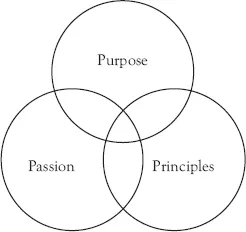
360 degree CEOs demonstrate P3. They generate profits by leading with… Purpose, Passion, and Principles.
The powerful trifecta: Purpose, Passion, and Principles (P3)
Purpose, Passion, and Principles (P3)
Purpose
Leaders who demonstrate purpose express their “why” in a way that excites and inspires their employees. Decades of research have reaffirmed that most people want to make a difference at work; they want to believe that what they do really matters and makes a difference in the world. When the CEO and other leaders offer a sense of purpose and loftier goals than profits and employment, employees respond. And here is a tip—in my interactions with those I consider 360 degree leaders, they are passionate when they describe the purpose of their organization. It is not enough to be able to describe the greater good or the overarching benefits to stakeholders—they have to still care about it.
Some of their comments are as follows:
• “Our products improve the day to day lives of our customers and their families.”
• “Our company creates interesting work and a great livelihood for thousands of people.”
• “We’re providing energy that powers lives.”—Mayo Schmidt
• “The electricity industry really matters. Without it, we would not have our economies and people’s health and livelihoods… It really matters to people’s lives”—Gianna Manes
• “We have a Rhodes Scholar in our band. We intervene when there are drugs. We are creating a better future for our band.”—Rose Laboucan
• “We help save lives.”
• “We are changing the face of education.”
When I spoke with Mayo Schmidt, President and CEO of Hydro One, he shared how a sense of purpose can help navigate through very demanding times in our careers.
Right now we’re going through a reorganization of a company, moving from crown into public [it is challenging] to keep people motivated, inspired, and engaged. The workloads are extraordinary right now and it’s hard for people who haven’t been through this environment more than once, as I have. It helps to maintain the vision of what comes out the other side, which is an extraordinarily large journey with a better balance and greater personal rewards in terms of accomplishments and, hopefully, rewards that make their lives better as well.
Passion
Leaders exhibiting passion speak with energy and conviction.
• “I get excited about creating winning teams.”
• “This is a fascinating industry that is always evolving. Technology is going to revolutionize healthcare and I want to be part of it.”
Passionate leaders retain enthusiasm even in challenging environments. They are not cheerleaders. They are not eternal optimists. They have conviction and fervor, oftentimes displayed as a quiet and confident energy. They care about what they are doing. They care about the company, the customers, and the purpose in a way that sustains them and others through periods of growth and downturns. They are in the industry or at the company that they are by choice. It is where they want to be; it aligns to their interests, their strengths, and their experiences. This is not to say they never lose their passion. But when that happens, they move on and seek a situation in which they can be mostly fulfilled and lead with passion (more on that in a later chapter).
In addition to being known for operating with the highest integrity, Gianna Manes demonstrates passion in every conversation, speech, and interaction:
Being a CEO allows me to affect an entire culture. That’s what gives me the most satisfaction and fulfillment. One of my biggest responsibilities is to create an environment where people can bring out their best and the collective best. Then we all align and point in the right direction. The leaders in this organization need to be of that ilk and that’s the environment I want to create and it starts from the top. That’s what I really love doing.
Principles
Principled leaders make decisions and take action based on a core set of values. They do not alter their decisions or the course of the company. I expect that most of us can cite examples in which this was not the case, as those are often identified in the media. This is what sets principled leaders apart.
• “I have certain beliefs and a set of values that are important to me. At times I had to compromise to some extent, but never to the point that I couldn’t sleep at night.”
• “Doing business in other countries… the normal protocol was to violate certain principles to get business done and we would just simply not do that. So, I think you’re called out all the time to make decisions that you have to reach in to yourself and ask, what’s the right thing to do?”
Everybody’s got integrity until it gets tested in some way. Your integrity is tested when you have to take out your chequebook to write a cheque. If you are willing to pay for your decision, you know you’ve got integrity. [As the CEO of a law firm and a non-lawyer] there were people who liked my approach and a lot of people who didn’t. There were people who wanted to be let off the hook; I had a line that I was not prepared to cross. When I was younger, I was far more black and white, and as I’ve gotten older, the grey zone has increased. It’s not as cut and dried as when I was younger. I have run every business the same way. I can walk down the street and if I run into someone whom I’ve fired, I can speak with him or her. I do not have to cross the street and walk the other way.
—Geoff Pulford
Some CEOs have said that it became harder to stay true to their values as they took on more senior roles. When I posed this question to Ed Clark, former CEO of TD Bank Financial Group, he responded:
I haven’t found that. Firstly, you’ve had more successes, so you’re more self-confident when you’ve gone with your gut again against the market to do the right thing… you’re good. You’re trying to run an organization in the long run and people want to feel proud of that organization. You should be trying to build an organization that 10 or 15 years later people will say, “This is a great place. I’ve made the right decisions at the right time.” I’ve actually found that it’s easier to [stay aligned to my values when you see what happens to] people who make short-term decisions and sacrifice the long term. It makes you more self-confident in saying, “we should do the right thing and we should do the right thing for 10 years from now.” The job of a CEO at a bank is to have a vision and show where you can get growth and lead that growth, but it’s equally being prepared to say no against opposition, not just outside the company, but inside the company as well.
Swiss Re’s former CEO balances passion and principles:
Swiss Re doesn’t just care about profitability. They want to create a better environment and make the world a better place. Swiss Re is very, very special in terms of its ability to influence the world.
For example, they spend a lot of time trying to h...