- 149 pages
- English
- ePUB (mobile friendly)
- Available on iOS & Android
eBook - ePub
About this book
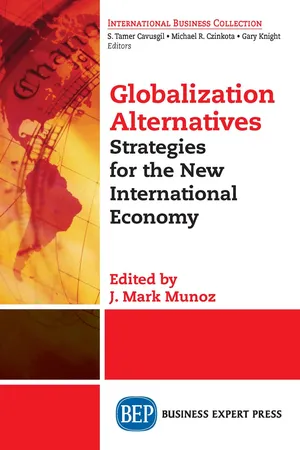
In a complex and growingly chaotic global environment, individuals, companies, and countries are forced to adapt, innovate, and operate in new ways. Creative and unconventional economic and business models are constantly being developed in order for countries and corporations to gain a competitive advantage. Countless novel ideas have challenged traditional views on the merits of globalization. Populist and protectionist sentiments have gained ground alongside calls for economic nationalism, alter-globalization, deglobalization and even unglobalization. Skepticism is on the rise, and there is a pressing need for fresh solutions and viable strategies. This book assembled a cast of international experts and thought leaders and gathered their views on alternative pathways toward global success.
Trusted by 375,005 students
Access to over 1 million titles for a fair monthly price.
Study more efficiently using our study tools.
Information
SECTION 1
Introduction
CHAPTER 1
Introduction
J. Mark Munoz
Globalization refers to social, economic, political, and cultural interconnectedness across countries (Ohmae 1995). It is both a fact and phenomena and foundation for many events around the world.
For many countries, it is the cornerstone for growth and development. Economic and trade liberalization is an important foundation for GDP growth (Soubbotina 2004; Giavazzi and Tabellini 2005). Financial and product market openness attracts capital, resources, and talent among others (Mishkin 2009). Globalization impacts macroeconomic factors such as inflation, output, and interest rates (Milani 2012). Evidences suggest that trade and financial openness impacts financial development (Baltagi et al. 2009; Kim et al. 2010).
Globalization runs deep into the core of contemporary business, economics, and politics. With its impact on reducing inequality and minimizing corruption, globalization creates a more democratic environment (Acemoglu and Robinson 2005). Mishkin (2009) indicated that economic globalization leads to institutional reforms and enhances its quality. Stultz (1999) indicated that globalization forces governments to improve legal and infrastructure systems.
The nature and architecture of globalization makes it a dynamo for change. Recent global events have shown a paradigm shift in traditional notions of politics, business, and economics. As examples, UK’s Brexit vote and USA’s 2016 Presidential election, which brought billionaire businessman Donald Trump to power, suggest that there has been heightened interest in experimentation and the pursuit of the unconventional.
In many corners of the world, political leaders have taken on populist and even protectionist standpoints. Policy makers have started to take a close look at programs promoting economic nationalism. Entrepreneurs have planned and implemented innovative models that defy conventional wisdom. Economists have started to explore radical concepts and theories.
Meanwhile, amidst this fast-changing and evolving global business environment, many have started to question the merits of globalization. Several tough questions have emerged: Does globalization benefit all countries and citizens around the world? Do some reap its rewards more than others? Is globalization for the privileged few? Are the billions of poorly educated and poverty stricken detached from the globalization loop? Are there adverse social, cultural, environmental, and financial consequences to globalization? Should new globalization models be explored? Should countries and firms be “unglobal” and detach itself from the rest of the world? How should countries, companies, and individuals manage the strong and ever-changing forces of globalization?
Critics claim that globalization has led to intense competition for the lowest costs and most appealing economic policies (Stiglitz 2002; Milanovic 2003). It puts a pressure on policy challenges that impact emerging economies (Law et al. 2014). It has adverse effect on public spending (Busemeyer 2009).
Others claim that low-cost producing countries in a global environment place pressure on wages and prices of goods in the industrialized countries (Borio and Filardo 2007; Pehnelt 2010). It has created an environment of consumer ethnocentrism and economic nationalism (Shimp and Sharma 1987; Baughn and Yaprak 1996). Financial and trade liberalization has created macroeconomic volatility leading to financial crises (Eatwell and Taylor 2000). There are challenges in accounting and the treatment of financial statements to deal with (Bryan et al. 2010).
Globalization touches many levels in a society. It has negative social and environmental effects (Harris and Nef 2008). It creates hybridization of cultures and economic structures (Nederveen Pieterse 2004). Furthermore, there is cause for concern for human and social rights (Baccaro 2010; Hafner-Burton 2005).
While there are criticisms about globalization, there are also many praises. For instance, there are economic benefits from globalization as a result of investments, trade, technology gains, and job creation (Kucera 2002; Flanagan 2006). Trade openness can contribute to financial development (Svaleryd and Vlachos 2002). Globalization of banking has led to several benefits (Goldberg 2009).
There is heightened sense of global connectedness among people (Strizhakova and Coulter 2015). A sense of global identity and world-mindedness has been created (Bartikowski and Walsh 2015; Nijssen and Douglas 2008). There has been a notable mobility of labor (Grogger and Hanson 2011). There has been observed homogenization and standardization (Ritzer 1993).
It can enhance governance in some nations. Trade openness decreases corruption (Ades and Di Tella 1999). Trade and financial openness will lead to wage increases and reduce inequality (Acemoglu and Robinson 2005). Emerging nations with open economies have significantly improved their world trade networks (International Monetary Fund 2006).
In the case of business, corporate overseas operations tend to complement domestic operations (Hayakawa et al. 2013). Many businesses have successfully expanded operations overseas and sold their products worldwide.
Debates continue worldwide on the actual merits and demerits of globalization. Conversations would likely linger for years due to many unanswered questions and unresolved issues.
This book would not be able to tackle all key issues regarding contemporary globalization. Instead, it aims to offer selected fresh perspectives on the subject of globalization alternatives from innovative thinkers from around the world. The intent is not to offer an all-encompassing and universal approach to alter globalization. Instead, the book’s goal is to focus on a few key issues to help the reader deliberate and assess potential merits of the selected globalization ideas. After this assessment, the reader can utilize certain aspects of the idea to develop a customized personal or organizational plan for success. In the concluding chapter of this book, suggestions and guidelines are offered for the strategic management of globalization.
In an effort to enhance appreciation and understanding of contemporary globalization, its defining attributes are described below.
- Discontentment – A multitude of individuals are unhappy or discontented with globalization. As a result of open border country policies, international trade and investment incentives, and heightened trade integration, some industries lost their competitive advantages and consequently experienced financial losses. Under this scenario, job losses were experienced in certain sectors. The fact that some countries offer subsidies and grants to certain industries lead to advantages that are deemed unfair by competitors who are not recipients of similar benefits.
- Diversity in approaches – Countries manage globalization in different ways. Some countries create policies that embrace internationalization and free trade, and some prefer to take on more protectionist measures. A similar variation in approaches is noticeable among companies. There are companies that execute an aggressive internationalization strategy, whereas others focus solely on domestic markets.
- Geopolitical influences – The confluence of geography, politics, and economics influence global events, trade, and relationships across nations. Countries that are geopolitically aligned may choose to limit trade dealings with those in opposing camps.
- Geoeconomic influences – The economic relationships of countries consequently impact trade and political relations. For example, some sectors feel that the EU operates like a trade fortress where members prefer to collaborate with fellow members.
- Global versus local pressures – Countries and companies feel both global and local pressures. Countries have to weigh in on the merits of enhancing global trade versus protecting local industries. When companies expand overseas, they need to consider the extent in which they pursue a one standard global strategy as opposed to responding to local preferences in each country.
- Uneven benefits across countries – Countries around the world experience profit and loss in varying degrees as a result of globalization. For example, some countries benefit with attracting investment and expanding trade, whereas others suffer from capital flight and brain drain.
- Uneven benefits across industries – Industries also experience profit and loss from globalization. Firms profit when investments pour in or when products find international markets, whereas firms lose when international competitors gain a foothold in their local market or when their top talent migrate to other countries for higher paying jobs.
- Accelerated by web and digital media platforms – The internet and digital media platforms sped up and added convenience to cross-border communication. Gathering of information and business intelligence has improved rapidly in recent years.
- Influenced by cultural changes – Globalization has also affected cultural transformation around the world. With facilitated international travel, cross-border business, and social media usage, consumer knowledge, sophistication, and tastes have evolved. For instance, in key cities in China the growing presence of French bakeshops are noticeable, along with high-end retail shops.
- Driven by advances in travel, tourism, transport, and logistics – The travel, transport, and tourism industries have facilitated the movement of people and goods around the world. In both cases, the volume has been consistently growing. This scenario has led to the acceleration of globalization.
- Language and convenience – Language has become less of a barrier to globalization and business. Bilinguals and multilinguals have been on the rise. Some languages have even started to evolve with the integration of foreign words in the vocabulary. Web and mobile apps with language translation features has facilitated cross-border global communication.
- Geographic cross-pollination – There has also been heightened global mobility. Employees have been more open to overseas postings. Inter-racial marriages are becoming more common. Many individuals choose to retire in exotic international locales.
These are just some of the changes that define globalization. In greater likelihood, more changes will follow and a hyper-globalized world will be the norm.
This book hopes to uncover these emerging changes and its implications. The goal is to showcase new ideas, solutions, challenges, as well as complexities brought about by globalization.
The book is organized in five sections. Section 1 is Introduction (J. Mark Munoz). Section 2 covers Countries and Governance and includes “Globalization’s Opposite: The Case of Bhutan” (Shelly Daly), “Strategic Globalization Alternative: The Case of Kenya” (Abel Kinoti Meru and Mary Wanjiru Kinoti), and “The Alternative of Pursuing Localization before Globalization: The Case of the City of Ferguson and International Media” (Shelly Daly). Section 3 pertains to Institutions and Policies and discusses “International Financial Institutions (IFIs): Facilitators or Obstructionists to Globalization? (Diana Heeb Bivona), Coping with State-Led Unglobalization: A Historical Analysis of Iran’s Petroleum Industry (Alireza Saify, Joobin Ordoobody, and Jasper Hotho), and “Local Content Policies: Global versus National?” (Irina Heim). Section 4 showcases Businesses and Industries and expounds on “Unglobal Finance: Informal and Alternative Banking Activities” (Les Dlabay), “Birth and Growth in Isolation: Development of the Generic Pharmaceutical Industry in Bangladesh” (Md. Noor Un Nabi and Utz Dornberger), and “Buy Local: A Consumer’s Alternative to the Global Market?” (Shelly Daly). Section 5 is the Conclusion (J. Mark Munoz).
Diverse sectors would benefit from this book. The academe would find fresh concepts to contemplate and debate on. Governments would find some of the ideas insightful in terms of policy formation. Businesses would find some of the information and mindsets useful in crafting internationalization strategies. Consulting companies, research firms, and international organizations would find the viewpoints useful in understanding the nuances of the new global environment. Finally, executives and entrepreneurs worldwide would find value on several innovative notions for global success.
This book is not meant to be a comprehensive volume that answers all questions and challenges brought about by globalization. It is, however, an important step toward expanding conversations and exploring innovative ideas for the enhancement of future global pathways.
References
Acemoglu, D., and J.A. Robinson. 2005. Economic Origins of Dictatorship and Democracy. Cambridge: Cambridge University Press.
Ades, A., and R. Di Tella. 1999. “Rents, Competition and Corruption”, The American Economic Review 89, no. 4, pp. 982–993.
Baccaro, L. 2010. “Does the global financial crisis mark a turning point for labour?”, S...
Table of contents
- Cover
- Half Title Page
- Title Page
- Copyright Page
- Contents
- Section 1 Introduction
- Section 2 Countries and Governance
- Section 3 Institutions and Policies
- Section 4 Businesses and Industries
- Section 5 Conclusion
- List of Contributors
- Index
Frequently asked questions
Yes, you can cancel anytime from the Subscription tab in your account settings on the Perlego website. Your subscription will stay active until the end of your current billing period. Learn how to cancel your subscription
No, books cannot be downloaded as external files, such as PDFs, for use outside of Perlego. However, you can download books within the Perlego app for offline reading on mobile or tablet. Learn how to download books offline
Perlego offers two plans: Essential and Complete
- Essential is ideal for learners and professionals who enjoy exploring a wide range of subjects. Access the Essential Library with 800,000+ trusted titles and best-sellers across business, personal growth, and the humanities. Includes unlimited reading time and Standard Read Aloud voice.
- Complete: Perfect for advanced learners and researchers needing full, unrestricted access. Unlock 1.4M+ books across hundreds of subjects, including academic and specialized titles. The Complete Plan also includes advanced features like Premium Read Aloud and Research Assistant.
We are an online textbook subscription service, where you can get access to an entire online library for less than the price of a single book per month. With over 1 million books across 990+ topics, we’ve got you covered! Learn about our mission
Look out for the read-aloud symbol on your next book to see if you can listen to it. The read-aloud tool reads text aloud for you, highlighting the text as it is being read. You can pause it, speed it up and slow it down. Learn more about Read Aloud
Yes! You can use the Perlego app on both iOS and Android devices to read anytime, anywhere — even offline. Perfect for commutes or when you’re on the go.
Please note we cannot support devices running on iOS 13 and Android 7 or earlier. Learn more about using the app
Please note we cannot support devices running on iOS 13 and Android 7 or earlier. Learn more about using the app
Yes, you can access Globalization Alternatives by J. Mark Munoz in PDF and/or ePUB format, as well as other popular books in Business & International Business. We have over one million books available in our catalogue for you to explore.