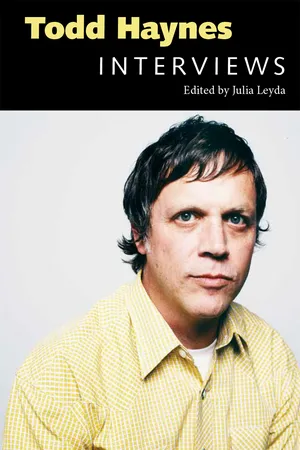
A pioneer of the New Queer Cinema, Todd Haynes (b. 1961) is a leading American independent filmmaker. Whether working with talking dolls in a homemade short (Superstar: The Karen Carpenter Story) or with Oscar-winning performers in an HBO miniseries (Mildred Pierce), Haynes has garnered numerous awards and nominations and an expanding fan base for his provocative and engaging work.
In all his films, Haynes works to portray the struggles of characters in conflict with the norms of society. Many of his movies focus on female characters, drawing inspiration from genres such as the woman's film and the disease movie (Far from Heaven and Safe); others explore male characters who transgress sexual and other social conventions (Poison and Velvet Goldmine).
The writer-director has drawn on figures such as Karen Carpenter, David Bowie, Iggy Pop, and Bob Dylan in his meditations on American and British music, celebrity, and the meaning of identity. His 2007 movie I'm Not There won a number of awards and was notable for Haynes's decision to cast six different actors (one of whom was a woman) to portray Dylan.
Gathering interviews from 1989 through 2012, this collection presents a range of themes, films, and moments in the burgeoning career of Todd Haynes.
- 240 pages
- English
- ePUB (mobile friendly)
- Available on iOS & Android
eBook - ePub
About this book
Information
Subtopic
Film & Video“Something That Is Dangerous and Arousing and Transgressive”: An Interview with Todd Haynes
From Bright Lights Film Journal 78 (November 2012). Reprinted by permission.
In the process of compiling and editing this collection of interviews with Todd Haynes, I took the opportunity to meet with him myself and ask him some questions of my own. I sat down with Todd Haynes in Portland on March 29, 2012.
JL: You’ve done several movies that are very clearly woman’s films, but the movie that I am most fascinated with in terms of gender is Velvet Goldmine, which is not usually interpreted in that context.
TH: No, except it’s probably gotten the strongest female fan base of any of my films. And what’s wonderful for me is to see new generations of young women, even as we think we progress as a society and there are new options available to each new generation that seem to be catering to that market more acutely, still Velvet Goldmine offers that market something that they’re not getting elsewhere. I always love it when girls come up to me at festivals and that’s the one, that’s the movie that really turned them around.
JL: I’m interested in the trope of playing with dolls in Superstar and Velvet Goldmine as a way to figure gender, embodiment, desire, identification. You said in an interview that playing with dolls is what you’re doing in Velvet Goldmine, as a metaphor for the filmmaking process. So what about the female characters in Velvet Goldmine? Fans, rock and roll girls like Mandy—talk a bit about them.
TH: Interesting question. The character of Mandy was probably one of the hardest roles I’ve ever had to cast. We did a really thorough, international search for who could play Mandy. When I look back on the experience, I’m amazed at how many actresses agreed to read for the role who don’t often do so. I think what was difficult about Mandy was that she, and the Angela Bowie template for that character, harkened back to a kind of performative femininity of which there are very few contemporary examples anymore. I see it as the Patti Smith divide in terms of rock and roll and public depictions of femininity, whose image emerged finally, after so many variations on the codified mannerisms that were available to women in midcentury American film, for instance, and popular music (although there have always been interesting deviations from this). I think over time a lot of the affectations associated with performing femininity had fallen away, to the point where you came to this iconic figure of Patti Smith, whom I see as similar in a way to the Jude figure in I’m Not There, a very androgynous, more masculine-identified figure. For young actresses reading the role of Mandy it became clear that recent examples of that kind of almost camp presentation of an affected, theatrical persona were very hard to locate; I think of Liza Minnelli, and maybe Parker Posey was one of the later examples, of almost a gay male idea of femininity.
One thing that was very interesting about Angela Bowie is the way she navigated the English and American influences and her accent would come and go, and that was one of the things we wanted to incorporate into the performance, but that’s very tough on an actor. We wanted to make it understood that it’s a mutable way of fixing into each culture with some fluidity. I mean, there’s no question that Angela Bowie was a central driving engine—her autobiography is amazing, and it’s supported by most of the documentation and oral histories of those years—in the transformation of David Bowie, who was experimenting with different kinds of feminine representations but ultimately fixed on this Warhol-infused figure of the Ziggy Stardust character. It was really Angela Bowie who championed these kinds of characters, part of the second-generation Warhol clan, who made their way to the UK and appeared in this play Pork in 1971. They just loved her and she loved them, and in a weird way Bowie was sort of a spectator, an observer of this love and energy. And I think, based on what she wrote in her book and other documentation, she was very interested in the gay liberation movement that was burgeoning at the time and she wanted to appropriate it, take it on, and become the spokesperson in a rock and roll vernacular for those ideas.
I don’t know if this relates directly to doll-playing except that it really might be the last time that you see an active female figure freely utilizing artificial terms of self-expression and persona in an unembarrassed, unabashed, almost radical way. That was in a way the fascinating counterpart to the more aloof, silent, objectified figure that Bowie assumed as Ziggy Stardust. Of course, there was also that hardcore influence from the American music that he loved—the Stooges, the MC5, and the Velvet Underground and Lou Reed—as the final ingredient to give it that kind of duality, the cross between English musical traditions and this American hardcore, a direct assault. He needed both of those, but there was still a kind of passivity and object-ness of that figure that seemed more quiet, and more comfortable being an image, an idealized beautiful façade that people could project onto; whereas Angela Bowie was active, pulling the strings and moving the levers—in that way, I think, making him up so that he was the doll that she was playing with. So a lot of that energy and that fire and fearlessness I think could be attributed to her.
JL: That is how I see the character of Mandy in the film, and the way that she gets shunted aside, because he’s moving on to a different persona.
TH: Exactly. After first embracing bisexuality in the free flow and openness of that marriage and the flexible terms of their sexual dalliances, she is ultimately excluded by this little romance, pushed to the side and becomes the spectator in the wings. I think of that one scene where they all gather in the wings watching Curt Wild perform a kind of apocalyptic ultimate expression of himself, she’s this melancholy observer of what she’s had a hand in fostering and then been excluded from.
JL: In the doll-playing scene in Velvet Goldmine, the girls are like Mandy, manipulating them and fantasizing about them. So that trope of little girls playing with dolls scene really gets at the way the movie is about bisexuality and a kind of less bordered sexual identity, that is based in play, in fantasy—
TH:—is fluid, is mutable, is conducive to all kinds of voices and all kinds of players pulling the strings. But one thing that Velvet Goldmine kind of misses is how strongly and passionately young women were the driving desiring consumers of this very unique moment in popular culture history. That has continued, too: the androgynous male object is something that still attracts a really passionate, active female spectatorship. That’s so fascinating to me, and you can see it played out in so many different ways: the tradition of the Japanese comics of the seventies, what’s it called again?
JL: The subgenre of manga with the boy lovers and its girl fans, yaoi.
TH: Exactly. The boy lovers and the girl fans, really directed at girl consumers and it’s this androgynous, starry-eyed princes and pretty boys who have sparkly eyes for each other.
JL: I wondered if you were aware of yaoi or not. When I was working on a conference paper about the girl fans in Velvet Goldmine some of my colleagues said, Hey that’s just like yaoi! And I said, Wow, it really is.
TH: It was a tangent that I learned about in the process of research, but I don’t remember when exactly. I was certainly aware of how there was a particular Japanese following with a passionate attachment to the Bowie phenomenon, glam rock, T. Rex; Japan made up a major part of their market. But I think it’s an interesting counter-argument to the classic Laura Mulvey idea of a limited female spectatorship and if anything it only further underscores—although I think this is all embedded in that, and though I haven’t read those articles in some years—that marginalized subjects, such as gay subjects and women, have to find a more dexterous and nuanced way of reading culture and finding their way into all kinds of content that is not designed for them. I think there’s this ability to transform and to enter into all kinds of different subject positions of which this is one amazing and fascinating example: the glam rock thing with young girls’ driving interest in it.
JL: When I was a teenaged Bowie fan, my mother would say, “You’re attracted to him, you have a crush on him, why do you want to look like him? When I was younger I loved Jean-Paul Belmondo, but I didn’t want to look like him.” But in the seventies, and in my case the eighties, and still today I think, girls of all sexual orientations experience that overlapping between desire and identification—it’s there in the Arthur character, too, but I’m thinking of in the opening sequence with the glam girls rampaging.
TH: Right, they’re absolutely rampaging, terrorizing the town in utter desire. And we all know that the passion that we see displayed there, the intensely sexual display of female spectatorship probably started with Valentino, Sinatra, the Beatles, and Elvis.
JL: It’s almost hysterical.
TH: Yes. There was in these cases an androgynous, feminine element to the actual performance; in a way, just for the star to be up on stage, just to be objectified, is to arguably be feminized. These artists in their unique and shaded ways capitalized on that and the result among female spectators is something that society is still startled by: that radical emotional response that it engenders.
JL: Similarly with the British band the Libertines, there was a great deal of sexual ambiguity between the two male performers and it wasn’t clear whether they were lovers or just close and demonstrative in ways that we aren’t used to seeing among men, but female fans went crazy for that. I think that plays right into this glam dynamic as well—a sort of punk, hard-edged rock and roll, but with a homoerotic side that plays to the girl fans in particular.
TH: This Twilight phenomenon too—it doesn’t really end. Each generation has its own variant on that. It does call into question all sorts of assumptions about opposites attracting, the whole simplistic reductive ideas of what drives desire—
JL:—and the borders of identity.
TH: Yes, and the female subjects, spectators, consumers, maybe because they’ve had to learn how to occupy different subject positions in dominant patriarchal culture, have revealed the ways that desiring has narcissistic or self-reflexive aspects. On the other hand maybe male spectatorship has just been so much more catered to and delineated in solid terms, and thus hasn’t been able to explore the margins as thoroughly, but women and gay people and African Americans, for example, all have to find different ways of entering mainstream cultural production.
JL: I love that the girls with the dolls in Velvet Goldmine are storytellers, they are controlling the narrative, in a sense, and that you say that that’s what you were doing as a director.
TH: I think that’s how we all begin to externalize our desires: through storytelling. Dolls are a tool that lends itself to that; they are supposedly made for little girls, and I loved dolls when I was a kid. The Barbie doll became a multiply useful subject in the Karen Carpenter film and that was the internal nod that I was making in Velvet Goldmine, but it was so relevant it didn’t feel like a detour or a private joke—it felt like it was getting to the core of the intense affect that is felt by these kinds of characters in popular culture. That free-floating desire in the little boy romance that the little girls are constructing is about as sweet and tender as anything in the film.
JL: That kind of storytelling, the freedom in play, helps the characters, but also the rest of us, decide who we are and how we want to tell our own stories.
TH: It’s the story and the engine of the film. It is really the fan’s point of view—the Arthur character, obviously—but it’s really the theme and the whole motor of it. I always knew I wasn’t really interested in getting inside the closed doors of these famous subjects and that’s why a fictionalization of this unique period made sense. We all already fictionalize and fill in and fantasize. And we see it too in the whole slash fiction phenomenon, which I didn’t even know about until Velvet Goldmine, and in which Velvet Goldmine has itself become a category.
JL: That’s the cool thing about Velvet Goldmine—it is itself a sort of slash fiction, and there’s this ongoing spinoff slash fiction community carrying the stories forward—it’s a perfect loop.
TH: Yes. To ignite that little flame that makes people want to respond actively and creatively and participate. It reminds me of a girl. . . . I was scared of Bowie when I was in junior high school, and I remember I was aware of him but it was all just too freaky. There was a girl in a lip sync show in seventh grade who picked his song “Changes.” She was this beautiful girl and she imitated him, as many girls did, right, because he was so pretty.
JL: It was easy for girls to look like him because he was so pretty.
TH: And he was mastering makeup, cosmetics, clothes, style, and posing, in every stage of himself, in his evolution: things that girls maybe do a little more in the mirror than boys? But maybe not much more.
JL: At that age, with makeup, yes.
TH: Exactly. And she just did the perfect lightning bolt like Aladdin Sane, and she got her hair just right—I forgot if she wore a wig. But she performed “Changes” and I remember hearing and thinking, “Oh, this isn’t so scary . . .” because I expected it to be really hardcore music and I would be put off by it. But it was so pretty.
JL: So she turned you on to Bowie.
TH: She really helped. Jean Sagal, I think that’s her name.
JL: I wonder if she’s related to Katey Sagal—[Married with Children’s] Peggy Bundy.
TH: I actually think she is.
JL: That would be cool.
TH: That would be cool. I think she actually might have been the sister of Katey Sagal.
JL: I’m trying not to let my brain explode with that idea! I remember that scene in Velvet Goldmine where they’re reporting on the news, saying something like, “Girls everywhere are wearing glitter makeup” and that conveyed the society’s sense of fear, of what are all those girls up to? The idea that they’re going to need to be controlled again somehow because they’re getting a little too weird or too powerful.
TH: The glitter girls, as they were sometimes called, especially the LA version of the glitter girls, that’s another thing I really remember fr...
Table of contents
- Cover
- Half title
- Title
- Copyright
- Contents
- Introduction
- Chronology
- Filmography
- Karen Carpenter: Getting to the Bare Bones of Todd Haynes’s Superstar: The Karen Carpenter Story
- Todd Haynes: The Intellectual from Encino
- Poison at the Box Office
- Cinematic/Sexual: An Interview with Todd Haynes
- Appendix: An Interview with Todd Haynes
- Diary of a Sad Housewife: Collier Schorr Talks with Todd Haynes
- Todd Haynes
- Antibodies: Larry Gross Talks with Safe’s Todd Haynes
- Briefs, Barbies, and Beyond
- All That Glitters: Todd Haynes Mines the Glam Rock Epoch
- Todd Haynes (Interview)
- Flaming Creatures
- Interview with Todd Haynes
- Fanning the Flames
- Heaven Sent
- Imitation of Film: Todd Haynes Mimics Melodrama in Far from Heaven
- Past Perfect
- A Scandal in Suburbia
- The Many Faces of Bob Dylan: An Interview with Todd Haynes
- Conversations: Todd Haynes
- Todd Haynes
- It Ain’t Me Babe
- From Underground to Multiplex: An Interview with Todd Haynes
- Interview with Todd Haynes
- HBO: Mildred Pierce—The Evening Class Interview with Todd Haynes
- Daughter Dearest
- Todd Haynes on Mildred Pierce: Too Racy for Indies, but Perfect for TV
- “Something That Is Dangerous and Arousing and Transgressive”: An Interview with Todd Haynes
- Key Resources
- Index
Trusted by 375,005 students
Access to over 1.5 million titles for a fair monthly price.
Study more efficiently using our study tools.
Frequently asked questions
Yes, you can cancel anytime from the Subscription tab in your account settings on the Perlego website. Your subscription will stay active until the end of your current billing period. Learn how to cancel your subscription
No, books cannot be downloaded as external files, such as PDFs, for use outside of Perlego. However, you can download books within the Perlego app for offline reading on mobile or tablet. Learn how to download books offline
Perlego offers two plans: Essential and Complete
- Essential is ideal for learners and professionals who enjoy exploring a wide range of subjects. Access the Essential Library with 800,000+ trusted titles and best-sellers across business, personal growth, and the humanities. Includes unlimited reading time and Standard Read Aloud voice.
- Complete: Perfect for advanced learners and researchers needing full, unrestricted access. Unlock 1.5M+ books across hundreds of subjects, including academic and specialized titles. The Complete Plan also includes advanced features like Premium Read Aloud and Research Assistant.
We are an online textbook subscription service, where you can get access to an entire online library for less than the price of a single book per month. With over 1.5 million books across 990+ topics, we’ve got you covered! Learn about our mission
Look out for the read-aloud symbol on your next book to see if you can listen to it. The read-aloud tool reads text aloud for you, highlighting the text as it is being read. You can pause it, speed it up and slow it down. Learn more about Read Aloud
Yes! You can use the Perlego app on both iOS and Android devices to read anytime, anywhere — even offline. Perfect for commutes or when you’re on the go.
Please note we cannot support devices running on iOS 13 and Android 7 or earlier. Learn more about using the app
Please note we cannot support devices running on iOS 13 and Android 7 or earlier. Learn more about using the app
Yes, you can access Todd Haynes by Julia Leyda in PDF and/or ePUB format, as well as other popular books in Media & Performing Arts & Film & Video. We have over 1.5 million books available in our catalogue for you to explore.