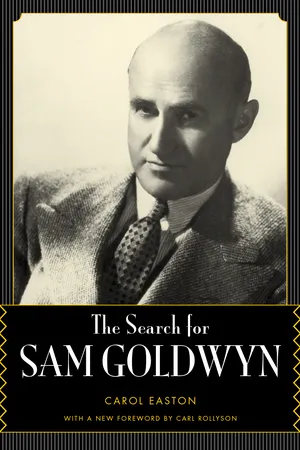
Sam Goldwyn's career spanned almost the entire history of Hollywood. He made his first film, The Squaw Man, in 1913, and he died in 1974 at the age of ninety-one. In the many years between, he produced an enormous number of films—including such classics as Wuthering Heights, Street Scene, Arrowsmith, Dodsworth, The Little Foxes, and The Best Years of Our Lives —and worked with many luminaries—Gary Cooper, Ronald Colman, Laurence Olivier, George Balanchine, Lillian Hellman, Howard Hawks, John Ford, Eddie Cantor, Busby Berkeley, Danny Kaye, Merle Oberon, and Bob Hope among them. When Samuel Goldfisch was born in the Warsaw ghetto, he was penniless; when Sam Goldwyn died in Los Angeles, he was worth an estimated $19 million. The Search for Sam Goldwyn locates the real Sam Goldwyn and shatters the "hostile conspiracy of silence" that protected his legend. In writing Goldwyn's story, Carol Easton has given us a fine examination of "the civilization known as Hollywood" and how Goldwyn himself shaped that culture.
- 304 pages
- English
- ePUB (mobile friendly)
- Available on iOS & Android
eBook - ePub
The Search for Sam Goldwyn
About this book
Information
Subtopic
Film Direction & Production
1. From Ghetto to Gloversville
In 1947, a handful of Hollywood’s royalty attended a dinner party given by Mr. and Mrs. Samuel Goldwyn in their sixteen-room home in Beverly Hills, just down the road from Pickfair and adjacent to the William Randolph Hearst estate. The five-acre Goldwyn spread contained all the obligatory Hollywood status symbols: swimming pool, tennis courts, manicured gardens and, as an added touch of opulence (an anniversary gift from Mrs. Goldwyn to her husband), croquet courts.
The menu, planned by Mrs. Goldwyn, was elegant; the wines, selected by Mrs. Goldwyn, superb. Every detail was first class, just like a Goldwyn movie. The party broke up around eleven. Getting into her car, one of the guests realized she’d left her gloves in the house; her husband, a director, went back to retrieve them. Passing the dining room doorway, the director got a rare glimpse of the real Sam Goldwyn: alone in the room, he was carefully pouring the wine left in the glasses back into a wine bottle.
Goldwyn had left the Warsaw ghetto at the age of eleven; but the ghetto never left Goldwyn.
Samuel Goldwyn was born in 1918 by order of the Superior Court of the State of New York; but the original, genuine article was born to Abraham and Hannah Goldfisch on or about August 27, 1882, in the infamous Warsaw ghetto.
Facts about his family background are sketchy and contradictory; in his memoirs, Goldwyn said only, “My early boyhood was spent in Europe.” One consistent fact is that he left home at the age of eleven; but under what circumstances? Goldwyn told Adolph Zukor, who knew him from 1915 until the end of his career, that he had run away to London following the death of his parents; and in 1943, a journalist reported in The New York Times that “There was a distant look in his eyes as he told of being left an orphan.” But a few years earlier, his biographer, Alva Johnson, wrote that when Goldwyn was eighteen and already a successful salesman, he “took two months off and went to Europe, meeting his mother at Karlsbad.” Goldwyn, who loved Johnston’s book, never disputed anything in it.
There was no premium on truth in the Warsaw ghetto of the 1890’s. There was only constant, grinding poverty, and the terror of pogroms. Much has been made of Goldwyn’s lack of formal education—but at the age of eleven, he matriculated from the toughest survival school in the world. The boy was father to the man.
The education he received in the ghetto uniquely equipped him for Hollywood, a world of which he reportedly said, “It’s dog eat dog—and nobody’s going to eat me.” As the overvalued firstborn son of Orthodox Jews, his birth conferred on his mother her only status in life. The first lesson she taught him was that he was a prince, not subject to the rules that governed ordinary mortals. He was expected only to pray, visit the temple with his father, and generally allow himself to be pampered. What Sam wanted, if it was humanly possible, whatever the means, Sam—presumably—got. This was the lesson drummed into him by word and deed.
To survive among the embattled minority that over-populated the ghetto required sharp wits, obsessive drive, monstrous arrogance and a suspiciousness conducive to paranoia. Nobody was to be trusted. Wheeling and dealing was a way of life. Morality was elastic; bribery, for example, was neither right nor wrong but merely necessary when corrupt officials threatened one’s means of livelihood or the destruction of one’s house in a “spontaneous” raid. “Money for the devil” it was called; no Jew wanted to be without it. Boys grew up under the approaching threat of conscription. And given the lack of privacy in the unbelievably cramped quarters of the ghetto, is it not reasonable to assume, and to understand, how a child might come to long for … space? Space. Sixteen rooms. Five acres. Space.
When the eleven-year-old Sam Goldfisch ran away/was sent to an aunt in Birmingham, England, he left behind two brothers—one seven, the other an infant—and his parents, living or dead. According to legend, under his arm he carried a loaf of bread; and under his skin, surely a load of guilt.
Birmingham was not his destination—merely a stopping-off place en route to America. He worked as a “dogsbody” (slang for flunky), first pushing a coal cart, then for a blacksmith, finally for a safe manufacturing firm, and after two years had accumulated enough money for steerage passage across the Atlantic. It is likely that the boy did little during those years but work long hours, eat whatever was available, and sleep. It is conceivable that in Birmingham he saw, for the first time, floors of wood rather than dirt, tablecloths, white bread and other such luxuries. It is certain that he thought obsessively of the promised land, America.
He arrived in New York harbor penniless, possibly with forged papers (not an uncommon practice), programmed for success—Sam Goldfish now, without the c (courtesy of an immigration official who took a phonetic guess at the name of the boy who spoke fluent Yiddish, some Polish, but almost no English). A government agency promptly placed him in Gloversville—a company town named for its product—near Albany. In Gloversville, his ambition was unleashed.
Poles were emigrating by the millions at the turn of the century, and Gloversville contained a substantial colony of them, at various stages of Americanization. Goldfish had no relatives there, but he was quickly absorbed into the community. The owner of the glove factory—Samuel Lehr, who had himself emigrated from Warsaw—enjoyed considerable status in Gloversville society.
Goldfish’s first job was sweeping floors at the factory for three dollars a week. He was industrious, a veritable sorcerer’s apprentice, and quickly graduated to operating a glovemaking machine. There is no reason to doubt his later claim that he got up at six A.M. to tramp through zero weather to work standing up at the machine all day long.
He learned to cut skins, for which he was paid by the piece. He made, quite possibly cultivated, the friendship of the boy who shared his workbench. Abe, two years Sam’s junior, undoubtedly admired the older boy for his adventures and independence. Abe was Samuel Lehr’s son.
Goldfish never outgrew the values he acquired in Gloversville. There he began his lifelong pursuit of the trappings, the ornaments, the ostentatious badges of success. In the overblown, ghostwritten prose of his memoirs, written ten years after he left Gloversville, one of the rare passages with the ring of truth refers to his envy of the drummers he saw through the window of the town’s leading hotel: “those splendid adventurers with their hats and their massive cigars both at an angle!”
By the time he was sixteen, he had completed a year of night school and acquired enough rudimentary English to get by. His horizons had widened, and he found the factory confining. He persuaded Samuel Lehr to let him go on the road as a salesman and, armed with his sample case—his ticket to immortality—the prince set out to claim his kingdom.
In the haberdashery and general stores of New England cities and towns, Goldfish came into his own. The resistance of cautious Yankee buyers only sharpened his wits and his determination. Bedeviled by cravings for the things he knew money could buy, he charmed, blustered, badgered, wheedled, wheeled and dealed his way through the Northeast, outtalking, outfoxing and outdistancing the competition. He would not acknowledge, let alone accept, rejection. He had an answer for every argument, a ploy for every occasion. He could not be insulted. He could not be deterred. He could not be withstood.
His years on the road refined his technique and gave him a reputation as the highest-paid glove salesman in the country. He earned up to $10,000 a year—more than enough to indulge his lifelong passion for expensive clothes. He traveled to Europe first class, steerage now and forever beneath him. He accepted an offer to manage the New York office of a rival glove company; but he began to find the glove business confining; restless, he cast about for new worlds, preferably with no limits.
His new boss was a man named Joe Moses, who had a dazzlingly beautiful niece named Bessie Ginzberg. Bessie became the object of Goldfish’s affections. The depth of his passion will never be known, but Goldfish was, above all, conventional, and convention dictated that a man in his late twenties should acquire a suitable wife. Sam was too crude and aggressive for Bessie’s taste, however, and she turned him down in favor of a gentler young man, a vaudeville performer turned producer named Jesse Lasky.
The Laskys settled in New York, and Goldfish sometimes dropped in to visit. The household was dominated by Jesse’s mother Sarah, a widow whose world revolved around her children, and Jesse’s sister, Blanche. These two strong-minded women had already driven Bessie to the brink of divorce; Blanche even told Bessie what clothes to wear.
Jesse and Blanche were San Francisco-born, grandchildren of German immigrants. Jesse had joined a vaudeville troupe as a child, playing cornet; later Blanche learned to play the instrument and joined the act. With stage mother Sarah in the wings, they toured the country from the Barbary Coast to the Bowery. But Blanche never enjoyed performing as Jesse did, and repeatedly pointed out to her brother that the people who were making money in vaudeville were not on the stage, but in management. Eventually, she persuaded him to open an office and book acts, which he also produced. Blanche ran the office, supervised the sets and selected the costumes. She was industrious and efficient—qualities greatly admired by Sam Goldfish—and she was a remarkably handsome young woman. By the time she met Goldfish, whatever glamour show business had held for Blanche had worn exceedingly thin. She dreamed of marrying a solid, respectable businessman, and Sam entered right on cue. Handicapped by his abysmal awe and ignorance of women, he soon found himself at the mercy of someone as adept as himself at manipulation. In 1910, they were married.
Sam lived with his wife and in-laws (including Jesse’s infant son) in a crowded apartment on Broadway. To his wife’s dismay, he was intrigued by Jesse’s show business world; the glove business looked increasingly tame by comparison. The gamble, the unpredictability, the high stakes to be won (he refused to consider the possible losses) excited him. He joined Lasky in backing a Broadway play called Cheer Up—a farce written by Mary Roberts Rinehart and produced by a friend of Jesse’s named Cecil De Mille. Cheer Up cheered no one; it was a disastrous flop. But Goldfish was hooked.
Early in 1911, in a Times Square nickelodeon, Goldfish had viewed his first film—a Western called Broncho Billy’s Adventures. He was transfixed—not by the film, but by the steady stream of coins that accumulated at the ticket window. He tried to persuade Jesse to go into the motion picture business, but Jesse, who had just lost $100,000 on another venture, was not in the mood for a gamble—especially with Sam, whom he disliked.
Motion pictures had been popular since 1903, but for what Lasky considered the wrong reasons: as intermissions between vaudeville shows. Crude two-reelers, seven to ten minutes long,* were called “chasers” because they cleared out the house. When Goldfish characteristically refused to take no for an answer, Jesse, uncharacteristically, became furious. “Now listen, Sam,” he said, “and get this straight. I’m a showman. You don’t have any idea what a showman is, so I’m going to tell you. A showman is a man who produces shows that attract people into the theater. God damn it, you’re asking me to go into something that chases them out! Now you can go to hell!”
Goldfish paid no attention whatever. A couple of weeks later he told Lasky, “I’ve been around to the General Film Company. There’s a trust. We can get into it or break it up!”
“I told you what I thought of it,” said Lasky. “Now let me alone!”
Goldfish’s prescience was sheer practicality, not artistic vision. Congress had lowered the tariff on imported gloves, and Sam feared this would result in the bottom dropping out of the domestic glove business. In 1912, Adolph Zukor, an immigrant whose past paralleled Goldfish’s—substitute Hungary for Poland and furs for gloves—produced a four-reel, hour-long extravaganza starring Sarah Bernhardt as Queen Elizabeth, and booked it into legitimate theaters on its own merits. Voilà—respectability.
In the original notes for his autobiography—considerably more revealing than the published version—Lasky wrote, “At about this time, two shabbily dressed men visited my office. One of them said, It’s an honor to meet you, sir. We are about to embark in the motion picture business and we need a trademark to attract the better public into the nickelodeons. We want to buy your name as a trademark and we are prepared to offer you $10,000.’ I nearly dropped dead. I would like to have had that $10,000, but I couldn’t bring myself to add my name to anything like that—I, the top vaudeville producer in America. I turned them down. It was a great temptation. I never heard of them again.”
That same day, Lasky lunched with his friend Cecil De Mille at a theatrical club. Heavily in debt, fed up with Broadway and restless, De Mille confided his plan to join the revolution in Mexico. “If you want adventure,” said Lasky impulsively, “I’ve got a better idea than that. Let’s go into the picture business.”
Lasky recalled that De Mille “looked at me with those strange eyes of his for a moment. ‘Let’s,’ he said. We shook hands.” On their way out of the club they ran into Dustin Farnum and Edwin Royale, the star and the writer of a hit play called The Squaw Man. On the spot, Lasky optioned the movie rights to the play. Then he telephoned Goldfish. “You win,” he told him. “We’re going into the picture business.”
The average two-reeler cost $1,000. Lasky and Goldfish budgeted their epic at $20,000. They borrowed $5,000 from Bessie’s uncle, Joe Moses, and invested $15,000 of their own. De Mille had no money to invest, but was to serve as “Director General” for a salary of $100 a week. But De Mille, although cocky and confident, had never directed a picture or even witnessed the making of one. Goldfish insisted, in the interest of protecting their investment, on hiring an experienced director. He approached a young man named David Griffith, who had already experimented with a “long” film. They met for lunch. Goldfish was impressed. Griffith was not. “Show me a bank balance of $250,000,” he said, “and then we’ll talk.” Goldfish settled for De Mille.
The Lasky Feature Play Company was formed. Lasky was president. Goldfish was vice-president and business manager. Blanche Lasky Goldfish was treasurer and Arthur Friend, a lawyer acquaintance, was secretary and legal consultant.
In the fall of 1913, Goldfish placed newspaper ads grandly announcing the company’s intention to produce twelve five-reel pictures a year. The first production (and the only one to which they were actually committed) would be The Squaw Man.
* The average mind was not believed capable of concentrating on a film longer than twenty minutes; even if it could, such concentration was certain to cause blinding headaches, double vision, perhaps eventual blindness.
2. The Squaw Man
The villain of the embryonic movie industry was the General Film Company, a monopoly commonly known as The Trust. It had been formed in 1909 by a group of producers who used their patents on cameras as a means of keeping potential competitors out of the action. The Trust exercised airtight control over the length, distribution and cost of its films; it also controlled the exchanges that bought the pictures which they in turn rented to theater owners for whatever the traffic would bear. The Trust even collected protection money—two dollars a week, called a “license fee”—from each of the 15,00...
Table of contents
- Cover
- Title
- Copyright
- Contents
- Foreword
- Establishing Shot
- 1. From Ghetto to Gloversville
- 2. The Squaw Man
- 3. The Goldfish Touch
- 4. Good-Bye, Mr. Goldfish
- 5. Eminent Authors
- 6. Behind Behind the Screen
- 7. Free at Last
- 8. Making Whoopee
- 9. Selling “The Goldwyn Touch”
- 10. Goldwyn’s Garbo
- 11. Gilding “The Goldwyn Touch”
- 12. Willy Wyler: The Finishing “Touch”
- 13. “The Great Goldwyn”
- 14. Business as Usual
- 15. The Goldwyn Follies
- 16. Wuthering Heights
- 17. Disunited Artists
- 18. The Midas Touch
- 19. The North Star
- 20. Enter Danny Kaye
- 21. The Best Years
- 22. Losing “The Goldwyn Touch”
- 23. The Worst Years
- 24. The Last Years
- 25. Fadeout
- Epilogue
- Bibliography
- Index
Trusted by 375,005 students
Access to over 1.5 million titles for a fair monthly price.
Study more efficiently using our study tools.
Frequently asked questions
Yes, you can cancel anytime from the Subscription tab in your account settings on the Perlego website. Your subscription will stay active until the end of your current billing period. Learn how to cancel your subscription
No, books cannot be downloaded as external files, such as PDFs, for use outside of Perlego. However, you can download books within the Perlego app for offline reading on mobile or tablet. Learn how to download books offline
Perlego offers two plans: Essential and Complete
- Essential is ideal for learners and professionals who enjoy exploring a wide range of subjects. Access the Essential Library with 800,000+ trusted titles and best-sellers across business, personal growth, and the humanities. Includes unlimited reading time and Standard Read Aloud voice.
- Complete: Perfect for advanced learners and researchers needing full, unrestricted access. Unlock 1.5M+ books across hundreds of subjects, including academic and specialized titles. The Complete Plan also includes advanced features like Premium Read Aloud and Research Assistant.
We are an online textbook subscription service, where you can get access to an entire online library for less than the price of a single book per month. With over 1.5 million books across 990+ topics, we’ve got you covered! Learn about our mission
Look out for the read-aloud symbol on your next book to see if you can listen to it. The read-aloud tool reads text aloud for you, highlighting the text as it is being read. You can pause it, speed it up and slow it down. Learn more about Read Aloud
Yes! You can use the Perlego app on both iOS and Android devices to read anytime, anywhere — even offline. Perfect for commutes or when you’re on the go.
Please note we cannot support devices running on iOS 13 and Android 7 or earlier. Learn more about using the app
Please note we cannot support devices running on iOS 13 and Android 7 or earlier. Learn more about using the app
Yes, you can access The Search for Sam Goldwyn by Carol Easton in PDF and/or ePUB format, as well as other popular books in Media & Performing Arts & Film Direction & Production. We have over 1.5 million books available in our catalogue for you to explore.