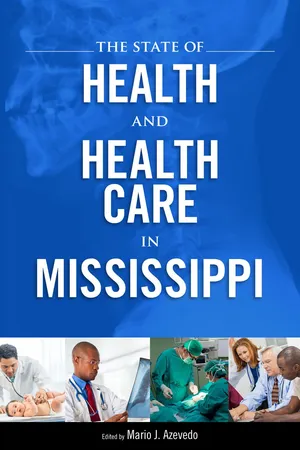
In this multidisciplinary book, the editor and contributors provide the most accurate and most recent information on health and health care in the State of Mississippi. They explain why the state finds itself in precarious health conditions and reveal the prevailing circumstances as the state debates a path toward a comprehensive health care system for its citizens. They show who has had access to good health care in the state and celebrate the heroes who struggled to provide health care to all Mississippians, and contribute to the debate on how the health care system might be restructured, reconstructed, or adjusted to meet the needs of all people in the state, regardless of race, ethnicity, socioeconomic status, and national origin.The issue of health disparities and socio-economic status leads to a relevant discussion of whether health and access to quality care are a right of all people, as the United Nations has proclaimed, or the privilege of a few who have the economic resources and the political clout to purchase first-rate care. The volume offers a clear understanding of health care trends in the state since the inception of its health system during the eighteenth and early nineteenth centuries up to the present and the prospects of transcending the obstacles of its own creation over the past two centuries. It likewise highlights the economic challenges that Mississippi, like other states, confronts; and how wise and realistic its priorities are in meeting the needs of its diverse populations, particularly racial and ethnic minorities.
- 480 pages
- English
- ePUB (mobile friendly)
- Available on iOS & Android
eBook - ePub
The State of Health and Health Care in Mississippi
About this book
Trusted by 375,005 students
Access to over 1.5 million titles for a fair monthly price.
Study more efficiently using our study tools.
Information
Topic
MedicineSubtopic
Health PolicyChapter 7
GEOGRAPHIC DISTRIBUTION OF DISEASE AND HEALTH DISPARITIES IN THE STATE OF MISSISSIPPI
Introduction
The remarkable use of geographic information systems (GIS) in public health continues to garner ample attention. In the process, administrators are now creating novel ways to tap into the data integration and spatial visualization potential of GIS. The integration capability of GIS has the potential of strengthening the analytical and descriptive solutions needed in the public health sector. GIS plays a vital role in deciding where and when to intervene, improving the quality of care and increasing accessibility of service. Furthermore, in the rapidly growing information-dependent environment of public health, the role of GIS has assumed greater importance due to its ability to integrate a wide range of information sources, such as image data, and to make complex data more quickly and easily understood. Public health uses of GIS include tracking child immunizations, conducting health policy research, identifying and unveiling disparities, mapping spatial diffusion of diseases, and developing service areas and health districts, especially in states like Mississippi, which has a long way to go before health conditions improve drastically.
GIS also serves as an important decision support tool for public health and health care practitioners. It offers a way of disseminating information from the project level so that it can be used by the entire organization. This way, clinical and administrative information can be disseminated in a visual and geographic manner. It has been proven that most policies and their applications are geo-based. Access to the right set of tools through model building in pinpointing areas in critical needs, and those underserved and well served, is always essential in the delivery of programs and the mitigation of epidemics whenever they might occur. Accordingly, simulating hypothetical cases of epidemic outbreaks under the current scenario has the potential for strengthening the provision of future services and intervention mechanisms that recognize the human costs of disparity and ways of addressing the problems.
This chapter highlights the geography of public health with focus on the use of GIS in mapping the location and the outbreak of diseases and other health variables based on disparity optics in Mississippi. This will involve a simultaneous presentation of the role of scenario mapping and model building as an essential tool for promoting public health decision making that recognizes service access for those at the margin. Going by the studies emerging from health care literature and other fields, including science and public policy in the twenty-first century, GIS applications have continued to grow as a relevant part of science. The ubiquitous energy radiated by the widespread acceptance of GIS as a policy tool over the years remains evident. This can be buttressed by looking at the persuasive studies in environmental and public health (for more information on this theme in the past years, see Merem and Twumasi 2008a, 2008b, 2010, 2011) and a host of other writers.
The use of geographic information systems can ease numerical spatial problem-solving tasks and initiatives (Foody 2006; Boelaert 1998), such as urban planning, delineation of ecologically sensitive natural habitats, and information management research (Scotch 2006). It is seen as a technology for investigating, presenting, and operating geographic data (Scotch 2006; Choi 2006). The GIS setting contains layers of land, rivers, roads, buildings, and cities, overlapping to generate a comprehensive map. GIS application is not solely aimed at spatial presentation of data; it is essential in a number of analyses, such as spotting the best paths between two sites (network analysis), shielding a specific space along a given location, like a hospital and geo-coding mapping coordinate points on a map, such as a cohort of patients threatened by a common ecological hazard. These tasks remain quite valuable during neighborhood health appraisal analysis (Choi 2006; Boelaert 1998; Wilkinson 1999).
Another twisting to the promise of GIS is the capability of unlocking the mysteries of health disparity that may not be visible to the general public and those charged with the task of making decisions pertaining to health care. Taking into account the situation of citizens in impoverished counties of Mississippi, a GIS perspective under the aegis of disparate access to health care merits our attention as well. For the National Conference of State Legislatures (NCSL) (2001), the concept of health disparities is used to describe population-explicit differences in the face of disease, health outcomes, quality of health care, and access to health care services that exist along racial and ethnic lines. Numerous health and socioeconomic factors trigger health disparities, including limited access to care, deprived quality of care, genetics, the surrounding environment, and individual actions. These elements are often linked with underserved racial and ethnic minority groups, usually called communities of color (NCSL 2011). Embarking on disparity analysis through the disparity optics has the potential of steering us to scrutinize numerous scopes of benefit or “disbenefits,” instances of prejudice, and social isolation that can aggravate ill health among ethnic minorities (Braveman 2009).
The disparity outlook improves our understanding of different circumstances within social environments that can generate prospects and challenges to health services. When, for instance, an improper diagnosis based on a patient’s race creates psychological trauma, our awareness should then be drawn to the relation between exposures to social advantages and disadvantages over time and the susceptibility to diseases from it. More so, let us not forget about how numerous sources of health difficulty, such as growing stress, are linked to economic deprivation and psychosocial hardships and ethnicity. Accordingly, such a research framework encourages us to consider social factors associated with health problems, like obesity and cardiac mortality rates that are products of experiences shaped by the biological and social circumstances creating these ailments and their adverse medical and social implications for the citizens at the margin (Braveman 2009).
The disparities framework, therefore, allows not to depend completely on plain labeling of social benefit or “disbenefit,” such as small earnings or school level as the product of social status, but to observe the tangible allotment of the important elements and how they are linked to health predictors of concern (Braveman 2009). In that light, the disparities analogy affords one the opportunity to scrutinize both ethnicity and social strata, jointly and individually, as points of reference. Therefore, a disparities standpoint begs one to pose the following questions: How are racial or ethnic or socioeconomic aspects of disease spread captured in space? How can the pathways to health disparities efficiently be tracked geospatially? These and related trends pertinent to the State of Mississippi will be examined in detail in the remaining portions of the chapter.
Objectives and Organization
Our research has four objectives. The first aim is to analyze the current issues in health-risk disparities. While the second objective assesses the geographic aspects of disease spread in the State of Mississippi, the third is centered on the analysis of the health hazards in counties of the state. The fourth and last objective focuses on the design of decision support tools to aid policymakers in tracking disparity and accessibility to services. The chapter is divided into five areas, with the first focusing on the introduction and background information. The second section offers a review of the literature. Section three describes the methods and the study area, while the fourth presents the results anchored on GIS and scenario mapping and the evaluation of the trends and descriptive statistics. The fifth section presents a discussion and our research findings. The sixth and last sections provide a closure and the future lines of action.
Review of Current Issues in the Literature on GIS and Health Disparities
The review follows two strands in the literature under the rubric of GIS and the growing incidence of disparity as conceptualized in the current research. Accordingly, in the last several years, society seems to be witnessing a growing use of GIS in the domain of environmental health analysis. This can be detected from the array of reviews of the public health literature. The body of research in the literature that describes the current recourse to GIS for public health analysis embodies the work of Wilkinson (1999) and many others such as Jenks (2004). Other studies highlighting the problems of disparity include the National Conference of Legislatures Report (2001) and Young (2003).
Mowatt (2000) points out that, while there was growing interest in public health use of GIS, it was mainly limited to minor tasks such as spatial display. In locating 10 pertinent studies in the domain of medicine since the year 2000, Chung (2004) noted that, even as GIS is not being applied to more sophisticated tasks, like spatial statistical analysis, basic applications, such as geo-coding and buffering, seemed to have gained currency. Accordingly, Ruston (2003) also presented GIS applications in public health through spatial analysis by offering numerous instances in which GIS found valuable use in the analysis of various variables, including adjustments for infection rates and socioeconomic deprivation and noise (Wilkinson 2003).
In related studies, Scotch (2006) investigated the functions of GIS in community health appraisal and problem-solving setting by interviewing public sector experts. The surveys centered on how the integration of GIS with other software could be actualized for the intended reasons. The results show ample use of GIS for spatial analysis along with other tools, including statistical packages. The author notes that concentrating on how public health issues are resolved can lead to an understanding of how GIS technology can play a vital role during community health assessment and problem solving. Given the growing quest for the development of tools for health care professionals and communities to assess environmental exposures by integrating GIS mapping, Choi (2006) analyzes the role of GIS as a novel tool for environmental health assessments. He notes that, considering the vital role that environmental health-risks data can play, it is important that community public health nurses commence to incorporate environmental health-appraisal expertise into their professional practices. Basic community surveys can provide efficient ways to improve their understanding of environmental health-risk factors, and adopting GIS has the potential for increasing their access and exposure to health data (Ardege 2003).
For Boelaert (1998), other dimensions to GIS than the design of radiantly colored maps exist; in that setting, environmental epidemiologists have continued to be in the forefront of current applications of GIS for research purposes (Briggs 1995). Additionally, in providing a practical guideline pertaining to the use of GIS as a proven tool for public health (Jenks 2004) Briggs notes that GIS has been used with continuing success to evidently convey public health issues and resolutions. The main benefit of GIS, as the author points out, is that users can overlay numerous layers of spatial data, then, alternatively, switch them on and off, while trying to discover a significant model among the probable basis and emergent effects. A public health practitioner can gain useful insights into solving health problems by examining the patterns of spatial relationships that a well-prepared map can often provide.
With its growing success, it comes as no surprise that climatic, vegetation, and other data processed using remote sensing can be integrated with epidemiological data to measure vector occurrence (Rogers 1993). While a synopsis of GIS use in communicable disease epidemiology has been presented in Clarke (1996), GIS-based analysis for health systems studies appears to be fully focused on catchment areas or river-basin research. Taking a cue from the precedent analysis, Boelaert (1998) argued that, despite the “adorable” success, recommending GIS to regional health managers would be premature in the absence of a methodical cost-benefit analysis. For the author, just as it is vital to appraise GIS pilot schemes independently and assess their strengths and weaknesses, the GIS industry continues to be making serious inroads into the health-service corridors.
Foody (2006) thinks that studies rooted in public health and welfare share deep historical attachment in the broad domain of geographical information systems research. Major themes of importance were the detection of geographic blueprints of sicknesses so that fundamental sources could be spotted for the generation of information and a mindset that shapes health care policy. A major case in point of significance highlighting spatially geographically oriented approach in health studies comes from John Snow’s work of mapping a cholera epidemic in London in the mid-nineteenth century. The study unveiled a major concentration of the epidemic adjacent to a water pump. Since then, health applications have remained an important area of research within GIS. Foody (2006) again delves into some of the health-related studies with particular emphasis on developments in health surveillance, most notably, those anchored in a spatial and temporal dimension. In adding a twenty-first century flavor to the debate, Croner (2003) highlighted the connections among public health, GIS, and the Internet. The belief is that, as we move further into the opening decades of the twenty-first century, Internet access and the use of community geospatial health data for GIS application will assume greater importance for the nation’s Department of Health and Human Services.
The Disparity Theme: National and Institutional Perspectives
In other studies, Booske (2011) notes that, aside from current efforts to improve public awareness of health disparities, little research has actually documented the public’s awareness of racial/ethnic and socioeconomic health disparities in the US. In response, the author conducted the National Opinion Survey on Health and Health Disparities among 2,791 US adults. As part of the questionnaire design, the survey participants were posed several questions on health disparities involving different demographic subgroups: African Americans paired against Caucasians, non-high school graduates versus high school graduates, high school graduates versus college graduates, and the poor versus the middle class. While the survey participants identified literacy as a predictor of well-being, they saw little connection between education and good health. Youthful respondents, less educated, and lower-income groups seemed less likely aware of health disparities.
Other studies of importance embody the work of Warnecke (2008) with focus on the National Institutes of Health (NIH) efforts on health disparities, being the first federal initiative to back multidisciplinary research on the determinants of health disparities, the NIH-sponsored Centers for Population Health and Health Disparities. This novel approach combines population, clinical, and basic science to analyze the complex determinants of health disparities. The alliances built through this multifaceted cooperation reinforce the belief that the centers’ research findings will be germane to communities by decreasing health disparities.
Orsi’s efforts (2010) to examine national and Chicago, Ill...
Table of contents
- Cover
- Half title
- Title
- Copyright
- Contents
- Acronyms
- Acknowledgments
- Preface
- Organization and Thematic Approach
- Part A
- Part B
- List of Contributors
- Index
Frequently asked questions
Yes, you can cancel anytime from the Subscription tab in your account settings on the Perlego website. Your subscription will stay active until the end of your current billing period. Learn how to cancel your subscription
No, books cannot be downloaded as external files, such as PDFs, for use outside of Perlego. However, you can download books within the Perlego app for offline reading on mobile or tablet. Learn how to download books offline
Perlego offers two plans: Essential and Complete
- Essential is ideal for learners and professionals who enjoy exploring a wide range of subjects. Access the Essential Library with 800,000+ trusted titles and best-sellers across business, personal growth, and the humanities. Includes unlimited reading time and Standard Read Aloud voice.
- Complete: Perfect for advanced learners and researchers needing full, unrestricted access. Unlock 1.5M+ books across hundreds of subjects, including academic and specialized titles. The Complete Plan also includes advanced features like Premium Read Aloud and Research Assistant.
We are an online textbook subscription service, where you can get access to an entire online library for less than the price of a single book per month. With over 1.5 million books across 990+ topics, we’ve got you covered! Learn about our mission
Look out for the read-aloud symbol on your next book to see if you can listen to it. The read-aloud tool reads text aloud for you, highlighting the text as it is being read. You can pause it, speed it up and slow it down. Learn more about Read Aloud
Yes! You can use the Perlego app on both iOS and Android devices to read anytime, anywhere — even offline. Perfect for commutes or when you’re on the go.
Please note we cannot support devices running on iOS 13 and Android 7 or earlier. Learn more about using the app
Please note we cannot support devices running on iOS 13 and Android 7 or earlier. Learn more about using the app
Yes, you can access The State of Health and Health Care in Mississippi by Mario Azevedo, Mario J. Azevedo in PDF and/or ePUB format, as well as other popular books in Medicine & Health Policy. We have over 1.5 million books available in our catalogue for you to explore.