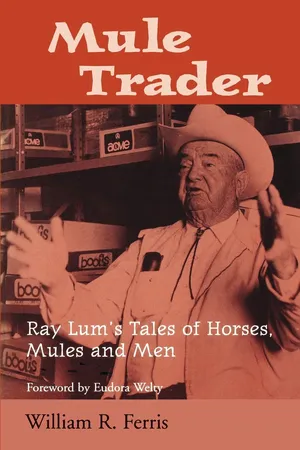
Readers captivated by this book will be happy that Bill Ferris found Ray Lum and that he thought to turn on a tape recorder. Lum (1891-1977) was a mule skinner, a livestock trader, an auctioneer, and an American original.
This delightful book, first published in 1992 as "You Live and Learn. Then You Die and Forget It All," preserves Lum's colorful folk dialect and captures the essence of this one-of-a-kind figure who seems to have stepped full-blooded from the pages of Mark Twain. This riveting tale-spinner was tall, heavy-set, and full of body rhythm as he talked. In his special world, he was famous for trading, for tale-telling, and for common-sense lessons that had made him a savvy bargainer and a shrewd businessman. His home and his auction barn were in Vicksburg, Mississippi, where mules were his main interest, but in trading he fanned out over twenty states and even into Mexico. A west Texas newspaper reported his fame this way, "He is known all over cow country for his honest, fair dealing and gentlemanly attitude. . . . A letter addressed to him anywhere in Texas probably would be delivered."
Over several years, Ferris recorded Lum's many long conversations that detail livestock auctioneering, cheery memories of rustic Deep South culture, and a philosophy of life that is grounded in good horse sense. Even among the most spellbinding talkers, Lum is a standout both for what he has to say and for the way he says it. Ferris's lucky, protracted encounters with him turn out to be the best of good fortune for everybody.
- English
- ePUB (mobile friendly)
- Available on iOS & Android
eBook - ePub
About this book
Information
Rattlesnakes,
Coyotes, and
Wild Horses
Ray Lum’s move to Texas signaled a major expansion in his business as a trader and auctioneer. He had often traveled to Texas to buy livestock in Fort Worth, and his move to the state brought him closer to his markets there. While he continued to ship livestock to his livestock barns in Vicksburg, he significantly broadened his markets to include Texas ranchers.
Harry Barnett, Lum’s partner and ring man from Memphis, and ten men from Vicksburg accompanied him to Texas. This staff joined thirty Texans who organized livestock sales for Lum in cities and towns throughout the state, Lum shipped each person stock and then auctioned the animals for them on a partnership basis.
Ellie Lum, his wife, moved to Texas with him, and they shared an apartment in Fort Worth. Mrs. Lum was born in Hopkinsville, Kentucky, where her father was a livestock dealer. When they first married, Mrs. Lum lived with her husband in an apartment in their livestock barn in Vicksburg. She later ran a real estate business and developed land they owned around the bam into Sky Farm Subdivision, Vicksburg’s first suburb. She sometimes lived in one of her newly built homes and would sell it while Lum was away trading. Lum remarked that before he returned to Vicksburg, he always called his wife to see where they were living.
A letter dated “7/17-50 Mon. night” that Lum wrote his wife from Texas has a formal, businesslike tone. On letterhead stationery illustrated with a bull, a goat, a sheep, and a bucking bronco from the Naylor Hotel in San Angelo. Texas, he describes his recent livestock trades in detail:
Dear Mother & Sonny,
Came in here this morning and attended the sale. Bought 9 bulls. Already had 4 here. Sent them to Stephenville to sell Wed. Will go to Abilene tomorrow. Looked at a Mr. Trimble’s cattle this evening after sale. Didn’t trade with him. Called Mr. Hughes. Nice chat. No business.
The pressures of travel and trades throughout Texas are felt as Lum concludes his three-page letter with:
Well I am tired and will say good night and write again when I have a chance—Love to you and Sonny.
Daddy
Lum enjoyed the Texas climate where air was thinner, rattlesnakes struck faster, and horses bucked harder than in his native Mississippi. He discovered West Texas people spoke less and often lived on isolated ranches. He traded with prominent ranchers such as Paul Waggoner who owned hundreds of thousands of acres.72 Waggoner developed Shorthorn and Hereford cattle and operated Waggoner Arlington Downs Stables between Fort Worth and Dallas where he specialized in fine horses.
Between 1889 and 1903 the Waggoner Ranch grew to over a million acres in Foard, Knox, Baylor, Archer, Wilbarger, and Wichita counties. In 1900 William Thomas Waggoner gave each of his three children, Paul, Guy, and Electra, 90,000 acres of land and 10,000 head of cattle. Oil was discovered on the ranch in 1903. In 1909 Waggoner divided half of the ranch among his children.
Lum met Paul Waggoner at Waggoner’s horse sale which also attracted famed humorist Will Rogers.73 On the evening before the sale Rogers performed his celebrated riding and trick-roping act. Lum appreciated Rogers’s humor and was also impressed with his roping skill.
Lum also bought horses on the King Ranch. He mentions Robert Justus Kleberg, a lawyer who represented Richard King, founder of the King Ranch. King established the ranch with a Spanish land grant of 75,000 acres in 1852. Kleberg married Richard King’s youngest daughter, Alice, and managed the ranch most of his life. Kleberg crossbred Brahman cattle with Shorthorns to create the famous Santa Gertrudis breed. The Santa Gertrudis cattle were named for the creek on which the ranch headquarters sits. The King Ranch was also known for its horses, and in 1947 it had 2,900 quarter horses and 82 racehorses. Fifteen hundred miles of fence surround its four divisions, Santa Gertrudis, Laureles, Norias, and El Sauz. Water comes from 75 artesian wells and 225 windmills.74
From Texas, Lum shipped registered Hereford bulls into the Deep South, where they were welcomed by local farmers. At a memorable auction in Baton Rouge he was challenged by Earl Long, who questioned the value of his cattle. One of the most colorful politicians in Louisiana history, Long was a progressive who supported education and was one of the earliest advocates for black voting rights.75
Lum admired the famed Texas cattleman Charles Goodnight. With his partner John G. Adair, Goodnight developed a herd of 100,000 cattle on one million acres of land. His final years were spent at his ranch at Goodnight, Texas, a Panhandle town named for him.76
Texas German farmers impressed Lum because they kept their stock in good condition. He noted with interest that the German preference for beer distinguished them from Mississippians, who loved whiskey.77
Lum encountered several celebrated outlaws in Texas. He met Frank James outside a shoe store in Dallas. A bank and train robber, Frank and his brother, Jesse, were among the nation’s most famous outlaws. Born in Clay County, Missouri, during the Civil War, Frank James joined William Clarke Quantrill’s guerrillas. Frank and Jesse’s career as outlaws began on February 13, 1866, when they robbed a bank and killed a bystander in Liberty, Missouri. Their celebrated robberies of banks and trains continued until April 3, 1882, when Jessie was murdered at his home in St. Joseph, Missouri, by Robert Ford as James stood on a chair adjusting a picture. Several months after Jesse James was murdered by Robert Ford, Frank James gave himself up and was tried for murder in Missouri and for robbery in Huntsville, Alabama. The James Brothers were said to have robbed from the rich and given to the poor, and juries in both trials found Frank James not guilty of all charges. He remained free until his death in 19I5.78
Another famed outlaw whom Lum met several times in the West was Pretty Boy Floyd. Floyd grew up in the Cherokee Indian Territory of Oklahoma and became a Robin Hood figure for sharecroppers in eastern Oklahoma. He robbed banks from Kansas City to Ohio and remained at large until 1934 when F.B.I. agents trapped and killed him in a cornfield near East Liverpool.79
Lum admired Judge Roy Bean, the famed Texas judge who was known as the “Law West of the Pecos.” As justice of the peace, Bean allowed divorces when marriages he had performed did not “take,” saying he had a right to correct his errors. He died in his saloon on March 16, 1903, and is buried in Del Rio, Texas.80
One of Lum’s best friends in Dallas, Frank Corolla, had his saloon destroyed by Carry Nation. Nation was a temperance champion who weighed 175 pounds and was almost six feet tall. She fiercely attacked saloon keepers and destroyed their businesses with her famed hatchet.81
During his travels in Texas, Lum was often accompanied by Squire Harris, his black hostler from Vicksburg. Harris was a fine rider who demonstrated horses to customers. Some of the towns they visited did not allow blacks to stay overnight. Harris quickly gained favor with Texans through both his wit and his riding skills.
Lum refers to both “black” and “Irish” gypsies. The “black gypsies” are Romany people who trace their roots to ninth-century India. Between 50,000 and 100,000 Romany gypsies lived in the South, with the largest communities in Texas, Arkansas, Georgia, Louisiana, Kentucky, and the Carolinas.82
Lum considered “Irish gypsies” the greatest traders he knew.83 Irish traders traveled in two-family convoys consisting of three cars, each drawing a trailer with tents and furniture, and three trucks for stock. Often four generations traveled together and would camp in tents with two large carpeted rooms.84
Irish traders used a secret language or “cant” to conceal their conversations from outsiders.85 Irish cant evolved from Gaelic, and traders spoke the language during business dealings. Many phrases dealt with horses and mules, and when Lum “partnered” in Texas with Irish trader Richard Riley he learned to use cant phrases such as “cat eye” for a hundred dollars and “pound” for five dollars.86
During their visit to the Lone Star State, New Yorkers Al Smith and Jimmy Walker had vivid impressions of Texas. Smith served as governor of New York, and in 1928 he ran as the Democratic candidate for president and was defeated by Herbert Hoover.87
Jimmy Walker was a popular mayor of New York City and held the office until 1932.88 Both Walker and Smith were popular figures in Texas, and Lum’s stories of their travels in the state were among his favorites.
From 1922 to 1940 Lum traded throughout Texas. Unlike Mississippi, where mules were his primary interest, most of his Texas trades were for horses. During his travels he encountered a dangerous bulldog, ate barbecued rattlesnake, and went on a coyote hunt. He grew to love Texas people as his own and regarded the state as a second home.
Over the course of the years I talked with Lum, his great hope was that I drive him to Texas to revisit the old friends and places he knew so well. As a young man he frequently drove from Vicksburg to Texas, and I regret we never made that trip together.
When I left Memphis in twenty-two, I went to auctioneering for Mr. Yount who owned a barn in Fort Worth. He was getting a good many miles on his speedometer, and I did most of his selling.
I shipped stock all over Texas. Harry Barnett and I come to Texas together and was partners. Harry never did leave the city, which was pretty smart. Wadn’t no use to get out in the country, ’cause the city was where the stock came to be sold, don’t you know. I anchored89 all over because I had men selling all over. There wadn’t a town in Texas that I wadn’t familiar with, and Texas is a big state.
Mrs. Lum’s father was in the livestock business, and I carried him to Texas too. Mrs. Lum and I stayed at Fort Worth in a big apartment house there. I got my brothers, John and Robert. I brought my brothers over, and I brought about ten more men from Mississippi. I had thirty Texas boys working too, and I’d split with all of them. They all made money.
I remember one fellow, Will Worthy, said, “Ray, I think I’ll just go to trading for myself.”
“That’s fine. Go right on.”
I had plenty without him. In about two weeks he was back with me. The horses he bought lost money. I had them all working, and I split with them.
I already had those sale barns and the liver...
Table of contents
- Cover
- About The Book
- About The Author
- Title Page
- Copyright Page
- Dedication
- Table of Contents
- Foreword by Eudora Welty
- Acknowledgments
- Introduction
- School Days
- Dog Days
- Up and Down That Dog
- Rattlesnakes, Coyotes, and Wild Horses
- Eighty Thousand Horses
- When Mules Played Out
- Letters
- Bibliographic Essay
- Endnotes
- About the author
Trusted by 375,005 students
Access to over 1.5 million titles for a fair monthly price.
Study more efficiently using our study tools.
Frequently asked questions
Yes, you can cancel anytime from the Subscription tab in your account settings on the Perlego website. Your subscription will stay active until the end of your current billing period. Learn how to cancel your subscription
No, books cannot be downloaded as external files, such as PDFs, for use outside of Perlego. However, you can download books within the Perlego app for offline reading on mobile or tablet. Learn how to download books offline
Perlego offers two plans: Essential and Complete
- Essential is ideal for learners and professionals who enjoy exploring a wide range of subjects. Access the Essential Library with 800,000+ trusted titles and best-sellers across business, personal growth, and the humanities. Includes unlimited reading time and Standard Read Aloud voice.
- Complete: Perfect for advanced learners and researchers needing full, unrestricted access. Unlock 1.5M+ books across hundreds of subjects, including academic and specialized titles. The Complete Plan also includes advanced features like Premium Read Aloud and Research Assistant.
We are an online textbook subscription service, where you can get access to an entire online library for less than the price of a single book per month. With over 1.5 million books across 990+ topics, we’ve got you covered! Learn about our mission
Look out for the read-aloud symbol on your next book to see if you can listen to it. The read-aloud tool reads text aloud for you, highlighting the text as it is being read. You can pause it, speed it up and slow it down. Learn more about Read Aloud
Yes! You can use the Perlego app on both iOS and Android devices to read anytime, anywhere — even offline. Perfect for commutes or when you’re on the go.
Please note we cannot support devices running on iOS 13 and Android 7 or earlier. Learn more about using the app
Please note we cannot support devices running on iOS 13 and Android 7 or earlier. Learn more about using the app
Yes, you can access Mule Trader by William R. Ferris in PDF and/or ePUB format, as well as other popular books in Social Sciences & North American History. We have over 1.5 million books available in our catalogue for you to explore.