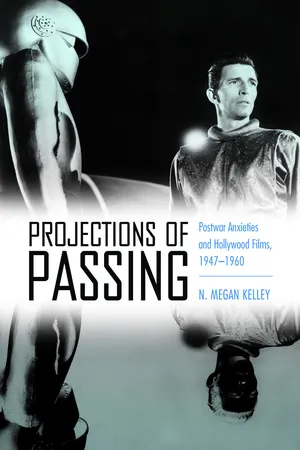
A key concern in postwar America was "who's passing for whom?" Analyzing representations of passing in Hollywood films reveals changing cultural ideas about authenticity and identity in a country reeling from a hot war and moving towards a cold one. After World War II, passing became an important theme in Hollywood movies, one that lasted throughout the long 1950s, as it became a metaphor to express postwar anxiety. The potent, imagined fear of passing linked the language and anxieties of identity to other postwar concerns, including cultural obsessions about threats from within. Passing created an epistemological conundrum that threatened to destabilize all forms of identity, not just the longstanding American color line separating white and black. In the imaginative fears of postwar America, identity was under siege on all fronts. Not only were there blacks passing as whites, but women were passing as men, gays passing as straight, communists passing as good Americans, Jews passing as gentiles, and even aliens passing as humans (and vice versa). Fears about communist infiltration, invasion by aliens, collapsing gender and sexual categories, racial ambiguity, and miscegenation made their way into films that featured narratives about passing. N. Megan Kelley shows that these films transcend genre, discussing Gentleman's Agreement, Home of the Brave, Pinky, Island in the Sun, My Son John, Invasion of the Body-Snatchers, I Married a Monster from Outer Space, Rebel without a Cause, Vertigo, All about Eve, and Johnny Guitar, among others. Representations of passing enabled Americans to express anxieties about who they were and who they imagined their neighbors to be. By showing how pervasive the anxiety about passing was, and how it extended to virtually every facet of identity, Projections of Passing broadens the literature on passing in a fundamental way. It also opens up important counter-narratives about postwar America and how the language of identity developed in this critical period of American history.
- 256 pages
- English
- ePUB (mobile friendly)
- Available on iOS & Android
eBook - ePub
About this book
Information
Subtopic
Film History & CriticismCHAPTER ONE
HOLLYWOOD’S PASSING CONTEXTS
The Rise of Psychoanalytic Discourse, Identity Studies, and Cold War Culture
Man had been tossed into the vestibule of another millennium. It was wonderful to think of what the Atomic Age might be, if man was strong and honest. But at first it was a strange place, full of weird symbols and the smell of death.1
—Time (1945)
The successful splitting of the atom at the end of World War II signaled the beginning of the atomic age. In 1945, Time suggested: “With the controlled splitting of the atom, humanity, already profoundly perplexed and disunified, was brought inescapably into a new age in which all thoughts and things were split—and far from controlled.”2 Fear of this new technology, the ability to split the atom with an unknown destructive intensity, became a key cultural anxiety. The nature of identity, how individuals defined themselves and their communities also became split in this period. Postwar American culture was obsessed with identity. A new vocabulary emerged featuring ideas of authenticity, alienation, “the enemy within” and “identity crisis” that focused on fear and anxiety.
Postwar concepts about identity reacted to shifting ideologies about race, gender, and sexuality. Postwar therapeutic culture developed through the marriage of cultural anthropology and psychology in the interwar period, but only became popularized after the Second World War. At the same time, the social sciences fostered new ideas about individual and cultural identities. For the first time culture and identity were understood as malleable social constructs that could evolve and change, a proposition that was in conflict with cultural desires for stable, unchanging identities. These competing discourses and disciplines intersected in Hollywood films where the Dream Factory met dream analysis and where popular psychology framed representations of identity, aided by a desire for social engineering and a shift to Method acting.
America came home from the battlefields of Europe searching for a better world. The experiences of the war demanded new approaches to identity, Selfhood and culture. In the postwar period the threat to America changed from the physical battlefields of the Second World War to the psychological terrain of the Cold War. The physical defense of the nation was couched in psychological terms. The Cold War was fundamentally “a psychological phenomenon,” and the combination of such Cold War factors and events as the National Security Act of 1947 and the Korean War “added up to a ‘dream come true’ for psychological experts.”3 Psychology became the ideological key to power on the war front while ensuring loyalty and good citizenship on the home front.
In postwar America, FBI leader J. Edgar Hoover used “the enemy within” to justify sweeping investigations of government workers and Hollywood filmmakers.4 In this culture of fear, Communist threats were described as “contagions” and “viruses.” America became the body politic and medical metaphors imagined that Communism could spread through America like a disease. Metaphors like this made Communism an invisible threat that could appear anywhere in America.
In popular memory and historical accounts, the 1950s is remembered through a prism of competing narratives. It is seen as an age of conservative conformity and political repression: the McCarthyite witch hunts, the Cold War dogmas of Truman and Eisenhower, the rigid cultural norms of appropriate gender behavior, the legal racial segregation of Jim Crow laws, and the repression of homosexuality. According to this narrative, the fifties were a time of fixed and rigid identities when people were classified by gender, national, racial or sexual orientations.5 It was the “age of conformity.”6
In contrast, a competing narrative posits the 1950s as an “age of anxiety.”7 It was a time of atomic fears and existential angst in the aftermath of World War II and the Holocaust.8 Rather than being a time of certainty, historians suggest that it was an era under siege.9 This interpretation has its own potent set of cultural icons: Elvis Presley’s transgressive dancing, Marlon Brando’s angst-ridden portrait of masculinity, Rosa Parks’s fighting for civil rights and beatnik poet Allen Ginsberg’s celebration of same-sex desire. While both these views are important, they are not mutually exclusive. Conformity and anxiety were sides of the same coin. Imagined conformity masked a wide range of insecurities. Anxieties about identity were intertwined with ideological and political values in postwar literary and cultural discourse.
Cold War political culture was shaped by a cultural emphasis on popular psychology and identity. The work of cultural anthropologists like Margaret Mead and Ruth Benedict became well known to the American reading public.10 Pre–World War II attempts to delineate personality types characterizing particular societies, such as Ruth Benedict’s Patterns of Culture, became national character studies that grew out of the experiences of World War II.11 The American military sought the aid of cultural anthropologists to understand these “alien” and “exotic” cultures.
Ruth Benedict’s 1946 study The Chrysanthemum and the Sword exemplifies many national character studies of the 1940s and 1950s.12 The government’s faith in the new tenets and approaches of cultural anthropology was made explicit in 1940 when Ruth Benedict and Erik Erikson, among others, were employed by the government. These “behavioral experts” acted as consultants for committees (including the Committee for National Morale) to aid in the war-time analysis of “national characters.” Japan, Germany, and Russia figured prominently in national character studies as America sought to find its place in the world politically and militarily.
Cultural anthropologists became famous and produced best-selling books that were widely read. The popularity of books by anthropologists reiterated the desire to understand identity, both on an individual and a national level. At the heart of these studies rested “the conviction that microscopic questions about individual personality and behavior and macroscopic questions about societal patterns and problems were nothing but two sides of the same coin.”13 From such studies came notions that socialization molded the personality of individuals, and that identity was a part of the personality that was created. Margaret Mead’s view that people were “made” not “born” and Benedict’s famous dictum that culture was “personality writ large” became part of American cultural literacy in the 1930s.14
During this period the language of psychoanalysis became part of the lexicon of identity. While these ideas percolated during the 1930s, it was not until after World War II that mainstream culture adopted the shift from biological to psychoanalytic understandings of self and society. Identity and Selfhood became a journey, a rigorous process of soul searching. Jung’s questing hero was popularized in the 1950s in the works of Joseph Campbell and Northrop Frye.15 At the same time, Erik Erikson’s studies of cross-cultural personality patterns influenced how Americans thought of identity. His work influenced by the experience of the war was also indebted to the ideas fostered by cultural anthropology. In this “age of Erik Erikson” the language of authenticity became pervasive, changing how the Self was understood and represented.16
After the war, a cultural ideology of authenticity ruled.17 The ideal of authenticity, as a distinct postwar discourse about identity, drew upon the philosophical language of existentialism and the therapeutic language of psychoanalysis. Prior to this, the normative notion of proper behavior was sincerity, which meant being true to the conventions of society. Selfhood was understood as a product of sincerity, as an external signifier. Authenticity, by contrast, was an internal ideal, involving fidelity to an inner, irreducible core. Because identity could not be taken for granted and required a quest or journey, the search for authentic identity became a source of cultural anxiety. Psychiatrists framed the “quest for identity” as a universal problem.18 Not coincidentally, “identity crisis” entered the culture “as a common term for the first time” in the 1950s.19
While the Great Depression encouraged a reevaluation of the impact of social conditions on individual behavior, an emphasis on environment over biology, the truly radical shift in racial ideology occurred after World War II: “Hitler gave racism a bad name.”20 Gunnar Myrdal, in his influential 1944 book An American Dilemma: The Negro Problem and Modern Democracy, argued that World War II made racism “inherently un-American.”21 It was not lost on African American soldiers that while fighting abroad for the “four freedoms,” discrimination and segregation reigned at home. The “Double Victory” campaign demanded that any victory abroad defeating fascism must be matched by a victory at home, ending discrimination.22 Veterans of World War II called for the desegregation of the armed forces and demanded their civil rights—demands that informed the nascent civil rights movement, ushering in an ideology of racial liberalism. The ideology of race shifted from biological determinism, discredited by Nazi ideologies and crimes, to a more psychological understanding of difference and Self.23 This meant that race relations in postwar America became viewed as a struggle within individuals as much as it was between them.24
After the war, as biology became suspect, psychology and the social sciences offered new ideologies for solving old social problems. In addition to the work by Myrdal, important studies by Abram Kardiner, Lionel Oversey, and Gordon W. Allport all defined identity and race relations as psychological problems.25 The government influenced by these experts used these ideas to address problems of race, defined best by Truman’s report entitled “To Secure These Rights.”26 Postwar civil rights victories, including Brown v. Board of Education, reflected an acceptance of these psychological arguments. The language of the couch informed government decisions as a burgeoning number of psychiatrists and psychoanalysts were employed. The psychoanalytic turn in American culture had a direct impact on everything from Supreme Court decisions to representations in film.
At the same time, psychology informed ideas of gender. Seemingly contradictory ideologies about gender coexisted in postwar American culture. Conservative and immutably binary gender ideals were heavily promoted. Such representations also epitomized Cold War “containment culture.”27 A stereotypical image remains the mythical white nuclear family with a male breadwinner as head of the household and wife as nurturing center. This new postwar stereotype, rooted in the suburban domesticity of the baby boom, was evoked by June Cleaver and Donna Reed. Underneath these superficial images, the culture was rife with anxieties and beliefs that categories of gender and sex were breaking down.
Lines were drawn between categories of “normal” and abnormal. New restrictive ideals about femininity developed in conjunction with a “crisis” in masculinity.28 The surge in the popularity of psychotherapy was part of a broader trend to de-institutionalize mental illness, showing that “normal” people had psychological problems.29 Popular magazines promoted not only the terminology but the ideas: “The women’s magazines also provided women with an entirely new language for expressing their feelings of dissatisfaction, terms such as unconscious, ego, inferiority complex, psychoanalysis, defensive reaction, and self-esteem.”30 There were also new drugs to help with the new anxieties. Advertisements for psychiatric drugs skyrocketed in the 1950s, marketing these drugs as a solution for “normal” if gendered problems. Miltown, the first widely distributed tranquilizer, was prescribed for unhappy women. Similarly, businessmen could “fix” the stress of their job by taking Seconal.31
While gender roles changed so too did concepts of sexuality. Debates about authenticity, Self, id, ego, and identity formation entered the nation’s bedrooms. Psychoanalysis claimed that sexual identity was a cornerstone of Selfhood. Sensational headlines about Christine Jorgensen, the first male-to-female transsexual, contributed to a growing sense that gender and sexual identities were permeable and unstable.32 The public identities of transsexuals destabilized core binary categories of male and female. It was difficult for Americans to separate ideas of gender from ideas of sexuality. World War II marked the beginning of sexuality as a category of identity.33 Just as the war tarnished ideas of biological determinism about race, postwar ideologies about sexuality shifted toward psychological and social conditioning.
In the 1940s and 1950s, the psychoanalytic ideas of Jung, Freud, Erick Fromm, and Erik Erikson intersected with the cultural anthropology of Edward Sapir, Ruth Benedict, Margaret Mead, and Franz Boas. Both professions addressed problems of alienation, personality, and identity, and used “national character” studies as the foundation of popular books and debates. “Character studies” informed other influential works, including David Riesman’s The Lonely Crowd.34 ...
Table of contents
- Cover
- Half title
- Title
- Copyright
- Dedication
- Contents
- Introduction
- Chapter One: Hollywood’s Passing Contexts
- Chapter Two: Passing as Social Strategy
- Chapter Three: Passing as Identity Crisis
- Chapter Four: “Hiding in Plain Sight”
- Chapter Five: They Walk among Us
- Chapter Six: “Both Body and Meaning Can Do a Cartwheel”
- Chapter Seven: Hollywood’s Postwar Feminine Masquerades
- Conclusion
- Afterword and Acknowledgments
- Notes
- Bibliography
- Select Filmography
- Index
Trusted by 375,005 students
Access to over 1.5 million titles for a fair monthly price.
Study more efficiently using our study tools.
Frequently asked questions
Yes, you can cancel anytime from the Subscription tab in your account settings on the Perlego website. Your subscription will stay active until the end of your current billing period. Learn how to cancel your subscription
No, books cannot be downloaded as external files, such as PDFs, for use outside of Perlego. However, you can download books within the Perlego app for offline reading on mobile or tablet. Learn how to download books offline
Perlego offers two plans: Essential and Complete
- Essential is ideal for learners and professionals who enjoy exploring a wide range of subjects. Access the Essential Library with 800,000+ trusted titles and best-sellers across business, personal growth, and the humanities. Includes unlimited reading time and Standard Read Aloud voice.
- Complete: Perfect for advanced learners and researchers needing full, unrestricted access. Unlock 1.5M+ books across hundreds of subjects, including academic and specialized titles. The Complete Plan also includes advanced features like Premium Read Aloud and Research Assistant.
We are an online textbook subscription service, where you can get access to an entire online library for less than the price of a single book per month. With over 1.5 million books across 990+ topics, we’ve got you covered! Learn about our mission
Look out for the read-aloud symbol on your next book to see if you can listen to it. The read-aloud tool reads text aloud for you, highlighting the text as it is being read. You can pause it, speed it up and slow it down. Learn more about Read Aloud
Yes! You can use the Perlego app on both iOS and Android devices to read anytime, anywhere — even offline. Perfect for commutes or when you’re on the go.
Please note we cannot support devices running on iOS 13 and Android 7 or earlier. Learn more about using the app
Please note we cannot support devices running on iOS 13 and Android 7 or earlier. Learn more about using the app
Yes, you can access Projections of Passing by N. Megan Kelley in PDF and/or ePUB format, as well as other popular books in Media & Performing Arts & Film History & Criticism. We have over 1.5 million books available in our catalogue for you to explore.